All images © by Roberto Piperno, owner of the domain. Write to romapip@quipo.it.


Notes:
Page added in March 2026.
All images © by Roberto Piperno, owner of the domain. Write to romapip@quipo.it.
Notes:
Page added in March 2026.
 An Excursion to Vicopisano
You may wish to see a page on the Walls of Pisa first.

Caprona, on the road from Pisa to Vicopisano: (left) Pieve di Santa Giulia; (right) Torre degli Upezzinghi
Caprona similar to Capranica and Caprarola is a name which refers to goats (capre) foraging on rough, steep land. The hill was fortified by Pisa in the XIth century and its castle was sieged by the Florentines in August 1289. Dante took part in the short siege which ended with the Pisan garrison surrendering.
Così vid'io già temer li fanti | And thus beheld I once afraid the soldiers |
Dante describes the fear that the Pisan soldiers when they exited the castle. In 1433 the Florentines dismantled the castle. In the XIXth century the Upezzinghi, a wealthy Pisan family, built a copy of the tower of the castle which today has been almost swallowed by the exploitation of limestone mines.
The parish church of Santa Giulia is first mentioned in a document dated 1096, but its architectonical structure dates back to the IXth century, although in smaller dimensions than the current one. It was damaged in 1433 and redesigned in 1597. In the 1970s it was brought back to its assumed medieval aspect. The lower part of its massive bell tower is dated XIIth century.
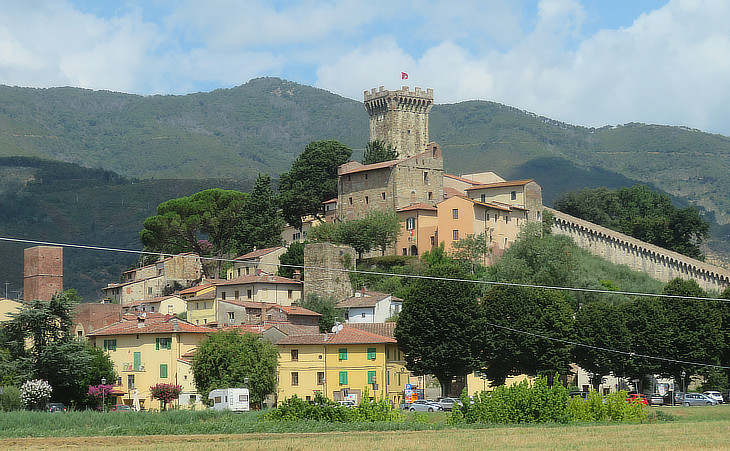
Overall view of Vicopisano with Palazzo Pretorio and Torre del Mastio (Keep) at its top (you can see a red flag with a cross symbolizing the Maritime Republic of Pisa waving on it)
Vicus is a Latin word which indicates a hamlet and it is often followed by another word specifying its location or its master, e.g. Vicovaro.
It is likely that the hill was already inhabited in Etruscan times, given the recent discoveries in its vicinity of pottery dating from the Vth century B.C., and perhaps in the Roman period there must have been farms in the plain.
Situated between Pisa, Lucca and Florence, at the centre of ancient trade routes, it was the passageway for pilgrims on their way to Rome along Via Francigena. With the River Arno at its feet, Vicopisano was involved in many conflicts among these three cities, which competed for dominance over the region. The town retains visible signs of its past in its monuments, in particular in the Torre del Mastio which stands on a commanding position.
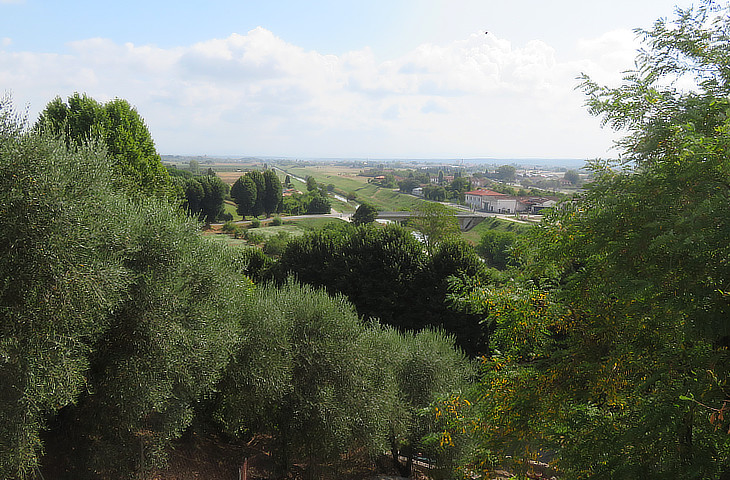
View of the countryside and of Canale Imperiale from the top of the town
Vicopisano stood at the confluence between the River Arno and the River Auser which allowed small boats to reach the Lake of Bientina and eventually Lucca. Today the landscape is very different because the area around the lake has been reclaimed and the lake itself does not exist any longer (similar to what occurred at Lake Fucino). Canale Imperiale was built by Grand Duke Francis Stephen I of Lorraine (who was also Emperor of the Holy Roman Empire) in 1757 in the frame of the reclamation activities which were continued in the XIXth century by his successors.
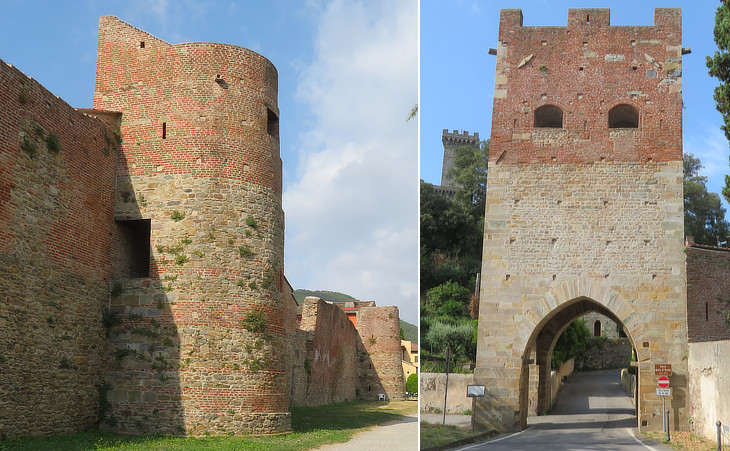
(left) A section of the walls; (right) Porta Quattro Porte (Gate of the Four Gates)
From the earliest written records we know that the area belonged to the Obertenghi, a family of Longobard origin who first fortified the hill to offer a shelter to the people of the vicus in case of danger. In the XIIth century Vicopisano was acquired by the Bishops of Pisa. In the early XIIIth century Vicopisano was acquired by Pisa and in 1230 it is mentioned as the location of Capitania, that was one of the military districts of the Republic. In 1330 a castle was built at the top of the hill. The strength of the medieval fortifications of Vicopisano was enhanced by the fact that the rivers fed the moat along the walls which made it very difficult to siege the town.
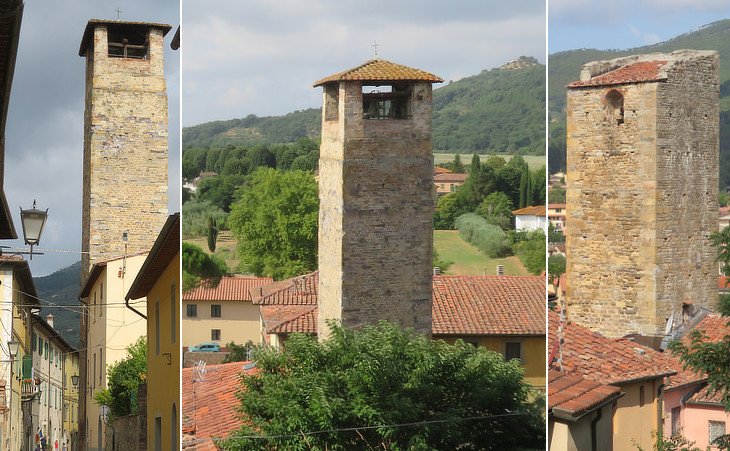
(left/centre) Torre dell'Orologio; (right) another medieval tower
Vicopisano benefitted from its location next to the Arno and the Auser also from an economic viewpoint, because its merchants could easily trade with both Pisa and Lucca. It retains nine well preserved medieval tower houses which date from the XIth to the XVth century and testify to the development of the town. They were mainly built by families who belonged to the Pisan merchant class and they gave Vicopisano the aspect of a real town, albeit very small. Tower houses are typical of many medieval Tuscan towns, including Pisa, Volterra and Siena.
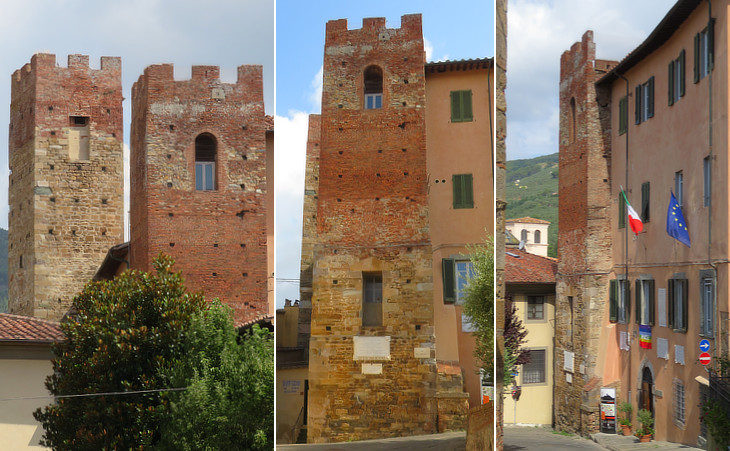
(left) The "Twin Towers"; (centre/right) that adjoining Palazzo Comunale
The citizens of Vicopisano were allowed by the Republic of Pisa to draw up and follow their own statutes which indicates the economic importance of the town. The end of the XIIIth century marked the beginning of Pisa's decline, opposed by Genoa at sea and by Florence and Lucca by land. The warlike events that raged throughout the area in those years undoubtedly brought trade to a standstill and led to a very diminished building activity. The Pisans managed to repel the enemy assaults until July 1406 when the Florentine army succeeded in conquering Vicopisano after a siege which lasted nine months. Soon after Pisa itself surrendered to Florence.

Top of Torre del Mastio, the keep of Rocca Nuova, with the symbol of Florence, a lily which is shown in the image used as background for this page
Florence dismantled the fortifications of many small towns of the Republic of Pisa, but they instead strengthened those of Vicopisano. In 1435-1438 they replaced the medieval castle with a new one (Rocca Nuova) which was designed by Filippo Brunelleschi, the leading architect in Florence. Its construction entailed the pulling down of many medieval buildings. The new fortress included the Tower of S. Maria dating back to the XIIth century, once a possession of the Archbishop of Pisa, which became its keep.
Except for short periods (1494-1498 and 1502) during the rebellion of Pisa Vicopisano remained in possession of Florence, and it retained the administrative role it had under Pisa, as the seat of the Vicariate of Valdiserchio and Valdarno Inferiore.
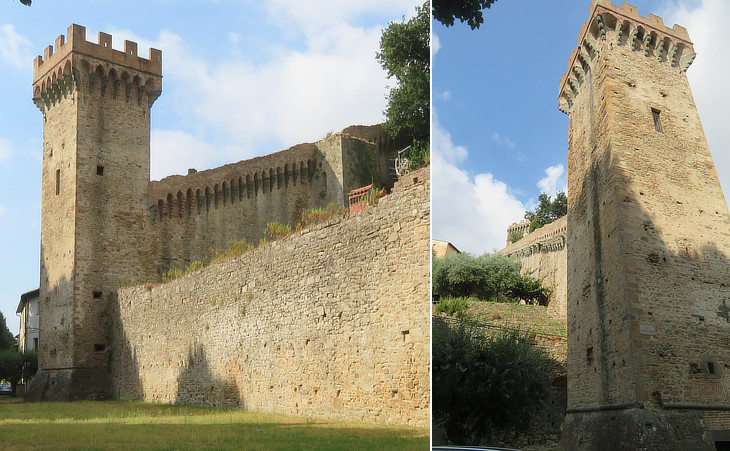
(left) Torre del Soccorso (support); (right) walls between Torre del Soccorso and Torre del Mastio
The most innovative aspect of the new fortress was the battlemented massive wall that descended from the Rocca to the base of the hill, ending at Torre del Soccorso, a very high tower, which at the time was situated near the river Arno. From that tower the garrison could receive support from Florence: the boats docked at a little fortified cove and unloaded gun powder, provisions and military reinforcements. Soldiers reached the second floor of the tower through a narrow gate and by means of ladders. From that position they were able to access the wall and go up towards the Rocca across a drawbridge.

(left/centre) Palazzo Pretorio; (left) oldest part; (centre) entrance; (right) coats of arms of the vicars Saracino di Antonio Pucci (1480-above) and Giovanni di Antonio Tornaquinci (1515-below)
The oldest part of the complex can be dated to the XIIth century and it was likely built by the Archbishops of Pisa for their representatives. It is characterized by three pointed arches similar to those which can be seen in many palaces of Pisa, e.g. Palazzo Mosca. Some small stone corbels suggest the presence of wooden balconies which facilitated communication between adjoining halls. After 1406 the Florentines appointed a Vicar to run the town and in 1411 Palazzo Pretorio was first mentioned as the residence of the Vicar who was also in charge of delivering justice, hence the reference to praetorium, the seat of a praetor, a Roman magistrate. Similar to what occurred in many other towns which were subject to Florence (e.g. Arezzo, Massa Marittima and Cortona) coats of arms of the governors were placed on the palaces where they resided or in other public places. There are still some 50 marble, majolica and stone coats of arms outside and inside Palazzo Pretorio.
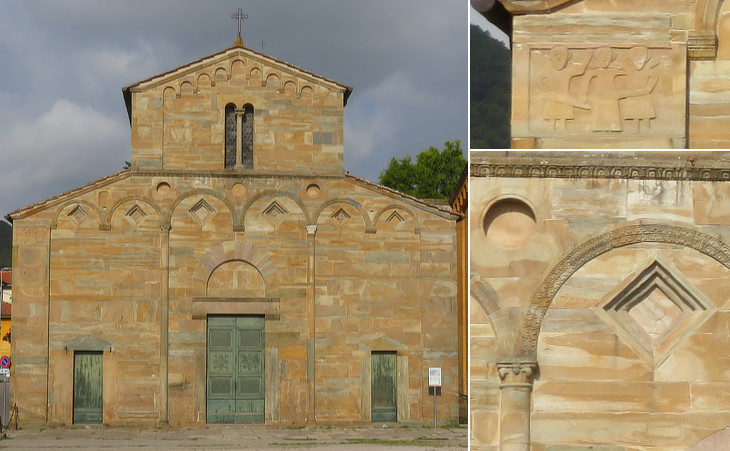
Pieve di Santa Maria at the foot of Vicopisano: (left) façade; (right-above) a rough relief, older than the church and maybe depicting the decollation of St. John the Baptist; (right-below) a typical rhomb decoration of Pisan architecture
The church is outside the walls of Vicopisano, thus it is referenced to as a pieve (rural parish). It is first recorded in 934 and it became a parish in the XIIth century when it was rebuilt in Pisan Romanesque style. The façade has walled up arches and geometric and floral decorations and it faces one of the gates of the town. The church was dedicated to the Virgin Mary and also to St. John the Baptist.
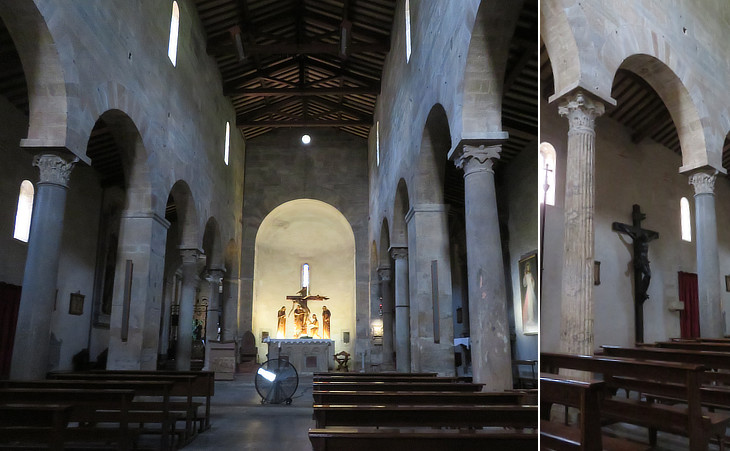
Pieve di Santa Maria: (left) interior; (right) ancient columns
The interior of the church is divided into one nave and two aisles, each of them bearing 12 granite columns with different capitals: the medieval ones are in grey freestone; others are ancient Corinthian capitals. Some of the columns are fluted and they come from Roman buildings (learn how the Pisans managed to acquire so many Roman marbles.
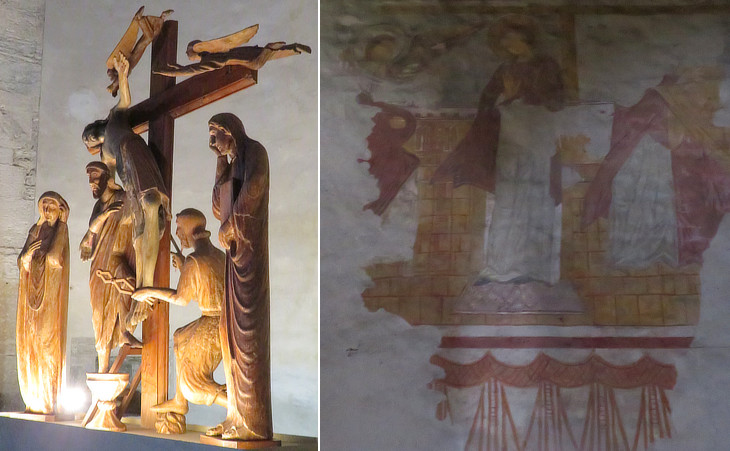
Pieve di S. Maria - XIIIth century works of art: (left) wooden Deposition; (right) fresco depicting the Annunciation
An imposing wood Deposition from the Cross is placed in the apse. The posture of Jesus Christ is similar to that of a statue at Pisa. Traces of the paint that once covered the garments are still noticeable.
The remaining medieval frescoes which decorated the walls show scenes from the Annunciation, the Visitation and the Nativity. Draperies are depicted below these scenes.
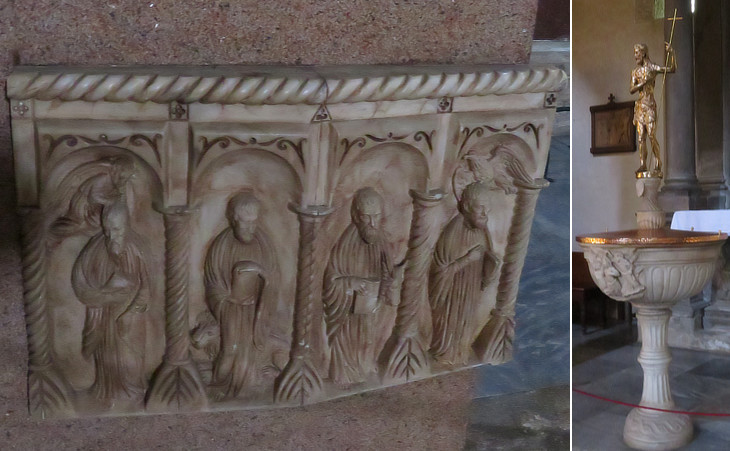
Pieve di S. Maria: (left) medieval relief depicting the Four Evangelists and their symbols; (right) Renaissance baptismal font
Move to
The Ancient Town
Piazza dei Miracoli and the Leaning Tower
The Baptistery
The Camposanto
The Cathedral
The Knights of Pisa
The Walls and the Lungarni
A Walk along the Northern Terzieri
A Walk along the Southern Terziere
Churches of Terziere S. Maria
Churches of Terziere S. Francesco
S. Matteo and its Museum
S. Maria della Spina
S. Piero a Grado


