All images © by Roberto Piperno, owner of the domain. Write to romapip@quipo.it.


Notes:
Page added in March 2026.
All images © by Roberto Piperno, owner of the domain. Write to romapip@quipo.it.
Notes:
Page added in March 2026.
 S. Matteo and the adjoining Museum
You may wish to see pages showing the monuments along the Lungarni or the other churches of Terziere S. Francesco first.

S. Matteo: (left) façade; (right) side along the Lungarno which retains its medieval design
San Matteo, at the E. extremity of the Lung'arno. The church, which is Italian Gothic, is partly altered.
John Murray - Handbook for travellers in Central Italy - 1861
According to tradition the church was founded in 1027 on the site of an earlier church. In the XIIth century it was enlarged and in the following one it was partly redesigned. A fire badly damaged the church and the adjoining convent in 1607. The partial reconstruction was completed in 1610 at the initiative of Grand Duke Cosimo II. The new façade is similar to those which in the same period were built at S. Francesco and at S. Giovanni dei Frieri.
The adjoining convent of Benedictine nuns was closed in 1866 and it was acquired by the Italian State.

(left) Palazzo Vecchio de' Medici adjoining S. Matteo; (right) coats of arms of Cosimo I de' Medici and his wife Eleanor of Toledo (daughter of Pedro Alvarez de Toledo, viceroy of Naples) inside the Collar of the Golden Fleece above an inscription in nearby Via La Rosa
The palace was acquired by the Medici family in 1441. At that time Florence had Republican institutions and Cosimo de' Medici (the Old), a very rich banker and the founder of the dynasty did not hold official positions in the government of the town, although it was the de facto ruler of Florence. Pisa was a possession of Florence and Cosimo felt he had to have a residence there. In 1539 Duke Cosimo I renovated the palace and he and his wife Eleanor of Toledo lived there when at Pisa. Later in the century a new palace was built by Grand Duke Francis, but the Medici retained the property of their old palace until the XVIIIth century. In 1879 the exterior of the building was given a Neo-Gothic aspect.
An interesting inscription in a nearby street testifies to the hegemony of Spain in Italy in the XVIth century. It is written in Spanish which is very unusual because in Italy the language used for inscriptions, even today, is Latin. It says "These four portals - with the building which you see - were made by Pietro de la Pena - who came from Spain - but enjoyed the favour - of the Dukes of Florence - the great Cosimo and the excellence - called Dona Leonor - the flower of the whole world." Cosimo owed his throne to the protection of Charles V, Emperor of the Holy Roman Empire and King of Spain, and Spaniards had a great say in Tuscan affairs.
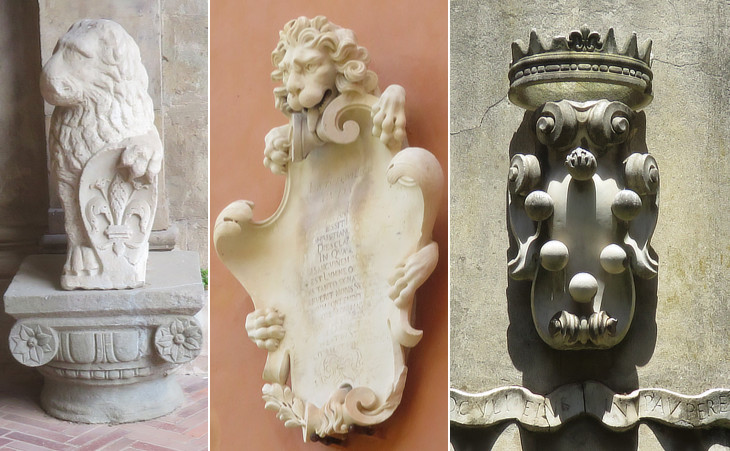
S. Matteo: symbols of Florence and of the Medici: (left) Leone del Marzocco; (centre) a lion holding an inscription; (right) coat of arms of Grand Duke Cosimo II above an inscription quoting a sentence "Oculi Eius in Pauperes" ("His eye is on the sparrow") by Jesuit Father Ignazio Martinez (d. 1598)
Memories of the Florentine rule over Pisa can be seen in very many parts of the town; some of them refer to the XVth century occupation of the town and they often depict the lily which is the symbol of Florence. The Grand Dukes, especially Cosimo I and Ferdinando I, preferred to place the Medici coats of arms on the palaces and churches which they built or restored. Although the rule of Florence was strongly opposed by the Pisans, over time they became accustomed to being part of the Grand Duchy and they did not damage the symbols of the Medici, as it occurred at Venice with the Lion of St. Mark when the French put an end to the Republic.
Connected with the church is a curious convent, which cannot be entered without special permission. It contains a fine cloister of pointed arches. There are some good paintings in the interior chapel of the nuns. (..) The Accademia delle Belle Arti, in the Via S. Frediano was founded by Napoleon in 1812. (..) It contains several valuable paintings, with very few exceptions of the early Pisan and Florentine schools; they are temporarily arranged in a suite of small rooms, and under so bad a light as to be seen to disadvantage; and as there is no catalogue, or names affixed to the pictures, the visitor is obliged to accept the names given by the custode. Murray (1867 ed.)
Museo Civico in the Convent of S. Francesco: Sala II. Early Pisan pictures: two Crucifixes, by Giunta Pisano.
Sala III. Pictures of 14th cent., including one by Buffalmacco, and several of the school of Simone Martini. S. Ursula rescuing Pisa from a flood, by Bruno di Giovanni, a Florentine. Sala IV. Pictures of 14th cent. Sala V. Madonna and Child, by Gentile da Fabriano. Pictures by Spinello Aretino, Gerini, and their schools. Sala VI. Fra Angelico, the Saviour with Chalice; Virgin enthroned, by Macchiavelli; pictures by Ben. Gozzoli; Coronation of the Virgin, by Nero di Bicci. Ante-room: S. Catherine, by Lucas of Leyden. Sala VII. Virgin and Child, by Raffaellino del Garbo. Virgin and Child, by Sodoma. Murray (1900 ed).
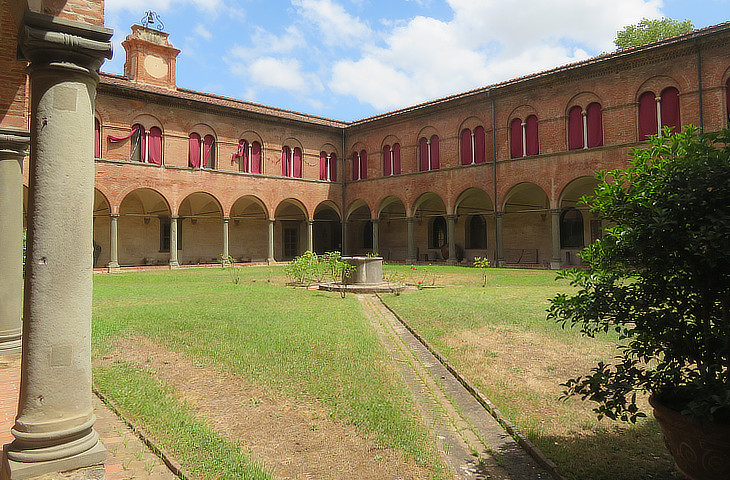
The convent was turned into a prison until 1940. In 1949 it became a museum to which the municipal collection at S. Francesco was relocated. It was subsequently enriched with donations and acquisitions. The works of art which have been removed from the Cathedral and the other monuments of Piazza dei Miracoli are on display at Museo dell'Opera del Duomo. Some of the works of art at S. Matteo are shown in the pages covering the churches from which they were removed e.g. S. Maria della Spina.
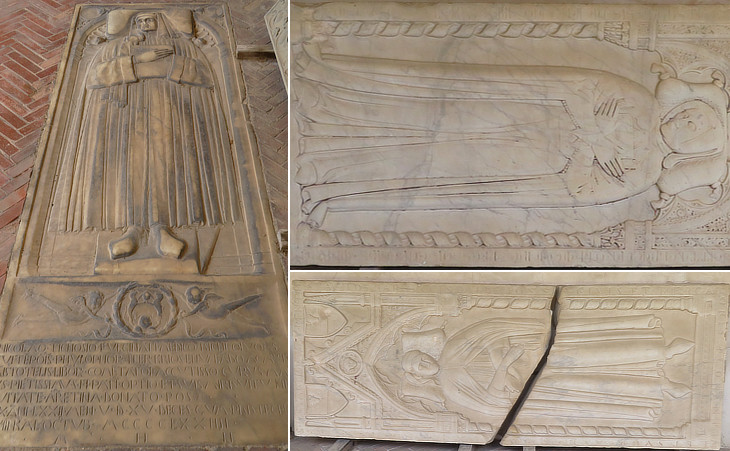
Tombstones in the cloister: (left) Nicolò Fulgianti del Tignoso (1474); (right-above) Giovanni Gittalebraccia (1384); (right-below) Lorenzo Stagi (1561)
Lengthy inscriptions shed some light on the life in Pisa and its history. Giovanni Gittalebraccia taught Medicine in the University in the 1370s and he is reported to have debated with St. Catherine of Siena about the contents of some of her letters.
The Del Tignoso were an important family of merchants of Pisa especially in the XVth century during the first period of Florentine rule. Nicolò was a physician and a commentator of the works by Aristotle whose Greek texts had reached Italy after the 1453 Fall of Constantinople.
Lorenzo Stagi was a citizen and merchant from Florence; his tombstone reflects traditional patterns which at the time of his death were out of fashion (see a 1585 tombstone at the Camposanto).
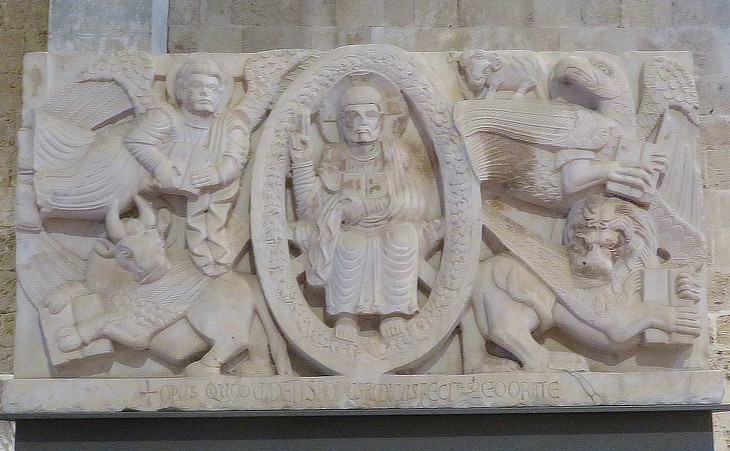
"Paliotto" (decorated front of an altar) by Bonamico (late XIIth century) depicting Jesus in Majesty, the symbols of the Four Evangelists and the Lamb of God (see a similar finer relief at Arles)
Art in Italy, was unquestionably in a lethargic state during the two centuries preceding that dreaded year 1000, in which all classes of people confidently expected the end of the world. (..) Men's minds were far too confused and anxious to think of aught else: crowds besieged the convents, filled the sanctuaries, or followed in procession the most venerated relics. (..) In the eleventh and twelfth centuries we first find sculptors
careful about signing their works, which proves that their profession was then held in esteem; as do the absurdly exaggerated praises heaped upon them by contemporary writers, and the inscriptions upon the works themselves, which also show how utterly all knowledge of what was good must have perished, when the rudest sculptor was looked upon as a prodigy.
Charles Perkins - Tuscan Sculptors - 1864
The inscription says "OPUS QUOD VIDETIS BONUS AMICUS FECIT P(ro) EO ORATE" (The work you see was made by Bonamico. Pray for him). The "paliotto" was donated to the Camposanto in 1794 by a gentleman of Castellina Marittima, a village south of Pisa. It was attributed to Biduinus, another sculptor and architect of the XIIth century, but today because of the discovery of another signed sculpture, art historians believe that "Bonus Amicus" does not mean "good friend", but is the name of a sculptor.

(above) Lintel with scenes of the life of St. Sylvester (XIIth century) from the portal of San Silvestro; (below) base of column of a pulpit from S. Michele in Borgo (1305-1310) by Lupo di Francesco (?)
The depiction of the life of St. Sylvester was a propaganda instrument of the Popes to affirm their supremacy over the Holy Roman Emperors in a conflict which reached its peak in the XIIth century. The Popes claimed that Emperor Constantine donated the City of Rome and the entire Western Roman Empire to Pope St. Sylvester I. The Oratorio di S. Silvestro in Rome was decorated with frescoes showing the Emperor escorting the Pope to Rome, but the lintel of Pisa was made before and it is regarded as one of the earliest attempts to develop the iconography of Sylvester's life, who was credited with having resurrected a bull and closed the mouth of a dragon (last two details of the relief). The sculptor of Pisa imitated the reliefs of ancient Christian sarcophagi.
Early Pisan art was of a religious nature, yet here and there sculptors depicted subjects which they had seen in Roman works of art, chiefly sarcophagi. This can be clearly seen in the base of a column from S. Michele in Borgo, where Hercules is portrayed with his lion skin together with a naked man (probably Adam) and David playing the lyre. David and Hercules were also portrayed in statues of the Cathedral. The hexagonal shape of the base is clearly derived from the base of the central column of the pulpit in the Baptistery.
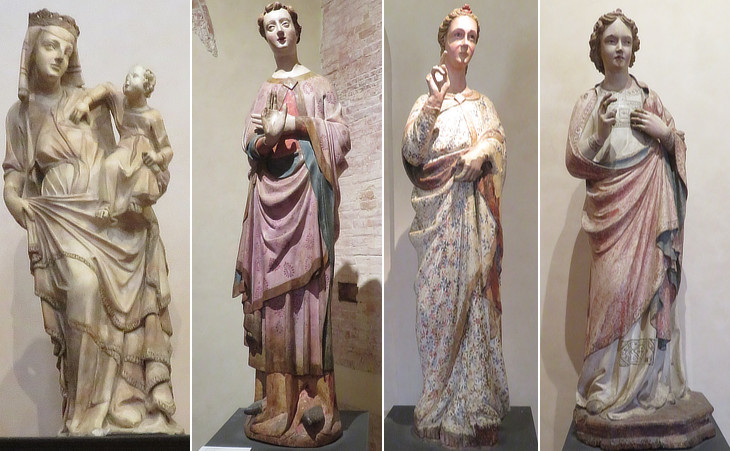
Statues by Lupo di Francesco (or attributed to him): (left) Madonna and Child from S. Michele in Borgo; (centre/right) statues of Annunciations
Lupo di Francesco, a pupil of Giovanni Pisano, was appointed Operaio dell'Opera del Duomo, i.e. supervisor of all activities concerning the Cathedral and the adjoining buildings in 1315. Several sculptures which were made in the early XIVth century at Pisa are attributed to him, including the group at the entrance of the Camposanto and part of the sculptural decoration of S. Maria della Spina.
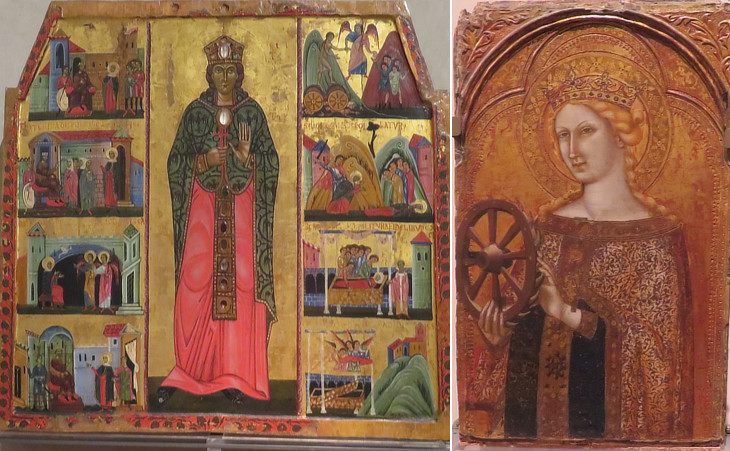
(left) St. Catherine of the Wheel and scenes of her life (see the wheels in the top right panel - XIIIth century); (right) St. Catherine of the Wheel holding the instrument of her martyrdom (ca 1330)
At Pisa, painters existed apparently in very early times. As far back as 1275 money was voted by the Comune for the purpose of repainting "the images of the Virgin Mary and other
saints on the gates of the city" because they were then well-nigh
obliterated. The earliest examples of painting are now crucifixes. (..) Towards the close of the thirteenth century the names of painters become frequent in records. (..) Yet of pictures, as old as the thirteenth century, Pisa possesses few; and these are by no means productions of merit. (..) Pisa, therefore, though great for its school of sculpture, was feeble as regards painting in the thirteenth century. Her artists produced, besides crucifixes, vast works, such as those of San Pietro in Grado, but they displayed no peculiarities which can be called exclusively Pisan.
J. A. Crowe and G. B. Cavalcaselle - A new history of painting in Italy - 1864
There is not a Pisan school of painting which is comparable to those of Siena and Florence. The first painting portraying St. Catherine reflects Byzantine patterns, the second one is similar, especially in the architectural background, to Florentine works.
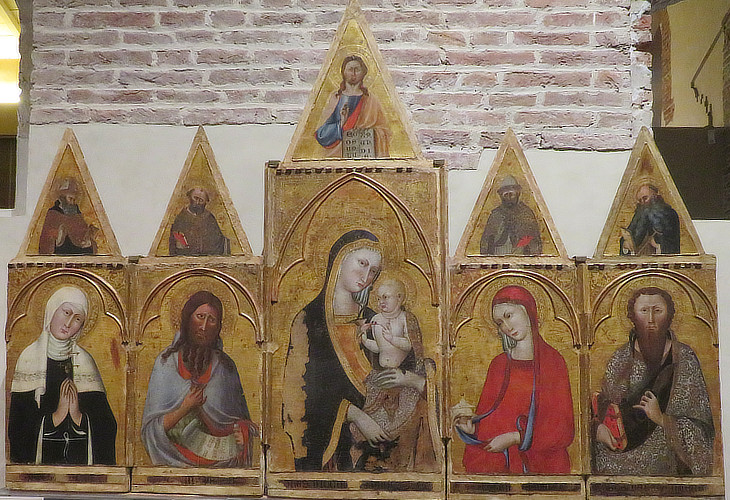
Polyptych by Giovanni da Pisa aka Giovanni di Nicola (1350); Virgin and Child and (left to right) St. Bona of Pisa (c. 1156-1207) an Augustinian nun who helped pilgrims travelling to Santiago de Compostela or Rome, St. John the Baptist, St. Mary Magdalene and St. Anthony the Abbot
Giovanni di Nicola is recorded in payments made in Siena where he worked with Simone Martini and his relative Filippo Memmi. You may wish to see an immense fresco of the Madonna and Child with saints by Martini and a polyptych by Ambrogio Lorenzetti a pupil of Martini, both at Siena.
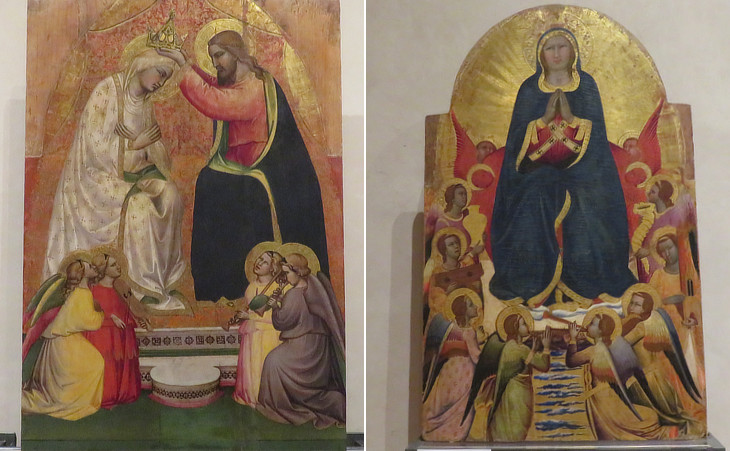
(left) Coronation of the Virgin Mary by Spinello Aretino, part of a polyptych, from the Cathedral; (right) Assumption of Mary by Antonio Veneziano from Convento di S. Tommaso; both paintings accurately depict angels playing musical instruments; this occurred very often and it has provided understanding of how these instruments developed through the centuries (see a fresco by Filippino Lippi in a page covering Museo degli Strumenti Musicali in Rome)
The continuous fights among the independent "Comuni" of Tuscany did not prevent painters and sculptors from working in all of them. Spinello Aretino decorated with frescoes many churches of his hometown, but also a hall of the Palazzo Pubblico of Siena and a polyptych for the Cathedral of Pisa.
Antonio Veneziano (d. 1388) was born in Venice, but he mainly worked in Florence with Taddeo Gaddi. See his frescoes and those of Gaddi at the Camposanto of Pisa.

Polyptych depicting the Crucifixion by Cecco di Pietro (1386) from Convento di S. Marta
Cecco di Pietro (1330-1402) today is regarded as one of the most interesting painters of Pisa, where he spent all his life. The polyptych was commissioned by a wealthy family for a newly-founded Dominican nunnery and this explains why the eight saints at the sides of the central scene are all women, some of whom hold a symbol of their martyrdom, e.g. St. Apollonia (lower left corner), who had all of her teeth violently pulled out. They were chosen among the martyrs who suffered most as examples for the nuns who were asked to live for others in complete abnegation of themselves.
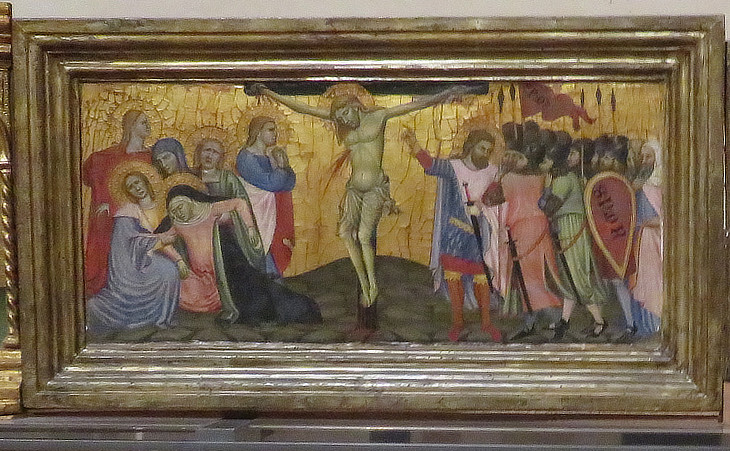
Predella (altar-step) with a Crucifixion by Cecco di Pietro (1386-1395)
The design of this Crucifixion is rather unusual because the group mourning the Death of Christ occupies one side of the painting to leave room for the depiction of Roman soldiers led by their commander all in XIVth century attire. They bear flags and hold shields with the SPQR acronym.
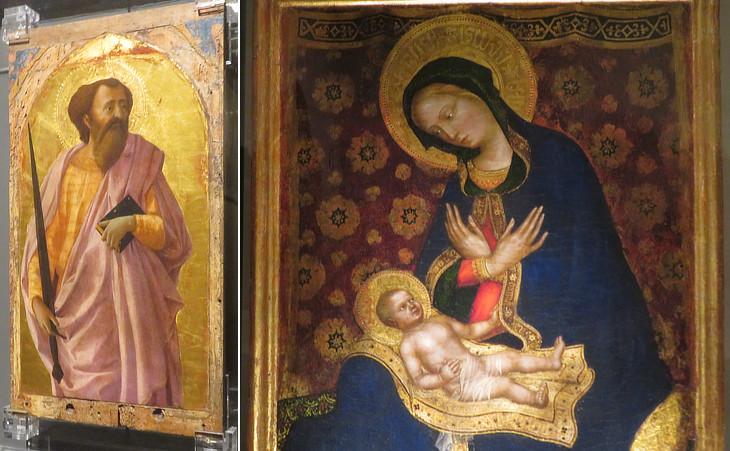
(left) St. Paul by Masaccio (1426); (right) Madonna by Gentile da Fabriano (ca 1420)
The Florentines occupied Pisa in 1406 and as a consequence many of the works art of the XVth century at Pisa were commissioned to Florentine artists (Masaccio) or to artists who were working in Florence (Gentile da Fabriano). In Gentile's Madonna one can clearly detect an Arabic inscription in Kufic calligraphy on her halo. The inscription had only a decorative purpose and it can be noticed in other paintings, e.g. the Maestà di Duccio at Siena or reliefs, e.g. a bronze door of S. Pietro in Rome.
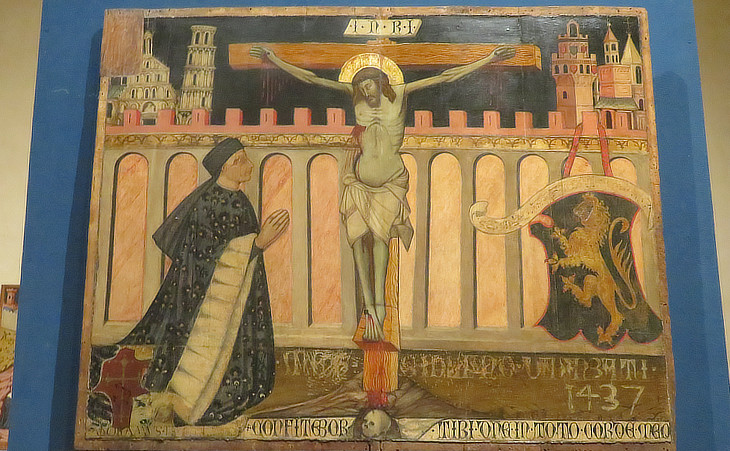
"Crocifisso della Dogana (Customs-house)" Christ crucified and Giuliano Davanzati, the donor of the painting, and in the background the City of Pisa by Turino Vanni, a Pisan painter (1437); inscription "Confitebor tibi - in toto corde meo" ("I will praise thee with my whole heart")
The Davanzati were a patrician family of Florence. In 1437 Giuliano Davanzati was in charge of the harbour of Pisa which included the customs-house. The painting is interesting because it shows (behind the walls of Pisa) the Cathedral and the Leaning Tower to the left and two towers and two bell towers to the right which most likely stood in Piazza degli Anziani (later on redesigned and renamed Piazza dei Cavalieri).
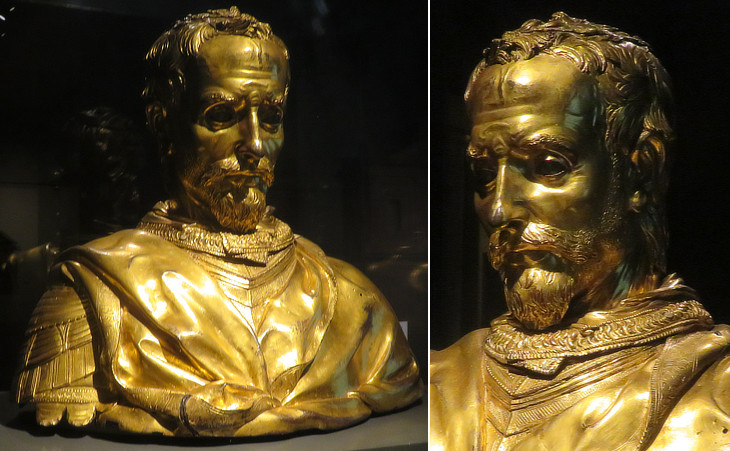
Reliquary containing the skull of Saint Luxorius (known in Pisa as "San Rossore") by Donatello (1424-1427)
With his Reliquary bust of Saint Rossore, Donatello established a new approach to religious iconography in Quattrocento Florence. In the 15th century, the new attention to the naturalistic representation of the human body in art was accompanied by a radical break in artistic tradition. Artists attributed greater importance to the accuracy in the depiction of faces of "real people". Even the traditionally schematized or idealized faces of long-dead saints were now given seemingly individual features. Especially Donatello breaks with this tradition, as his bust is sculpted with a very sensitive, naturalistic gesture; the expressive intensity Donatello imparted to it reinforces the illusion of confronting a living person.
Meryem Coskun - Reliquary bust of Saint Rossore: Celebrated, Forgotten, Rediscovered
According to tradition Luxorius, the assistant to a magistrate in Sardinia, was beheaded because of his Christian faith at the time of Emperor Diocletian. When Pisa conquered most of Sardinia, the worship of Luxorius spread to the city and in general to Tuscany. The Umiliati, a medieval religious order, acquired the skull of the saint and commissioned the reliquary for their church of Ognissanti in Florence. The Order was suppressed in 1571 and the reliquary is recorded as being in Pisa in 1591. It is made of five individual parts.

Processional banners: (left) Flagellation of Christ (XIVth century); (right) The Saviour holding the Chalice by Beato Angelico (ca 1440)
Angelico seized the religious side of Giotto's character without his severity. In the Saviour whom Angelico depicted we find the finest and most suitable exposition of the ideal of one who, bleeding for the sins of the world, pardons and prays for his enemies. J. A. Crowe and G. B. Cavalcaselle
Processional banners were carried at church festivals and certain special services, especially by brotherhoods (see them at a Roman festival) and occasionally famous painters were asked to decorate them with a sacred image.
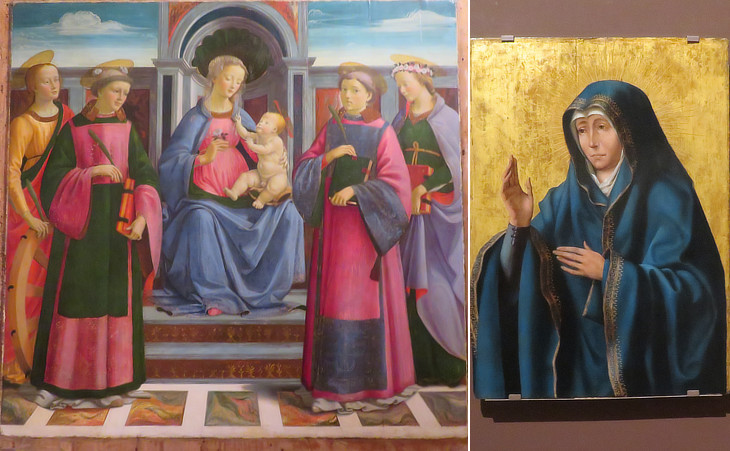
(left) Madonna and Saints by il Ghirlandaio (1470s see another of his paintings at Volterra); (right) Mater Dolorosa by Quentin Metsys, a Flemish painter, from S. Stefano dei Cavalieri (1520)
We may believe that Ghirlandaio is truly described as having been bred in the shop of his father or of some other jeweller, known perhaps by the name of the "Garland maker" which clung to him and his kin. (..) He delivered a great many altarpieces at Florence and in other towns of Italy. Such, for instance, as two Madonnas between saints in S. Anna of Pisa; the first of which (..) displays, in spite of great injury, a style not unlike that of the master in 1480, whilst the second, of the same period, is broadly painted and exhibits a certain freshness in the heads. (..) The second altarpiece, not free from restoring, represents the Virgin holding a white rose in her right, with the infant on her lap, between S.S. Stephen and Catherine of Alexandria, S. Lawrence and a female decked as to the head with red roses. J. A. Crowe and G. B. Cavalcaselle
The image used as background for this page shows a glazed terracotta by Benedetto Buglioni (late XVth century).
Move to
The Ancient Town
Piazza dei Miracoli
The Baptistery
The Camposanto
The Cathedral
The Knights of Pisa
The Walls and the Lungarni
A Walk along the Northern Terzieri
A Walk along the Southern Terziere
Churches of Terziere S. Francesco
Churches of Terziere S. Maria
S. Maria della Spina
S. Piero a Grado
An Excursion to Vicopisano