All images © by Roberto Piperno, owner of the domain. Write to romapip@quipo.it.


Notes:
Page added in February 2026.
All images © by Roberto Piperno, owner of the domain. Write to romapip@quipo.it.
Notes:
Page added in February 2026.
 S. Maria della Spina
You may wish to see pages on the monuments along the Lungarni or in the southern Terziere first.
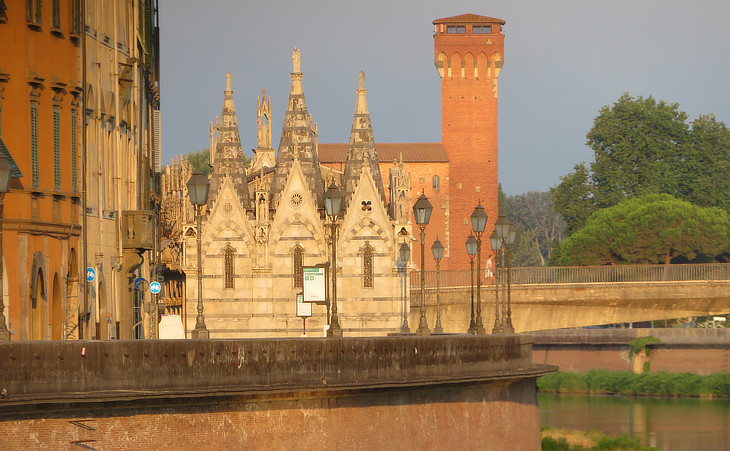
S. Maria della Spina on the Lungarno and Torre Guelfa in the distance
Not farre thence is a little, but most faire Chappell, all of marble, built in the forme of a Thorne, vulgarly called La Capella Jesu di Spina.
Fynes Moryson - An Itinerary: Containing His Ten Years Travel Through .. Italy (in 1594)
The Gothic Chapel, on the opposite side of the Lung' Arno, called the Spina, attracts all eyes, being one of the most beautiful specimens of the skill of Giovanni di Pisano, so celebrated in his art. The smallness of the dimensions, and exquisite execution and proportion of the building, justify the naive exclamation of an English fine lady of great wealth, who, on beholding it, said to her lord, "Do, pray, dear, buy me that beautiful little thing, and have it
sent home, to be placed in my flower-garden."
Marguerite, Countess of Blessington - The Idler in Italy - 1839
I found the simple large pacified felicity of such an afternoon aspect as that of the Lung' Arno, taken up or down its course; whether to within sight of small Santa Maria della Spina, the tiny, the delicate, the exquisite Gothic chapel perched where the quay drops straight, or, in the other direction.
Henry James - Italian Hours - 1909
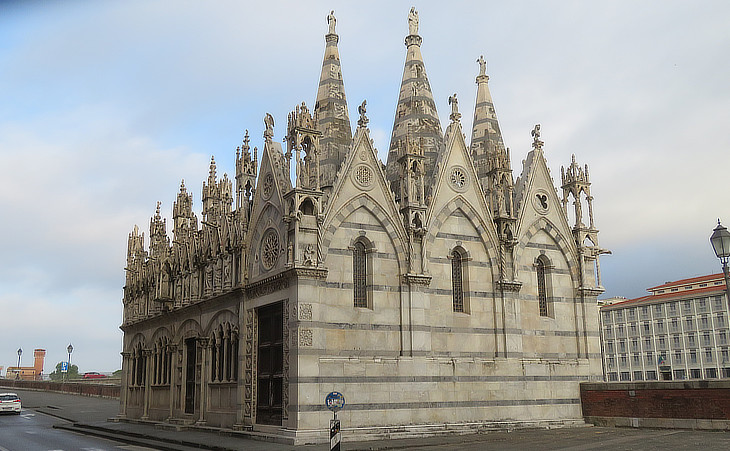
Eastern side
Among its churches the traveller cannot fail to observe a singular edifice on the banks of the Arno called Santa Maria della Spina (from part of our Saviour's crown of thorns said to be preserved there) it is nearly square, low, and of an appearance whimsical and grotesque rather than beautiful. It is cased with black and white marble. Two great doors with round arches form its entrance: over each portal rises a pediment; the other end is surmounted by three obelisks crowned with statues; the corners, the gable ends, and indeed the side walls are decorated with pinnacles, consisting each of four little marble pillars supporting as many pointed arches with their angular gables, and forming a canopy to a statue standing in the middle of the pillars; they all terminate in little obelisks adorned with fretwork. I mention this building merely for its singularity and as a specimen of that species of architecture which the Italians called Gotico Moresco (Moorish-Gothic), introduced into Italy in the eleventh century, and as its name seems to import, probably borrowed from the East by the merchants of the commercial republics.
John Chetwood Eustace - Classical Tour of Italy in 1802 (publ. 1813)
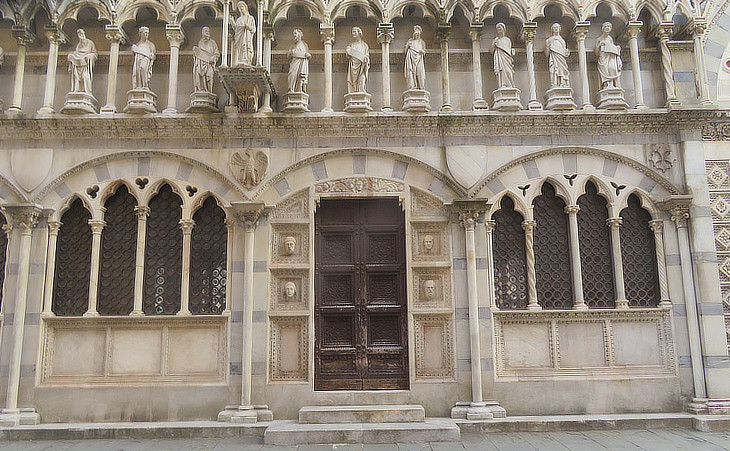
Central part of the southern side; the image used as background for this page shows the eagle, an imperial symbol, to the left of the portal
Santa Maria della Spina, on the S. bank of the Arno. This chapel is an architectural gem, and at the time it was executed was considered to be a miracle of art. It stands on the side of the Arno on the S. bank, and was built for the convenience of mariners, who, in the flourishing times of Pisa, repaired to this chapel before they set forth on their voyage to implore the protection of the Virgin ship. It was built twice. The first edifice was begun in the year 1230, at the joint expense of the Senate and of a noble family of Pisa, the Gualandi. The celebrated sculptor, Giovanni Pisano, is said to have executed some of the statues with which this building was adorned, and, by the talent which he displayed on that occasion, to have obtained the privilege of giving the design for the Campo Santo. In 1323 the Senate of Pisa determined to enlarge this chapel. At that time it was that the building acquired the form and exuberance of ornament which it at present exhibits. It appears from successive decrees of the senate that the work was in progress during the greater part of the 14th century. In this building though its general style is that of the advanced period round forms still make their appearance; but in all the upper part the pointed style is employed alone. The canopies and tabernacles are of the most delicate workmanship. The statues are well executed. The whole building is of white marble. On the E. front are the statues executed by Giovanni Pisano. (..) This ch. originally called Santa Maria del Ponte, derives its present name from a thorn of our Saviour's crown, which was brought from the Holy Land by a merchant of Pisa, and presented to it by his descendants in 1333.
John Murray - Handbook for travellers in Central Italy - 1861

(left) Western side; (right) tabernacle
The little chapel della Spina on the quay of the Arno at Pisa has generally been attributed to Giovanni Pisano, or at least its decoration, for the building we now see is remodelled on an older foundation. Vasari says "Giovanni, with the aid of some of his young men, applied many ornaments to that oratory, and brought it that perfection which we see to-day." Further researches, however, show that the enlargement and adornment of the building dates from 1323, three years after Giovanni's death. The building, which has lately been restored and raised some feet, is of marble, and consists of two aisles. The side windows are simple, but are surmounted by a series of arcades containing statues and rich with tabernacle work, gablets, and pinnacles. In spite of many beautiful details, the design has in excess the redundancy of ornament into which Italian Gothic fell, and to a northern eye it seems fussy and overdone.
Thomas Graham Jackson - Gothic architecture in France, England, and Italy - 1915

Museo Nazionale di S. Matteo: statues on the southern side of S. Maria della Spina
Pisa, Sunday morning 25 May 1845. My Dearest Father. Of all the inclements Mays I recollect I think this has been the worst. Since I left Sestri I have not had one really fine day, and here I have been completely prevented by the wind from getting out of doors studies, and even from standing long enough about the cathedral to have its architecture. Yesterday in the campo Santo I had to put up a piece of matting to shelter me from the wind. On Thursday night we had an awful thunderstorm, which went away to Florence and caused the Arno, as I told you, to rise, not five feet, but I see now by the marks on the stones, nine. I never saw so furious a current as at 10 o'clock on Friday night.
John Ruskin - Letters to his parents 1845
In 1871 the church was completely dismantled and reassembled in the place where we see it today in order to preserve it from floodings. The works lasted until 1884. During the works which lasted until 1884, the church was rebuilt, its walls were raised by one meter, the original sculptures were replaced with casts (the originals are now kept in the Museum of San Matteo). The sacristy, once facing the Arno, was never rebuilt.
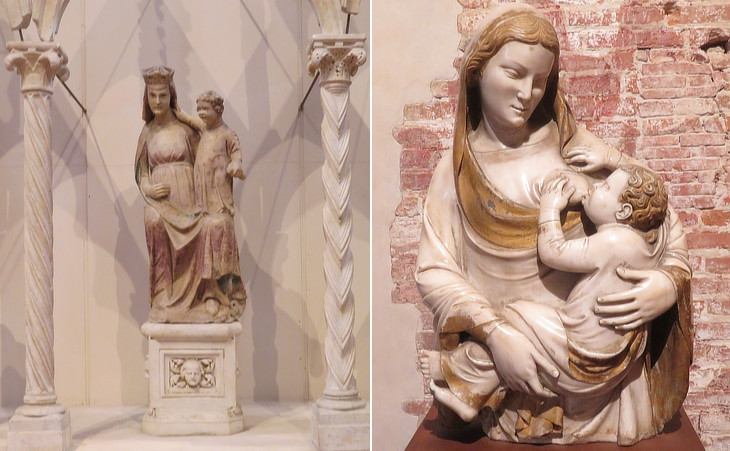
Museo Nazionale di S. Matteo: (left) Madonna from the Monument to Count Bonifazio della Gherardesca by Lupo di Francesco (from S. Francesco); (right) Madonna del Latte (Nursing Madonna) from the interior of S. Maria della Spina
Within are some very interesting specimens of Pisan sculpture. At the high altar the Virgin offering a flower to the Infant Saviour, and called the Madonna del Fiore. (..) At the opposite end of the ch. is another group of the Virgin and Child by Nino or Ugolino da Pisa on which the gilding of the hair and a part of the drapery is perfectly fresh; by some this group has been attributed to Nicolo or Giovanni. Murray
Today the Nursing Madonna is attributed to Andrea Pisano who started his career at Pisa and returned there after a long stay at Florence where he worked at the Baptistery and at the Campanile di Giotto. See his Monument to Archbishop Simone Saltarelli at S. Caterina.

Museo Nazionale di S. Matteo: reliefs by Andrea di Francesco Guardi (1461) from a balustrade inside S. Maria della Spina: (left) Strength; (right) Charity
Guardi was a Florentine sculptor who began his career in the workhshops of Bernardo Rossellino and Michelozzo, both pupils of Donatello. The reliefs portraying Virtues which he made for S. Maria della Spina are regarded as his finest work. He was mainly active at Pisa and other towns which at the time were subject to Florence. See a sarcophagus he made for an abbot at the Camposanto.
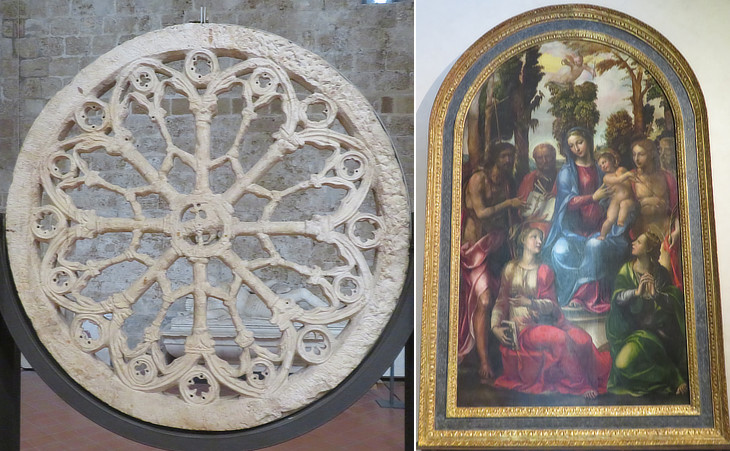
Museo Nazionale di S. Matteo: (left) rose window from the southern side, probably executed under the supervision of Lupo di Francesco; (right) Sacra Conversazione (a depiction of the Virgin and Child amidst a group of saints in a relatively informal grouping) by Giovanni Antonio Bazzi, aka Il Sodoma (1542)
Giovanni Antonio went to Pisa, where he executed two pictures for the Warden of Works of the Duomo (..) but since these pictures did not succeed very well, the Warden, who had intended to make him paint some altar-pieces for the church, dismissed him. At that same time Giovanni Antonio finished an altar-piece that he had previously begun in oils for S. Maria della Spina, painting in it Our Lady with the Child in her arms, with S. Mary Magdalene and S. Catharine kneeling before her, and S. John, S. Sebastian, and S. Joseph standing at the sides; in all which figures he acquitted himself much better than in the two pictures for the Duomo.
Giorgio Vasari - Lives of the most eminent painters, sculptors and architects - tr. by G. Du C. De Vere - 1913
Il Sodoma was one of the leading painters of his time. See his frescoes at la Farnesina in Rome and some small paintings at Siena.
Move to
The Ancient Town
Piazza dei Miracoli and the Leaning Tower
The Baptistery
The Camposanto
The Cathedral
The Knights of Pisa
A Walk along the Walls and the Lungarni
A Walk along the northern Terzieri
A Walk along the southern Terziere
Churches of Terziere S. Maria
Churches of Terziere S. Francesco
S. Matteo and its Museum
S. Piero a Grado
An Excursion to Vicopisano


