All images © by Roberto Piperno, owner of the domain. Write to romapip@quipo.it.


Notes:
Page added in March 2026.
All images © by Roberto Piperno, owner of the domain. Write to romapip@quipo.it.
Notes:
Page added in March 2026.
 S. Piero a Grado
You may wish to see a page on the Ancient Town of Pisa first.
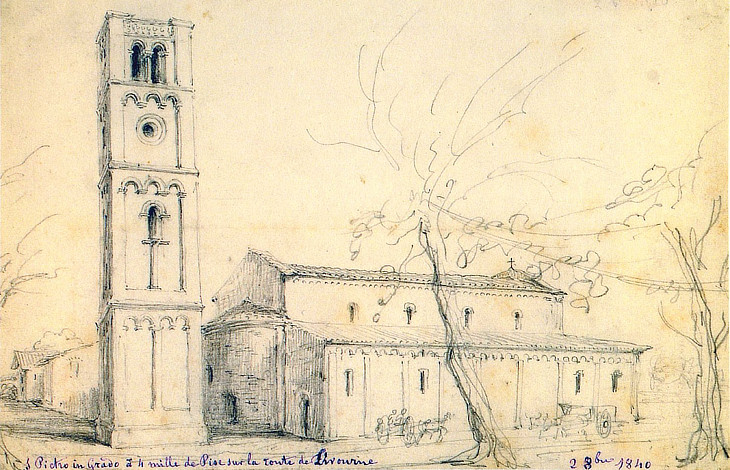
S. Piero a Grado in an 1840 drawing by a French traveller (De La Morinière)
Four Miles from Pisa, whither the Sea (they say) formerly came, is the Church of S. Pietro in Grado, built in memory of S. Peter's landing there, when he came from Antioch in his way to Rome; and in it they shew the Altar, at which they pretend he said His first Mass. That the Reader may have the history the more authentick, the Inscription follows, Which I took in the Church. "In the forty fourth Year from the Birth of Christ, S. Peter, Prince of the Apostles, in his way from Antioch to Rome, - arriving at the Pisan Shore, in that very place, where, near the middle of this Church, the Shrine, so much resorted to, now stands, built a Marble Altar, and offer d the unbloody Sacrifice."
Edward Wright's Observations made in France, Italy &c. in the years 1720, 1721 and 1722.
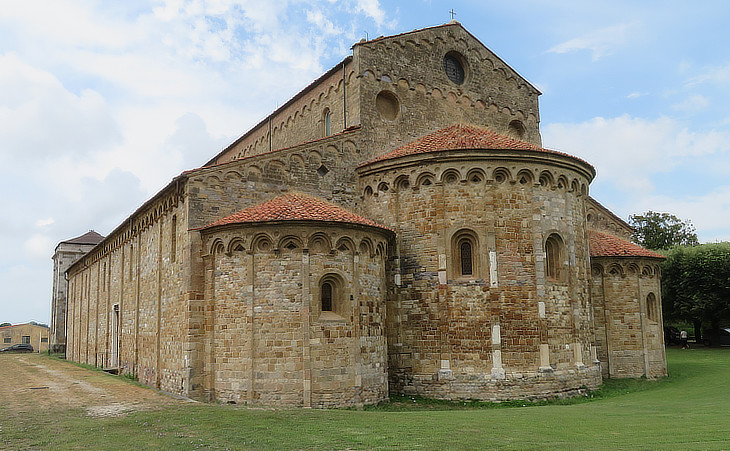
Western side with three apses
San Pietro in Grado, upon the old post-road to Leghorn, about 4 m. S.W. from Pisa. This is a curious church, erected before the year 1000. It was altered, whitewashed, and plastered in 1790; but where the original can be discerned, the Romanesque is seen in a style different from that of the Duomo. (..) This church owes its name to the tradition that St. Peter built a church on this spot when he here set his foot for the first time in Etruria. Here was the landing-place, "Gradus". The authority quoted for this is a sermon of Visconti Archbp. of Pisa in the 13th century.
John Murray - Handbook for travellers in Central Italy - 1861
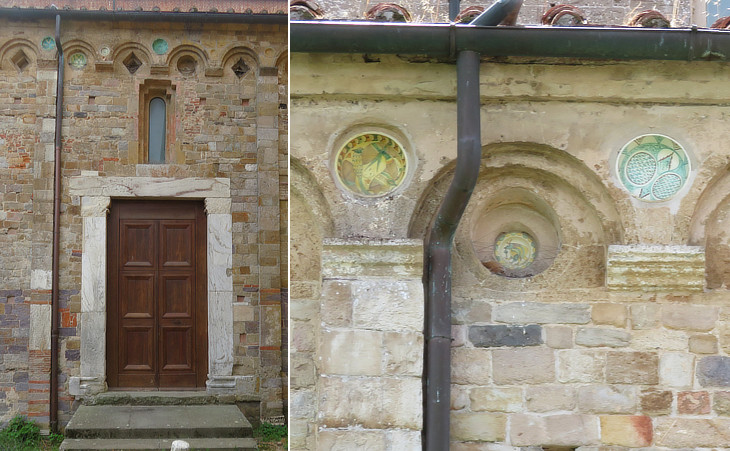
(left) Southern entrance; (right) pottery decoration, most likely from Moorish Spain; it can be seen also in many churches of Pisa and in some Romanesque bell towers of Rome e.g. that of SS. Giovanni e Paolo
The Latin word basilica originated from Greek roots meaning "Royal Hall", a roofed building where a king (basileus) or his appointees administered justice. In addition to being the seat of a tribunal, a Roman basilica was a meeting place to discuss politics, do business, announce new laws or initiatives. Basilicas had a rectangular shape with three naves and occasionally one or two apses. The central nave was higher than the others so that windows could be opened in the walls supporting its roof.
You may wish to see the Pagan basilica of Pompeii which housed a tribunal or the Christian basilica of Hagia Irene at Constantinople which housed a synthronon, an early form of choir.
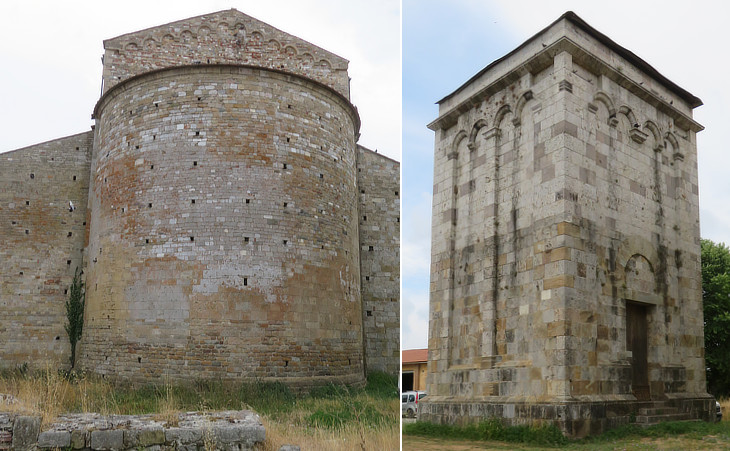
(left) Eastern side with one apse (the 1840 drawing shows that there was one entrance at the side of the apse); (right) partially reconstructed bell tower
The lack of a façade is most likely due to a change of orientation of the church: initially the main altar was located in the western part of the building; in the XIIth century it was moved to the eastern part in line with the orientation of the Cathedral. Other modifications/additions occurred in the following centuries, until a general restoration of the building after WWII emphasized its medieval aspect.
The campanile is of a century or two later. Murray
The church was bombed during WWII because of its location along the old road between Pisa and Leghorn and its bell tower was almost razed to the ground.

Interior: western side with a modern altar
The current church was erected between the Xth and the XIIth centuries, but it is a very complex building in which many modifications have occurred. They have been identified by archaeological excavations carried out after WWII and parts of of the old buildings are partially visible inside the basilica. The first place of worship in this area dates back to the IVth century AD, although, according to the traditional account, in the year 44 AD St. Peter landed right here. It is said that during a terrible storm his ship sought shelter in this strip of land (Gradus Arnensis) that at the time was surrounded by the sea. He decided to erect a stone altar, the first in Italy.
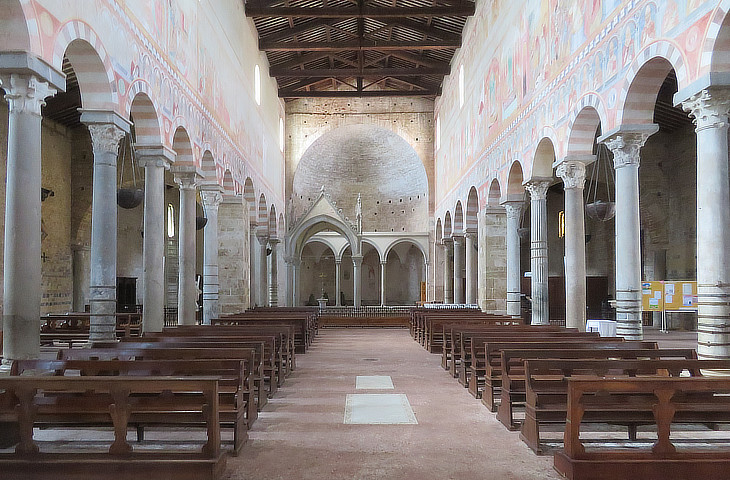
Interior: eastern side and reconstructed Gothic canopy over the site where St. Peter landed
It is built with ancient materials. Of the 26 columns which divide the nave from the aisles, 15 are of Greek marble, and 11 are of granite. The capitals, which are of different orders, style, and size, are of Roman workmanship. Murray
The interior is very well proportioned and it does convey the feeling of being inside an ancient building. Only the different capitals (partly Ionian, partly Corinthian) and stones of the columns indicate the medieval construction of the church. You may wish to see the interior of S. Maria Maggiore, the Roman basilica which best retains its original design.
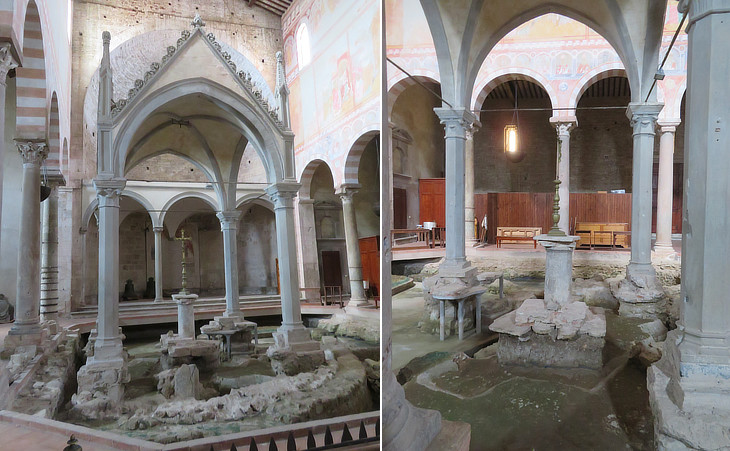
Canopy and column marking the landing site of St. Peter
They shew likewise the Place where S. Peter tied his Boat, with a Grate before it. There are in this Church antique Pillars of several Orders as in some old Basilicas about Rome. Wright
The column of St. Peter, on which the Apostle placed a large stone to celebrate mass stands under a Gothic canopy. According to tradition, Pope St. Clement, the third (or the fourth) Bishop of Rome, in the act of consecrating the altar of Peter, had an episode of epistaxis and a few drops of his blood fell on the stone. Around it are the remains of the first early Christian church of the Vth century and of a three-apse church of the VIIIth century. Nearby Volterra claims that Linus, a citizen of that town, was converted by Peter on his way from Pisa to Rome. Linus became the second Bishop of Rome.
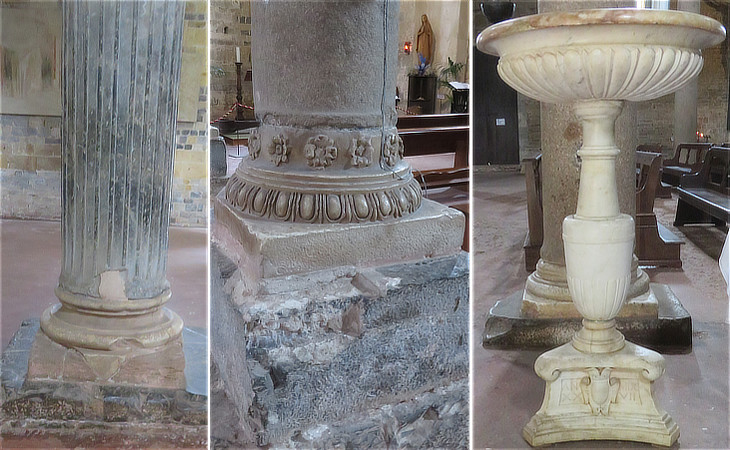
(left/centre) Details of the bases of the columns; (right) Renaissance holy font
The bases of the columns were adjusted in order to give the same height to the capitals which supported the arches. The decoration of some of them shows typical Roman patterns e.g. rosettes and egg-and-dart (a series of ovals alternating with pointed, narrow, dartlike carvings - see this pattern at a temple in Rome). The church belonged to the Cathedral, but in the XVIIth century it was assigned to the Franciscans and eventually it became a rural parish church.
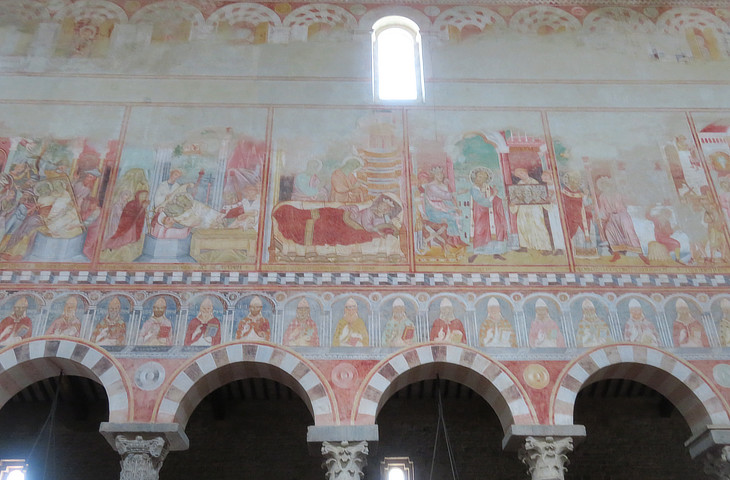
Frescoes of the nave attributed to Deodato Orlandi (very early XIVth century)
Deodato lived in the close of the thirteenth century. (..) Deodato still painted as late as 1301, when he executed a Virgin and saints in five arched compartments now in the gallery of Fine arts at Pisa. (..) A light style of colouring may already be noticed in the latest work of Deodato Orlandi.
J. A. Crowe and G. B. Cavalcaselle - A new history of painting in Italy - 1864
The nave was decorated with a cycle of large frescoes during a period of great splendour for the basilica, an important stop for many pilgrims for whom a (lost) portico was built around the building. The frescoes are divided into three bands: (above) angels inside fake windows; (middle) events of the lives of St. Peter and other saints; (below) portraits of popes, from St. Peter to John XIV (late Xth century). Similar galleries of portraits of popes can be seen in the Cathedral of Siena and at S. Paolo fuori le Mura. The black and white decoration of the arches calls to mind that of mosques; fake metal discs were painted above each column.
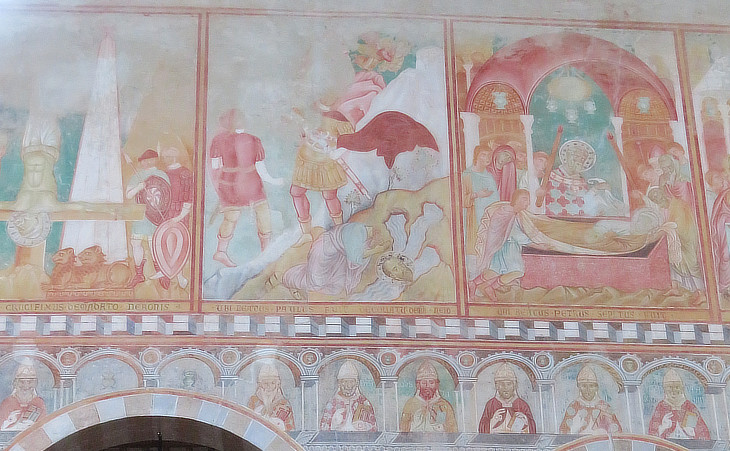
Frescoes: (left) Crucifixion of St. Peter (see the same subject in a dramatic painting by Caravaggio); (centre) Decollation of St. Paul with the depiction of the three fountains; (right) Burial of St. Peter
The frescoes were whitewashed more than once and when in the XIXth century they were brought to light they were very barely visible. A lengthy process of restoration which involved some repainting lets today's visitor to have an understanding of how the interior of the basilica looked like in its heydays. The light colours used by Deodato give the feeling that he illustrated some fables, rather than cruel martyrdoms (see a page on the iconography of the saints).
The image used as background for this page shows the portrait of a pope.
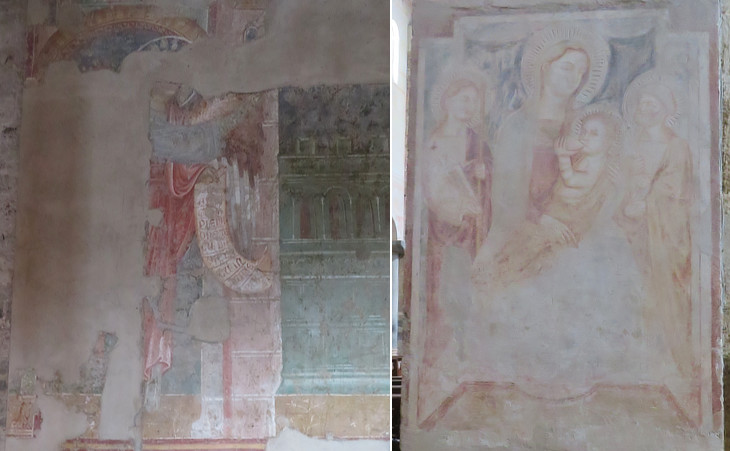
Other frescoes: (left) fragment of an Annunciation; (right) Madonna del Latte (Nursing Madonna) between Sts. Paul and Peter (see a statue from S. Maria della Spina)
Move to
The Ancient Town
Piazza dei Miracoli and the Leaning Tower
The Baptistery
The Camposanto
The Cathedral
The Knights of Pisa
The Walls and the Lungarni
A Walk along the Northern Terzieri
A Walk along the Southern Terziere
Churches of Terziere S. Maria
Churches of Terziere S. Francesco
S. Maria della Spina
S. Matteo and its Museum
An Excursion to Vicopisano