All images © by Roberto Piperno, owner of the domain. Write to romapip@quipo.it.


Notes:
Page added in December 2025.
All images © by Roberto Piperno, owner of the domain. Write to romapip@quipo.it.
Notes:
Page added in December 2025.
 The Baptistery
You may wish to see a page on Piazza dei Miracoli first.
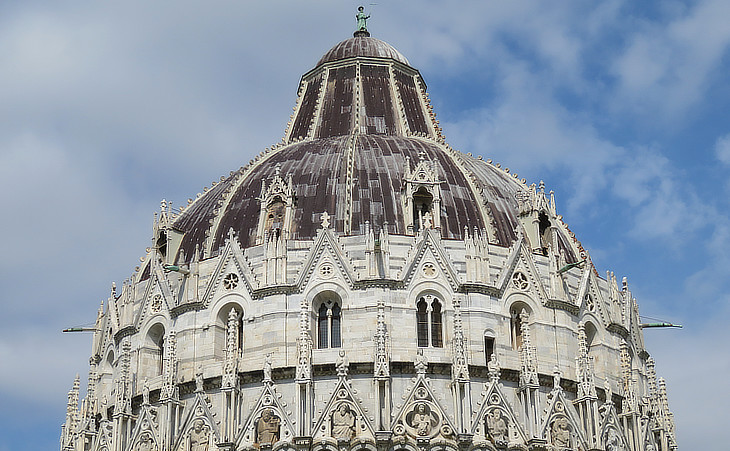
Dome and upper part of the Baptistery
October 1644. Near the Cathedral, and in the same field, is the Baptistery of San Giovanni, built of pure white marble, and covered with so artificial a cupola, that the voice uttered under it seems to break out of a cloud.
John Evelyn - Diary and Correspondence related to his stay in Italy in 1644
The Baptistery is built somewhat in the form of a Bell and has the effect of one. It is a Rotonda whose sides and Cupola Roof do so reverberate the Sound of a Voice or Instrument, that you have it extremely loud at first; and then it diminishes by slow degrees, till it goes off at last as at a great distance.
Edward Wright's Observations made in France, Italy &c. in the years 1720, 1721 and 1722.
Above the second story a division in the compartments occurs, which embraces three of the lower arches; the separation being effected by triangular piers crowned by pinnacles. Between these piers semicircular-headed small windows are introduced, over each of which is a small circular window and thereover sharp pediments. The covering is a double brick dome, the inner one conical, the outer hemispherical. The former is a frustum of a pyramid of 12 sides. Its upper extremity forms a polygon, showing 12 marble ribs on the exterior, covered by a small parabolic cupola. The outer vault terminates above, at the base of the small cupola, which stands like a lantern over the aperture. Above these springs the convex surface of a dome, divided by 12 truncated ribs ornamented with crockets. Between these ribs are a species of dormer windows, one between every two ribs, - ornamented with columns, and surmounted each by three small pointed pediments. The total height is about 179 ft. The cupola is covered with lead and tiles on the sea side to prevent corrosion.
John Murray - Handbook for travellers in Central Italy - 1861.
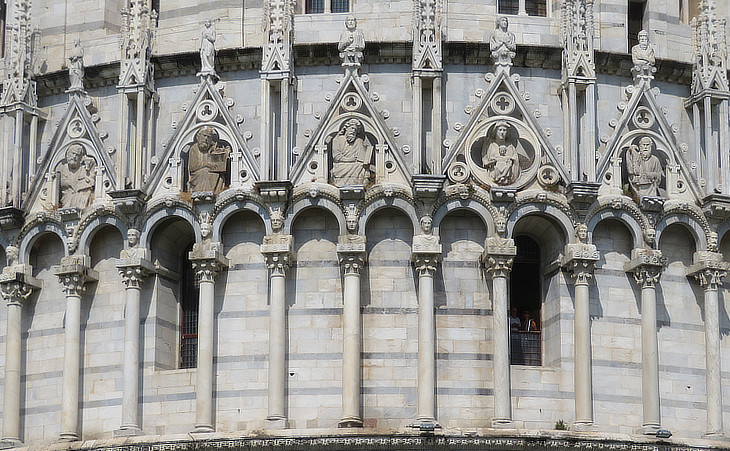
Decoration of the second storey
The Baptistery, which, as in all the ancient Italian churches (e.g. S. Giovanni in Laterano and the Baptistery of Ravenna), is separated from the cathedral, stands about fifty paces from it full in front. It is raised on three steps, is circular, and surmounted with a graceful dome. It has two stories, formed of half-pillars supporting round arches; the undermost is terminated by a bold cornice; the second, where the pillars stand closer, and the arches are smaller, runs up into numberless high pediments and pinnacles, all topped by statues. Above these, rises a third story without either pillars or arches, but losing itself in high pointed pediments with pinnacles, crowned again with statues without number. The dome is intersected by long lines of very prominent stone fretwork, all meeting in a little cornice near the top, and terminating in another little dome which bears a statue of St. John the Baptist, the titular saint of all such edifices. (..) This edifice, which is the common baptistery of the city, as there is no other font in Pisa was erected about the middle of the twelfth century by the citizens at large, who, by a voluntary subscription of a fiorino of each, defrayed the expenses.
John Chetwood Eustace - Classical Tour of Italy in 1802 (publ. 1813)
The Baptistery displays a crowd of unnecessary columns, placed under mean and unnecessary arches, round an immense polygon; and betrays, too, something like the Gothick; for certainly the figure inscribed in each of the acute pediments of the second order does resemble our cathedral trefoils.
Joseph Forsyth - Remarks on Antiquities, Arts, and Letters in Italy in 1802-1803
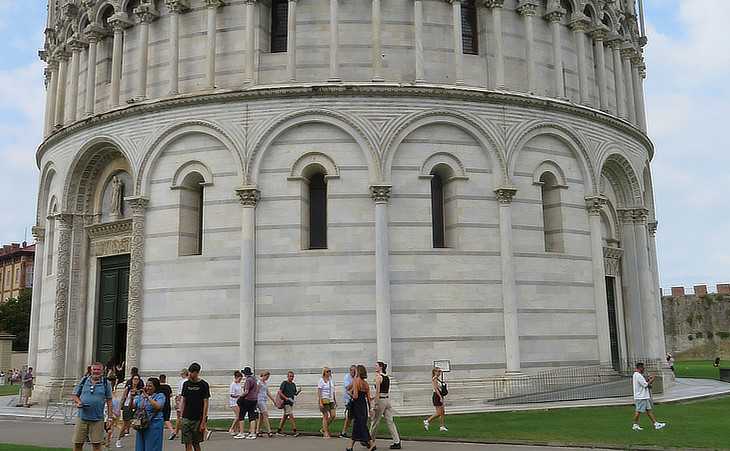
On the exterior are two orders of Corinthian columns, the lower one being engaged in the wall, as pilasters, which support semicircular arches. In the upper order the columns are more numerous, inasmuch as each arch below has two columns above it. Over every two arches of the upper order is a pointed pediment, separated by a pinnacle from the adjoining ones, and above the pediments a horizontal cornice encircles the building. Murray
The Baptistery of Pisa was begun in 1153, the architect being Diotisalvi. (..)
Externally the walls of the baptistery are of the original design up to the second storey. The lower stage has the tall blank arches of Pisan design like the basement of the Duomo. Above is a row of smaller arches now surmounted by pediments and crocketting of 14th century Gothic, which are continued in an upper storey reaching the dome.
Thomas Graham Jackson - Byzantine and Romanesque architecture in France, England, and Italy - 1913
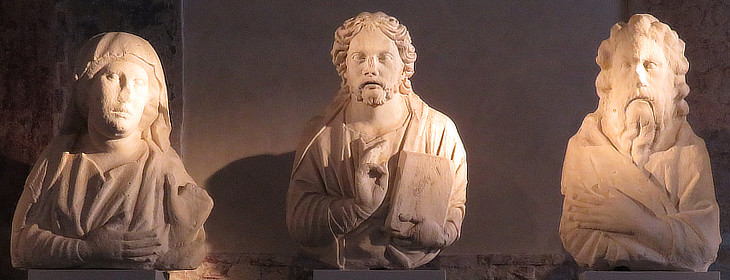
Museo dell'Opera del Duomo (in a building near the Leaning Tower): busts by Nicola Pisano from the exterior of the Baptistery: a Blessing Jesus (Deesis) between the Virgin Mary and St. John the Baptist, in a typical Byzantine posture
The earliest mediaeval sculpture of Tuscany is, perhaps, to be seen at Pistoia, where a Maestro Gruamonte has left several specimens of his chisel. Pisa was illustrated by Nicolo da Pisa and other artists of the Pisan school. Murray
Nicolo di Pietro from Apulia transplants the same love of the antique to Pisa, and acquires by his works there both the rights of a new home and the name of Nicola Pisano. (..) In Nicola Pisano's sculptures Roman influence is sometimes set aside by that of French ivories.
Corrado Ricci - Romanesque Architecture in Italy - 1925
Nicola Pisano, similar to many other Italian artists of his time was both an architect and a sculptor and in this dual capacity he worked also at the Cathedral of Siena with the assistance of his son Giovanni.

Main entrance (eastern doorway facing the Cathedral); statue by Giovanni Pisano (copy); reliefs: (above) Jesus between the Virgin Mary and St. John the Baptist (another Deesis), angels, the Evangelists and two palm trees (see those at S. Paolo fuori le Mura in Rome and at S. Apollinare in Classe in Ravenna); (below) scenes from the life of St. John the Baptist
The principal entrance, facing the E. and the Duomo, is by a decorated doorway, from the sill of which the steps and the wall having been provided for the accommodation of the persons assembled to view the ceremony of baptism. The principal sculptures of the exterior are on the eastern doorway. They represent the martyrdom of St. John the Baptist, together with three larger statues. Murray
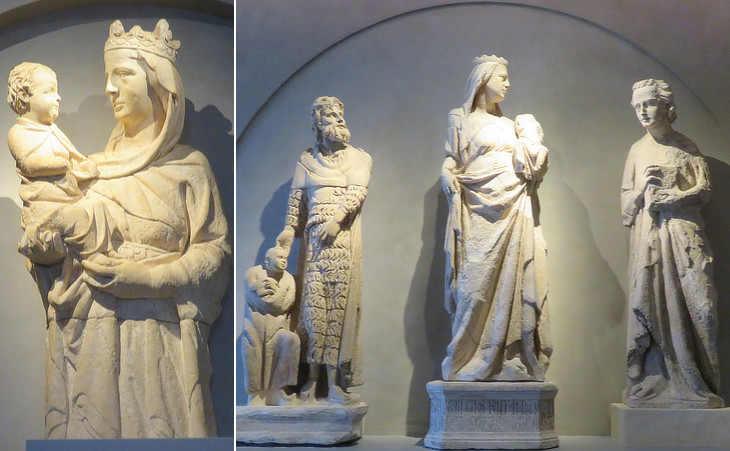
Museo dell'Opera del Duomo: statues by Giovanni Pisano: (left) from the Cathedral; (right) from the main entrance of the Baptistery; the statues of St. John the Baptist and St. John the Evangelist and of the donor who is portrayed at a smaller scale, were made by his assistants
The prototype of all Madonnas of the Pisan school. In strict accordance with the spirit of early Christian art, which demanded the concealment of her figure, she is amply draped; and in token of her peculiar mission of showing Christ to the world, she holds Him far from her, as though her natural affection were absorbed in reverence for His Divine nature.
Charles Perkins - Tuscan sculptors - 1864
The statue from the Cathedral with the Madonna smiling tenderly towards the Infant Saviour is popularly known as Madonna del Colloquio (Conversation), for her eye-to-eye pose with her Child.
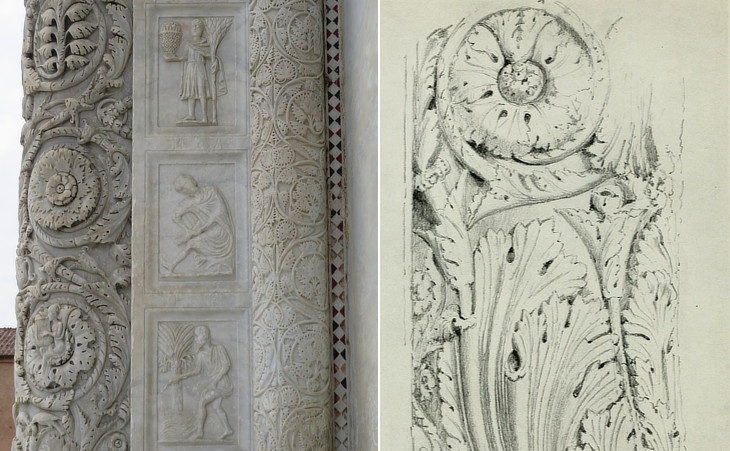
Main entrance: (left) detail of its decoration showing allegories of the Months (a popular motif at the time see those at S. Zeno in Verona and at S. Maria della Pieve in Arezzo); (right) illustration from Graham Jackson's book on Romanesque architecture
The classic feeling of the interior sculpture shows itself again in that of the columns flanking the portals in particular that of the doorway facing east has a magnificent sweep of foliage that could not have been surpassed in the best period of Roman art, and which is surprising at this date. Graham Jackson
The reliefs as well as the columns are dated XIIIth century. You may wish to see the similar columns which Giovanni Pisano executed for the Cathedral of Siena.
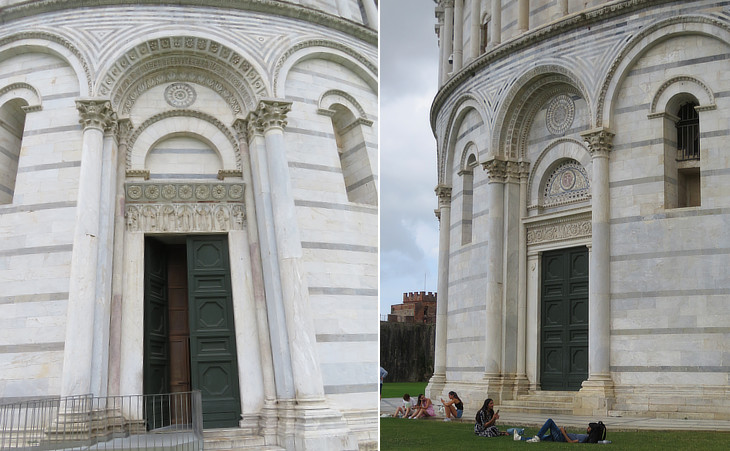
Side entrances: (left) northern, towards the Camposanto; (right) southern towards Spedale di S. Chiara
The Baptistery stands but a step away from the Campo Santo, and our guide ushered us into it with the air of one who had till now held in reserve his great stroke and was ready to deliver it. Yet I think he waited till we had looked at some comparatively trifling sculptures by Nicolo Pisano before he raised his voice and uttered a melodious species of howl. While we stood in some amazement at this, the conscious structure of the dome caught the sound and prolonged it with a variety and sweetness of which I could not have dreamed. The man poured out in quick succession his musical wails, and then ceased, and a choir of heavenly echoes burst forth in response. There was a supernatural beauty in these harmonies of which I despair of giving any true idea: they were of such tender and exalted rapture that we might well have thought them the voices of young-eyed cherubins, singing as they passed through Paradise over that spot of earth where we stood. They seemed a celestial compassion that stooped and soothed, and rose again in lofty and solemn acclaim, leaving us poor and penitent and humbled. We were long silent, and then broke forth with cries of admiration of which the marvelous echo made eloquence.
"Did you ever," said the cicerone after we had left the building, "hear such music as that?"
"The papal choir does not equal it," we answered with one voice.
The cicerone was not to be silenced even with such a tribute, and he went on: (..)
"I am unique," pursued the cicerone, "for making this echo. But, "he added with a sigh" it has been my ruin. The English have put me in all the guide-books, and sometimes I have to howl twenty times a day. When our Victor Emanuel came here I showed him the church, the tower, and the Campo Santo. Says the king: Pfui ! make me the echo! "I was forced," concluded the cicerone with a strong pretense of injury in his tone, "to howl half an hour without ceasing."
Dean Howells - Italian Journeys - 1867
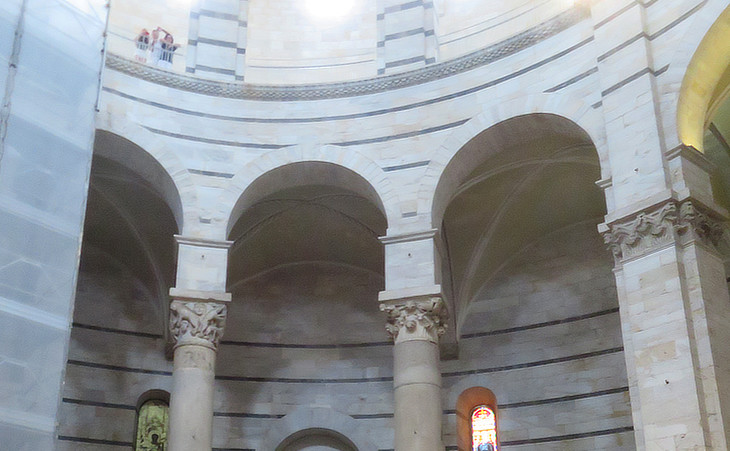
Interior: upper part
An aisle or corridor is continued round its inner circumference, being formed by 8 composite columns with varied capitals, and 4 piers, the former of granite from the island of Sardinia, on which rest arches, which support an upper gallery; and above these arches are 12 piers built of alternate courses of white and black marble, bearing the others which support the dome. Murray
It consists of a circular central domed area surrounded by a circular aisle, from which it is divided by a circular arcade. This consists of four piers with two columns between each pair, carrying twelve arches. Above the aisle is a second storey with twelve arches carried by plain rebated piers. The lower aisle is cross-vaulted with transverse ribs from capital to wall, and slender diagonal ribs of marble. (..) The upper storey has an annular vault, interrupted by cross arches carrying walls from each pier. The main walls are banded with Verde di Prato like the Duomo.
The four piers below have Romanesque capitals of a very classic character, and the other capitals are either imitations of Corinthian, or composed of figures of men and animals. Graham Jackson
This Baptistery is endowed with the most pleasing echo of all the echoes we have read of. The guide sounded two sonorous notes, about half an octave apart; the echo answered with the most enchanting, the most melodious, the richest blending of sweet sounds that one can imagine. It was like a long-drawn chord of a church organ, infinitely softened by distance. I may be extravagant in this matter, but if this be the case my ear is to blame - not my pen. I am describing a memory - and one that will remain long with me.
Mark Twain - The Innocents Abroad - 1869

Interior
The font and pulpit, supported by four lions, is of inestimable value for the preciousness of the materials.
Evelyn
The interior is admired for its proportion. Eight granite columns form the under story, which supports a second composed of sixteen marble pillars; on this rests the dome. The ambo or desk for reading is of most beautiful marble, upheld by ten little granite pillars, and adorned with basso relievos, remarkable rather for the era and the sculptor than for their intrinsic merit. The font is also marble, a great octagon vase raised on three steps and divided into five compartments, the largest of which is in the middle. The dome is famous for its echo; the sides produce the well-known effect of whispering galleries. Eustace
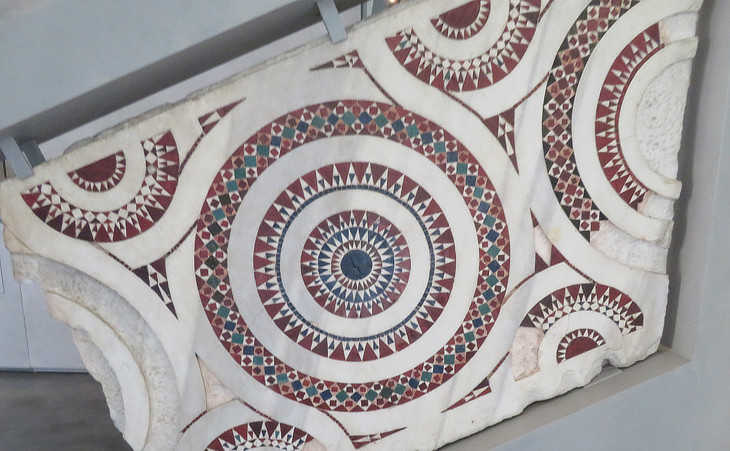
Museo dell'Opera del Duomo: decoration of the chancel of the Baptistery (first half of the XIIIth century) by a local workshop with Cosmatesque and Islamic features (see a similar decoration at S. Cataldo in Palermo)
Within, the pavement before the altar is in mosaic and opus Alexandrinum. Other parts of the pavement are formed by slab-tombs. (..) In the centre of the building is the octagonal font, about 14 ft . in diameter. At the alternate sides are 4 small conical basins, which are supposed to have been used when baptism by immersion was practised. The lower mouldings of the font, itself of white marble, are of brocatello. Murray
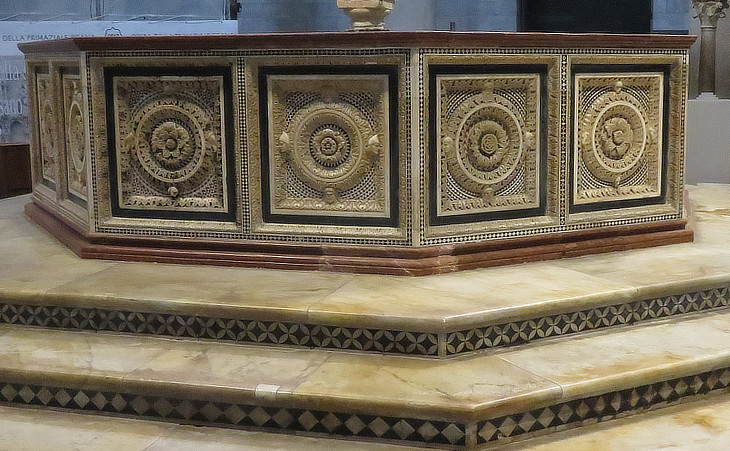
Baptismal Font; the image used as background for this page shows one of the rosettes
The inner elevation is still inferiour to the outside. Arches are perched on arches, and pedestals are stilted on the capitals of columns, as a base to a hideous tunnel which screens the fine swell of the cupola. Who could ever suppose that such a structure and such dimensions were intended for a christening! The purpose of an edifice should appear in the very architecture; but here we can discover it only in the accessories, the font, statues, relievos, all allusive to baptism. Forsyth
The ornamental rosettes are carved in the marble, and surrounded with mosaic-work. The altar and the enclosure around are decorated in the same style, with rosettes in relief. Murray

(left) Pulpit by Nicola Pisano; (right) its upper section
The famous pulpit in the baptistery at Pisa survives unaltered as a monument of Nicola's skill both in architecture and sculpture. It bears an inscription with the date 1260. Though designed in the Gothic style, it is frankly eclectic in execution. The Classic egg and dart ornament appears amid trefoiled arches and Gothic mouldings; and the sculptured panels, representing biblical scenes, are adapted from the reliefs on an antique sarcophagus in the Campo Santo. (..) A Juno-like Madonna sits like a Roman empress to receive the adoration of the wise men, and reclines like another Agrippina in the scene of the nativity, with little resemblance to her portraiture in the stiff Byzantine manner of preceding artists. The pulpit is hexagonal, probably a novel form, for the earlier pulpits, of which there are several examples at Pistoia, were rectangular.
Thomas Graham Jackson - Gothic architecture in France, England, and Italy - 1915
In 1311 Giovanni Pisano completed a similar pulpit in the Cathedral.
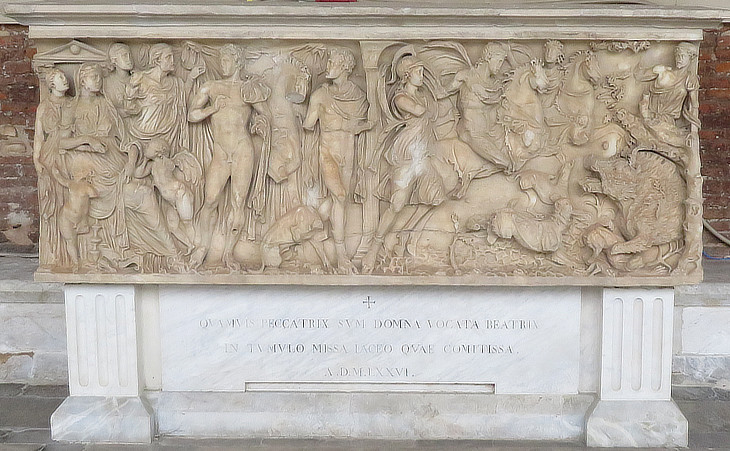
Camposanto: Countess Beatrice sarcophagus, actually depicting the myth of Phaedra and Hippolytus (see a similar one at Istanbul and some of the other sarcophagi at the Camposanto)
Although Niccola Pisano had widely established his fame as an architect during the first half of the thirteenth century, it was not until the year 1260 that he produced a work which at once placed him equally high as a sculptor. (..) He turned his thoughts and studies to sculpture, and found in the antique a sure guide to that improvement of style which he sought. Not only does the general character of his style bear out this belief, but the direct imitation in two of his pulpit reliefs from the bas-relief on the sarcophagus of the Countess Beatrice (mother of Countess Matilda of Tuscany), and of the bearded Bacchus on a Greek vase in the Campo Santo, furnishes positive proof of it. That his reproductions want the elegance and grace of the originals, here lost in a squareness and solidity of form and heaviness of drapery generally characteristic of Niccola's sculptures, merely proves his want of skill. Perkins
The panels are filled with reliefs based on ancient example which paved the way for the Renaissance of Donatello and Brunelleschi. Graham Jackson
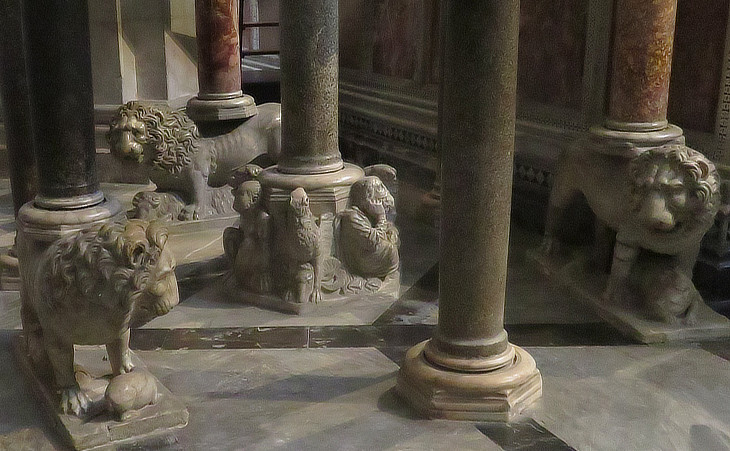
Pulpit: pedestals of the columns
The great ornament of this building is the pergamo, or the pulpit, by Nicolo Pisano. This work was so much prized that it was placed under the special guardianship of the law; and during the holy week the Podestà was sworn to send one of his officers, with a guard, to preserve it from injury. It is of an hexagonal form, resting upon 7 pillars, of various materials: five are of granite, each of different kinds - one of brocatello, and one of Pisan marble. These columns stand alternately on the ground and upon crouching lions, and the central pillar upon crouching human figures, griffins, and lions. Murray
Of the six supporting columns, the alternate three rest on the backs of lions in the traditional manner; the centre is supported by another column with a group of a griffin, a lion, and a dog alternating with three human figures round its pedestal. The pulpit abacus has the classic ovolo moulding. The section of the bases of the various parts is very refined. All the mouldings throughout are exquisitely delicate. Graham Jackson
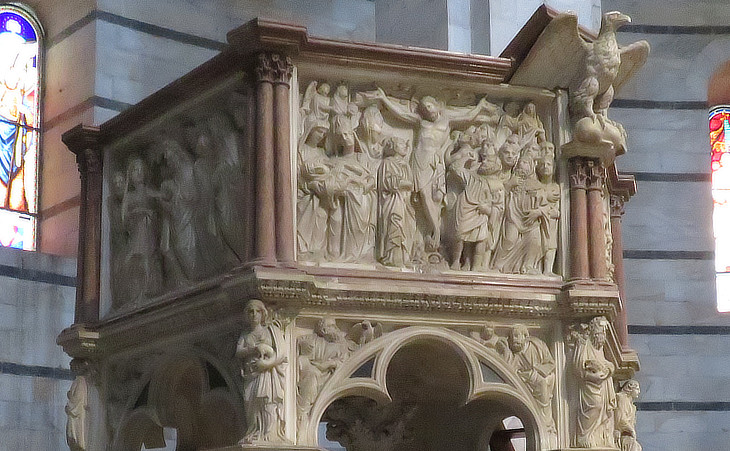
Detail of the pulpit: Crucifixion
The form of pulpit general throughout Italy up to this time was that of a sarcophagus, supported upon four columns, and sculptured with reliefs on three sides.
Niccola's Pisan pulpit in the Baptistery is of quite a different type, and far more ornate and elegant, is hexagonal, by which he gained more space for sculptural decoration. It has many supporting columns, spanned by round arches, which are filled in with Gothic tracery, and with a multitude of statuettes, placed above the Corinthian and Byzantine capitals, and in the spandrils of the arches.
Its columns are supported upon the backs of lions, the emblems of sacerdotal vigilance, and symbols of Jesus Christ and His Resurrection. The five bas-reliefs upon it represent the Birth of Christ, the Adoration of the Magi, the Circumcision, the Crucifixion and the Last Judgment. The first of these follows the Byzantine type in composition, but differs from it utterly in that its long meagre figures and stiff folds are replaced by short round-limbed forms, draped in broad flowing robes. Perkins
The arches are circular, but in each is a Gothic trefoil; figures are placed in the spandrils of the arches and the mouldings are, with slight variations, taken from Roman architecture. The bas-reliefs are (..) a very extraordinary production. Underneath are the lines recording the date and the name of the artist. The sixth side is occupied by the doorway. There are two marble desks; one for reading the Gospel, another lower down for the Epistle. The first, projecting from the side of the pulpit, is in the shape of a book, and supported by an eagle. Murray
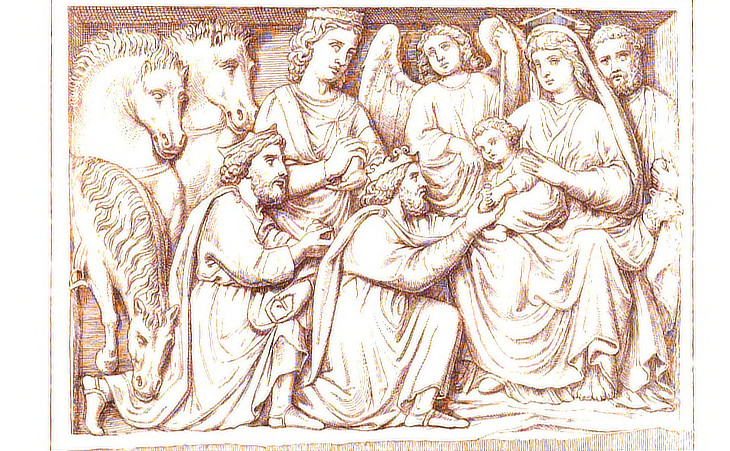
The Adoration of the Magi, an illustration of Perkins' book
In the Adoration which is decidedly the best and most original of the series, sits a dignified Madonna (suggested by the Phaedra of the sarcophagus) holding the Divine Child upon her knees, who graciously leans forward to receive the costly mjrrh, typical of His burial, from Caspar, King of the Ethiopians; the incense, symbolic of God, and of the priest after the order of Melchisedec, from Balthazar King of Saba; and the little golden apple, in token of allegiance to the King of the earth, from Melchior, King of the Arabians. Behind the Madonna stands St. Joseph; next to him an angel, and still further to the left the three fiery-looking steeds of the three kings. In the Circumcision relief, the Bacchus with Ampelus of the already mentioned Greek vase is almost exactly reproduced in an imposing amply draped figure, who assists at the holy rite. The two other compositions, representing the Crucifixion and the Last Judgment, were more effectively treated by Niccola in the pulpit which he afterwards made for the Duomo at Siena. Perkins
Move to
The Ancient Town
Piazza dei Miracoli and the Leaning Tower
The Camposanto
The Cathedral
The Knights of St. Stephen
The Walls and the Lungarni
A Walk along the northern Terzieri
A Walk along the southern Terziere
Churches of Terziere S. Maria
Churches of Terziere S. Francesco
S. Maria della Spina
S. Matteo and its Museum
S. Piero a Grado
An Excursion to Vicopisano