All images © by Roberto Piperno, owner of the domain. Write to romapip@quipo.it.


Notes:
Page added in January 2026.
All images © by Roberto Piperno, owner of the domain. Write to romapip@quipo.it.
Notes:
Page added in January 2026.
 The Walls and the Lungarni
You may wish to see pages on the monuments of Piazza dei Miracoli and Piazza dei Cavalieri first.
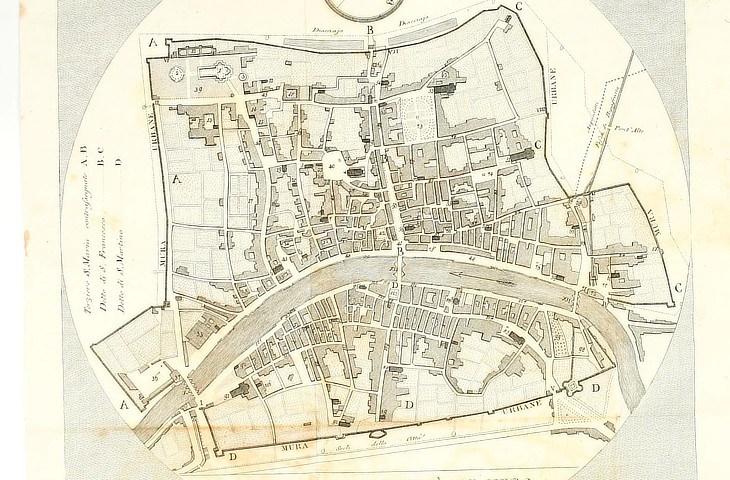
1831 Map of Pisa from "Descrizione Storica e Artistica di Pisa e de suoi Contorni
by Ranieri Grassi - 1836". It shows the division of the town into three districts (terzieri): Terziere di S. Martino, south of the River; Terziere di S. Maria (the Cathedral) from the western walls (A in the map) to Via di Borgo, a straight street (B) which crosses the northern part of the town and Terziere di S. Francesco from Via di Borgo to the eastern walls (C)
Pisa has not extended beyond its ancient boundaries. The old wall which surrounds the city remains nearly in the same state as when defended by her citizens against the forces of Florence. The Piazza del Duomo is partly bordered by this wall, of which the circuit includes much garden-ground; and the destruction of many convents has increased the void. These outskirts have therefore a desolate appearance.
John Murray - Handbook for travellers in Central Italy - 1861
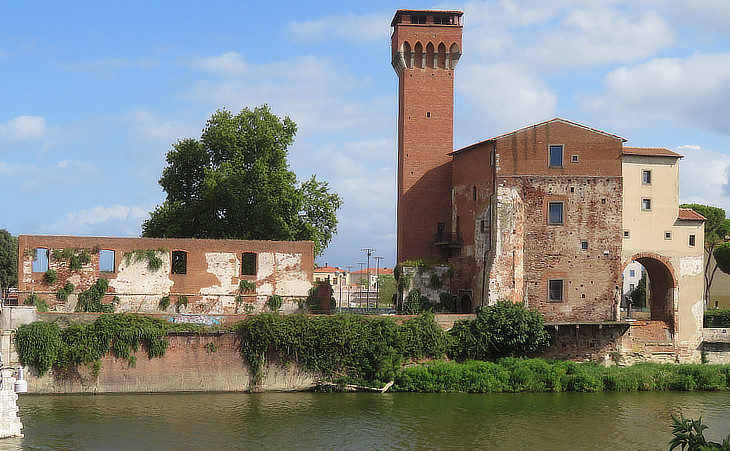
The Lung'arno is closed on the W. by the Torre Guelfa, which forms a beautiful termination of the view, especially in the evening sun. It is now used as a prison, and is generally called the Torre dei Sforzati. It was intended for the defence of the Ponte a Mare, the bridge close to it, and it is also a part of the arsenal, in which some other vestiges of the buildings of the age of the Republic may also be seen. Murray
During WWII Pisa suffered severe damage on August 31, 1943 when it was bombed by the Allies especially in its southern part and near the Citadel because of their proximity to the railway, and in August 1944 when the withdrawing German Army destroyed all its bridges and some of the buildings next to them. The tower of the Citadel and other historical buildings were subsequently restored, but the modern bridges have a characterless aspect.
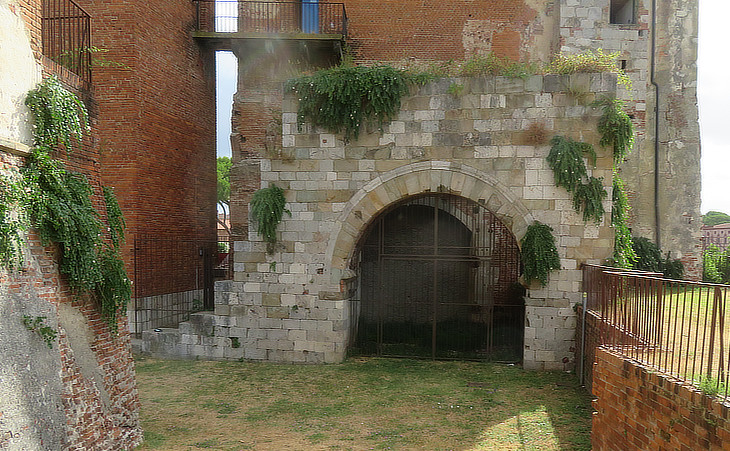
Ancient Porta Degazia or Legazia or "a Mare" inside the Citadel; it was the gate where the merchandise of the Pisan ships was unloaded; Degazia is perhaps an old term for Dogana (Customs-house); some chronicles refer to it as Legazia, an ecclesiastical title (Legatus) of the Archbishops of Pisa because of their jurisdiction over parts of Sardinia
Pisa, a Ghibelline city, reached the peak of its wealth and power in the XIIth century when it enjoyed the support of the German emperors in its long conflicts with Genoa at sea and with its Tuscan rivals, Lucca and Florence, on land. The city's participation in the Crusades secured valuable commercial positions for Pisan traders in Syria, and Pisa grew in strength to rival Genoa and Venice. They had colonies in Laodicea, Antioch, Tripoli, Tyre, Acre, Jaffa, and probably also in Jerusalem and Caesarea. Neither was it in the East alone that the Pisans possessed colonies. They seem to have enjoyed a larger share of the trade of Morocco than any other Italian state and possibly than all the other Italian states together.
From "William Heywood - A history of Pisa, eleventh and twelfth centuries - 1921"
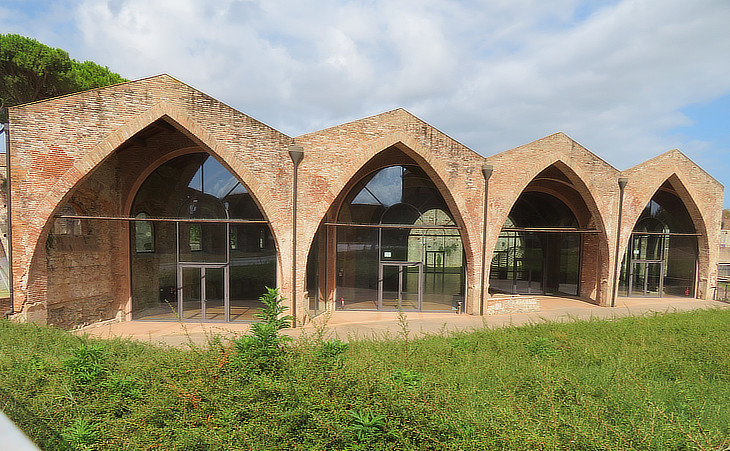
Republican Arsenal near the Citadel (you may wish to see the Arsenal of the Knights of St. Stephen)
While Pisa was about to achieve the control over the whole of Sardinia the Florentines were not idle, and no sooner had they consolidated their authority over their contado than they initiated a policy of peaceful penetration which was hardly less dangerous than open hostilities. By the tireless energy of their merchants, they conquered the markets of Volterra, Colle, S. Gimignano, Pistoia, Prato and S. Miniato; the coinage of Pisa was gradually superseded by the coinage of Florence; judicious loans of money afforded specious pretexts for subsequent interventions, and a vast net was woven in the fine meshes of which the other nations of Tuscany were insidiously trammelled. In 1220 Frederick II was crowned in Rome and the following year saw the Ghibellines of Tuscany drawing together. Pisa definitely broke with Florence, and all the Florentine merchandise in the city were confiscated. The Ghibelline confederation was a formidable one; but Florence was already too powerful for them all. In July 1222, the Pisans were broken before they could join forces with their allies; and from thenceforward the animosity between the rival cities increased with every decade. Pisa no longer fought for supremacy but for existence. The hegemony of Tuscany had passed from her, and the hegemony of the Tyrrhenian Sea was passing with it. The struggle with Florence and Genoa culminated in Pisa's defeat by the Genoese fleet in August 1284 at the decisive Battle of Meloria, a rocky islet opposite Leghorn. Two Genoese squadrons crushingly defeated a numerically superior Pisan fleet under Albertino Morosini (of a Venetian noble family), Ugolino della Gherardesca, and Andreotto Saraceno. After this Pisa never recovered its naval power. From Heywood's book
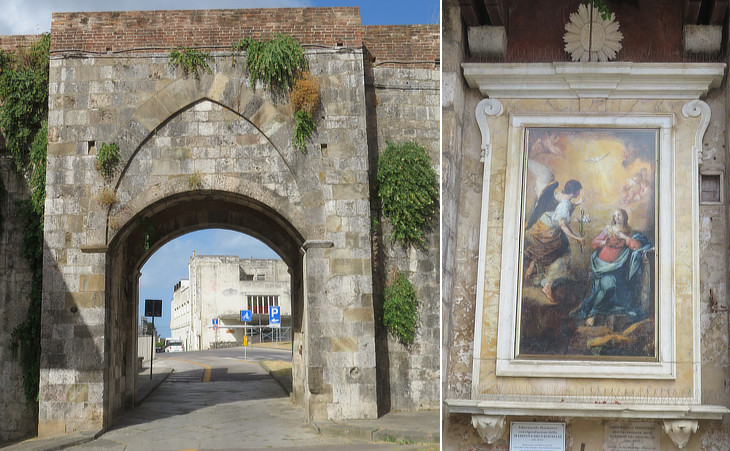
(left) Porta a Mare or Degazia or Legazia (XIVth century) on the opposite side of the river near S. Paolo a Ripa; (right) XVIIIth century Altare dei Navicellari, the guild of the seamen who navigated along the canal between Pisa and Leghorn
Even after the battle of Meloria, when so many of their noblest and bravest had been carried into captivity that it became a common saying that "to see Pisa you must go to Genoa," they were still unconquered and unconquerable. In vain the other Tuscan nations gathered, yapping and snarling, like curs about a wounded lion, thinking to feast themselves upon the carcase. Under the wise leadership of Guido da Montefeltro, the Pisans recovered much of their military prestige. Her great days were not yet done. The coming of Henri VII, in 1312, re-kindled all their old Imperial enthusiasm; and, captained by Uguccione della Faggiuola, they broke the Florentines and their Guelf allies in the bloody battle of Montecatini (August, 1315). Large quantities of merchandise continued to pass through the city until the 15th century, when silting made the movement of laden galleys up the Arno River almost impossible. Pisa was still warlike but she was no longer free. In 1328 she was compelled to submit to Castruccio Castracane, Lord of Lucca, and, after his death, was misruled by a succession of petty tyrants, until, in 1399, she was ignominiously sold to the Visconti of Milan. Through all the last half of the fourteenth century, her eventual ruin became yearly more inevitable. Internal factional struggles helped to bring about the occupation of Pisa by the Florentines in 1406. From Heywood's book
In 1362 Florence and Genoa waged war on Pisa. The Florentines occupied the Pisan countryside and the Genoese entered its port and removed the chain which protected it and sent a section to Florence (the chain is now in the Camposanto).
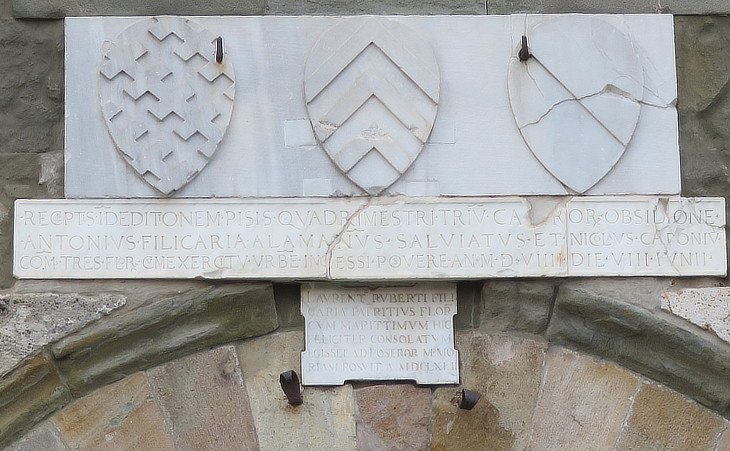
Palazzo Gambacorti: inscription celebrating the surrender of Pisa in June 1509 with the coats of arms of Alamanno Salviati, Antonio da Filicaja and Niccolò Capponi, the commanders of the Florentine armies
He who becomes master of a city accustomed to freedom and does not destroy it, may expect to be destroyed by it, for in rebellion it has always the watchword of liberty and its ancient privileges as a rallying point, which neither time nor benefits will ever cause it to forget. And whatever you may do or provide against, they never forget that name or their privileges unless they are disunited or dispersed, but at every chance they immediately rally to them, as Pisa did after the one hundred years she had been held in bondage by the Florentines.
Niccolò Machiavelli - The Prince - Translation by William K. Marriott - 1909
When Pisa was brought in subjection to Florence, many of the chiefe Citizens chose rather to live at Venice, and other places, in perpetual banishment with their posterity, then to be subject to the Florentines.
Fynes Moryson - An Itinerary: Containing His Ten Years Travel Through .. Italy (in 1594)
When French armies invaded Italy in 1494, Pisa temporarily reasserted its independence; the city withstood three sieges and repulsed three attacking armies. In June 1509 a delegation of eight noblemen of Pisa went to Florence and negotiated the surrender of the city; three days later the agreement terms were ratified by a popular assembly. They were relatively favourable, but a number of noblemen and wealthy merchants chose to leave Pisa and its population began to decline.
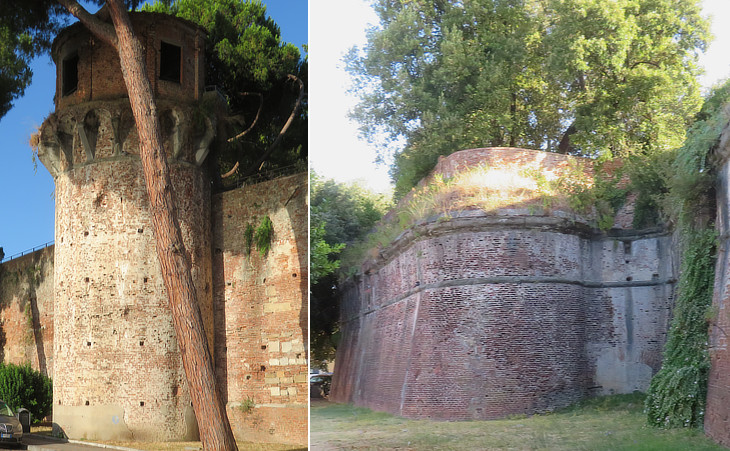
(left) South-eastern walls; (right) Bastione Sangallo
On the South side of the City a strong Fort lies neere the wall, and there is the third gate of the City. Moryson
Pisa is defended by a good wall, a citadel, and other fortifications.
Thomas Nugent - The Grand Tour - 1749
After the surrender of Pisa, the Florentines entrusted Giuliano da Sangallo and his brother Antonio da Sangallo the Elder, both military architects, to redesign the south-eastern side of the walls to upgrade it to the requirements of cannon warfare. You may wish to see the Fortress of Nettuno which Antonio designed for Pope Alexander VI, an early example of the features of this new kind of fortress.
The Medici built a series of granaries near the fortifications; the image used as background for this page shows a detail of one of the coats of arms which decorated them (at Piazza Toniolo).
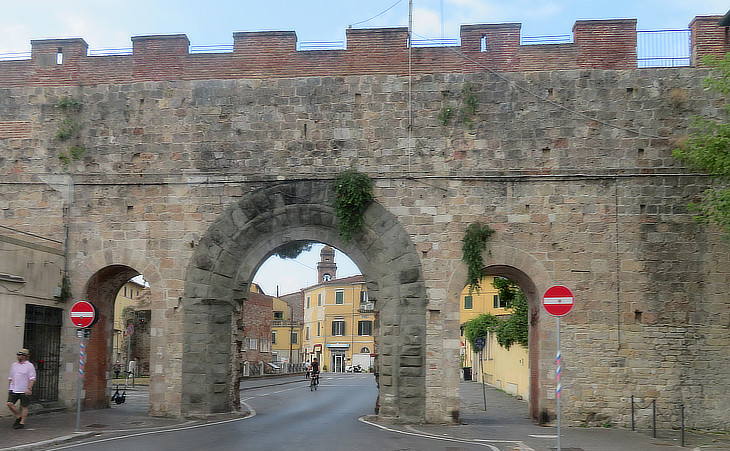
Porta a Lucca, at the end of Via di Borgo in the northern walls and beyond it "Bagni di Nerone"
This gate was opened in the XVIth century to replace a previous one (Porta del Parlascio) which was included into a bastion designed by Nanni Unghero, a pupil of Antonio da Sangallo the Younger. The outworks which protected Porta a Lucca were turned into icehouses in the XVIIIth century and were demolished in the XIXth century when two additional passages were opened at the sides of the gate.
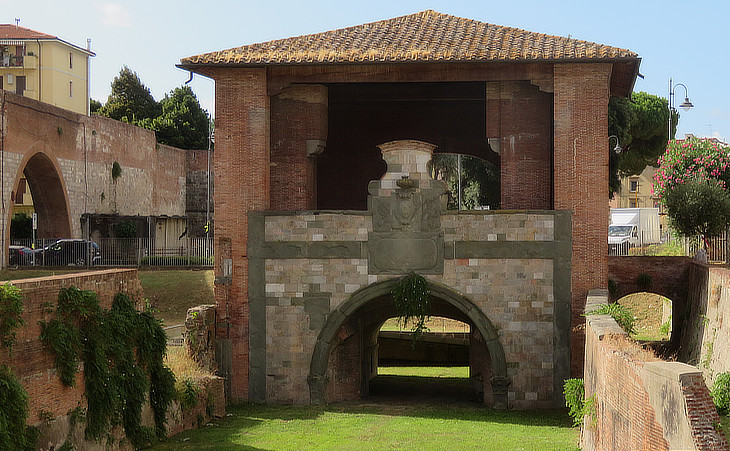
Sostegno (Support) del Canale dei Navicelli (XVIIIth century), near the second Porta a Mare, a sort of lock between the river and the channel connecting Pisa to Leghorn
I went 3 miles through fenny ground, often overflowed with the River Arno, and came to Pisa. Arno is a little River falling from the Apenine Mountaines neere Florence, through which City it runs, and so passeth through a most pleasant and fruitful Plaine to Pisa, through which Citie it also runs; and by reason of the narrow bed, and the neere Mountaine of Pisa, is subject to overflow upon any great raine, so as with great hurt it drowneth the fields of Pisa, and those that lie from thence to the Sea. Neere the first bridge is another gate of the City, leading towards the sea, and neere the same, is the most sweete walke, that ever I beheld. It hath in bredth some five rowes of trees, on each side, and a like distance of greene grasse betweene those trees, but it reacheth in length many miles; and out of the River Arno are drawne two ditches, which runne all the length of it, one upon each side: so as the Citizens in summer time, use to take boat in Arno, at their doores, with a basket of victuals; and so many Families of them, passing by the ditches on both sides the walke, sit downe a good distance the one from the other, and there sup and converse with great pleasure. Moryson
The Navicelli Channel was built between 1563 and 1575 to connect Pisa with the port of Leghorn. The name originates from the small sized Tuscan boats that transported goods. The "Sostegno" was equipped with pulleys to move the boats between the channel and the river.
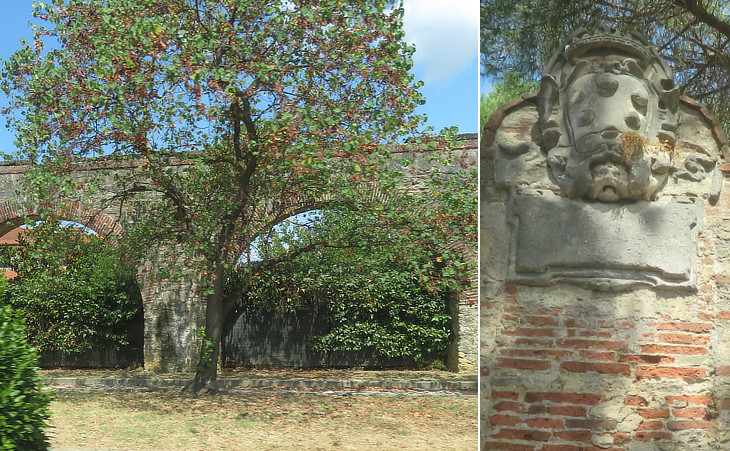
Aqueduct: (left) some of its remaining arches; (right) early XVIIth century Medici coat of arms
The most remarkable things we took notice of in this City were: (..) 7. The Aqueduct of above 5000 arches, begun by Cosmus and finished by Ferdinand I Great Dukes of Tuscany, bringing water to the City from the mountains about 5 miles distant. This water is so good that it is carried in flasks as far as Ligorn to sell.
John Ray - Observations topographical, moral, and physiological: published in 1673.
The water of the Arno is not considered salubrious, and that of the wells and springs near the town is hardly drinkable; and the frequent epidemic diseases which prevailed in Pisa in the middle ages, and its then general insalubrity, have been, and with much probability, ascribed to the bad quality of the water. The inconvenience was however remedied in 1613. A watercourse was then formed from the Valle di Asciano; at first by underground channels, and afterwards by an aqueduct of more than 1000 arches, and upwards of 4 m. in length. Murray
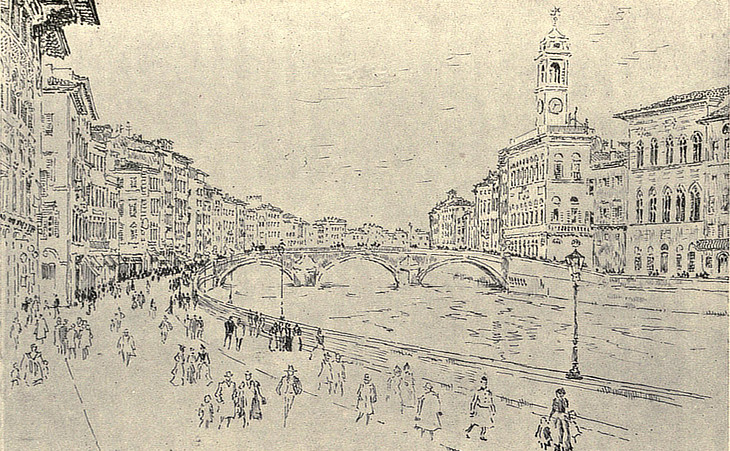
The Lungarno and Ponte di Mezzo, illustration from "Dean Howells - Italian Journeys - 1867"
October 1644. The river Arno runs through the middle of this stately city, whence the main street is named Lung' Arno.
John Evelyn - Diary and Correspondence related to his stay in Italy in 1644
The river Arno, which is of a good breadth here, divides it into two almost equal parts, which communicate by three handsome bridges, one of them of marble. The sides of the river, lined with a sloping wall, form a commodious quay, where ships of burden formerly unloaded their merchandize; but the mouth of the river being now choaked up, it is navigable only for smaller vessels. Nugent
The beautiful old town, which every one knows from the report of travelers, one yet finds possessed of the incommunicable charm which keeps it forever novel to the visitor. Lying upon either side of the broad Arno, it mirrors in the flood architecture almost as fair and noble as that glassed in the Canalazzo, and its other streets seemed as tranquil as the canals of Venice. Howells
I found the simple large pacified felicity of such an afternoon aspect as that of the Lung' Arno, taken up or down its course. (..) The Pisan Lung' Arno is shorter and less featured and framed than the Florentine, but it has the fine accent of a marked curve and is quite as bravely Tuscan; witness the type of river-fronting palace which, in half-a-dozen massive specimens, the last word of the anciently "handsome," are of the essence of the physiognomy of the place. In the glow of which retrospective admission I ask myself how I came, under my first flush, to fail of justice to so much proud domestic architecture.
Henry James - Italian Hours - 1909
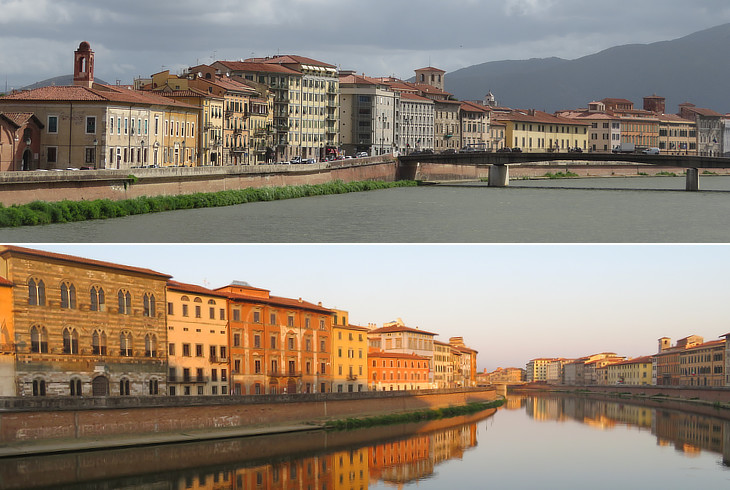
Lungarno: (above) northern side from the west; (below) southern side from the east
Pisa covers an enclosure of near seven miles in circumference; the river intersects and divides it into two parts nearly equal; the quays on both sides are wide, lined with edifices in general stately and handsome, and united by three bridges, one of which (that in the middle) is of marble. As the stream bends a little in its course, it gives a slight curve to the streets that border it, and adds so much to the effect and beauty of the perspective, that some travellers prefer the Lungarno (for so the quays are called) of Pisa to that at Florence.
John Chetwood Eustace - Classical Tour of Italy in 1802 (publ. 1813)
The central part of Pisa has hardly the deserted character which has been attributed to the city; and the Lung'arni, continuous quays on both sides of the river, are cheerful. On the Festival of San Ranieri the banks of the Arno present a remarkable sight. That feast is celebrated triennially on the 16th and 17th of June, and attracts vast crowds. The last took place in 1854. On the vigil of the saint (16th) the celebrated Luminara, or illumination, takes place - the most striking spectacle of Pisa. The whole of the Lung' Arno and the banks of the river are illuminated with thousands of lamps during nearly the whole night (see the fireworks in Rome). On the festival (17th) a splendid service in honour of the saint takes place in the Duomo, followed by the exposition of his relics, and in the afternoon there are boat-races on the Arno. Murray
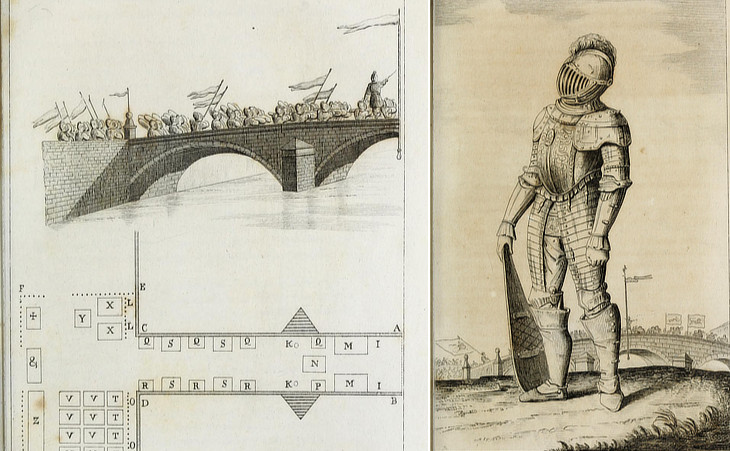
Gioco del Ponte, illustrations from Grassi's book
Three bridges cross the Arno. That highest up the river, with 4 arches, is called the Ponte alla Fortezza, from the Citta Nuova, which was built by the Florentines. (..) The central bridge, with 3 arches, called the Ponte di Mezzo, or Ponte Vecchio, from its being the earliest of bridge, was erected in its present form in the reign of Ferdinand II. It was preceded by a bridge with a single arch, which fell 1st January, 1644, on the centering being removed. It was upon the Ponte del Mezzo that the celebrated combat, called the Mazzascudo, used to take place, which could hardly be called a sham fight, since it often ended in loss of life or limb. The contest took place between the North and the South sides of the city, 6 companies of 80 on each side. The last fight took place in 1807, and it seems likely that it never will be repeated. The bridge most to the W. with 5 arches, is the Ponte a Mare, built in 1331, and restored a century later by Brunelleschi. Murray
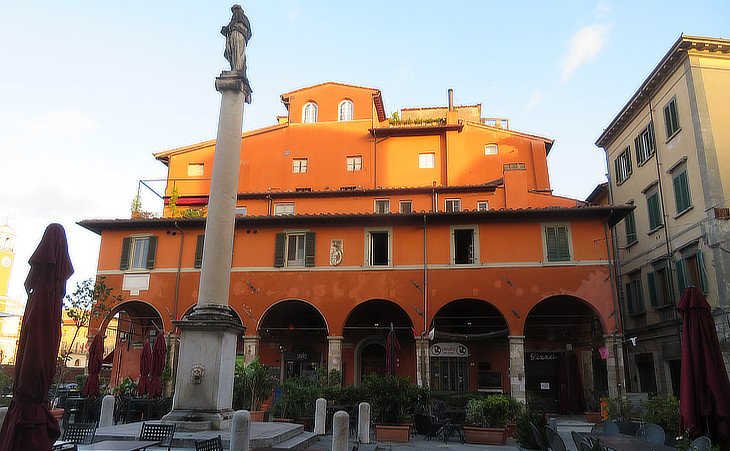
Piazza Cairoli, once Piazza dei Cavoli (Cabbage), western side (the river is to its left)
The harbour of Pisa was at its western end, but the town was supplied with vegetables, fruit, wine and cheese which came from its eastern contado (countryside) and to this purpose Grand Duke Cosimo I promoted the construction of a landing site and of a market on the northern side of the Lungarno, east of Ponte di Mezzo. The market was embellished in 1550 by a statue of Dovizia (Abundance) by Pierino da Vinci, a nephew of Leonardo, which was placed on a tall marble column (a similar column existed in Florence). Rome, too, had a river harbour (Porto di Ripetta) for receiving vegetables and fruit from the Tiber valley.
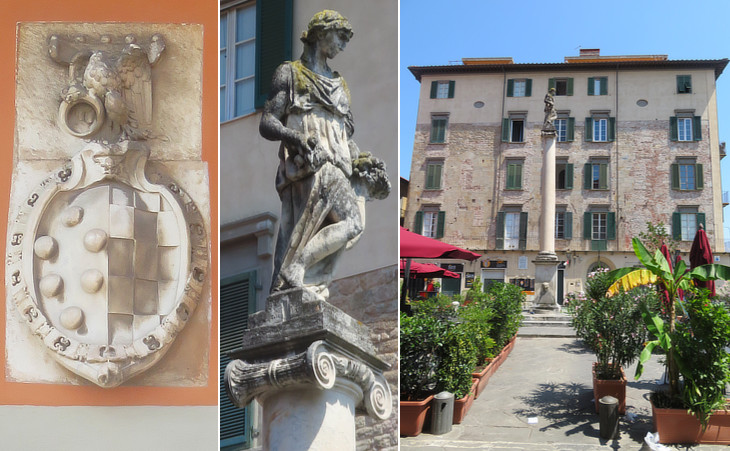
Piazza Cairoli: (left) coats of arms of Cosimo I de' Medici and his wife Eleanor of Toledo (daughter of Pedro Alvarez de Toledo, viceroy of Naples) inside the Collar of the Golden Fleece; (centre) statue of Dovizia; (right) modernized XIIth century building at the eastern side of the square
The market was reserved to vegetables and fruit, because a larger market, Mercato delle Vettovaglie (Provisions), was located in Terziere S. Maria, the most populous one. The plan drawn by Giovan Battista Cervelliera, the architect in charge of the Cathedral, foresaw three identical buildings with a porch, but only one of them was completed. Those on the other two sides are tall medieval houses which were adapted to the needs of the new market.
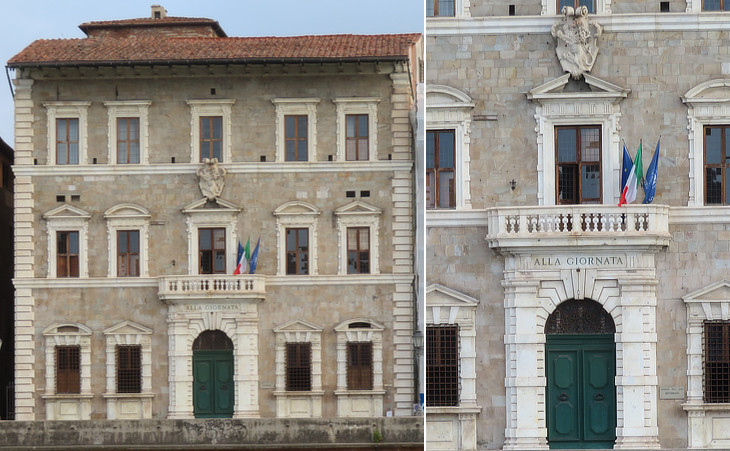
Palazzo Lanfreducci alla Giornata (northern side of the Lungarno)
Many interesting buildings yet adorn the Lung'arno. Near both ends of the Ponte di Mezzo are groups of imposing edifices. The links of a chain hanging over the arch of the principal doorway, with the motto Alla Giornata, sculptured in large letters on the architrave, distinguish the Palazzo Lanfreducci, now Uppezzinghi. All that is known respecting the chain is that the church of San Biagio alla Catena, of which the Lanfreduccis were the patrons, was demolished to make room for the palace. The meaning of the inscription has been lost. The design of this fine palace is by Cosimo Pogliani, erroneously attributed to Michael Angelo. There is a small collection of paintings in it; amongst them a good Guido - Human Love subdued by Love Divine. Murray
Vivere alla giornata is an Italian saying for to take one day at the time, but the motto is more likely to mean "on the battlefield" or "in the hour of reckoning".
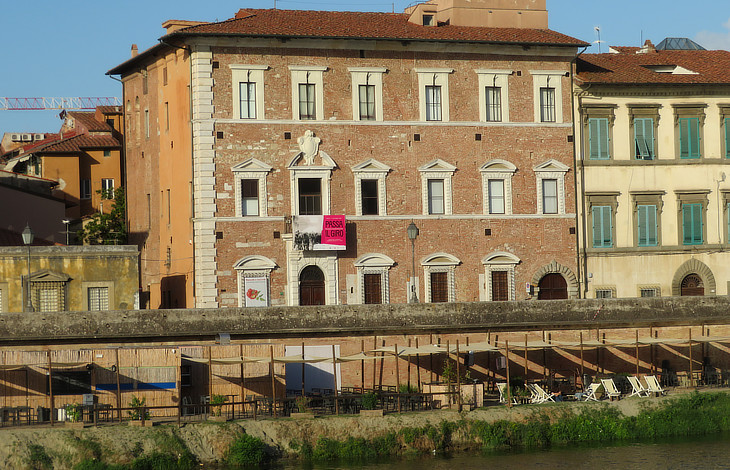
Palazzo Lanfranchi (southern side)
The Palazzo Lanfranchi, now Toscanelli, on the Lung'arno, above the Ponte di Mezzo, is perhaps more certainly by Michael Angelo; the mellowed tint of the marble adds much to the effect of the architecture. It was for some time the residence of Lord Byron in 1822. Murray
I paid my compliments, in a wistful, wondering way, to the fine Palazzo Lanfranchi, occupied in 1822 by the migratory Byron, and whither Leigh Hunt, as commemorated in the latter's Autobiography, came out to join him in an odd journalistic scheme. James
The Lanfranchi were a major family of medieval Pisa. Dagoberto Lanfranchi was the first archbishop of Pisa in 1092. Their palace on the Lungarno was designed in 1539 by uniting four medieval buildings. Today it houses Museo della Grafica with an important collection of contemporary graphics.
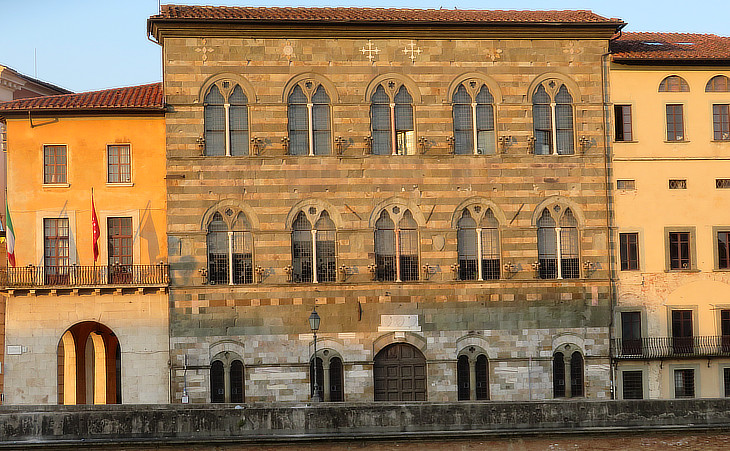
Palazzo Gambacorta or Gambacorti (southern side - see its rear, XVIIth century entrance)
The ancient palace of the Gambacorti family is now the Custom-house. Murray
The Gambacorti acquired importance in the XIVth century when they headed a faction which sought an alliance with Florence. For this reason they were twice exiled. Their palace on the Lungarno was built between 1370-1392. When Florence conquered Pisa they were rewarded with the lordship of Bagno, a town in Romagna, which belonged to Florence. A branch of the family moved to the Kingdom of Naples.
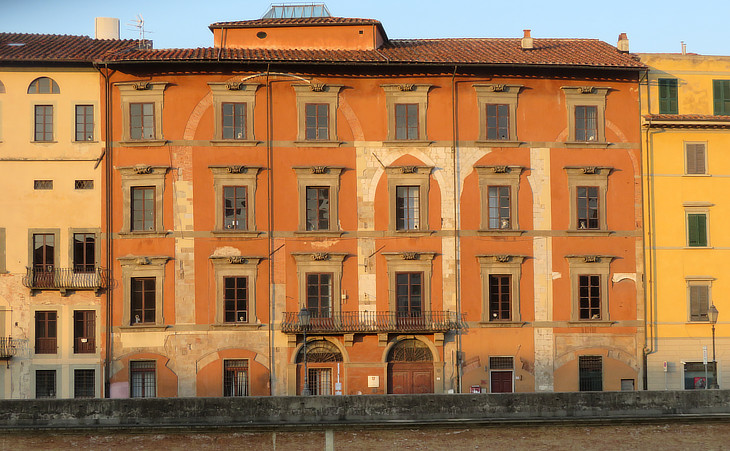
Palazzo Mosca near Palazzo Gambacorta
The building known as Palazzo Mosca testifies to the size of the population of Pisa in its heydays. Tall tower houses were built in many parts of the town to provide accommodation to its many citizens (see those near Borgo Stretto). Palazzo Mosca is a combination of several of these towers. The oldest one dates from the end of the XIIth century and it is coupled at the top by a pointed arch. Tower houses attached one to another were a development of the XIIIth century. In 1302 Mosca di Ventura, merchant and banker, moved from S. Gimignano to Pisa and commissioned Master Gerardo da Firenze the design of a residence which included warehouses and offices by uniting a group of tower houses; the details of their agreement are carefully outlined in an act that has reached us. Mosca's descendants increased the property so that in ca 1600 the palace achieved its present size and appearance.
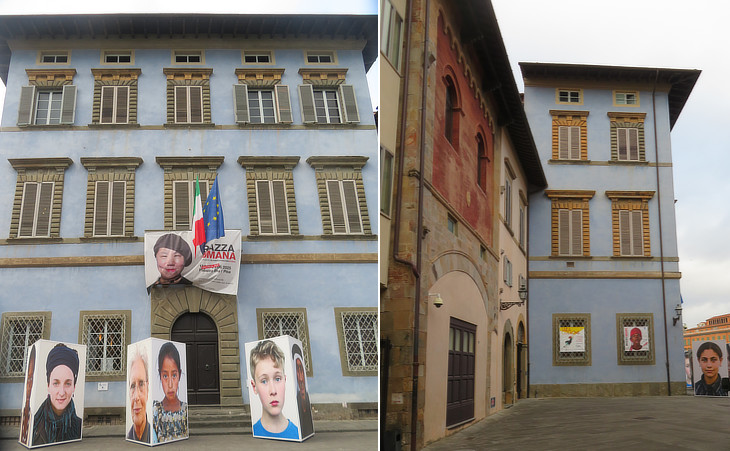
Palazzo Blu (Palazzo Giuli Rosselmini Gualandi) and a medieval house in nearby Via Toselli (southern side)
The Gualandi were a very important family of medieval Pisa. They are mentioned by Dante with the Sismondi and the Lanfranchi among the families who helped the Archbishop of Pisa in making prisoner Count Ugolino della Gherardesca and Torre della Fame where the Count died with his sons belonged to them. The palace on the Lungarno however was acquired by a branch of the Gualandi only in the second half of the XIXth century and its current aspect is mainly due to an enlargement and redesign which occurred in that period. In origin, similar to Palazzo Mosca, it was a combination of medieval buildings. In 2001 it was bought by Pisa Foundation, which has turned it into a painting gallery and a space for temporary exhibition.
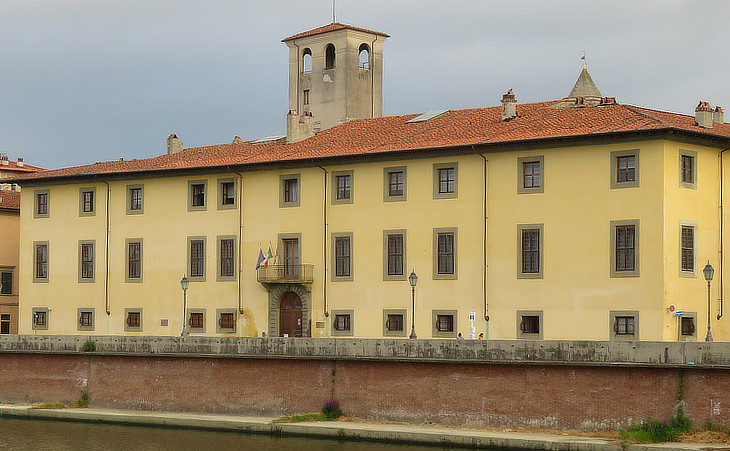
Palazzo Reale or Granducale and Torre de Cantone behind it (northern side)
In the midst of the City upon the banke of Arno, is the Pallace of the Duke of Florence, and there is a statua erected to Ferdinando the Duke then living, who much favoured this City, in which he was borne. Moryson
The Duke has a stately Palace. Evelyn
The long building was designed by Bernardo Buontalenti, a Florentine architect, in 1583. It incorporated already existing medieval buildings, including a tall tower from which a covered passage connected the palace to the church of S. Nicola. The Grand Dukes usually spent part of the winter at Pisa which enjoys a climate milder than that of Florence. The palace was heavily damaged by WWII bombings. Today it houses a museum with collections illustrating the patronage of the Medici and of the Habsburg-Lorena who left
copious evidences of their stay, such as
tapestries and garments, wooden furniture,
court portraits, paintings and sculptures.
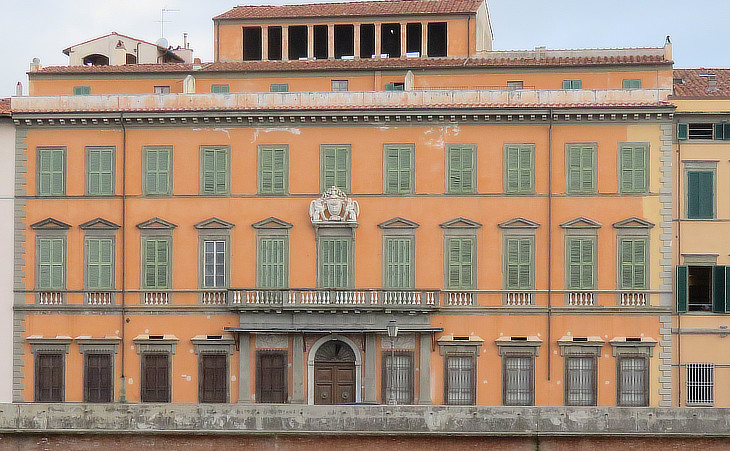
Palazzo Prini-Aulla (redesigned in the early XIXth century) near Palazzo Lanfreducci (northern side)
But full of interest as the mediaeval history of Pisa may be, for Anglo-Saxon men and women there is a closer link uniting Pisa to England, a link which made her, in the early years of the nineteenth century, peculiarly attractive to our wandering countrymen. At that time Percy Bysshe Shelley with his wife and son left Florence to reside in Pisa, for the Florentine climate, owing to the keen winds which prevail there during winter and spring, had proved most unfavourable to the poet's delicate health. On the 29th of October 1820 he writes to Miss Clairemont from Pisa: "We have now removed to a lodging on the Lung'Arno, which is sufficiently commodious, and for which we pay thirteen sequins a month. It is next door to that marble palace, and is called "Palazzo Galetti," consisting of an excellent mezzanino and of two rooms on the fourth floor, and all to the south, and with two fireplaces." The marble palace referred to in this letter is supposed to be the Palazzo Lanfreducci, Lung'Arno, easily distinguished by the mysterious inscription over the door, "Alla Giornata". Here, surrounded by a small circle of friends, among whom were the Williamses, and later Trelawney and Byron, the Shelleys lived.
Colonel R. C. Goff and Clarissa Catherine De Hochepied - Florence & some Tuscan cities - 1905
Move to
The Ancient Town
Piazza dei Miracoli
The Baptistery
The Camposanto
The Cathedral
The Knights of Pisa
A Walk along the northern Terzieri
A Walk along the southern Terziere
Churches of Terziere S. Maria
Churches of Terziere S. Francesco
S. Maria della Spina
S. Matteo and its Museum
S. Piero a Grado
An Excursion to Vicopisano