All images © by Roberto Piperno, owner of the domain. Write to romapip@quipo.it.


Notes:
Page added in February 2026.
All images © by Roberto Piperno, owner of the domain. Write to romapip@quipo.it.
Notes:
Page added in February 2026.
 Churches of Terziere di Santa Maria
You may wish to see a page on the Northern Terzieri and a map of 1831 Pisa first. The Cathedral (S. Maria) and S. Stefano are covered in other pages.
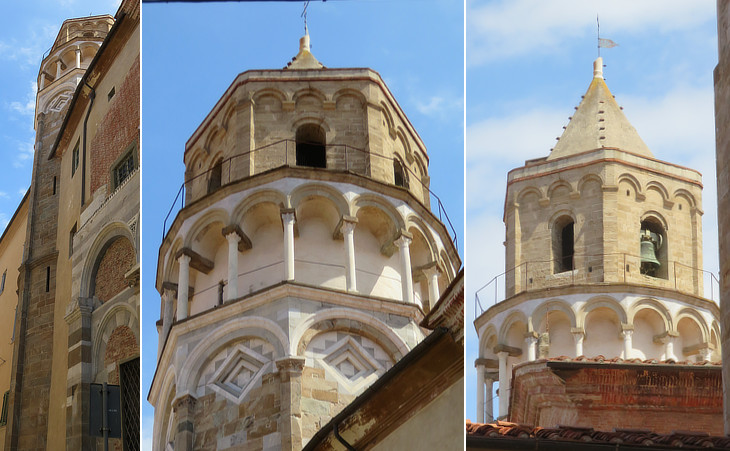
S. Nicola: views of its bell tower
San Nicola, founded about 1000, by Hugh Marquis of Tuscany, being one of the seven Benedictine abbeys which he endowed. The campanile, built by Nicolo Pisano, is curious and beautiful; it leans a little towards the N. The exterior is a solid panelled octagon for two stories; the third is an open loggia, and surmounted by a pyramid. The interior, which presents a winding staircase supported by marble columns and arches, exhibits singular skill and contrivance. This staircase is important in the history of art, for, according to Vasari, it afforded the pattern for that of the Belvedere at the Vatican by Bramante.
John Murray - Handbook for travellers in Central Italy - 1861
The bell tower, very similar to the Leaning one, is a jewel of Romanesque architecture. The work is attributed to master Diotisalvi and therefore it is presumably coeval with the Baptistery of Pisa. Diotisalvi designed also Santo Sepolcro in Terziere S. Martino.
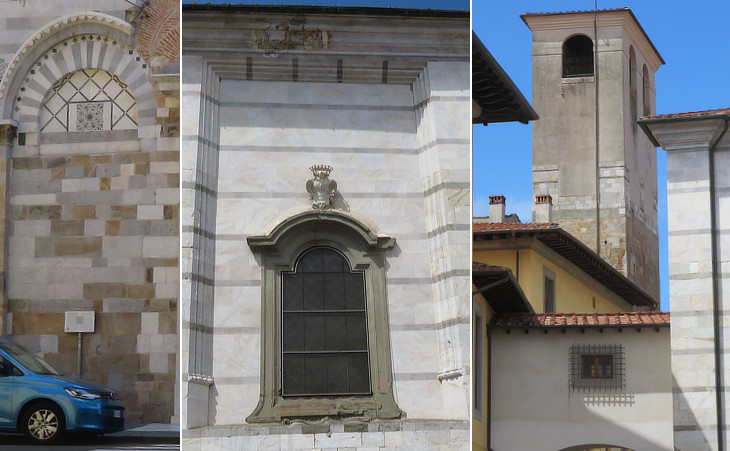
S. Nicola: (left) detail of the façade; (centre) rear side of the church; (right) Torre de Cantone, one of the tallest tower houses of Pisa
This ch. is connected with the palace of the Grand Duke by an archway; it was the chapel of the Court during its residence at Pisa. It has been repeatedly altered and reconstructed. Murray
The construction of the church is prior to 1097. However, of the medieval building only the bell tower and part of the façade remain today, since in 1572, perhaps following a fire, it was redesigned with eight chapels and a great vault. Other restorations were carried out by the Grand Dukes because the church was an integral part of their palace. Despite the damage suffered during WWII, the façade still shows features of the Pisan Romanesque style.
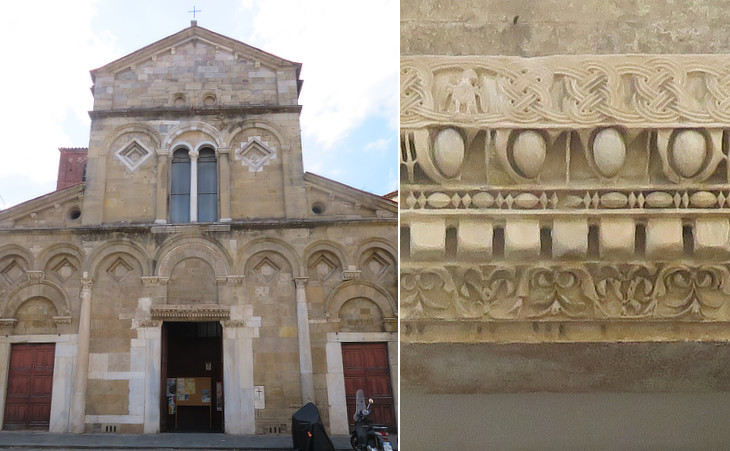
San Frediano: (left) façade; (right) detail of the portal
San Frediano was founded by the family of Buzzaccherini Sismondi in 1077, and of which a portion is probably unaltered. The front has some curious fragments of an early date; a Romanesque frieze with what we should call Runic knots. Murray
The façade might have been designed by Busketus, the architect of the Cathedral, but the use of marble from ancient buildings was very limited. The decorated lintel is dated IVth century, but the Runic knots might have been added at a later time (see this type of decoration in Longobard tombstones at Brescia).
Saint Frediano was an Irish prince who, after spending some years as a hermit, became Bishop of Lucca in the VIth century.

San Frediano: interior
The fine ancient columns may have been taken from some Roman building. The church is imperfectly lighted, so that the paintings cannot be well seen; and none are of any great merit. The slab marking the place of interment of Giovanni Stefano de' Sismondi, 1427, is one of the few memorials in Pisa of that ancient family. Murray
The interior of the building is divided into three naves by rows of ancient granite columns with Roman and medieval capitals. It appears rather bare because some of its works of art were sold.

San Frediano: Crucifix similar to those made for S. Sepolcro and S. Paolo all'Orto with scenes from Jesus' life (XIIth century); (right) Monument to Giovanni Battista Ruschi, a professor of anatomy (1653) and confession box (1615); the image used as background for this page shows a detail of the decoration of another confession box
The body of Christ is devoid of suffering and his face is characterized by open eyes, an image of Triumphing Christ, opposite to the more common image of a Suffering Christ (see some Crucifixes from the Cathedral).
The monument to Giovanni Battista Ruschi is typical of its time in the use of coloured marbles and in the references to Death and the long inscription. The confession boxes are nested into the architecture of the church, something which can be seen also in some XVIIth century churches of Rome, e.g. Gesù e Maria.
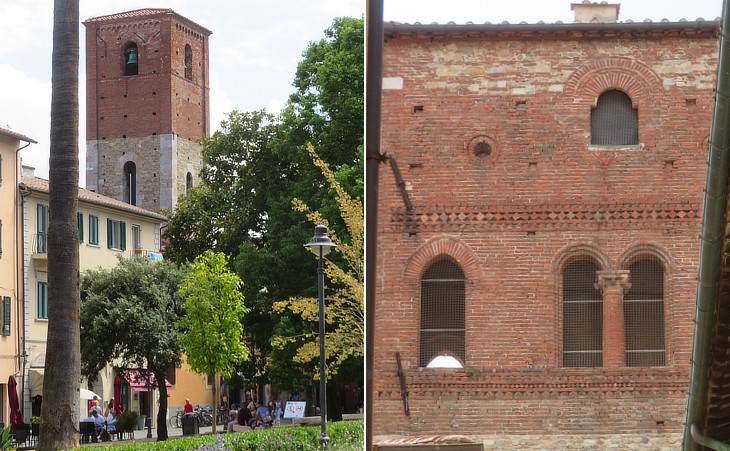
S. Frediano: (left) bell tower; (right) brick decoration of its older part
Some parts of the building retain their original aspect with a fine brickwork decoration which, although medieval, calls to mind ancient Roman buildings, e.g. Sepolcro di Quinto Veranio.
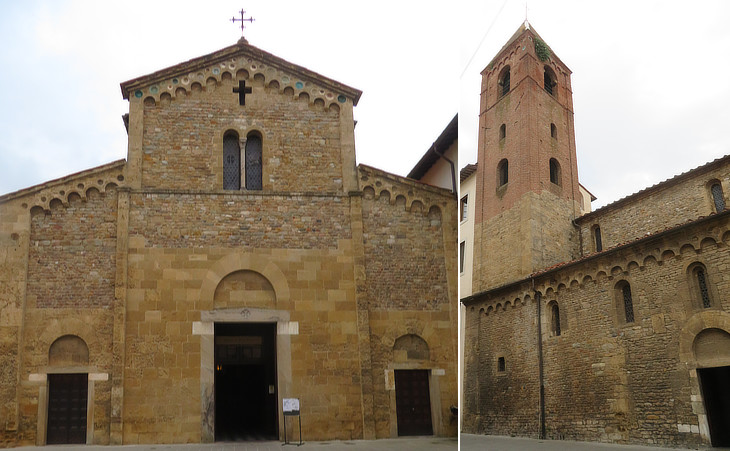
S. Sisto: (left) façade; (right) bell tower and lateral entrance
Ch. of San Sisto. The feast of Pope St. Sixtus II (6th August) was a fortunate day in the annals of ancient Pisa. On it the following victories were obtained: in 1006 against the Saracens in Calabria; 1063, again against the same enemies, at Palermo; 1070, against the Genoese; 1087, over the Moors at Mahdia in Africa; 1114, the sailing of the successful expedition against the Balearic Islands; and 1119, over the Genoese of Porto Venere. In consequence of these repeated coincidences, the citizens erected the church of San Sisto, as a token of their gratitude. The Consiglio Grande of the Republic used to meet in this church and throughout all the changes which the country has sustained, the city still retains the patronage. Murray
The church is located very near Piazza dei Cavalieri. Its exterior is completely made of stone (verrucano, a local greenish quartzite rock) and it is decorated with blind arches and ceramic basins from Muslim Spain or Africa, similar to S. Martino.
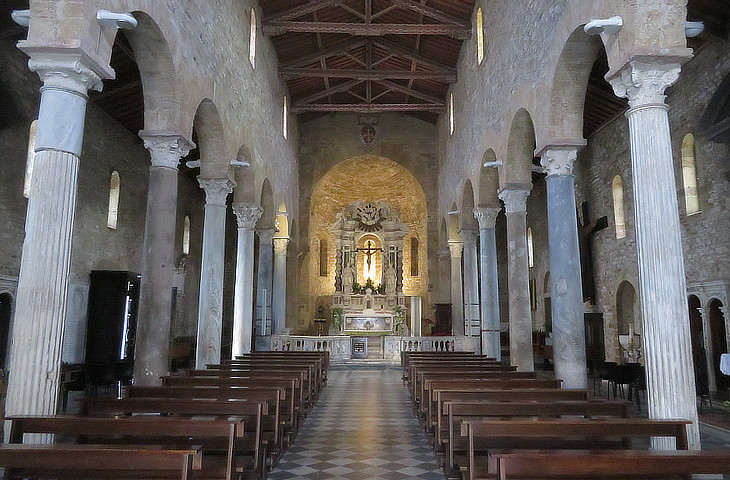
S. Sisto: interior
It was begun in 1089. The interior is supported by ranges of fine ancient columns of granite and cipollino; many are fluted. Murray
The church was founded in 1087 and dedicated to Pope St. Sixtus II to celebrate the victory over the Moors. The current appearance of the interior is the result of a number of changes made in the XIXth and XXth centuries which were aimed at emphasizing its medieval aspect.
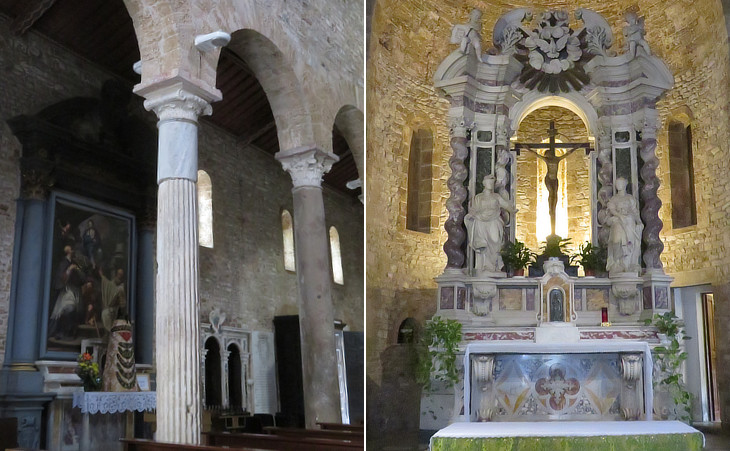
S. Sisto: (left) ancient columns; (right) altar (see a similar altar at S. Michele in Borgo)
The columns might have come from Mahdia, the ancient Aphrodisium, where many broken columns of granite and cipollino can still be seen in the courtyard of Borj el-Kebir, an Ottoman fortress. The main altar is the most notable element of the interior, but it was designed by Andrea Vacca in 1730 for a small oratory in Piazza dei Cavalieri. Other works by members of the Vacca family can be seen in the Cathedral.
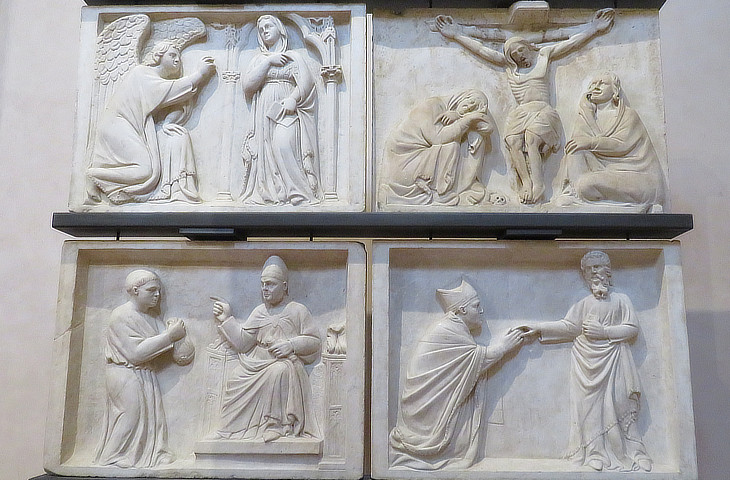
Museo Nazionale di San Matteo: reliefs from S. Sisto by a local sculptor (1390-1410): (above) Annunciation and Crucifixion; (below) Pope St. Sixtus II instructs the deacon Lawrence to distribute the alms (learn more about this story) and the Pope and St. Peter
The paintings are not of much merit; affixed to the walls, on each side of the door, are two good bas-reliefs of the early Pisan school, originally forming part of the pulpit. Murray
The museum houses also fine reliefs from the pulpit of S. Michele in Borgo, another medieval church.
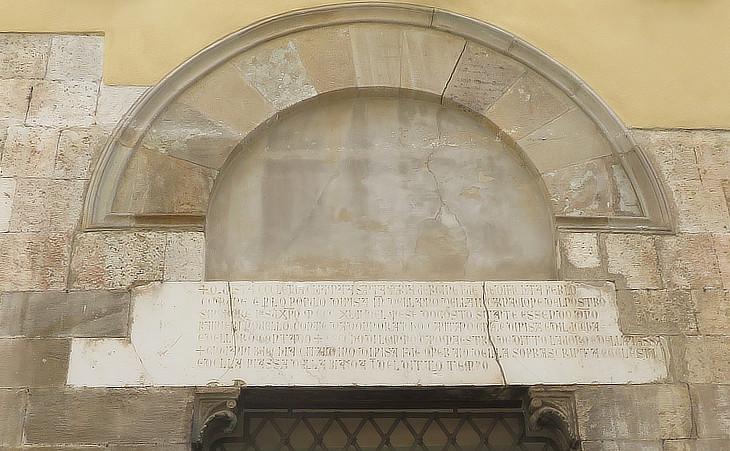
Casa Volterrani (Via Filippo Serafini): inscription celebrating the reconstruction of S. Maria Vergine in 1346 (see a finer example of medieval inscriptions in Rome)
In 1784 Grand Duke Leopold I issued a series of decrees aiming at expanding the role of the State in education and in assistance to the sick, the poor and the orphans. The same decrees reduced the role of religious charities and led to the closure of monasteries and churches. Similar policies were followed by the French in 1807-1814 when Tuscany was part of their empire. In 1830 the building bearing an inscription referring to S. Maria Vergine was already recorded as a private house.
Move to
The Ancient Town
Piazza dei Miracoli
The Baptistery
The Camposanto
The Cathedral
The Knights of Pisa
The Walls and the Lungarni
A Walk along the northern Terzieri
A Walk along the southern Terziere
Churches of Terziere S. Francesco
S. Maria della Spina
S. Matteo and its Museum
S. Piero a Grado
An Excursion to Vicopisano


