All images © by Roberto Piperno, owner of the domain. Write to romapip@quipo.it.


Notes:
Page added in February 2026.
All images © by Roberto Piperno, owner of the domain. Write to romapip@quipo.it.
Notes:
Page added in February 2026.
 A walk along the southern Terziere
The old town is divided into three districts: Terziere di S. Maria and Terziere di S. Francesco, north of the River Arno, and Terziere di S. Martino, south of it (see a map of 1831 Pisa).
This page shows also the main churches of the southern Terziere, exception made for S. Maria della Spina which is covered in a separate page.
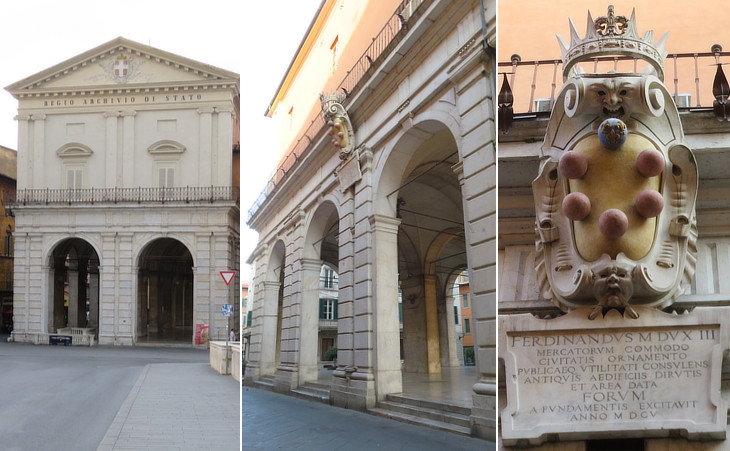
Loggia della Mercanzia: (left) northern side; (centre) eastern side; (right) 1605 coat of arms and inscription celebrating Grand Duke Ferdinand I
On the S. side of the Ponte di Mezzo, are the Loggie di Banchi, erected by Buontalenti at the expense of Ferdinand I. The open arches are supported by pilasters of rustic-work - a style much in favour with the Tuscan architects. These Loggie di Banchi are now used as a corn-market, and stand between the Palazzo del Governo and the ancient palace of the Gambacorti family, now the Custom-house.
John Murray - Handbook for travellers in Central Italy - 1861
In 1865 the upper floor, originally decorated with two weather vanes on the facade towards the Arno, was completely redesigned with a gabled pediment. See Loggia della Mercanzia at Siena and other loggias built by the Medici at Castiglion Fiorentino and Montepulciano.

(left) Via Toselli, off Corso Italia, which retains some medieval buildings, e.g. the rear side of Palazzo Mosca and others near Palazzo Blu; (right) rear entrance of Palazzo Gambacorti (early XVIIth century) with the inscription SPQP (Senatus PopulusQue Pisanus)
Terziere di S. Martino in general retains less of its historical than the northern Terzieri for two main reasons: a) in 1862 a new railway station was built at its southern end and the medieval walls were pulled down to make room for a large square and facilities for the travellers; b) in 1943 Allied bombings damaged the railway station and many buildings along the railway line. Corso Italia, the main north-south street of the Terziere, unlike Borgo in the northern part of the town is chiefly modern.

(left) Palazzo Mastiani Brunacci in Corso Italia; (right) family coat of arms
The palace was built in the early XIXth century on the site of some small medieval houses. It testified to the enormous wealth of the Mastiani Brunacci, minor noble families with a very successful trading background. They bought large estates south of Leghorn. The heirs were not able to carry on the family businesses and they went bankrupt in 1914.
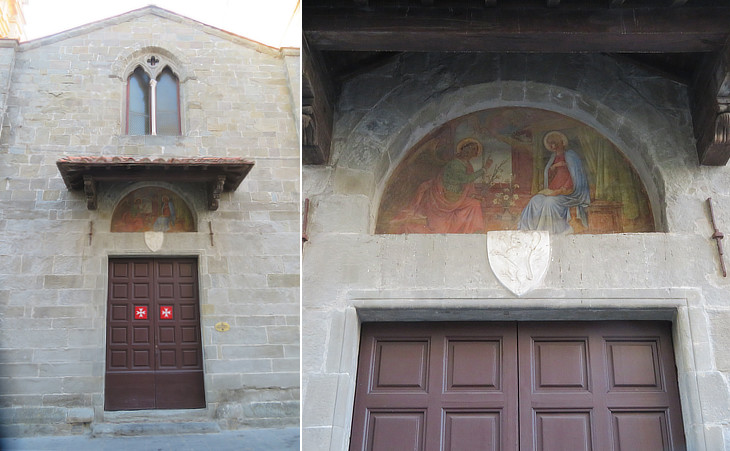
S. Domenico (at the southern end of Corso Italia): (left) façade; (right) portal
The church and the adjoining convent belonged to Dominican nuns and it was located near the medieval walls. Female houses differed from male Dominican houses in that they were enclosed. The nunnery was founded in the late XIVth century and in line with the ideals of the order the church had a very plain façade. The main Dominican church (S. Caterina) had instead a grand façade. See how cloistered nuns have contacts with the outside world at S. Lucia in Selci in Rome.
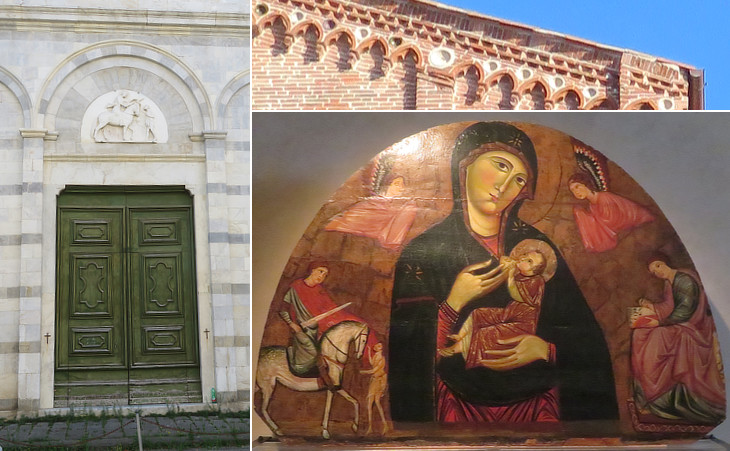
S. Martino: (left) portal with a relief by Andrea Pisano which is a copy of one inside the church; (right-above) detail of the apse which is decorated with ceramic basins which came mainly from Moorish Spain; (right-below) Museo Nazionale di S. Matteo: Madonna del Latte (Nursing Madonna) between St. Martin and St. John the Evangelist by a local painter (ca 1280) from S. Martino
The church is mentioned starting from 1067 with the name of San Martino in Guazzolongo, in reference to a long ford which allowed the crossing of the river before the construction of bridges. The current building was founded in 1331 for a nunnery of Clares which was closed in 1785. The lower level of the façade shows the typical elements of the Pisan Romanesque style, but the upper level is the result of a XVIIth century restoration. It is located at the eastern end of the terziere.
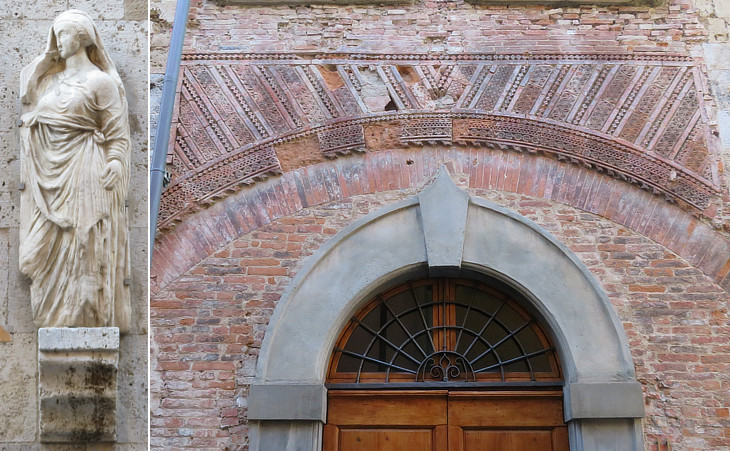
(left) Statue of "Cinzica de' Sismondi"; (right) nearby former warehouse with an almost Islamic decoration because of the lack of references to living creatures and the use of geometric patterns (see some details of the Great Mosque of Cordoba)
Pisa asserted its independence at an early period, and in the tenth century blazed forth in all the glory of a mighty and victorious republic. Its numerous fleets rode triumphant on the Mediterranean; and Corsica and Sardinia, the Saracens on the coasts of Africa, and the infidel sovereign of Carthage bowed beneath its power. Captive kings appeared before its senate.
John Chetwood Eustace - Classical Tour of Italy in 1802 (publ. 1813)
The tocsin of the Cinzica, which awoke Pisa and saved her from being sacked by the Saracens, is a legend.
Corrado Ricci - Romanesque architecture in Italy - 1922
A relief, part of a Roman sarcophagus, near S. Martino commemorates a Pisan heroine. It is said that in 1004, on a dark night, only one woman was awake, because she was thinking of her lover, who had left like many others to conquer lands and treasures. From the top of a tower house, she saw lights in the distance: they were the torches of the Saracens attempting to seize Pisa, knowing that very few young and strong men were left to defend it. Cinzica de' Sismondi ran down the streets, shouting fire, fire, up to the palace of the regents of the Republic and began to ring the bells that woke up all remaining citizens. The Pisans thus managed to defend themselves and chase away the Saracens.
Cinzica or Kinzica is the name of the neighbourhood near S. Martino where Muslim merchants had their warehouses and some architectural details of its buildings still testify to their presence. The Sismondi were a very important family of medieval Pisa.
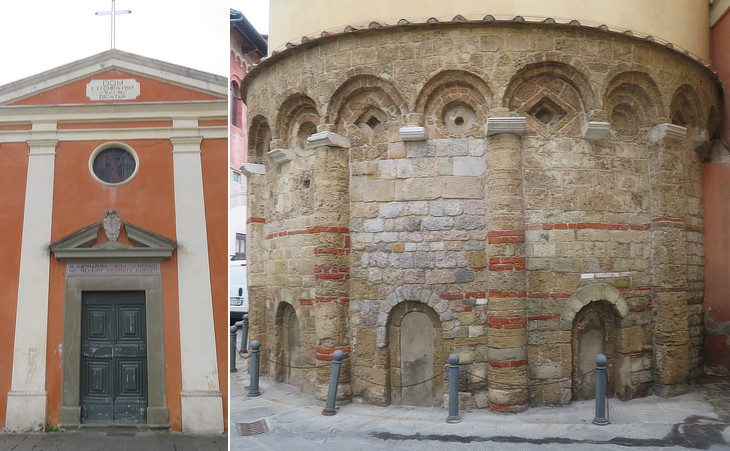
S. Cristina: (left) XIXth century façade with the following inscription on the lintel of the portal: "S. Catharina Virgo Senensis Hic Recepit Stigmata Christi" a reference to St. Catherine of Siena who received the stigmata in this church in 1375; (right) apse
The earliest mention of a church dedicated to St. Christina of Bolsena is in an VIIIth century index of documents, but only after the year 1000 is it reported to be in the Cinzica neighbourhood. From medieval records we know that the church had a porch. Its current aspect is the result of a XIXth century redesign which did not affect the apse, the oldest remaining part, which is dated XIth century and has already some key elements of Pisan architecture, including a rhomb decoration.
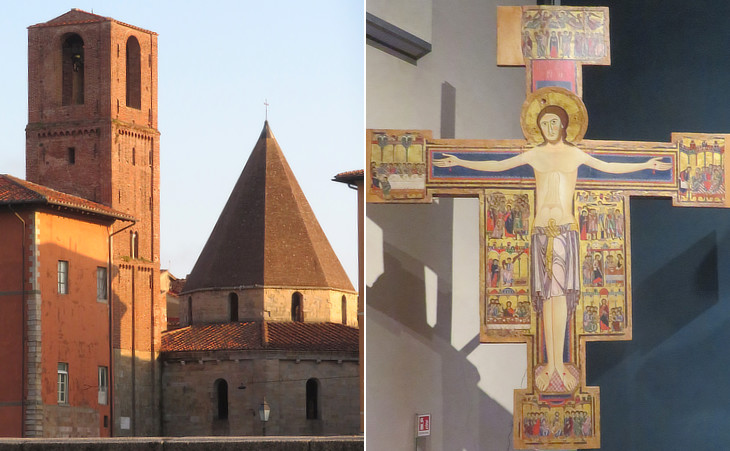
Santo Sepolcro: (left) seen from the northern Lungarno; (right) Museo Nazionale di S. Matteo: wooden Crucifix with scenes from Jesus' Death and Resurrection (XIIth century) by unknown artist (similar Crucifixes were made also for S. Frediano and S. Paolo all'Orto)
San Sepolcro, on the S. side of the Arno, not far from the Ponte di Mezzo, is a curious octagonal church of the 12th centy., built for the Knights Templars, by Diotisalvi, the architect of the Baptistery, who has left his name at the base of its campanile. The ch. which had fallen into decay, has been recently restored by the Accademia delle Belle Arti.
Murray
The Order of the Templars was dissolved in 1312 at the request of Philip the Fair, King of France, but today the church is thought to have been built for the Knights Hospitallers. It eventually belonged to their heirs, the Knights of Malta. There is no left evidence of the hospital which adjoined the church.

Santo Sepolcro: portals, reliefs and inscription mentioning Diotisalvi the builder ("fabricator") of the church
The church was embellished with a Renaissance portico which was pulled down in the XIXth century by a restoration which was aimed at emphasizing the medieval character of the building. Most likely the restoration went too far because some heads of lions look too rude when compared to the overall decoration of the portals.
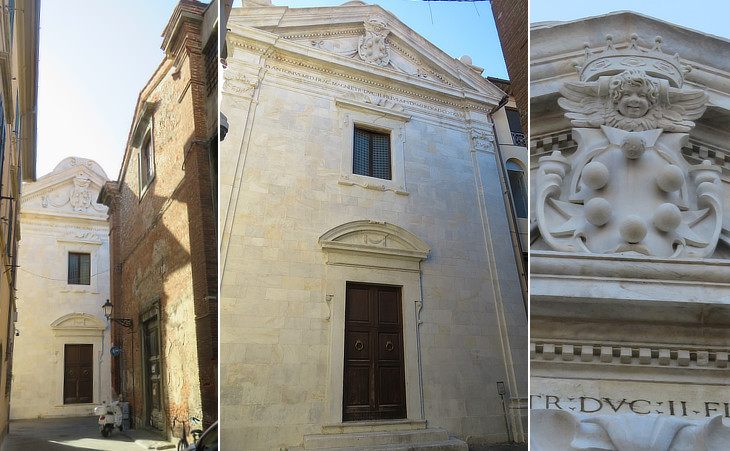
(left) S. Bernardo (brick façade) and S. Giovanni dei Fieri (marble façade - Fieri, in origin Frieri i.e. brothers, a reference to the Knights of Malta); (centre/right) details of S. Giovanni dei Fieri with the coat of arms of Antonio de' Medici, Knight of Malta and son of Grand Duke Francis I
The church of S. Bernardo was built in one of the most ancient streets of Cinzica. The adjoining Cistercian convent included a hostel for pilgrims and seafarers. In 1444 the entire religious complex was redesigned but additional changes were made in 1616 and in the XVIIIth century.
The contrast between the materials used in the church of S. Bernardo and the marble façade of the church of San Giovanni dei Fieri is evident. The construction of the latter was financed in 1613 by Don Antonio de' Medici, as recalled by the inscription surmounted by the large Medici coat of arms. The church was part of the Renovatio Urbis promoted by Grand Duke Ferdinand I which also included the façades of S. Francesco and S. Matteo.
Antonio de' Medici was the son of Grand Duke Francis I and Bianca Cappello, his second wife. At the death of his father in 1587 he was a boy of eleven. His uncle Ferdinand claimed he was an illegitimate child and managed to become the ruler of the Grand Duchy. Later on Antonio was induced to join the Knights of Malta, thus giving up his rights to the throne.
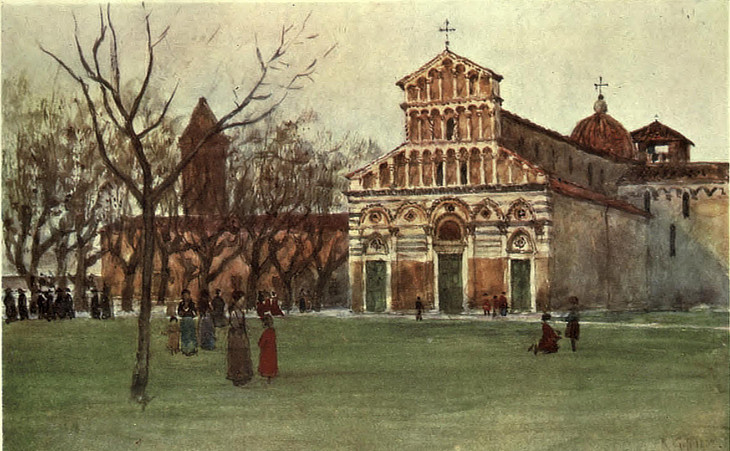
San Paolo a Ripa, illustration from "Florence & some Tuscan cities painted by Colonel R. C. Goff - 1905"; the bell tower of the church is behind the dome, that to the left of the building belonged to a Benedictine nunnery
San Paolo a Ripa d'Arno, at the extremity of the Lung'arno, on the S. of the river. Its architecture, is of the 12th century; for it appears from a Papal bull, dated 9th February, 1115, that service was then performed there, and that this church, together with the adjoining monastery, belonged to the monks of Vallombrosa (a branch of the Benedictine order). (..) It is called the Duomo Vecchio, and it has been thought that the present cathedral is, in fact, a copy of San Paolo instead of being the original. The ancient paintings, by Cimabue, Buffalmacco, Simone Memmi, and other old masters, which once covered the interior, have nearly all been whitewashed over.
Murray
The façade is also very similar to that of S. Michele in Borgo.
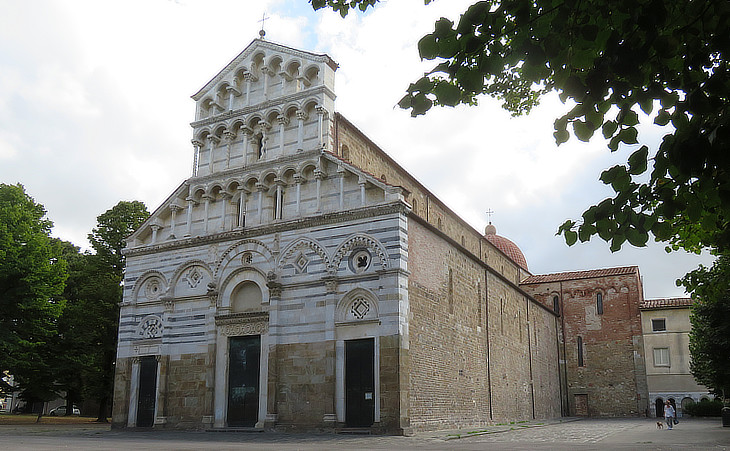
San Paolo a Ripa d'Arno today, after the WWII bombings
The façade consists of 5 closed arches, 2 circular and 2 pointed, the entrance being through the central one; over these arches rise 3 tiers of pillars supporting open galleries, ending in a gable. The interior is in the form of a Latin cross, and is divided into a nave and two side aisles by columns of granite, with marble capitals, of varied patterns, supporting arches. Murray
The church is located near Porta Degazia, the sea gate of Pisa and S. Paolo a Ripa d'Arno was the first church of Pisa which travellers saw when they entered the town. That explains why such a grand building was erected. Today the area is rather peripheral and it is very quiet.
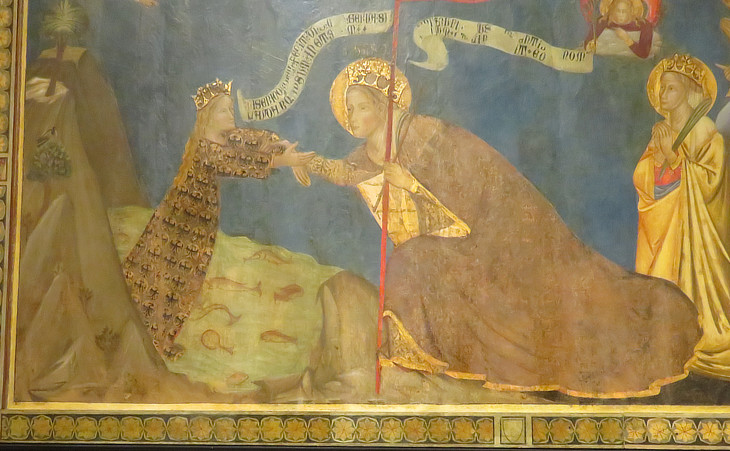
Museo Nazionale di S. Matteo: Saint Ursula with her companions saves a personification of Pisa from the flood, from S. Paolo a Ripa d'Arno (second half of the XIVth century)
Both the Arno and its secondary streams glide very slowly on beds which are but little inclined, and nearly level with the surface of the Pisan territory. Hence their embankments, however stupendous, cannot ultimately protect the plain.
Joseph Forsyth - Remarks on Antiquities, Arts, and Letters in Italy in 1802-1803
The frescos which Bruno is said by Vasari to have executed in company with Buffalmacco in the Abbey of Ripa d'Arno are obliterated, but the altarpiece of S. Ursula, produced for the same church, is described by Vasari in terms almost completely applicable to a picture now in the Academy of Pisa. There the Virgin companions of the British Saint are represented with S. Ursula herself, holding in one hand the Pisan standard, and supported by a symbolical figure of Pisa. This is a rough distemper picture split in four places, in great part repainted.
J. A. Crowe and G. B. Cavalcaselle - A new history of painting in Italy - 1864
The painting has been linked to a major flood that occurred on the feast of Saint Ursula (October 21). See a page on the floods of Rome.
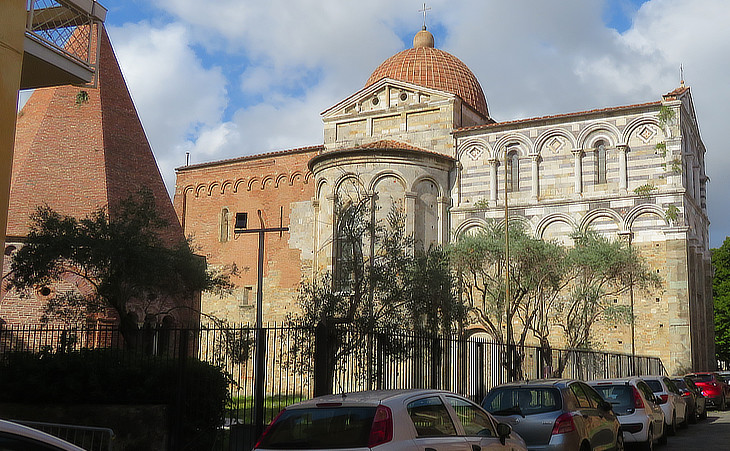
San Paolo a Ripa d'Arno: apse and site of the lost monastery
In 1943 and 1944 Allied bombings destroyed the monastery, the cloister and the bell tower which stood behind the church. Today they are replaced by a garden planted with olive trees, a symbol of peace. The bombings made more visible the rear part of the church and S. Agata, a curious chapel which stood in the cloister and was its Chapter Hall.
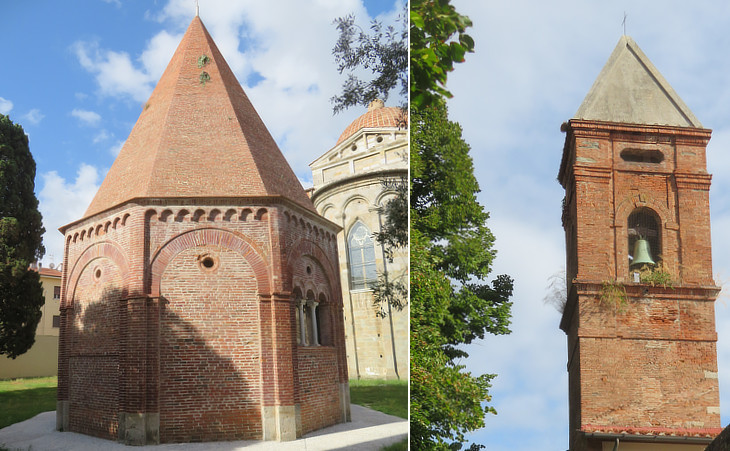
San Paolo a Ripa d'Arno: (left) S. Agata (Baptistery?); (right) XIXth century bell tower of the adjoining Benedictine nunnery where the bells of of S. Paolo have been relocated
In the centre of the cloister adjoining the church is a very interesting and picturesque heptagonal building, with a high pointed roof, not unlike that in the cloister of St. Stephen at Westminster: it is used as a chapel, and may have been the baptistery of the ancient cathedral. Murray
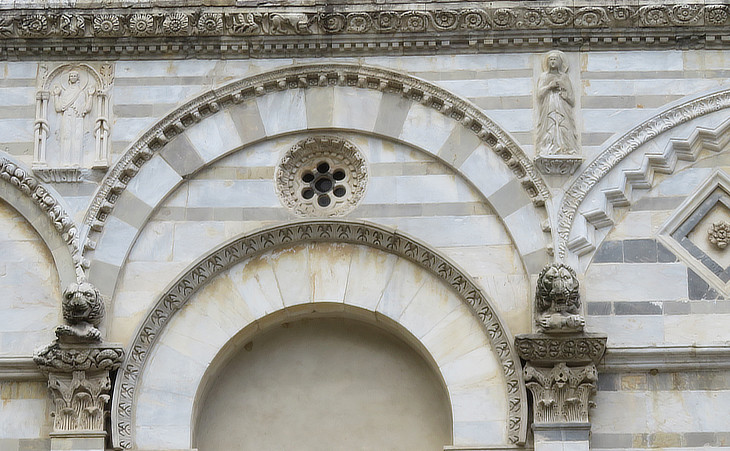
San Paolo a Ripa d'Arno - main portal with reliefs portraying two Byzantine-style Madonnas, one of which resembles "Madonna Greca" at Ravenna, and two guardian lions (see those at S. Lorenzo in Lucina in Rome); the image used as background for this page shows the geometric decoration of the lintel
The exterior of the church is very richly but not orderly decorated with many odd details which the viewer discovers only by focussing on the various parts of the building.
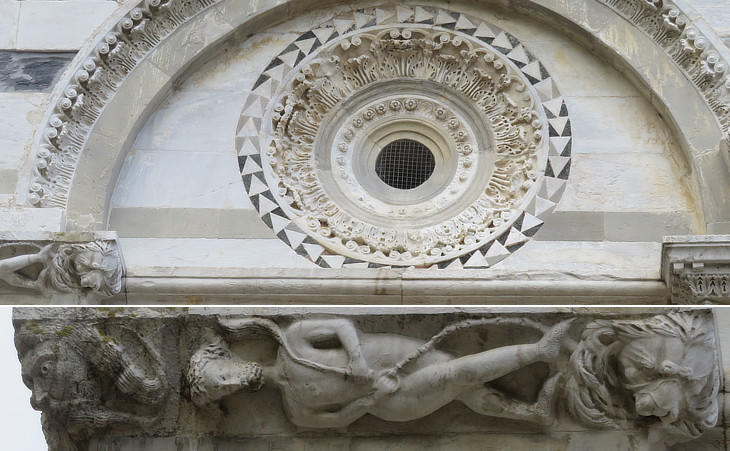
San Paolo a Ripa d'Arno - details of the decoration above the left portal: (above) rose window (see a similar one at S. Paolo all'Orto); (below) medieval relief depicting the head of a man with long hair and moustaches, a naked man holding a rope and the head of a lion (perhaps a fragment of a sarcophagus)
The meaning of the reliefs at the side of the left portal is still baffling art historians. They call to mind the decoration of the Abbey of Saint-Gilles in France.
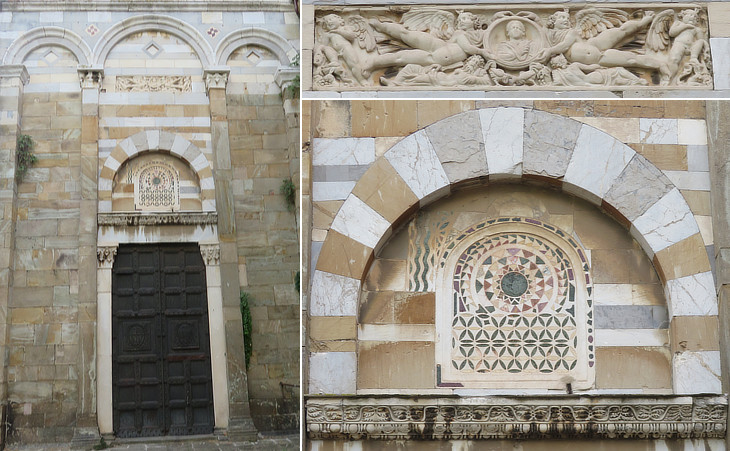
San Paolo a Ripa d'Arno - side entrance: (left) portal; (right-above) Roman sarcophagus with relief depicting winged genii holding a clipeus with the portrait of the dead; (right-below) marble inlay decoration
Move to
The Ancient Town
Piazza dei Miracoli
The Baptistery
The Camposanto
The Cathedral
The Knights of Pisa
The Walls and the Lungarni
A Walk along the Northern Terzieri
Churches of Terziere S. Maria
Churches of Terziere S. Francesco
S. Maria della Spina
S. Matteo and its Museum
S. Piero a Grado
An Excursion to Vicopisano