All images © by Roberto Piperno, owner of the domain. Write to romapip@quipo.it.


Notes:
Page added in February 2026.
All images © by Roberto Piperno, owner of the domain. Write to romapip@quipo.it.
Notes:
Page added in February 2026.
 Churches of Terziere di San Francesco
You may wish to see pages on the northern Terzieri, the churches of Terziere di S. Maria and a map of 1831 Pisa first.

S. Francesco: (left) façade; (centre) bell tower; (right) apse window
Ch. of San Francesco. This, like many of the churches belonging to the Franciscan order, consists of a single nave. The vaulting is a bold span of 57 ft. The lofty campanile is half supported by two large consoles springing from the wall of the church. On the roof of the choir are some interesting frescoes, probably by Taddeo Gaddi. The cloisters are remarkable for the richness of the foliage within their enclosure, and for the grace of their columns. The apse window contains some good painted glass. A chapel painted by Taddeo Bartolo, representing the history of the Virgin, has been recently discovered in the sacristy; the frescoes are unfortunately much injured. The cloisters, as in most convents of the Franciscan order, have been converted into a general cemetery from an early period.
John Murray - Handbook for travellers in Central Italy - 1861
The façade bears the name of Grand Duke Ferdinando I de' Medici, who commissioned the work, and the year of construction (1603). It replaced an unfinished façade of the XIVth century and it is very similar to those of S. Giovanni dei Fieri and S. Matteo. It testifies to the efforts by Ferdinand to embellish Pisa (Renovatio Urbis). The Gothic bell tower, marked by a cell opened by mullioned windows and a cuspidal roof, is visible from a great distance.
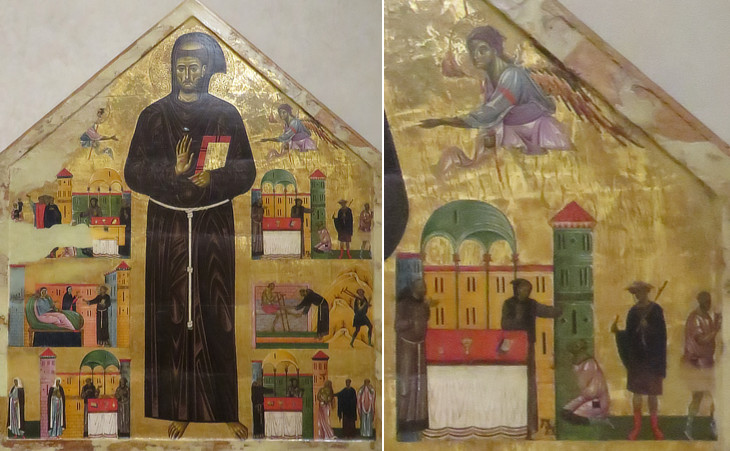
Museo Nazionale di S. Matteo (from S. Francesco): "Dossale" (altarpiece placed behind the altar, an early form of polyptych see another one at Perugia) portraying St. Francis by Giunta Pisano (ca 1255), and a detail depicting the miracle of the cripple who was cured at a shrine having a bell tower resembling the Leaning one (all six scenes depict thaumaturgic miracles)
Museo Civico in the Convent of S. Francesco. Murray (1900 ed).
In the XVth century S. Francesco was one of the largest Franciscan monasteries in Italy, but afterwards it had a troubled life, because it was turned into a barracks after the 1494 failed revolt of Pisa and in 1543 it housed facilities for the University. Eventually it became the seat of the Inquisition and it was deconsecrated during the French annexation of the Grand Duchy in the early XIXth century. In 1863 most of the works of art which decorated the chapels of the church were withdrawn by the families who owned them. In 1893 the convent was chosen to display the collections of the Town Museum (now at S. Matteo). In 1901 the church was returned to the Franciscans.
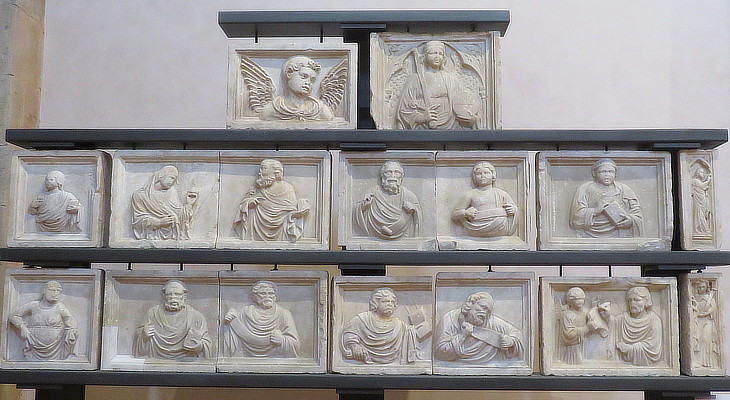
Museo Nazionale di S. Matteo: reliefs from chapels of S. Francesco (ca 1350-1399)
The sepulchre of Count Bonifazio della Gherardesca, and his family, is amongst the most worthy of notice; it was removed from the suppressed church of San Francesco; but it has lost many of the statues which adorned it where it originally stood. Murray
Sixteen reliefs of different size and subject were removed from chapels of the church and were used to decorate a private garden, before being relocated to the museum.
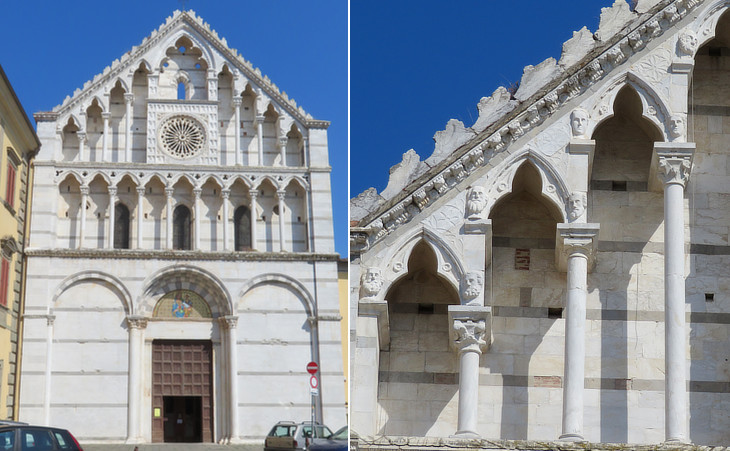
S. Caterina (di Alessandria): (left) façade; (right) detail of its upper part
Sta. Caterina, once attached to a Dominican monastery, built by Guglielmo Agnelli, is a Gothic adaptation of the Duomo, tier above tier. It was completed about 1253. (..) This church was the first settlement of the Dominicans in this city; they were brought here by Uguccione Sardi, who himself took the habit of the order. St. Thomas Aquinas resided for some time in this convent, and the pulpit from which he preached is yet preserved. Murray
The church was dedicated to Saint Catherine of Alexandria, the martyr, but after the canonization in 1462 of Saint Catherine of Siena, a Dominican Tertiary, most of the works of art were dedicated to the latter.
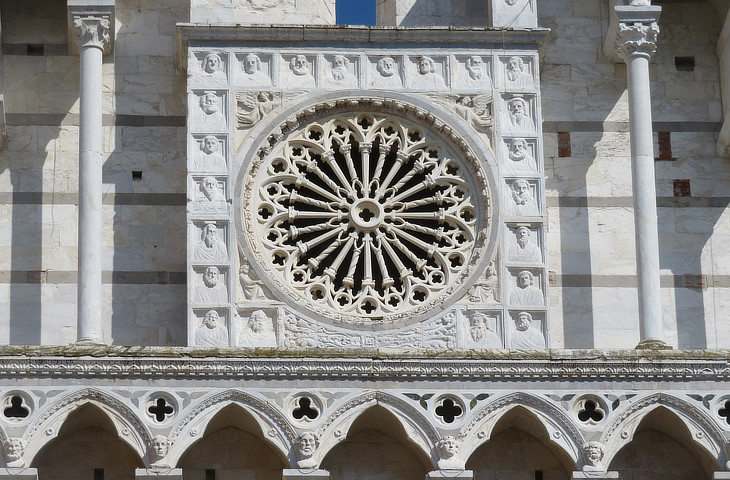
S. Caterina: detail of the façade
The borders of heads round the windows are curious. The marbles of the front, fretted by small trefoil arches above, are the gift of the Gualandi family. Murray
Two-tone stripes unite the lower round arches with the three-lobed arches above. These rest on columns with capitals and human heads. Busts of saints in high relief surround a very elaborate central rose window with 24 small columns, half of which are fluted (see similar rose windows at L'Aquila and at Celano in Abruzzo). Symbols of the Evangelists were usually depicted at the four corners of a rose window (e.g. at Spoleto).
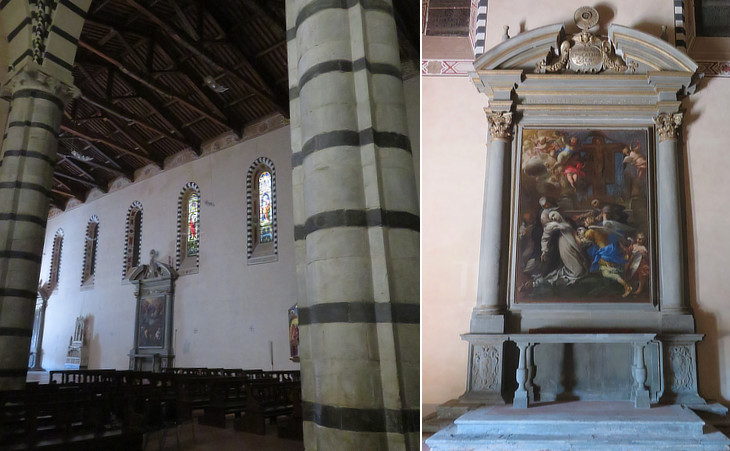
S. Caterina: (left) interior; (right) St. Catherine receiving the stigmata in S. Cristina at Pisa in 1375 by Raffaello Vanni (1655 - see another painting by him at S. Maria del Popolo); the inscription says: "Senis Natalibus Pisis Stigmatibus"
It has no aisles, nothing that can interrupt the sound. Murray
The depiction of St. Catherine receiving the stigmata was the object of a fierce debate between Dominicans and Franciscans for a long time until the event was formally acknowledged by Pope Urban VIII in 1630. He prescribed that painters should represent the wounds as glowing and not bleeding points, as those in portraits of St. Francis. In the painting by Vanni Catherine was portrayed in the same ecstatic posture which in 1651 Gian Lorenzo Bernini designed for the statue of St. Teresa at S. Maria della Vittoria.

S. Caterina: (left) "The Triumph of St. Thomas Aquinas" (1323) once attributed to Francesco Traini and today to Lippo Memmi from Siena, brother-in-law of Simone Martini; (right) detail showing St. Thomas holding the initial pages of "Summa contra Gentiles" (Summary against the unbelievers), one of his most important treatises which is introduced by a quotation of Prov. 8.7. "Veritatem meditabitur guttur meum, et labia mea detestabuntur impium." (for my mouth will utter truth; wickedness is an abomination to my lips)
.
On the l.-hand side of the nave, half way up, is a curious picture by Francesco Traini, a pupil of Orcagna. Christ from his lips sends rays of light to the heads of the four evangelists, from whom they are reflected to the head of St. Thomas, who then illuminates numerous auditors. Below are Arius, with several followers, and near him Plato and Aristotle. The figures of the Greek philosophers are the finest. (..) Just beyond this picture is the pulpit, from which St. Thomas, who was a reader in this convent, lectured or preached. Murray
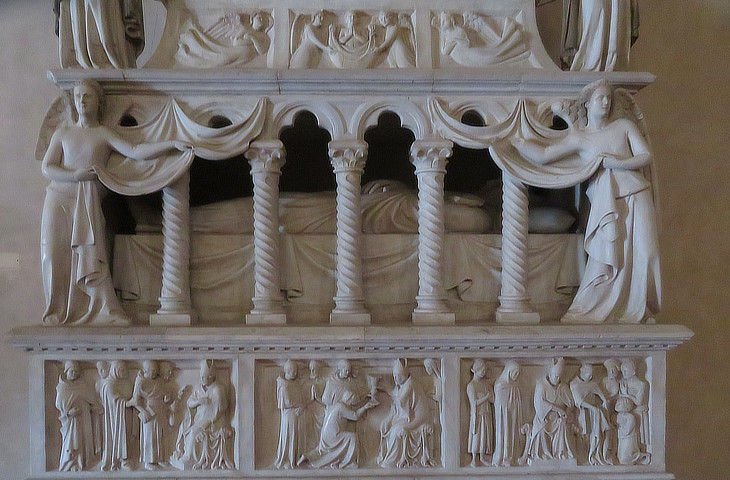
S. Caterina: Monument to Archbishop Simone Saltarelli (1343-1347), by Andrea Pisano (see some of his works in Florence) with the help of Nino Pisano, his son
On the l.- hand side of the door, at the bottom of the nave, is the monument of Simone Saltarelli, Bishop of Parma, and afterwards Archbishop of Pisa (died 1342). It is composed of an altar tomb with bas-reliefs; the canopy above is supported by ill-shaped arches; it has marble draperies, which angels draw back, exhibiting the effigy below, which is hardly to be seen in the darkness. It is fine, though cut on the outside only for effect. (..) The bas-reliefs below have character and expression, but the rest is of rude and clumsy workman-ship. Murray
Andrea Pisano started his career at Pisa and he returned there after a long stay at Florence where he worked at the Baptistery and at the Campanile di Giotto. He had a very active workshop which was continued by his sons Nino and Tommaso. See the Madonna he made for the Cathedral of Pisa and the funerary monuments his son Nino made for two other archbishops. The design of the Monument to Archbishop Simone Saltarelli was influenced by earlier works by Arnolfo di Cambio at Orvieto, Lorenzo Maitani at Perugia and Tino di Camaino at Siena.
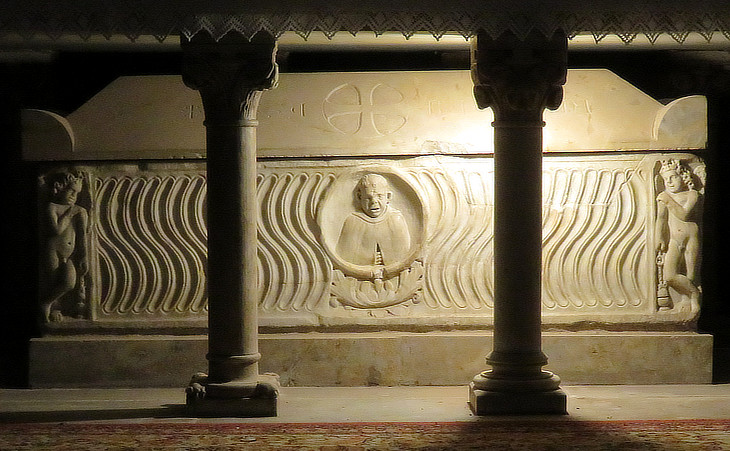
S. Caterina: Sarcophagus of Blessed Giordano da Rivalto, a widely respected Dominican preacher (XIVth century - the lid is modern)
The Camposanto of Pisa houses a large collection of Roman sarcophagi, some of which were reused for important personages of medieval Pisa. In some instances however the Roman sarcophagus was actually made in the XIVth/XVth centuries (e.g. that of Abbot Benedetto). The same applies to the sarcophagus of Giordano da Rivalto, which in origin was placed under the main altar of S. Caterina. Strigiles, mourning genii and the portrait of the dead in a clipeus (Roman round shield) are among the most typical decorative elements of a Roman sarcophagus (see an example in Piazza del Popolo in Roma).

S. Caterina: Monument to Gherardo di Bartolomeo di Simone di Compagno (1419 ca) by an unknown sculptor; the inscription adds "Cittadino di Pisa" (Citizen of Pisa) indicating that citizenship was regarded as a title of honour not requiring additional designations
The acanthus-based rich and elaborate decoration of this tomb attracted the attention of Friedrich Maximilian Hessemer, a German architect and traveller who visited Italy in 1827-1829, who made a pencil drawing of it (now at the Städel Museum, Frankfurt am Main).
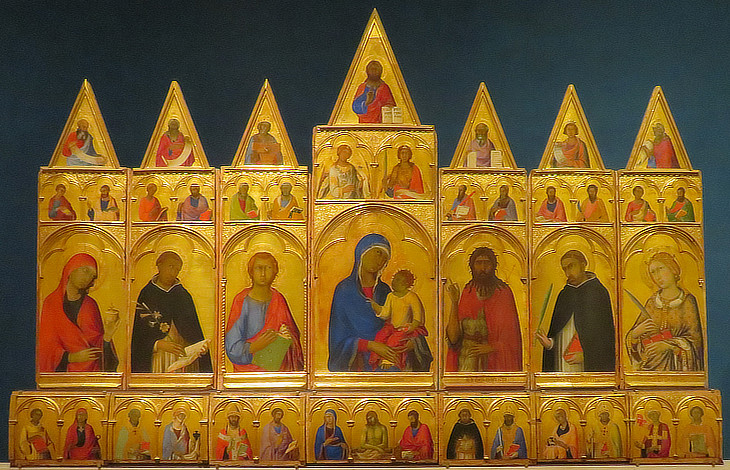
Museo Nazionale di San Matteo: Polyptych by Simone Martini (ca 1320) from S. Caterina
This large polyptych by Simone Martini stood on the main altar. It is signed SYMON DE SENIS ME PINXIT in the central panel with the Madonna and Child. It is Martini's largest work, and includes numerous sub-panels. The altarpiece consists of seven main elements, each one in three parts: a cusp, a smaller panel divided into two sections, and a larger panel depicting a single saint. There is also a predella consisting of seven smaller size panels. There are 15 predella figures, an upper row with other 14 figures and seven cusps with other characters for a total of 44 figures. The central panel depicts the Madonna with Child; the remaining six main panels portray (left to right): St. Mary Magdalene, St. Dominic, St. John the Evangelist, St. John the Baptist, St. Peter of Verona (a Dominican preacher) and St. Catherine of Alexandria. In the cusps, next to the Blessing Christ, are prophets and patriarchs. The predella shows Christ in the Sepulchre with the Madonna and St. Mark and six couples of saints.
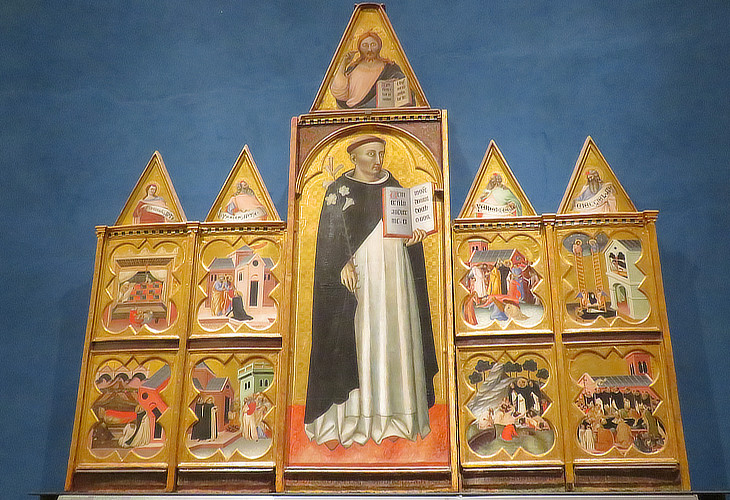
Museo Nazionale di S. Matteo: Triptych of S. Domenico, by Francesco Traini (1345) from S. Caterina; it depicts eight stories of his life
This is the only work signed by Francesco Traini, who in the past was regarded as one of the most important painters from Pisa for his frescoes at the Camposanto, which are now attributed to Buonamico Buffalmacco.
Vasari says that Among all the disciples of Orcagna none was more excellent than Francesco Traini, who surpassed his master by a great measure in colouring, in harmony, and in invention., but he attributed the Triumph of St. Thomas Aquinas to Traini.
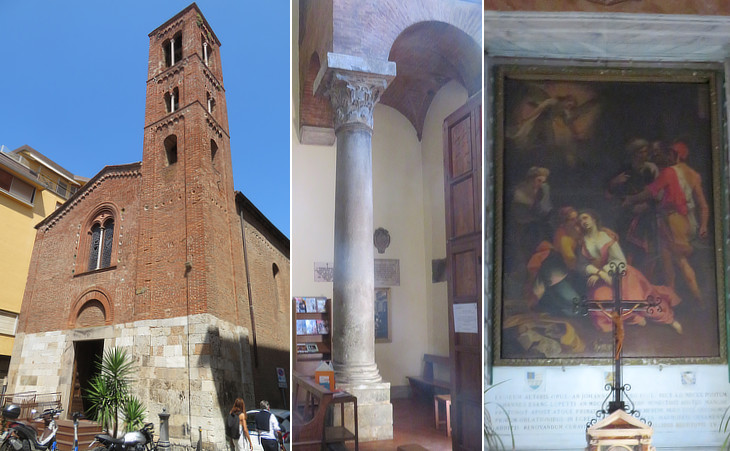
S. Cecilia: (left) façade and bell tower; (centre) column supporting the bell tower; (right) Martyrdom of St. Cecilia by Ventura Salimbeni (1607 - see other paintings by Ventura Salimbeni at Siena and Perugia)
The church was damaged by bombings during WWII. The façade is gabled, the base is in stone and the upper part in brick, decorated with ceramic basins. The particularity of the church is the 1236 suspended bell tower, two sides of which rest on an ancient column inside the church and the other two are included in the corner of the façade.
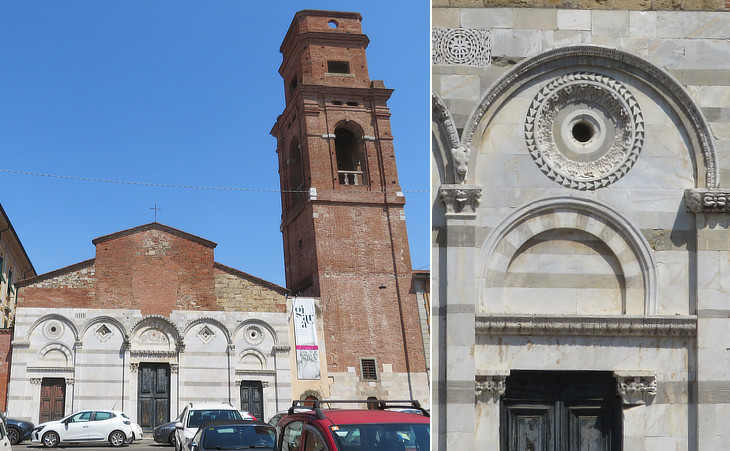
San Paolo all'Orto: (left) façade (late XIIth century); (right) detail of the right portal, a similar decoration can be seen at S. Paolo a Ripa d'Arno
The name indicates that the church was built at the limit of the urban area (orto, kitchen garden). The façade is another fine example of Pisan Romanesque style, with five blind arches decorated with rhombi and round windows. The brick bell tower was built in 1595 on the remains of the original one. The church is deconsecrated and it now belongs to the University of Pisa.
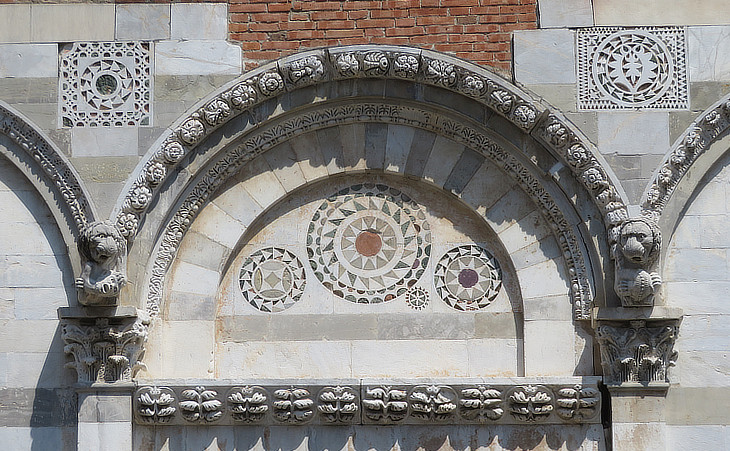
San Paolo all'Orto: main portal
The elaborate decoration of the façade can be compared with that of the Cathedral both for the subjects and for the use of coloured marbles. It testifies to the level of excellence achieved by Pisan sculptors, not only by those who are known for their statues and reliefs, but more in general by all stonecutters.

Museo Nazionale di San Matteo from S. Paolo all'Orto: (left) Crucifix, maybe by Giunta Pisano, similar to those at S. Frediano and at S. Sepolcro with scenes from Jesus' life (they are all characterized by portraying Jesus with open eyes); (centre/right) lectern support of the pulpit (late XIIIth century)
The lectern support is a symbolic representation of the Evangelists because it portrays an angel (Matthew), a lion (Mark) and an ox (Luke). The eagle of John was depicted in the lectern itself, similar to what can be seen in the pulpit by Nicola Pisano in the Cathedral of Siena. The eyes of the angel are made of lead.
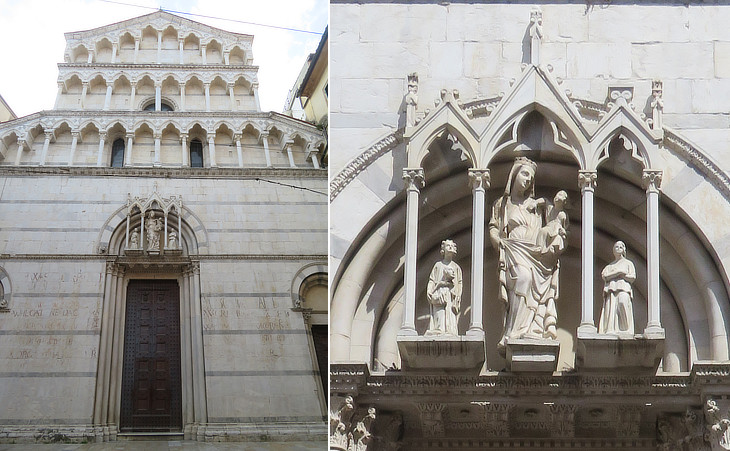
San Michele in Borgo: (left) façade; (right) central portal with a group of statues by Lupo di Francesco (originals at Museo Nazionale di S. Matteo) which are very similar to those he made for the Camposanto
San Michele in Borgo, near the Ponte di Mezzo, claims to stand on the site of a heathen temple. The crypt, which has been supposed to show vestiges of its pagan origin, is of the 11th centy. and highly remarkable. It was painted in fresco, of which some small remains may yet be discerned; all the figures are Christian emblems. The façade of the church above was built by Guglielmo Agnelli, a pupil of Nicolo da Pisa. It is a Gothicised copy of the Duomo. Murray
The church is located along the eastern side of Borgo Stretto. WWII bombings and a major flood in 1966 greatly damaged the building and its crypt.
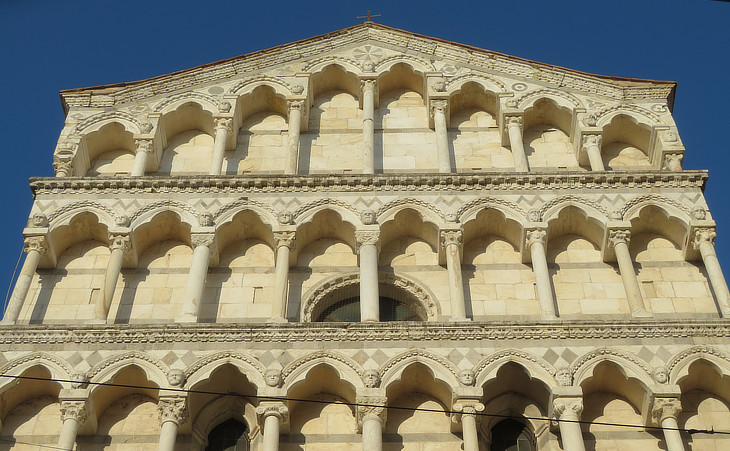
San Michele in Borgo: upper part of the façade
The church of S. Michele in Borgo attributed to Fra Guglielmo, has three tiers of arcading, but the arches that spring from the colonnettes are pointed and have trefoil cusping. Otherwise the general design, with a high central part corresponding to the nave, and triangular sloping wings at a lower level corresponding to the aisle, is precisely that of the Duomo and of S. Paolo a ripa d'Arno on a reduced scale.
Thomas Graham Jackson - Gothic architecture in France, England, and Italy - 1915
The church was founded in the XIth century, but the façade is the result of works carried out in the XIIIth and XIVth centuries which gave it a Gothic appearance.
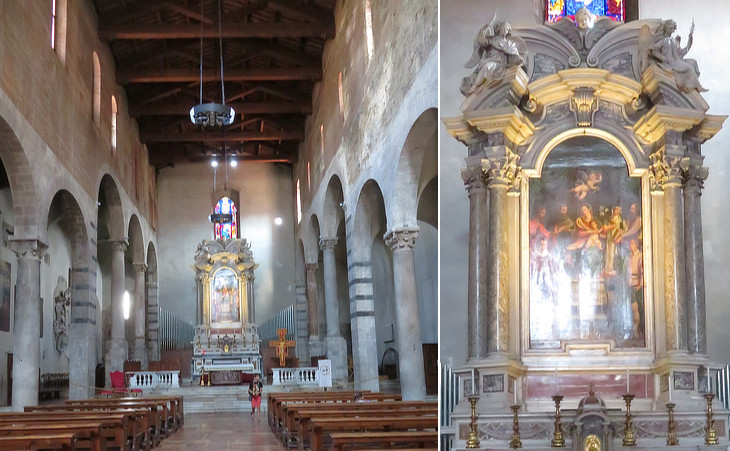
San Michele in Borgo: (left) interior (reconstructed after WWII); (right) main altar (XVIIIth century - see a similar one of the same period at S. Sisto)
The interior, which is of the early part of the 13th centy. is fine: excepting the rows of granite columns, all the rest has been modernized. With the exception of a Virgin and Saints by Battista Lomi, over the high altar, which is tolerable, (..) the paintings are not remarkable Murray
The painting on the main altar was originally made for another church. Baccio Lomi, the painter to whom it is attributed was the brother of Orazio Lomi Gentileschi, who worked in Rome in 1576-1612.
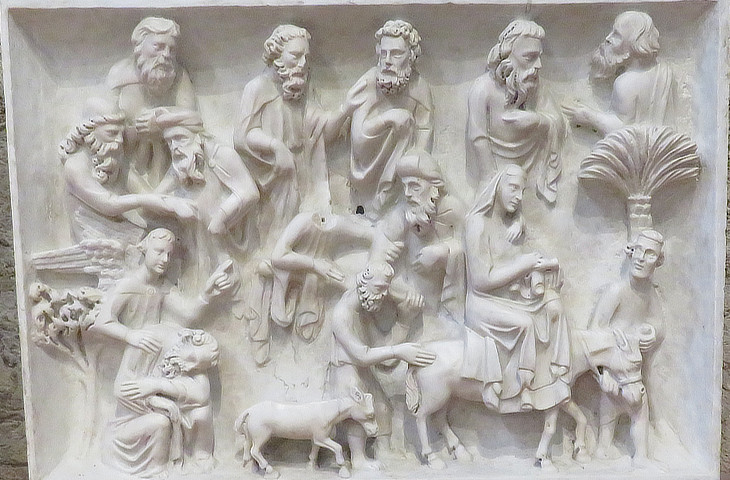
Museo Nazionale di San Matteo: relief showing the Dream of Joseph, the Flight to Egypt and other scenes of Jesus' life from the pulpit of S. Michele in Borgo by Lupo di Francesco; the image used as background for this page shows an isolated bust portraying Christ in Majesty inside the church
Lupo di Francesco, a pupil of Giovanni Pisano, was appointed Operaio dell'Opera del Duomo, i.e. supervisor of all activities concerning the Cathedral and the adjoining buildings in 1315. In designing the pulpit of S. Michele in Borgo he was influenced by that which his master made in the Cathedral.
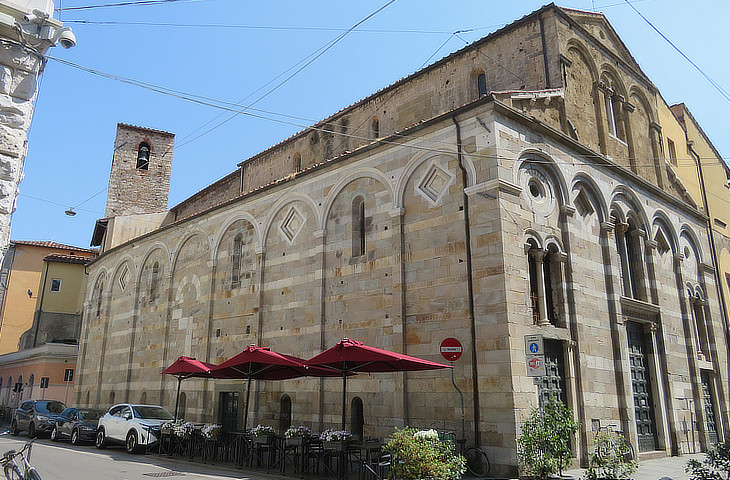
S. Pierino
Piero derives from Pietro and it was particularly popular in Tuscany; the official name of the church is S. Pietro in Vinculis (Chains), a reference to Peter having been jailed at Pisa after he landed there when he came from Antioch in his way to Rome. It was founded in the VIIIth century at the same time as S. Cristina. It was enlarged and redesigned in the XIIIth century. Later modifications were removed in 1929-1930 to bring it back to its assumed Pisan Romanesque style. The façade is divided into two levels, with five blind arches, mullioned windows on the first and three blind arches and one mullioned window on the second.
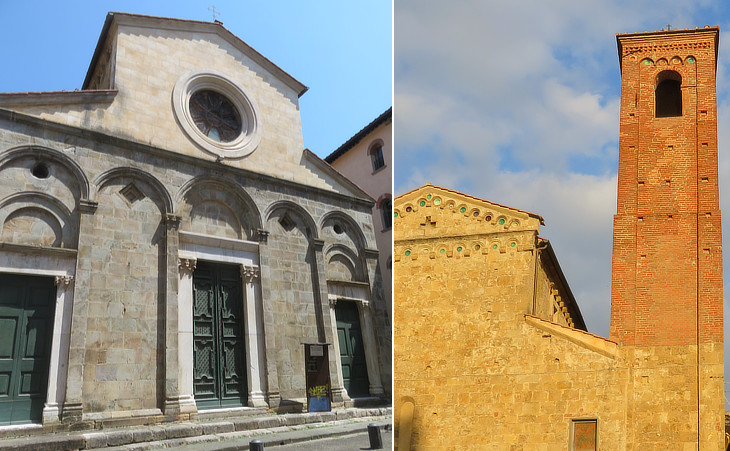
S. Andrea Forisportam: (left) façade; (right) bell tower
The small church of Sant'Andrea Forisportam (outside the walls) was first mentioned in 1104. On February 19, 1564 Galileo Galilei was baptized in this church. His mother lived nearby in today's Via Ammannati. Today the building houses a small theatre. Similar to S. Pierino its Romanesque aspect was emphasized in 1929-1930.
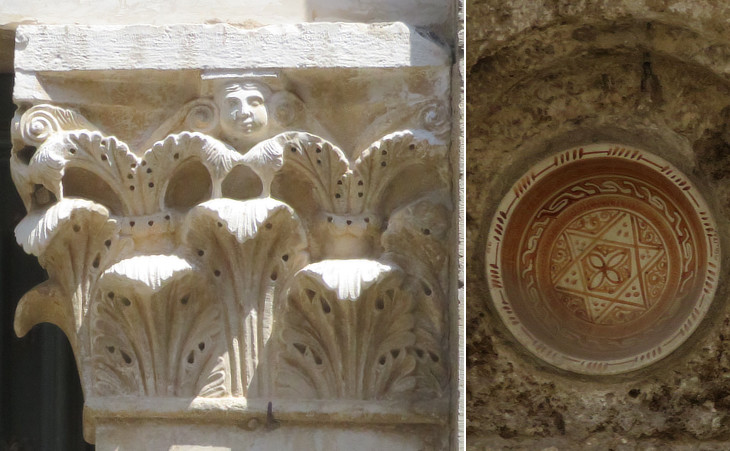
S. Andrea Forisportam: (left) capital of the portal; (right) decorative basin (copy)
Very many historical churches of Pisa were decorated with ceramic basins which have all been relocated to Museo Nazionale di S. Matteo in the 1970s to avoid theft or damage. They are dated from the second half of the Xth century to the XVIIth century. Many of them came from Northern Africa and Andalusia. Starting from the XIIIth century, there is also extensive documentation of local productions. They can be noticed also in some Romanesque churches of Rome, especially in their bell towers (e.g. that of SS. Giovanni e Paolo).
Move to
The Ancient Town
Piazza dei Miracoli
The Baptistery
The Camposanto
The Cathedral
The Knights of Pisa
The Walls and the Lungarni
A Walk along the northern Terzieri
A Walk along the southern Terziere
Churches of Terziere S. Maria
S. Maria della Spina
S. Matteo and its Museum
S. Piero a Grado
An Excursion to Vicopisano