All images © by Roberto Piperno, owner of the domain. Write to romapip@quipo.it.


Notes:
Page added in May 2026.
All images © by Roberto Piperno, owner of the domain. Write to romapip@quipo.it.
Notes:
Page added in May 2026.
 Perugia - Galleria Nazionale dell'Umbria
You may wish to see a page on the interior of Palazzo dei Priori first.
It is the student of art who profits by the present arrangement, for the pictures at Perugia are not difficult to find. With the exception of the Duomo and S. Pietro, most of the churches have been ransacked, and their canvasses and panels neatly stored in perfect order of dates and names on the walls of the Pinacoteca, and it is an easy matter, even in a quiet morning's stroll, to follow here the rise and fall of Umbrian art.
Margaret Symonds and Lina Duff Gordon - The Story of Perugia - 1898 (1912 ed.)
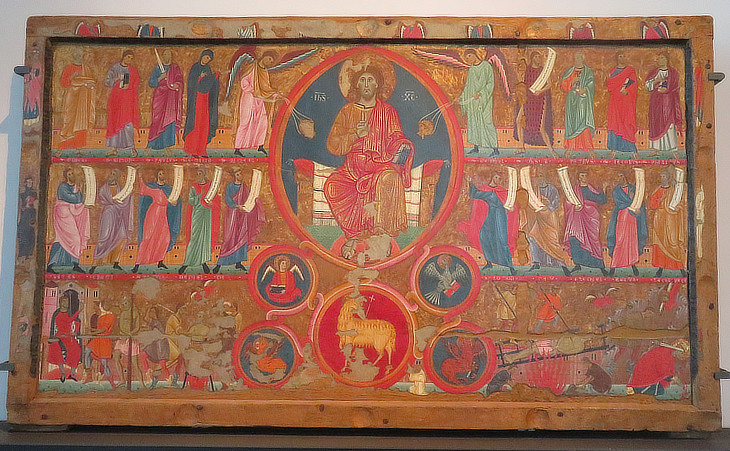
Paliotto or dossale (antependium) by Maestro di S. Felice a Giano, a small town near Spoleto (ca 1250)
Subjects: in the centre: Christ enthroned imparting his blessing between the Archangels Michael and Gabriel, Agnus Dei adored by the commissioning monk and symbols of the Evangelists; upper register: Apostles led by the Madonna, Apostles led by St. John the Baptist; central register: Prophets; lower register; episodes from the martyrdom of St. Felix, a bishop who was executed at the time of Emperor Diocletian.
This wooden painting is an early form of polyptych which was developed in the XIIIth century (see one at Pisa by Giunta Pisano); the depiction of Christ enthroned within a mandorla shaped aureola is typical of reliefs in portals or paintings in apses of medieval churches, e.g. at Arles and at Pomposa. The posture of Christ derives from Byzantine patterns.
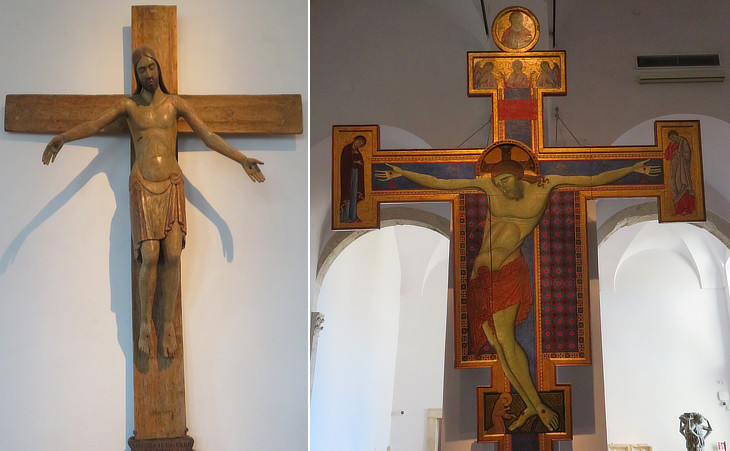
(left) Dead Christ (1236); (right) Processional Crucifix by Maestro di S. Francesco (ca 1272 - the saint is portrayed at the foot of Christ)
The first room in the gallery is devoted to the very earliest art of Siena and Umbria, and is one of those rather painful collections of pictures which we find in every local Italian gallery - a room of the primitive painters - which are, as the narrow path of art, beset with many thorns, where only those who passionately love the goal need try to push the briars back and tread the damp and pebbles. But we never forget, though we may even dislike, the pitiful pale figures of the crucified Christ, and the staring wooden saints in triptychs, for in them is shown the strain of technical ignorance, but of ignorance which strives with passionate pain to get beyond itself and soar towards the expression of some deep emotion. Symonds and Duff Gordon
This originally polychrome wooden figure of the dead Christ would have originally formed part of a group that included other actors in the deposition: the Virgin, St John the Evangelist, and probably Joseph of Arimathea and Nicodemus. Similar and broadly contemporary crucifixes were executed elsewhere, e.g. at Pisa and at Vicopisano.
The processional crucifix by Maestro di S. Francesco is double-sided: each side depicts the suffering Christ on the cross, with the Virgin and St John the Evangelist, but some other details are different. The side shown above bears the inscription HIC NAZARENUS; REX IUDEORUM; REX GL(ORIA)E on a red background (see a similar crucifix at Pisa by Giunta Pisano).
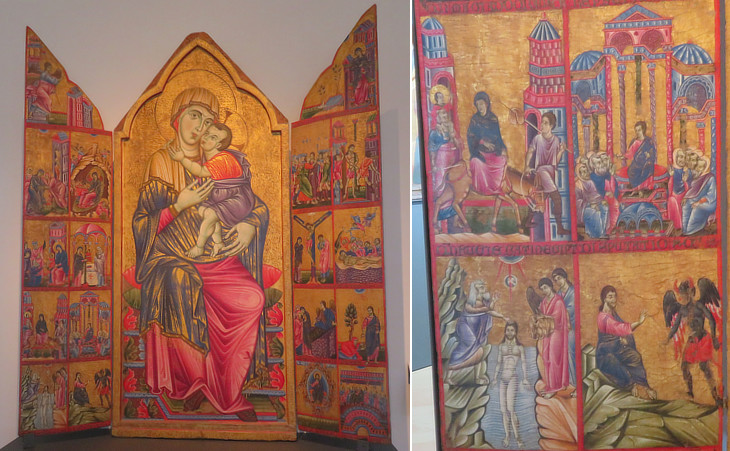
(left) Trittico Marzolini (1280-1290); (right) Scenes from the Life of Christ
The triptych was first exhibited in 1907 as a property of Monsignor N. Marzolini. It is interesting especially for the depiction of Infant Jesus in the act of giving Mary a tender kiss, a posture which departs from the formal iconography. Unlike other polyptychs no saints are portrayed. The small scenes are very vivid and in one of them the Devil is portrayed with wings of feathers in line with the opinion that he was a fallen angel, rather than a beast with bat wings. The triptych is associated with a Franciscan nunnery because at a later time the outer sides of the cover were decorated with portraits of Sts. Francis and Clare.
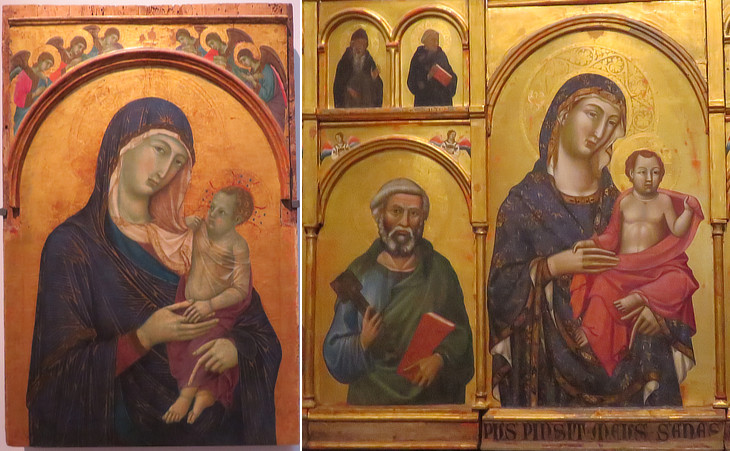
Madonna and Child: (left) by Duccio di Buoninsegna; (right) Detail of a polyptych by Meo di Guido da Siena with St. Peter and above Sts. Anthony the Abbot and Benedict
No great original work (with the exception of the missal workers, in which style of art Perugia is very rich) is left to us from the hand of a Perugian artist before the time of Bonfigli, and the early history of her art may be said to have been a great deal that of outside influences, for from very early times the best and greatest masters appear, like foreign tribes before them, to have climbed the hill and left some subtle marks upon her churches and her palaces. Symonds and Duff Gordon
Before the development of an Umbrian school of painting in the XVth century, the decoration of walls of churches and altars was chiefly entrusted with painters from Siena. A fine Madonna and Child was attributed to Duccio di Buoninsegna in 1897 by Bernard Berenson, and this attribution has never been questioned. It was originally the central panel of a polyptych: this would have been one of the first polyptychs in Umbria. Its design is closely related to that of Duccio's famous Maestà (1308-11) at Siena.
The polyptych is the only signed work by Meo di Guido da Siena (MEUS SENE[N]SIS) and it was clearly inspired by Duccio, although its structure is very similar to a polyptych by Simone Martini at Pisa. In both paintings the index of the left hand of Mary is very long and it derives from the Byzantine iconography of Theotokos Odigitria - She who shows the Way (see a mosaic from S. Pietro Vecchio in Rome).
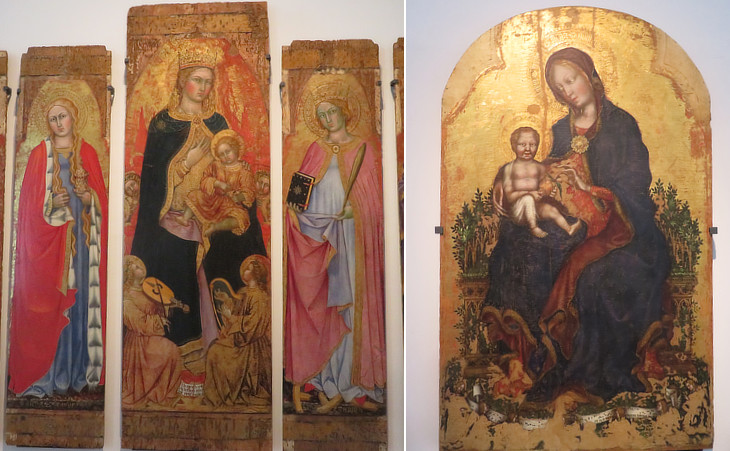
(left) Polyptych by Taddeo di Bartolo from S. Francesco al Prato: Madonna and Child with angels playing music (centre), St. Mary Magdalene (left) and St. Catherine of Alexandria (right); (right) Madonna and Child by Gentile da Fabriano from S. Domenico
As the School of Siena died, that of Umbria awoke to life. Close upon the heels of Taddeo Bartoli, those men followed who were born to precede the School of Perugino. Before them there were around Perugia only phantoms: stiff saints on panels and on parchment, without dates, ghosts of unattained, though dimly felt, ideals - a scattered flock of " primitives," left here and there on chapel walls or psalters. (..) The Umbrian School followed close upon that of Siena, and the Gallery of Perugia has some fine bits of Sienese work, notably some panels by Taddeo Bartoli in Sala IV. This room has some other good panels of early masters - of masters who probably influenced the Perugians, but whose names are lost to us. Symonds and Duff Gordon
See frescoes by Taddeo di Bartolo at Palazzo Pubblico of Siena.
Vasari mentions a very beautiful panel that Gentile da Fabriano painted for San Domenico, and it is usually dated to the period in which Gentile lived in Venice (ca. 1402-14). This was one of the first examples of what is now called International Gothic art to appear in Perugia (see another madonna by Gentile at Pisa).
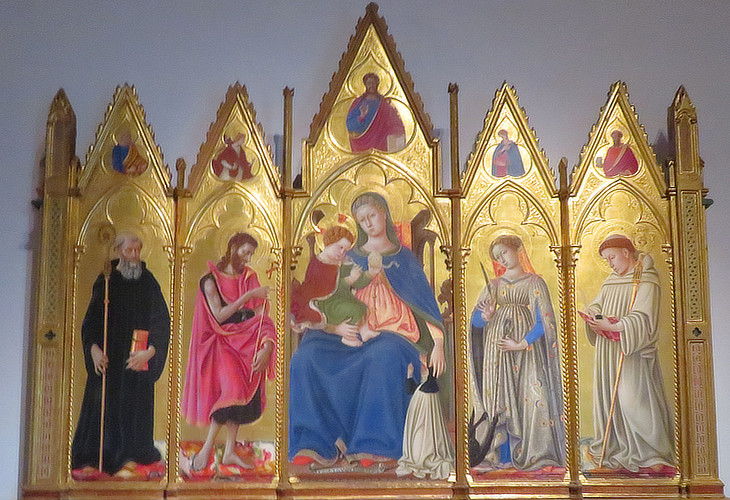
Polyptych from S. Giuliana by Domenico di Bartolo (see his frescoes at the Pellegrinaio of S. Maria della Scala in Siena) portraying Madonna and Child and the Abbess Antonia di Francesco Buccoli kneeling before her with Christ blessing in the gable above; (left to right) St. Benedict, with St. Peter in the gable above; St. John the Baptist, with the angel of the Annunciation in the gable above; St Juliana of Nicomedia (with a winged devil), with the Virgin Annunciate in the gable above; and St. Bernard, with St Paul in the gable above
S. Giuliana was a Benedictine nunnery outside the southern walls of Perugia. The dedication to St. Giuliana of Nicomedia (today's Izmit near Nicaea in Turkey) is not very frequent in Italy and in Rome there are no churches dedicated to this IIIrd century martyr who was executed because she refused to marry a Pagan. A medieval legend added to this account that she was tempted several times by a demon. Eventually the latter gave up: Madam, let me go, and give me leave to go in to some other place, for it is no need that I accuse thee to my father. At the last she let him go. (Golden Legend). This explains why St. Juliana is depicted leading a winged demon by a chain (in this case the chain seems to be attached to her navel through a hole in her gown). You may wish to see the frescoes which portray St. Frances of Rome tempted by a devil in the nunnery of Tor de' Specchi.
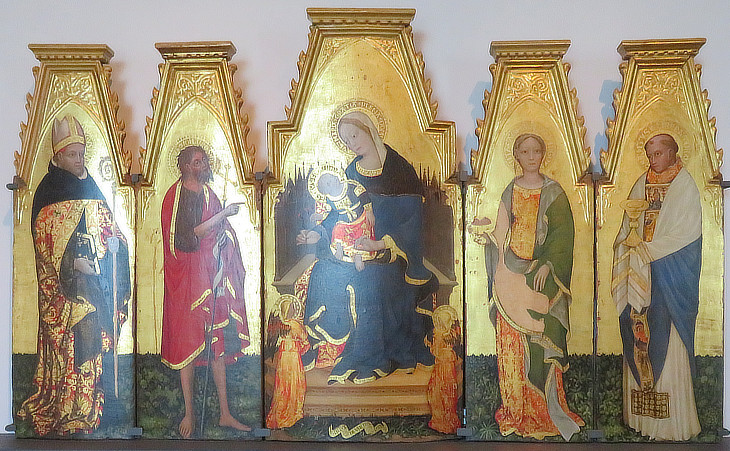
Polyptych portraying Madonna and Child Enthroned with two angels between St. John the Baptist and St. Augustine, St. Agatha who holds her severed breasts on a plate and St. Liberatore by Lello da Velletri (ca 1430 - his only signed work), a pupil of Gentile da Fabriano from S. Benedetto dei Condotti, a former nunnery
The scroll at the foot of the throne identifies the artist as Lello da Velletri. All five panels are set in a carefully painted flowery meadow, a tendency which eventually will lead to the depiction of madonnas and saints on a landscape background, especially in Umbria. The golden surface is elaborately carved in order to obtain arabesques and inscriptions in the haloes of the saints, of the Madonna (AVE MARIA GRATIA PLENA DOMINUS) and of the Child.
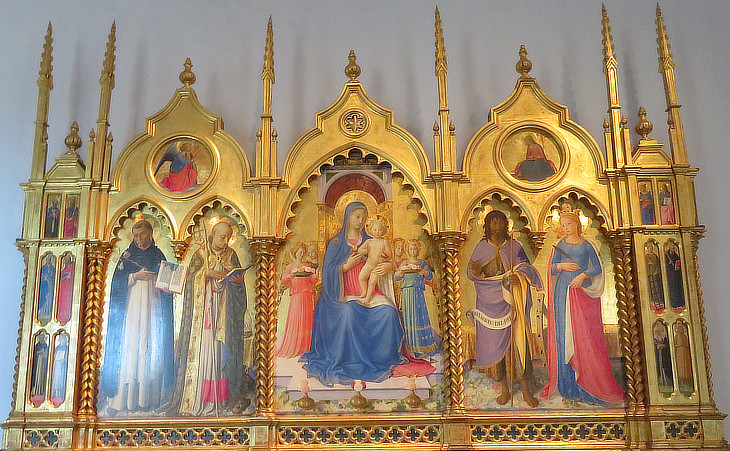
Polittico Guidalotti by Beato (Fra Giovanni) Angelico from S. Domenico (ca 1440)
The life of this really angelic father was devoted to the service of God, the benefit of the world and duty towards his neighbour. Virtue so great and remarkable should not and could not descend on any one of a life less holy than that of Fra Giovanni.
Giorgio Vasari - Lives of the most eminent painters, sculptors & architects - transl. by Gaston Du C. De Vere
We have dealt chiefly with the work of the Umbrian painters, and indeed, with the exception of Fra Angelico's panels and those of some of the Sienese masters, there is little else to study in this small and charming gallery. (..) Fra Angelico came to Cortona, and there did some of his very earliest work. Thence, very probably, he travelled to Foligno, staying on his way to rest at Perugia, and leaving there, in the church of S. Domenico, that wonderful picture, all the parts of which now hang together in the Pinacoteca. They are jewels, these small panels - jewels fresh as dewdrops on the first May wreaths of girls. Angelico never lost this bloom of utter purity, and here we find it at its very dawn. The Madonna and Child are in the centre; round them stand four angels, their baskets full of roses. Symonds and Duff Gordon
Yet simple though he was as a person, simple and one-sided as was his message, as a product he was singularly complex. He was the typical painter of the transition from Mediaeval to Renaissance. The sources of his feeling are in the Middle Ages, but he enjoys his feelings in a way which is almost modern; and almost modern also are his means of expression. We are too apt to forget this transitional character of his, and, ranking him with the moderns, we count against him every awkwardness of action, and every lack of articulation in his figures. Yet both in action and in articulation he made great progress upon his precursors so great that (..) we should value him as an innovator.
Bernard Berenson - The Florentine Painters of the Renaissance - 1896
The polyptych portrays also Sts. Dominic and Nicholas of Bari to the left; and Sts. John the Baptist and Catherine of Alexandria to the right. You may wish to see the frescoes by Beato Angelico in the Cathedral of Orvieto.
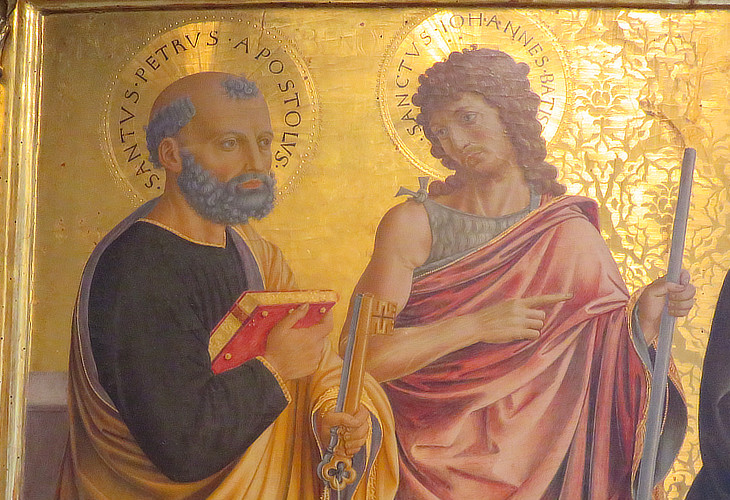
Detail of Pala della Sapienza Nuova portraying St. Peter and St. John the Baptist by Benozzo Gozzoli
Then gradually, all through Umbria and her border lands, in a steady circle of glory, like the stars on a summer night, the lights arose and burned. At Gubbio, Camerino, Foligno, Gualdo, Fabriano, and Urbino we trace their steady progress through the work of men like Nelli, Piero della Francesca, Gentile da Fabriano, Niccolo Alunno, and many others. And as these stars arose great comets travelled through them - Giotto, Fra Angelico, Benozzo Gozzoli, Filippo Lippi, and others, till the whole sky was full. Symonds and Duff Gordon
After the painters of Siena it was the time of those of Florence to be commissioned altarpieces for the churches of Perugia. Benozzo Gozzoli was a pupil of Beato Angelico; he worked at Montefalco, not far from Perugia.
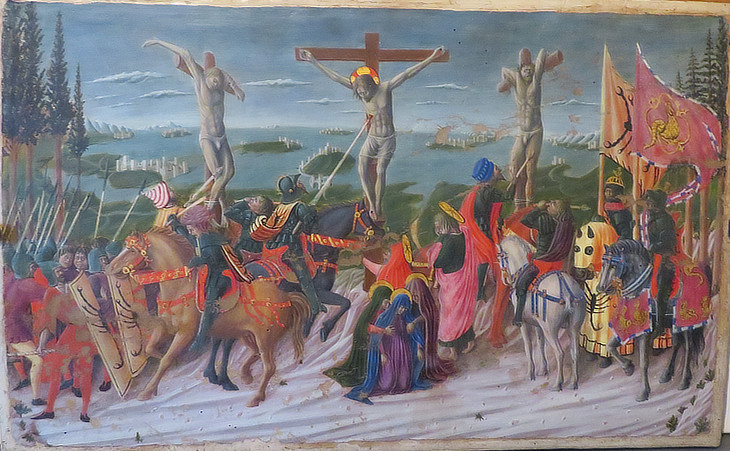
Small painting in the "predella" of Madonna del Pergolato, a polyptych by Giovanni Boccati (ca 1440)
Boccati da Camerino's work is rare. (..) The Madonna sits enthroned under a heavy pergola of roses, and all around her is a stiff little choir of angels: a most delightful and original conception. The picture was painted for the monks of S. Domenico, and so the emblem of the saint, his dog, had to figure in it. (..) The predella of the picture is full of stories almost in the style of Carpaccio. Boccati had a rare and charming fancy. Symonds and Duff Gordon
Perugia and Umbria had close contacts with Tuscan cities and painters, but during the XVth century they developed similar relations with towns of the Marches and today art historians often refer to an Umbro-Marchigian school of painting.
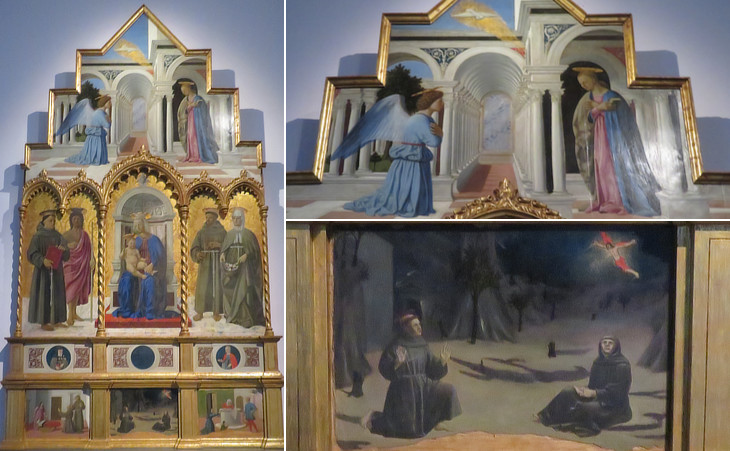
(left) Pala di S. Antonio by Piero della Francesca (ca 1470): Madonna and Child ; (right-above) Annunciation; (right-below) detail of the "predella": St. Francis receiving the stigmata (the scene is set at night, a choice which was unusual at the time)
Piero was one of Perugino's first masters. He was born early in the fifteenth century at Borgo San Sepolcro. He had a passion for perspective, and was one of the first men who made a real study of this branch of art. We hear that he wrote books on geometry, and grappled with Euclid and the laws of measurement. He also studied the proportion of light and shade, and all these points are admirably proved by his picture at Perugia. (..) Vasari gives a full account of it in his life of Piero. He describes the lower part, then adds: "Above them is a most beautiful Annunciation with an angel, which seems, in truth, to have descended from heaven; and what is more, a range of columns in perspective, which is indeed most beautiful. Symonds and Duff Gordon
The central part portrays the Madonna and Child, Sts. Antony of Padua and John the Baptist to the left and Sts. Francis and Elizabeth of Hungary to the right. The figures of the Annunciation are painted in front of an arcade that appears to be a mathematical study in perspective. Piero della Francesca wrote De prospectiva pingendi (On the Perspective of Painting) a treatise solely devoted to the subject of perspective. You may wish to see frescoes by Piero Della Francesca at Arezzo and Madonna di Senigallia at Urbino.
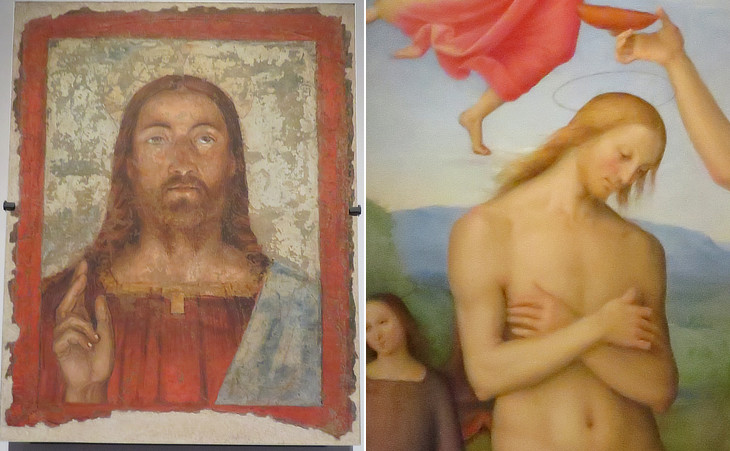
(left) Salvator Mundi, a detached fresco from Palazzo Pontani which was recently attributed to Melozzo da Forli (ca 1480) (see other paintings by Melozzo at Loreto and Rome); (right) detail of the Baptism of Christ in a dismantled polyptych by il Perugino
Piero was followed by two pupils, Melozzo, and Signorelli, each of whom, starting with the heritage Piero left them, and following the promptings of his own temperament, and the guidance of his own genius, touched excellence in his own splendid way.
Bernard Berenson - The Central Italian Painters of the Renaissance - 1897
In no land perhaps, and in no school of art, was the feeling of the painters more purely and more absolutely religious than in the land of Umbria. The saints were painted for places where saints were worshipped; the Christs have the love of the Father in their faces; the Marys are Mothers of pity and of grace; the bishops have renounced the ways of earth - their faces are calm and grey beneath their mitres. And the Umbrian angels are crowned with roses, but they are the roses of Paradise, and not the flowers of earth and of her banquets. Symonds and Duff Gordon
Perugino had a feeling for beauty in women, charm in young men, and dignity in the old, seldom surpassed before or since. Then there is a well ordered seemliness, a sanctuary aloofness in all his people which makes them things apart, untouched and pure. Berenson
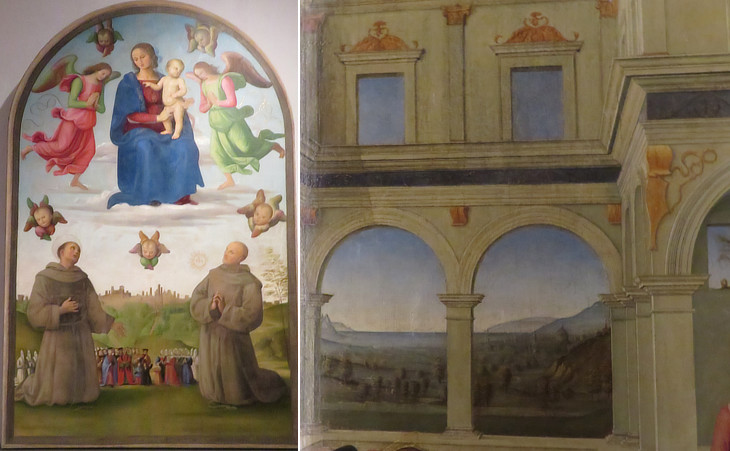
Perugino: (left) Standard of Justice (ca 1496); (right) detail of Annunciazione Ranieri (after the name of the owner of the painting - 1488 - another detail can be seen in the image used as background for this page)
Then from the centre of Umbria, straight from the hill of Citta della Pieve - there rose Pietro Perugino, and to his school came one with the halo of pure art upon his forehead, - Raphael Sanzio of Urbino. (..) It was at such times that the Umbrian school (..) painted the gonfalone, a style of picture which is very typical of Umbria, and which should be looked at with a knowledge of the events from which it first originated. These banners were carried about the city, the priests walking in front, the populace behind, a wail and shriek of lamentation falling on the air as the procession passed. Symonds and Duff Gordon
A gonfalone (religious standard) was a typically devotional work of art, the elements of which were carefully chosen in every detail. The divine role in the upper part is played by Virgin Mary, seated upon the clouds, with the Infant Jesus in her arms. The two kneeling figures in the central area are Sts. Francis and Bernardine of Siena. Below them, in the background, the faithful are divided by gender: women on the right, men on the left. Some of them wear elegant clothes; some, white garments, and a hood of the same color. They indicate the different kinds of membership in the brotherhood.
Finally, the town of Perugia provides the general background.
In the small painting depicting the Annunciation the scene was set in an elegant Renaissance courtyard in which Perugino showed his skill in perspective. His main work at Perugia was the decoration of Collegio del Cambio inside Palazzo dei Priori, but with an independent entrance.
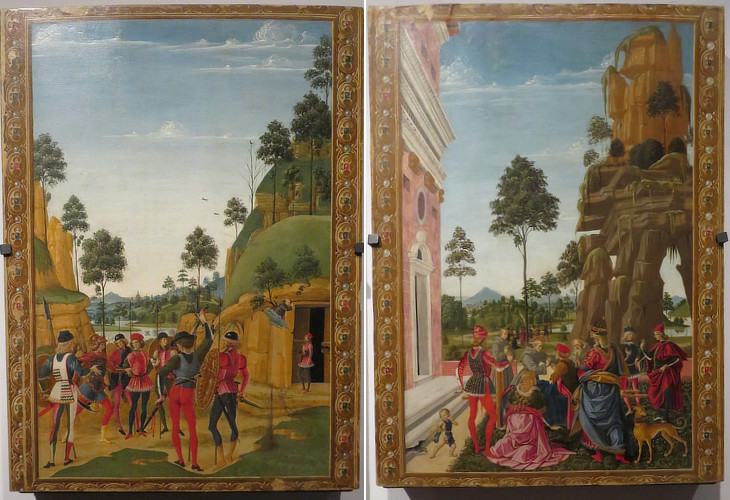
Miracles of St. Bernardine of Siena by il Pinturicchio: (left) the saint frees a prisoner; (right) the saint resuscitates a man who was hit by a falling tree
Bernardino di Betto, usually known as Pinturicchio and sometimes as il Sordicchio because he was deaf, and small and of a mean appearance, studied in the school of Perugia, and indeed was one of its most distinguished painters; but having left that earliest studio he carried his talents to other parts, and painted as we know for popes and princes, painted above all things those two wonderful series of frescoes in the Duomo at Siena and in the Borgia rooms at the Vatican. He has been called sometimes the Umbrian Gozzoli; certainly he was the historical painter of the great school which grew in the times of Perugino. Symonds and Duff Gordon
A group of artists known as the Workshop of 1473 is named for eight panels which depict miracles of St. Bernardine of Siena. They are dated by inscription and were first recorded in 1784 in the sacristy of S. Francesco al Prato and subsequently moved to the gallery. Two of them are attributed to Pinturicchio. The miracles are only an excuse for depicting fantastic landscapes and members of the affluent society of Perugia. See other paintings by Pinturicchio in Rome at S. Maria in Aracoeli and at S. Maria del Popolo.
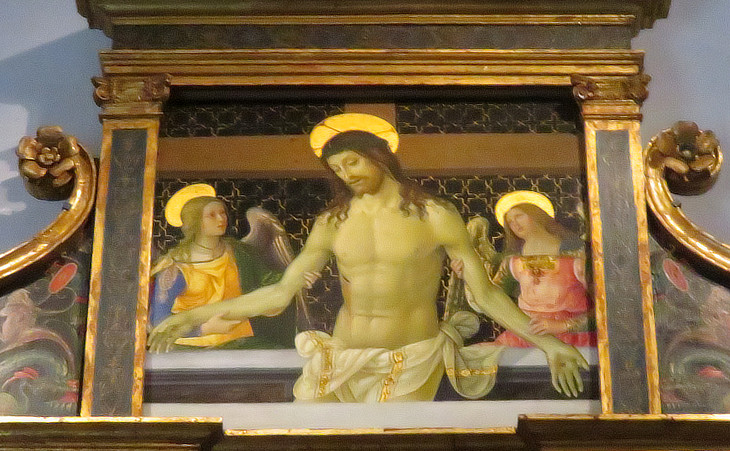
Pietà supported by angels, a detail of Pala di S. Maria dei Fossi by il Pinturicchio (ca 1495)
The splendid altar-piece, which alone remains to Perugia of this distinguished pupil of Perugino, is ill lighted and rather difficult to judge from top to bottom, but is interesting as well as beautiful; for the picture remains just as the painter painted it with all its panels in their proper order, unlike the panels of so many of Perugino's finest altar-pieces. The Pieta, the angel of the Annunciation, both the figures of the Virgin and the detail of their dresses, fruit and books, are exquisitely finished. Symonds and Duff Gordon
This was the most important commission that Pinturicchio ever received in his native Perugia, and it was highly regarded when it was unveiled.
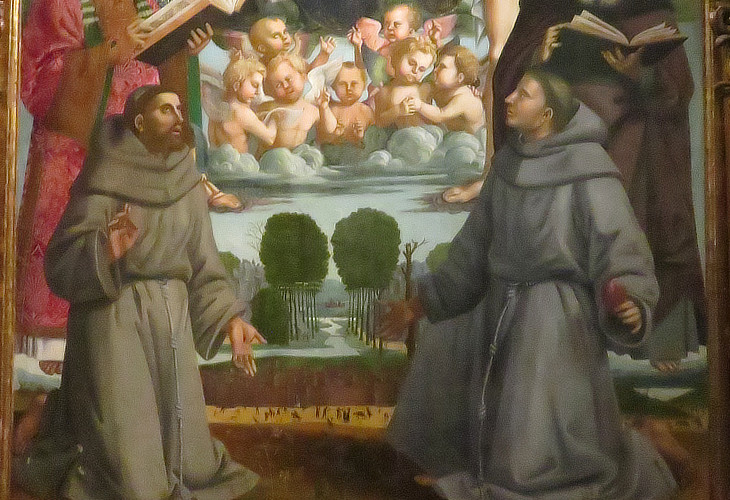
Lower section of Pala di Paciano portraying Sts. Francis and Antony of Padua by Luca Signorelli (1517) (notice the three knots of the white cord belts which represent the three evangelical vows taken by members of the Franciscan order: Poverty, Chastity and Obedience)
The landscape has been identified as a view of Lake Trasimeno between the villages of Panicale and Paciano. In this painting Signorelli paid tribute to the Umbrian tradition, but he is best known for an altarpiece in the Cathedral of Perugia and more dramatic works at Volterra, Castiglion Fiorentino, Cortona, Urbino and chiefly at Orvieto.
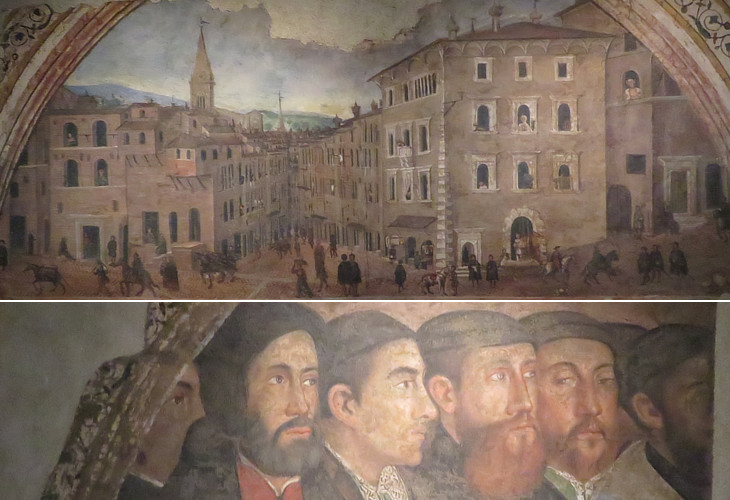
Frescoes which were detached in 1880 from Palazzo Pontani by Giovanni Battista Caporali (1535): (above) view of Palazzo Pontani at the beginning of Borgo S. Pietro; (below) a group of students whom Guglielmo Pontani (1478-1555) taught in the law school that he had established in the palace
The inhabitants of Perugia were very proud of their city and they often asked painters to depict it (e.g. at Cappella dei Priori). Guglielmo Pontani had his palace and the neighbouring buildings carefully depicted in a fresco. The economy of Perugia greatly declined after the conflict between the town and Pope Paul III and this had a negative impact on the embellishment of churches and palaces and also on the depictions of the city.
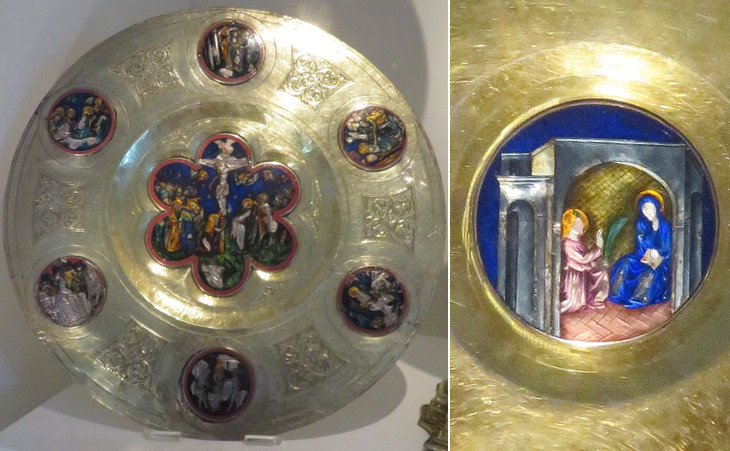
XIVth century patens, small plates used for the celebration of the Eucharist, from S. Domenico: (left) central enamel depicting a Crucifixion by Cataluccio da Todi; (right) central enamel depicting an Annunciation
The museum houses also a small number of sacred vessels (chalices, patens, reliquaries, etc.) which are made from precious metals. They come from the monastery and church of S. Domenico which were deconsecrated in the 1860s. The monastery today houses the Archaeological Museum of Perugia.
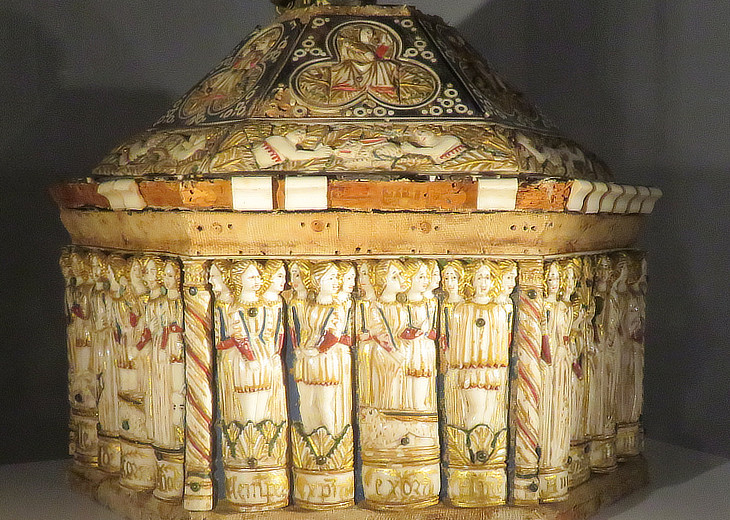
Hexagonal casket with nailed figures (1350-1390)
The wealth of XIVth century Perugia is testified to by a small number of luxury objects which are thought to have been made locally such as an ivory painted casket with virtues, geniuses, young figures, and animals in relief. These luxury objects were attempts to imitate those which were made at Constantinople.
You may wish to see a 2026 temporary exhibition on St. Francis and Giotto at Accademia Nazionale dell'Umbria.
Move to Walls and Gates, The Two Piazzas, The Interior of Palazzo dei Priori, Cathedral: Interior and Museum, The Papal Street (Borgo S. Pietro), S. Pietro de' Cassinesi, The Tomb of the Volumni, The Archaeological Museum or wander about to see other churches, palaces and fountains.