All images © by Roberto Piperno, owner of the domain. Write to romapip@quipo.it.


Notes:
Page added in May 2026.
All images © by Roberto Piperno, owner of the domain. Write to romapip@quipo.it.
Notes:
Page added in May 2026.
 Perugia - Inside Palazzo dei Priori
You may wish to see a page on the exterior of the palace first, which includes coverage of Collegio del Cambio and Collegio della Mercanzia.
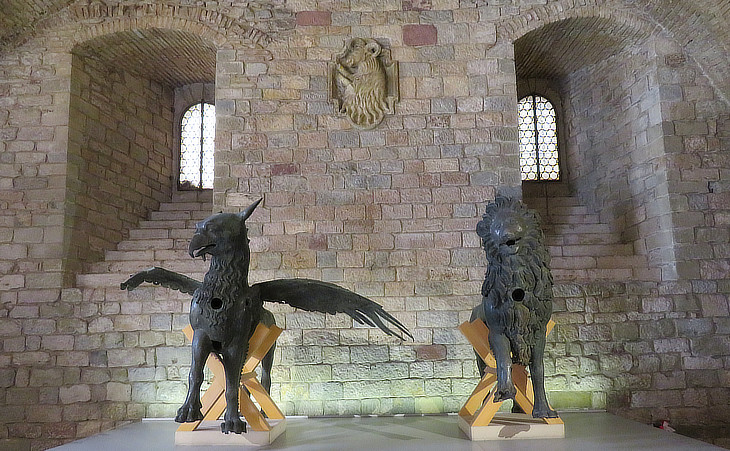
Entrance hall with the original bronze symbols of Perugia (a griffin and a lion) which stood outside the northern side of the palace and on the wall the heraldic symbol of Braccio Fortebracci aka Braccio da Montone (ram), a condottiere, i.e. a mercenary warlord, who ruled over Perugia between 1416 and 1424
The interior is not particularly remarkable.
John Murray - Handbook for travellers in central Italy - 1843
In the interior there is not much to see except a fresco in the Sala del Consiglio Communale, of Julius III. restoring to the city the magistrates who had been taken away by Paul III. ; and, in the chapel of the Priors, a fresco of Benedetto Bonfigli, 1460.
Augustus J. C. Hare - Cities of Northern and Central Italy - 1878
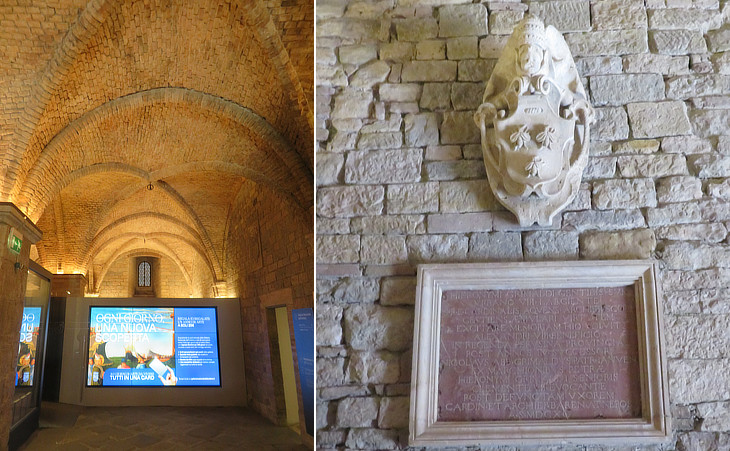
Unlike other public buildings of Italian medieval towns (e.g. Siena and Volterra), the interior of Palazzo dei Priori does not retain much of its original decoration because in the XVIth century part of it was turned into the residence of the Papal governors and later on it was used for the city administrative offices.
Though merely the municipal council house and exchange of a decayed country town, this structure was worthy to have held in one portion of it the parliament-hall of a nation, and in the other, the state apartments of its ruler.
Nathaniel Hawthorne - The Marble Faun - 1860
In Perugia as elsewhere, we find the usual titles of Consoli and Podestà, then of the Heads of City Guilds, the Priori (a very strong power in Perugia), Capitano del Popolo and Capitano della Parte Guelfa; all of whom recur again and again in her chronicles, playing important parts as peace-makers or as arbitrators in her turmoils and dissensions. (..) Having glanced thus rapidly over the general historical interest of the piazza, it may be well to describe the buildings separately, taking the Palazzo Pubblico first. Anyone who comes to Perugia, even for a single afternoon, will naturally hurry to this point and spend an hour or two in the Cambio and Pinacoteca; but if a little time remains he should wander further through its public corridors and halls and archives, its council chambers, library, and prisons. All these are gathered together with a certain indifference to the first lines of architecture in the shell of the massive old buildings, and by penetrating these mysterious regions one seems better able to understand the spirit of historical Perugia.
Margaret Symonds and Lina Duff Gordon - The Story of Perugia - 1898 (1912 ed.)
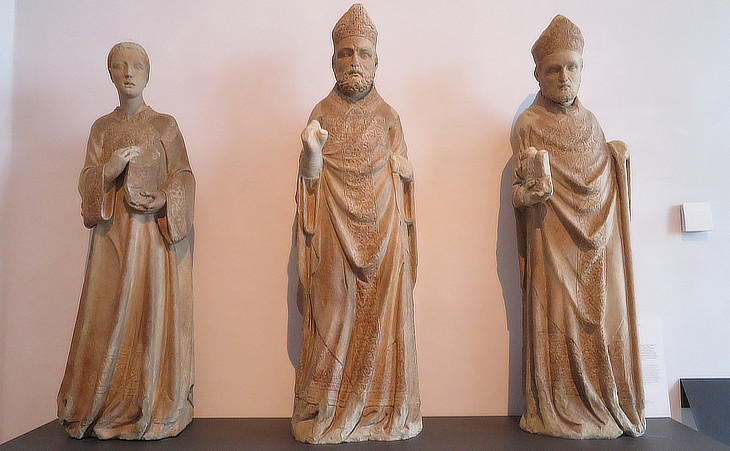
Statues of the patron saints from the eastern portal (early XIVth century): (left to right) St. Lawrence, St. Ercolano and St. Costanzo
According to tradition Costanzo was the first bishop of Perugia at the time of Emperor Marcus Aurelius. Similar to St. John the Evangelist he was thrown into a cauldron of boiling oil, but he survived. After many other tortures he was beheaded at Foligno. Of the three patron saints he is the most worshipped and a gate of the town is named after him. Il torcolo di S. Costanzo is a local cake having the shape of a ring which was made for the saint's feast on January 29.
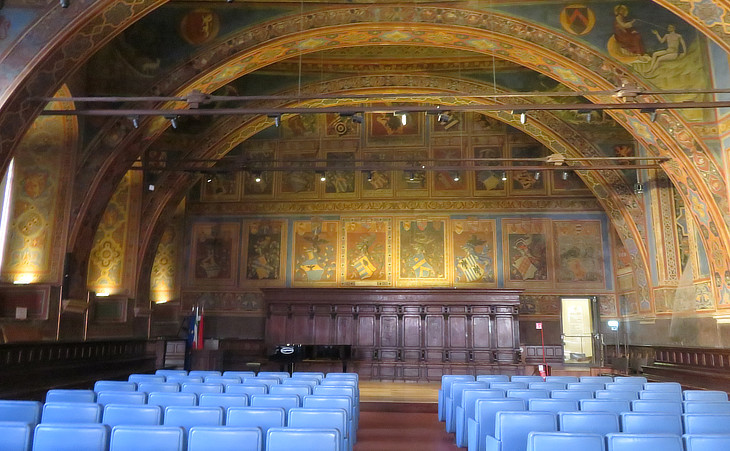
Sala dei Notari (highly restored paintings)
The door with the brazen beasts above it leads straight into the Sala del Notari - a splendid vaulted hall, its ceiling covered with frescoes, surrounded by high wooden stalls and steps of walnut. This big hall was given over to the lawyers of Perugia in 1583. They bought it, and their Collegio down below, from the city for the sum of 1000 scudi; and they at once decorated their fine new quarters, and settled comfortably into them, doing all their business there till early in the century. By the code of Napoleon they were, however, deprived of their privileges, and during the imperial French rule the hall was used as a criminal court. (..) They never returned to the pleasant haunts from which the Emperor ousted them, and the big hall is now used for public concerts and lectures. Symonds and Duff Gordon
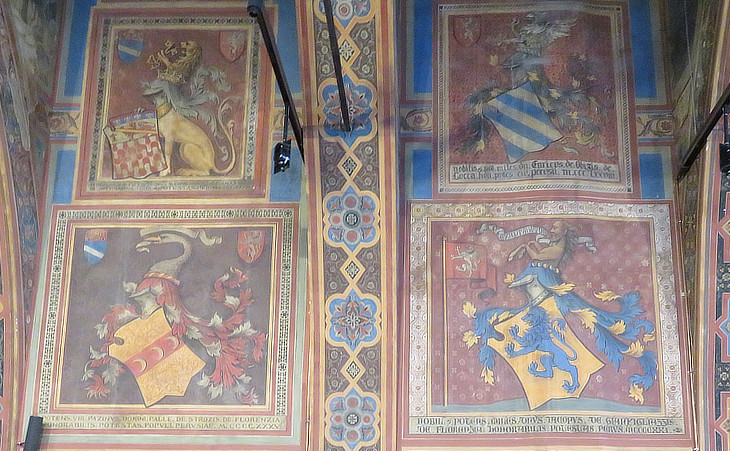
Sala dei Notari - Coats of arms of Capitani del Popolo or Podestà, some of which show a small coat of arms of Pope Eugenius IV; one of them (left-below) was a Strozzi from Florence
While Alexander VI., the Borgia Pope, was staying at Perugia in the summer of 1495, he made an effort to rid the Church of the whole Baglioni family at one stroke, but to gather at once all its members into his net required some diplomacy. Symonds and Duff Gordon
The hall was designed for the meetings of the Consiglio dei Priori. The arches were decorated with small scenes and the walls with coats of arms covering the period 1297-1499. Most likely the series was interrupted because of the conflict between Pope Alexander VI and the Baglioni, the de facto rulers of the town.
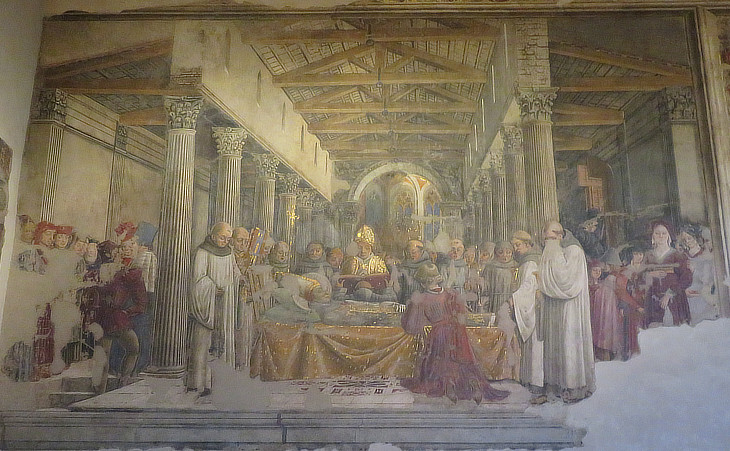
Cappella dei Priori - Funeral of St. Louis of Toulouse by Benedetto Bonfigli
One of the antechambers, formerly the chapel of the priors, has a fresco of Benedetto Bonfigli, in 1460, much damaged. Murray
We require no better clue for tracing the progress of Perugian
art in the person of its first local celebrity than that afforded by
the series of frescoes illustrating the legends of St. Louis of Toulouse
and St. Ercolano, in the Palazzo Comunale in that city.
They were begun in 1454, partly finished in 1461, and still incomplete in 1496. They reflect changes induced by the progress
of painting throughout Italy. (..) The fresco of the death of St. Louis is a composition of symmetrical order. The mendicant brothers surround the youthful saint, and mourn over him with decent grief, whilst males and females in lay costume stand in the aisles of the church in which the funeral ceremony is performed. The monks who bear the tapers or incense, move with some nature and animation. The architecture is drawn with a perspective skill which reveals the influence of Piero della Francesca. (..) The Priori did not at first contract for the whole chapel. (..) The Perugians really admired Bonfigli; they declared that the frescoes of the chapel were the greatest ornament to the city; and they believed that, were they not finished with equal talent and success, an ignominious stain would be cast upon them.
J. A. Crowe and G. B. Cavalcaselle - A new history of painting in Italy - 1864
Leaving the Sala dei Notari one crosses the main staircase of the palace, and passes into the living heart of the building, into a network, of separate rooms and offices which it is not necessary to describe at length. (..) Cappella di Bonfigli; half ruined by a form of restoration which perhaps is worse than none, ill-lighted, and without their former colour, the frescoes yet remain a delightful and engaging study. They represent the lives of St Louis of Toulouse, and S. Ercolano, patron saints of Perugia. (..) The following fresco is perhaps the most delightful of the series. It represents the burial of the Bishop of Toulouse. Now S. Louis is known to have died in his father's castle of Brignolles in Provence at the early age of twenty-four, but all this was of very secondary importance to Bonfigli. It was sufficient for him to know that a dead Bishop had to be painted. He selected the architecture that he loved best - his own Perugian church of S. Pietro - he sliced it in half so that all might look inside it, and on a bier in the centre of the aisle he laid the corpse of a quite middleaged Bishop. With infinite care and faithful precision he copied the lines of his church. The true basilica is here, not touched at all by decoration. There was no choir in those days; a dark blue sky looks in at the windows, the roof is bare with all its rafters showing. But the central figure is out of all proportion. The feet and the head of S. Louis of Toulouse almost touch the columns in the aisle. His robe, with the golden fleur de lis, is neatly folded round him, his mitre glistens in the light; his face is grey and calm, and full of dignity and of repose. Bonfigli had a sense of humour and could not refrain from a touch of caricature. It is impossible to look at the group of monks and prelates round S. Louis, and not to feel at once convinced of this. A fat and pompous Bishop in golden cope and mitre, is saying the mass for the dead. His large red book is supported by the head of a kneeling friar, and the very thumbs of this friar express his disgust and discomfort. To the left of the Bishop a group of roaring monks take up his words and repeat them in dolorous voices. Only to look at their faces one knows that their litany is absolutely out of tune. At the head of the Saint another priest is reading in a book, his acolytes swing incense, one holds the Bishop's staff. The rest of the church is filled with quiet groups of men and women; and the most charming figure of the whole is that of a young man in a red gown with a shock of yellow curls, who kneels, lost in prayer, at the knees of the dead Saint, his back turned to us. Symonds and Duff Gordon
St. Louis of Toulouse was a son of Charles II of Anjou, King of Naples who was canonised in 1317 and was regarded as a patron saint of Perugia, albeit a minor one. The decision to celebrate him at Palazzo dei Priori in the second half of the XVth century was perhaps linked to a political alliance with René of Provence, of the Anjou family, who at that time claimed rights on the Kingdom of Naples.
The image used as background for this page shows a fresco by Bonfigli depicting the bell tower of S. Pietro.
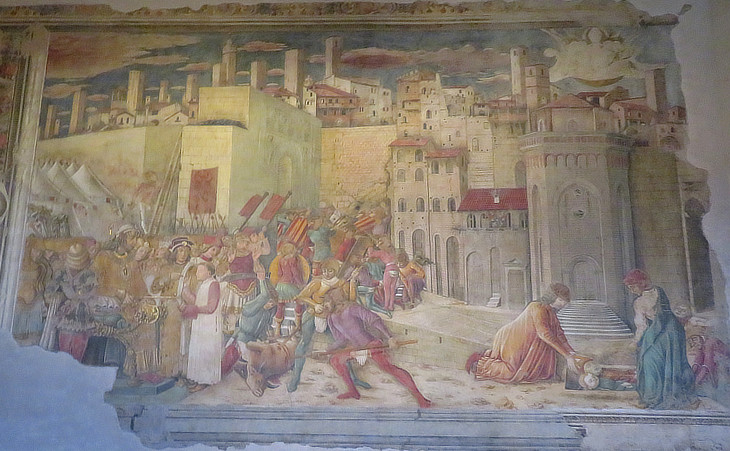
Cappella dei Priori - Perugia seized by Totila by Benedetto Bonfigli; the scene is set outside the southern walls of the town and it depicts Porta Marzia and the church of S. Ercolano
The next picture represents the siege of Perugia by Totila. No doubt this siege - that most memorable event in the annals of Perugia - was rather a chaos to the mind of Bonfigli as it is to many people nowadays; but the following history, taken from old chronicles, will explain the whole fantastic pageant. It will be remembered that Totila besieged Perugia in 549, and that the little town held out valiantly, but finally fell into the power of the Goths. During a terrible siege the Bishop of Perugia, S. Ercolano, attempted certain childlike and vain subterfuges of war, which unhappily ended in failure and in his own martyrdom. Ciatti records the events of the siege as follows : - "It is said that the saintly Bishop S. Ercolano, receiving much heavenly aid and holy counsels, and perhaps led by God, turned his soul to an act of human prudence. It happened that the city was reduced to extreme misery by reason of the scarcity of victuals, so that the citizens decided to surrender or to die fighting. S. Ercolano counselled them to bring him any grain which should still be found in the granaries, and they, knowing his great sanctity, obeyed and brought to him, after most diligent search, one small measure of corn. Then the Saint took the sole surviving lamb " (Bonfigli in his frescoes has painted an ox) " and, to the wonder and silent indignation of the people, he gave it to eat of the grain; it ate abundantly and the Bishop then threw the lamb with great force down from the ramparts, when, by reason of its great fulness and the height of its fall, the innocent beast was at once killed. When the captains of the enemy beheld this thing they were angry, saying: ' These Perugians have so much grain that they can give it to their beasts to eat, and so much meat that they cast it carelessly away, how can we, therefore, hope to subdue them by famine? ' But it chanced that a young acolyte spoke from off the ramparts to some Goths and unwittingly revealed to them the distress and the mortality reigning in the city by reason of the want of food; and the stratagem of S. Ercolano becoming known in the camp, the infuriated Goths, hot with anger, returned to the attack and with impetuous fury assailed the deserted walls. Greeks and Perugians rushed to arms, but what could they, poor starvelings, do against the Gothic host? "
Thus fell Perugia. Our learned author goes on to describe how S. Ercolano was conducted to the ramparts and after his skin had been torn off in strips from the neck downwards, he was beheaded and his body thrown into the ditch. Some faithful adherents gave it secret burial, and finding the body of the foolish young acolyte near by, laid it in the same grave. Later, Uliphus, governor of the city, allowed the Perugians to give their beloved pastor proper burial. To the astonishment of all beholders the Saint's head was found joined to his body, which seemed like that of a man asleep. This miracle converted many of the Arian Goths to the Roman faith, and "with rejoicings and hymns of praise the body of S. Ercolano was borne through the streets to the church of S. Lorenzo." Symonds and Duff Gordon
This piece is striking, because it contains a view of the church of S. Ercolano and the Roman gate as they now stand, without effect of light and shade, but wonderfully minute in drawing. Crowe and Cavalcaselle
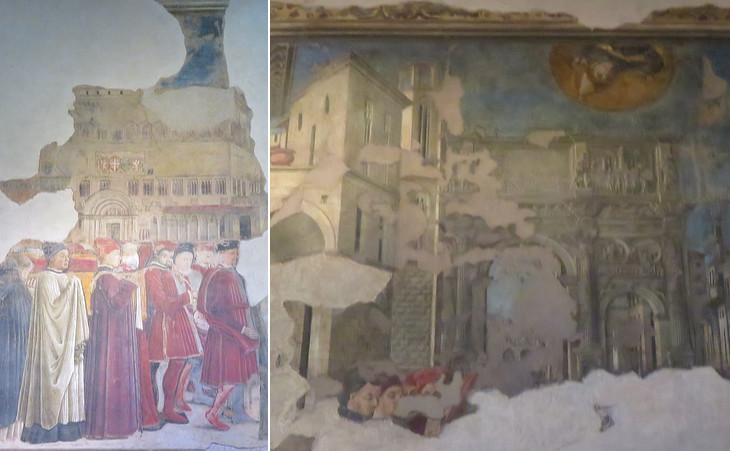
Cappella dei Priori - frescoes by Bonfigli: (left) detail of the burial of S. Ercolano showing the eastern façade of Palazzo dei Priori; (right) a Roman arch similar to that of Constantine
The next picture gives the burial of S. Ercolano. It is only a fragment, and we can hardly piece the scattered groups together. (..) The curving front of the Palazzo Pubblico upon the Corso is painted with accurate care, the loggia of Fortebraccio too, is clearly seen and understood. But the picture is only a shadow; the part we most wish to see, namely, the north front of the Palazzo, is wholly obliterated, and the restoration spoils it terribly. (..) The next picture has been terribly damaged, and it is difficult to understand the subject; but a learned gentleman of Perugia, to whom we are indebted for various most ingenious suggestions, fancies that it is simply the representation of some miracle of healing performed by the Saint in Rome; certainly Bonfigli has striven to combine in his background a marvellous mixture of Roman and Etruscan architecture, the arch of Constantine mingling with Porta Susanna and the Colosseum! Symonds and Duff Gordon
Looking at the work as a whole (1454-1480), we are not surprised that a man who thus modified the Umbrian style by adapting to it that of Domenico Veneziano and Piero della Francesca should be a favourite with his countrymen. He is superior to all the Umbrians of his age except Francesca. Crowe and Cavalcaselle
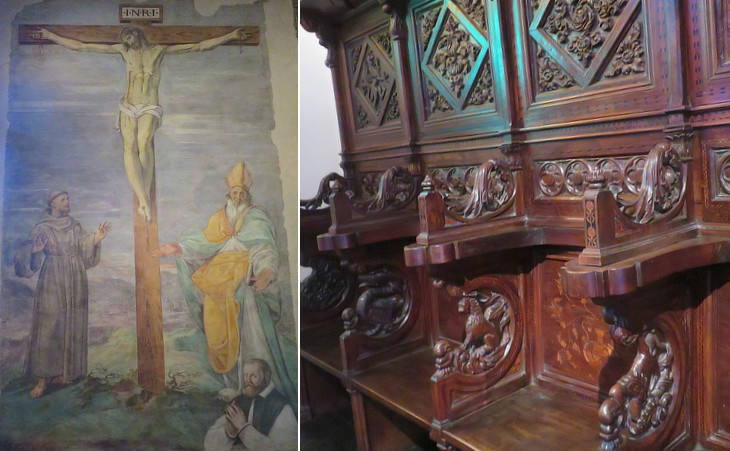
Cappella dei Priori: (left) Crucifixion between St. Francis and St. Ercolano (1565) by Arrigo Fiammingo (Hendrick van den Broeck); (right) stalls (1452-1466) by Gaspare da Foligno and Paolino da Ascoli
Hendrick van den Broeck or Arrigo Fiammingo (1530-1597) was a Flemish painter and sculptor of the late-Renaissance. After training in Flanders, he travelled to Italy where he remained active in various cities for the remainder of his life. He painted a very large Last Judgement at the Abbazia di Farfa. The donor who is portrayed next to St. Ercolano is most likely Francesco Bossi(o), vice-governor of Perugia.
Wood carvings and inlays were highly appreciated by the citizens of Perugia (see other carvings at the Cathedral, Collegio della Mercanzia and S. Pietro dei Cassinesi).
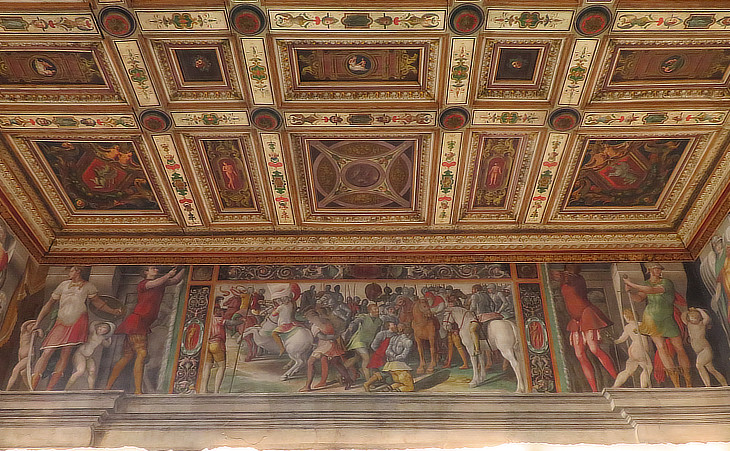
Sala Farnesiana: the killers of Pier Luigi Farnese, Duke of Parma are arrested by Tommaso Bernabei (1546)
Sala dei Cimeli. The frieze round the top of the same room clashes hopelessly with the calm pre-Raphaelite figures beneath it. It was painted by Tommaso d'Arcangelo. a pupil of Giulio Romano, and represents some of the events in the life of Braccio Fortebraccio. Symonds and Duff Gordon
The events depicted in this hall were traditionally thought to be linked to the life of Braccio da Montone, but this opinion was not consistent with the date of their execution because in 1534 Pope Paul III took possession of Perugia and turned the palace into the residence of his governors. It is very unlikely they would have promoted the celebration of Braccio, a symbol of the independence of Perugia.
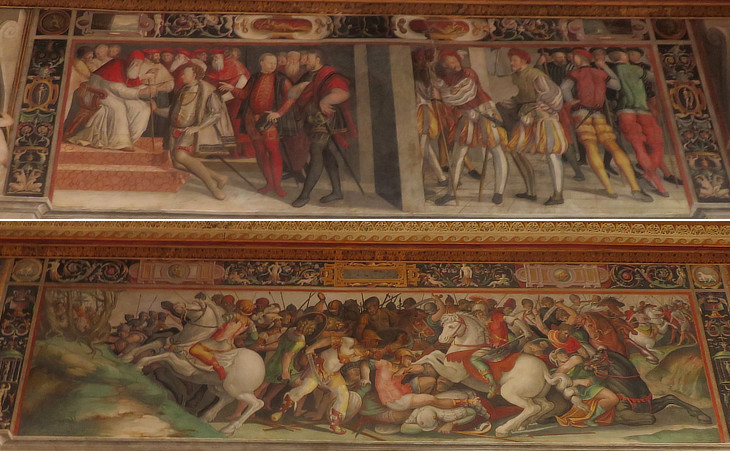
Sala Farnesiana: (above) Ottavio Farnese, son of Pier Luigi is appointed "Gonfaloniere della Chiesa" by Pope Paul III; (below) scene of an ancient battle
The efforts by Pope Paul III to install Pier Luigi as lord of Piacenza and Parma were made difficult by the conflict between France and Spain for the hegemony over Italy. Ottavio Farnese (who married Margaret, natural daughter of Emperor Charles V) eventually managed to be recognized as Duke of Parma and Piacenza and also as Duke of Castro (this fiefdom was lost in 1649). In 1714 Philip V of Bourbon, King of Spain married Elisabeth Farnese, daughter of the last Duke of Parma. Their son Philip became Duke of Parma in 1748 and he founded the House of Bourbon-Parma, a cadet line of the House of Bourbon. They ruled over Parma until 1859.
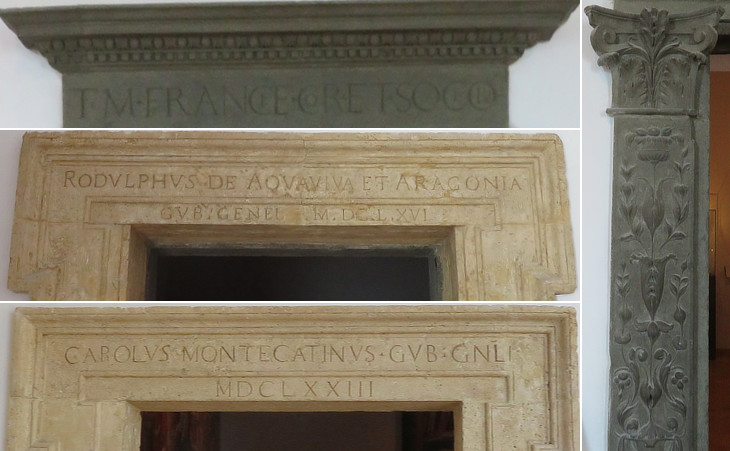
Palazzo dei Priori: portals in the former apartments of the governors (XVIth century dark stone - XVIIth century white stone)
It was on the last day of August 1535, and at about midnight, that "His Blessed Holiness" arrived at the gates with fourteen cardinals and some companies of 600 or 700 horse and 700 infantry. The Pope rode up on horseback, dressed in scarlet. Drums and tambours heralded his approach. The cardinals rode by two and two. (..) The Priori all in new and gorgeous robes, preceded by the Holy Eucharist, came out to meet him, and through their ambassador they presented to His Holiness a silver basin containing the keys of the city. (..) The following day he entered the city with extraordinary pomp and took up his abode in the Palazzo Pubblico, where the Priori had vacated their own rooms in order to give him proper space. Symonds and Duff Gordon
The papal governors modified the interior of Palazzo dei Priori to suit their needs. The Acquaviva d'Aragona were a noble family of Atri. Carlo di Montecatini is buried at S. Maria in Aquiro in Rome.
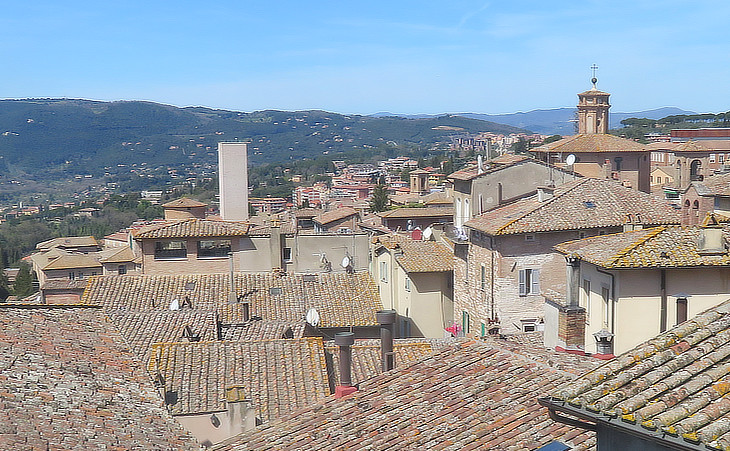
Palazzo dei Priori: view westwards showing Torre degli Sciri and S. Filippo Neri and in the distance the mountains on the northern shore of Lake Trasimeno
Perugia is chiefly known to
fame as the city of Perugino, Raphael's master; but it has a still higher claim
to renown and ought to figure in the gazetteer of fond memory
as the little City of the infinite View. (..) I spent a week in the place, and when it was gone I had
had enough of Perugino, but hadn't had enough of the View.
Henry James - Italian Hours - 1874
The apartments of the governors enjoyed commanding views over the town and the surrounding countryside.
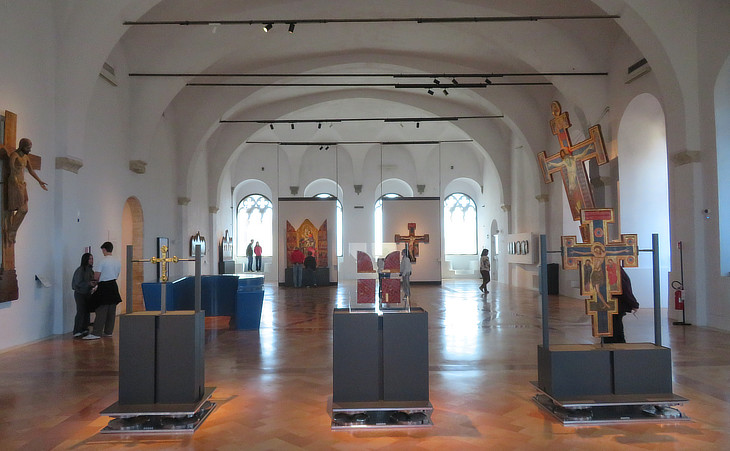
Palazzo dei Priori: First Hall of Galleria Nazionale dell'Umbria
At the University the Pinacoteca, or Gallery of the Academy of Fine Arts, although a small collection, comprises many interesting works in the history of art. Murray
The Via de Pasteni, on the right, leads to the University, founded in 1307, in an Olivetan convent. It is the third largest University in Italy.
Here also is the Pinacoteca, arranged in the desecrated church and its sacristies. Hither the best pictures in the town have been removed, and greatly lose in interest by separation from the places for which they were intended and painted. Hare
The pictures of Perugia were formerly stored in the museum of the University. In 1871 they were removed to the top storey of the Palazzo Pubblico, and here, since they may never again return to church or convent, they have found a permanent and fitting home. Symonds and Duff Gordon
The museum was known as Pinacoteca Vannucci (Pietro Vannucci being il Perugino) until 1918 when it was acquired by the State. It is still mainly a pinacoteca, i.e. a public art gallery concentrating on paintings, but it now contains a few sculptures which come from the main monuments of the town. The paintings are covered in a separate page.
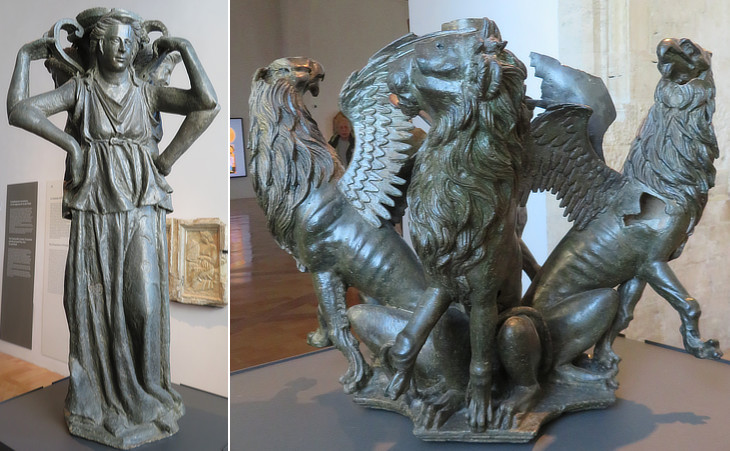
Bronze spouts from Fontana Maggiore: (left) the three "nymphs" who represent the three theological virtues (Faith, Hope, Charity); (right) lions and griffins
The people of Perugia having brought a very great body of water through leaden pipes from the hill of Pacciano, (..)
it was given to Giovanni Pisano to make all the ornaments of the fountain, both in bronze and in marble; wherefore he put his hand thereto and made three tiers of basins, two of marble and one of bronze. The first is placed above twelve rows of steps, each with twelve sides; the other on some columns that stand on the lowest level of the first basin-that is, in the middle; and the third, which is of bronze, rests on three figures, and has in the middle certain griffins, also of bronze, that pour water on every side; and because it appeared to Giovanni that he had done very well in this work, he put on it his name.
Giorgio Vasari - Lives of the most eminent painters, sculptors & architects - transl. by Gaston Du C. De Vere
The posture of the arms of the nymphs is that typical of Italian women carrying water (see a XIXth century painting) whereas their clothing is based on ancient models (e.g. canephorae, basket-bearers). The groups are attributed to Giovanni Pisano or to Rosso Padellaio, aka Rubeus, a German foundryman.
The lions and griffins are recorded as spouts of Fontana Maggiore by Vasari and they were actually removed from there, but today they are thought to have been designed for another (lost) fountain.
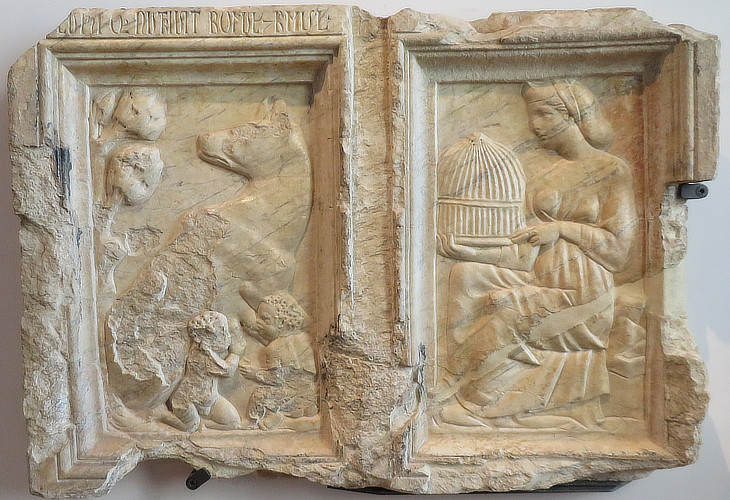
Reliefs from Fontana Maggiore by Giovanni Pisano: (left) the she-wolf and Romulus and Remus with the inscription: Lupa Q(ui) Nutrivit Romul(us) Remul(us); (right) Rea Silvia, their mother, holding the model of a round temple (assumed to be that to Vesta)
You may wish to see other reliefs by Giovanni Pisano in the Cathedral of Pisa which have similar explanatory inscriptions. Remolus instead of Remus is a frequent mistake, because it better hints at the fact that the two brothers were twins.
Chi ha fabbricato a Roma er Vaticano,
er Campidojo, er Popolo, Castello?
Furno Romolo e Remolo, Marcello:
che nisun de li dua era Romano!
Giuseppe Gioacchino Belli (1791-1863)
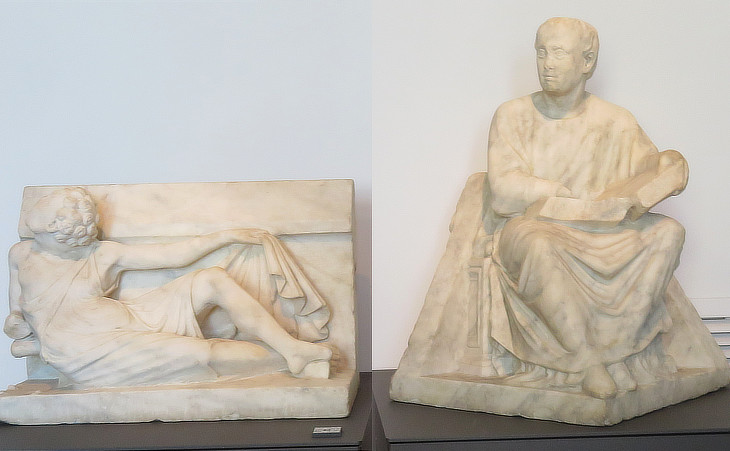
Small statues (a thirsty sick man and a scribe) from a lost fountain by Arnolfo di Cambio (1281)
We find proof of Arnolfo being settled as an independent maestro at Naples, in a letter written by the magistrates of Perugia a.d. 1277. requesting Charles of Anjou to allow his architect Arnolfo to assist in building the fountain of the piazza at Perugia. To this letter the king returned a gracious answer, giving the required permission, and promising to send with him a present of marbles to be used in the construction of the fountain, but whether Arnolfo went is uncertain, as his name is not found with those of Niccola and Giovanni upon the fountain, and as the municipal records of the time, which would have settled the question, are unfortunately missing.
Charles Perkins - Tuscan sculptors - 1864
Today we know that Arnolfo worked at a fountain near Palazzo dei Priori which was dismantled in 1308. Other sculptures by him can be seen at Florence, Orvieto, Viterbo and Rome.
Move to Walls and Gates, The Two Piazzas, Galleria Nazionale dell'Umbria, Cathedral: Interior and Museum, The Papal Street (Borgo S. Pietro), S. Pietro de' Cassinesi, The Tomb of the Volumni, The Archaeological Museum or wander about to see other churches, palaces and fountains.