All images © by Roberto Piperno, owner of the domain. Write to romapip@quipo.it.


Notes:
Page added in September 2026.
All images © by Roberto Piperno, owner of the domain. Write to romapip@quipo.it.
Notes:
Page added in September 2026.
 from the early days!
The exhibition Greece in Rome (November 1925 - April 2026) at Palazzo Caffarelli (Musei Capitolini) displayed some 150 items which testify to the influence of Greek art in the early days of Rome through trade and the purchase of costly and refined artifacts and later on, as a consequence of IInd century BC Roman conquest of Greece, by the relocation of works of art, chiefly statues, to the palaces and gardens of wealthy Romans. The identification of the Greek origin of reliefs and statues is mainly based on the analysis of their marble, in order not to include Roman copies of Greek works or items made by Greek workshops for Roman customers. For this reason almost all the exhibits are dated BC. The exhibition includes also some recent archaeological discoveries.
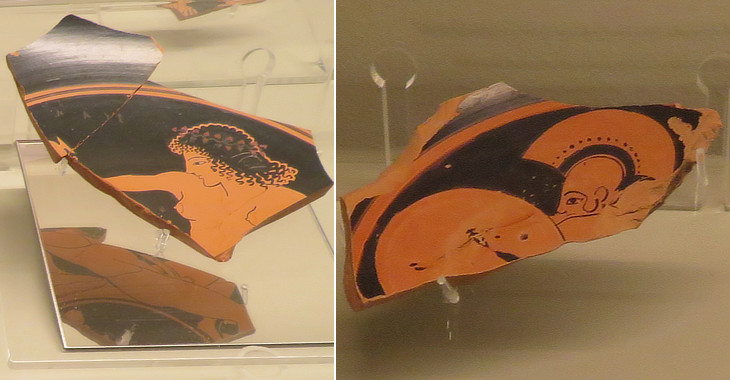
Curiae Veteres was a shrine at the north-eastern end of the Palatine near the modern passage between Meta Sudante and Arco di Tito which has been identified and excavated in 2014-2017. Curiae were the original groupings of the citizenry. In this shrine the representatives of the curiae met to celebrate and perform sacrifices to Quiritis, a goddess of the Falisci who eventually was associated with Juno. The building was initially built in the VIIth century BC and it was modified many times until it was destroyed by the 64 AD fire of Rome. Fragments of fine red-figure vases imported from Greece were discovered in a well. These vases were very sought after by the Etruscan towns near Rome (see the Euphronios Krater at Cerveteri).
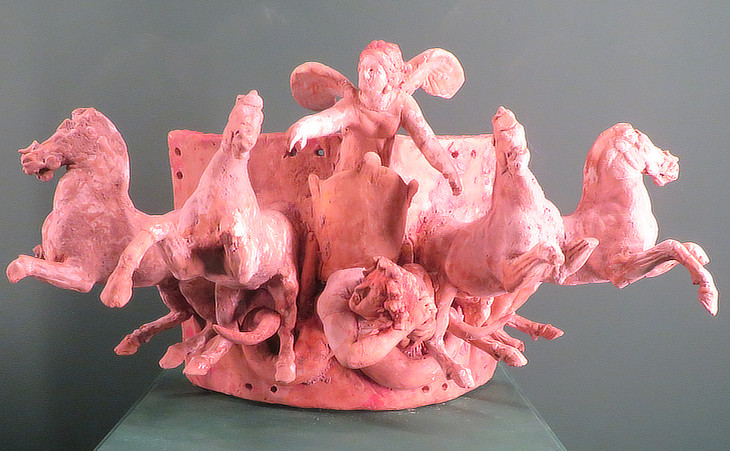
Quadriga (chariot drawn by four horses abreast) driven by a Nike running over a triton (painted pottery - IIIrd century BC - Museo Nazionale Romano)
In 1965 during excavations for the modern Ospedale di S. Giovanni a number of tombs of the Republican period were discovered. They had been looted, but the robbers were interested only in jewels and metal objects and they did not care about some broken pottery decorations. In particular restorers have been able to reconstruct two very similar quadriga. They retain evidence of painting. The design of the horses is typical of Greek art so either they were made in Greece or the local Roman ceramists were familiar with Greek models of the Hellenistic period which broke away from the composure of the Classical patterns by creating dynamic movement and realistic details. They probably decorated a cista, a container for jewels or toiletries.
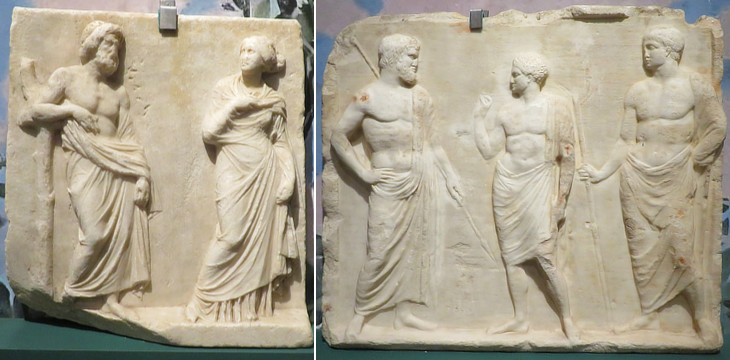
White marble reliefs (most likely Pentelic marble): (left) Homer and a Muse, discovered in 1896 near Colosseo (early IIIrd century BC) from the Deposits of Musei Capitolini; (right) three men (late Vth century BC) recorded in Rome since the mid of the XVIth century (Musei Vaticani - Museo Gregoriano Profano)
At the narrow neck of the Isthmus, Hellas begins, by our people known as Græcia. The first state that presents itself is Attica. (..) Athens is a free city, and needs not a word more from us in its commendation; of fame it enjoys even more than enough (Book IV).
All these (Greek) artists, however, used nothing but the white marble of the Isle of Paros, a stone which was known as "lychnites" at first, because, according to Varro, it was cut in the quarries by lamplight. Since their time, many other whiter marbles have been discovered, and very recently that of the quarries of Luna. (..) In the ædileship of M. Scaurus, three hundred and sixty columns were to be seen imported of Hymettian marble (Book XXXVI)
Pliny the Elder - Historia Naturalis Loeb Edition
Of the white marbles of antiquity the most important were the Parian and the Pentelic, both quarried in Greece. The Hymettian marble, from Mount Hymettus on the southeast side of Athens, was employed in the construction of temples and statues, throughout Greece, but especially in Athens. The Romans used it to a much greater extent than the Pentelic which was quarried north of Athens, partly because the quarries were nearer the sea, and partly because its peculiar tint became the fashion. It was of a much less brilliant white than the Pentelic, in some places becoming almost grey.
The study of the crystalline and texture structure of marble reliefs is a key element in the identification of their Greek origin. When however they cannot be associated with a particular monument or their subjects are not particularly interesting they end up in the deposits of museums or in their less important sections. One of the purposes of the Exhibition was to highlight their importance by placing them in the proper historical context.
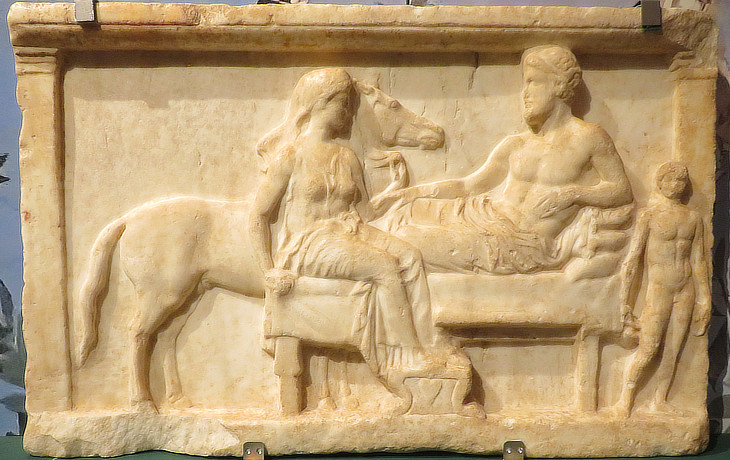
Relief with scene of a funerary banquet (Pentelic marble ca 400 BC - Museo Nazionale Romano); the image used as background for this page shows the head of a bearded man in a funerary relief
This fine relief was part of the collection of Cardinal Camillo Massimo who is best known for having been a collector of coins, manuscripts and books. At the time of his death in 1677 he had collected 2553 coins, some very valuable for their rarity and historical value. He was considered one of the most knowledgeable experts on Greek and Roman coins and his opinion was sought by other antiquarians of his time. In addition to coins his collection included reliefs and small Roman mosaics, as he was among the first to appreciate them.
The presence of a horse in the relief is a symbol of wealth, prestige, and military power. The Parthenon was decorated with a frieze depicting horses and a fine relief by the same subject can be seen at Delphi.
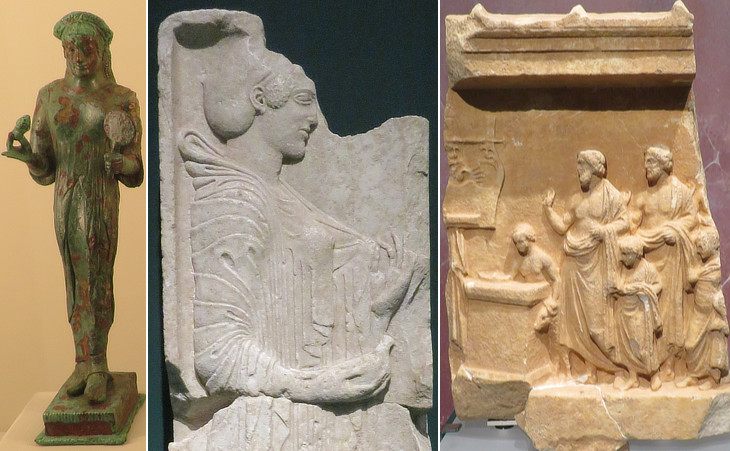
(left) Bronze "kore" (girl) from Lavinium (VIth century BC - MNR); (centre) Parian marble funerary relief depicting a woman with a dove, a symbol of marital fidelity (500-475 BC - Musei Capitolini see an Etruscan relief); (right) Pentelic marble votive relief to Apollo Patroos (of the fathers) (late IVth century BC - Ny Carlsberg Glyptotek Copenhagen)
Since its early days Rome was in contact with Greek colonies in Campania and with minor settlements (e.g. Lavinium) with a mix of Etruscan and Greek cultures. kore is a free-standing statue of a girl of the Greek archaic period and Kore is the epitome of this girl being the daughter of Demetra.
The funerary relief of a woman with a dove and the fragment of the relief to Apollo Patroos were both discovered after 1870 in an area where after the Ist century BC the wealthy Romans had their horti (gardens). The gardens were embellished with works of art which included early Greek reliefs. They were most likely bought in the antiquarian market of Athens. The Temple of Apollo Patroos (meaning "of the fathers") is a small ruined temple on the west side of the Ancient Agora of Athens. The original temple was built in the mid-sixth century BC and destroyed in 480 BC. The area probably remained sacred to Apollo. A new temple was built ca. 306-300 BC. Some fragments from its sculptural decoration survive.
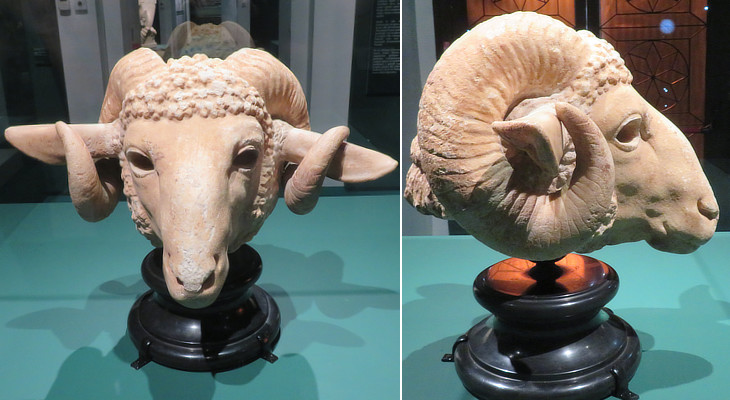
Pentelic marble head of ram from the Villa of Lucius Verus at Acquatraversa (Vth-IVth century BC - Boston Museum of Fine Arts)
The sanitation of the city and of the Campagna, on a large scale, was undertaken towards the end of the Republic, and continued by Augustus and his successors. (..) The results were astonishing. Pliny says that Laurentum was more delightful in summer than in winter; while in modern times the place was quoted until a few years ago as one of the most dangerous on the coast. (..) The same can be said of Hadrian's villa below Tivoli, of the villa Quinctiliorum on the Appian Way, of that of Lucius Verus at Acqua Traversa, etc. The Campagna must have looked in those happy days like a great park, studded with villages, farms, lordly residences, temples, fountains, and tombs.
Rodolfo Lanciani - Wanderings in the Roman Campagna - 1909
Acqua Traversa is located along Via Cassia near Tomba di Nerone. In 1609 the Borghese bought a group of farms there and they soon discovered that the fields were rich of fragments of ancient buildings and they granted permits to search for antiquities. In particular in 1796 Gavin Hamilton, a Scottish painter, archaeologist and antique dealer, unearthed several statues which were eventually bought by the Pope for the decoration of Braccio Nuovo. Other findings, including a Greek head of ram, were sold on the antiquarian market.
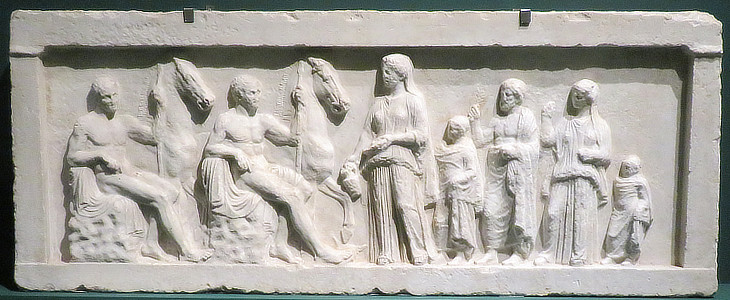
Pentelic marble relief depicting a ceremony in honour of the Dioscuri (350 BC - MNR)
The temple of Isium Metellinum stood between the Via Leopardi, the Via Curva, and the Via Macchiavelli. It was a magnificent structure, rich in masterpieces of Egyptian, Greek, and Roman art, and yet the only mention we have of it is a brief passage of Pietro Santi Bartoli (1635-1700). And so thoroughly did the seicento excavators destroy it that not one stone is left in situ. Its marble spoils seem to have been scattered far and wide soon after the prohibition of pagan worship. Many hundred fragments were discovered in 1888 under the house at the corner of the Via Labicana and the Via Macchiavelli, having been used as building material in a foundation wall of the sixth or seventh century. Lanciani
The relief was discovered in Via Buonarroti in the assumed area of the Temple to Isis. It indicates that the Roman syncretism placed references to different worships under the same roof. The Dioscuri had a particular relevance for the Romans.
The Exhibition includes a very fine Vth century BC relief from Grottaferrata.
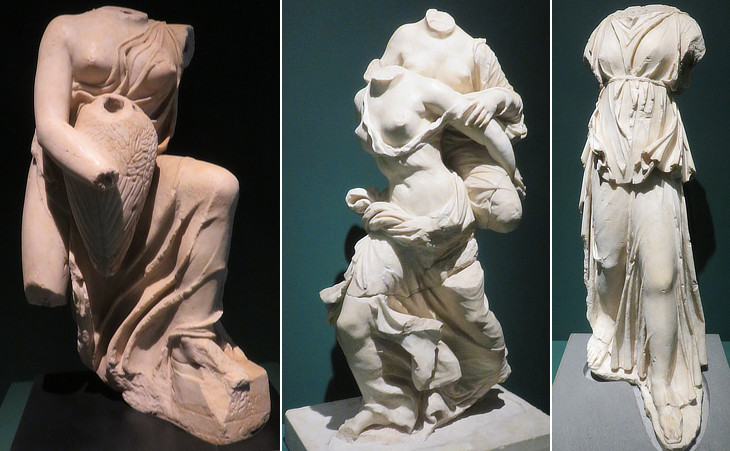
(left) Parian marble group of Leda and the Swan (400 BC - Boston Museum of Fine Arts); (centre) girls playing the "ephedrismos" game from "Horti Lamiani" (IIIrd - IInd century BC - Musei Capitolini); (right) statue of a woman from "Horti Tauriani" (?) (IInd century BC - Musei Capitolini)
The group of Leda and the Swan is recorded among the ancient statues which embellished Palazzo Farnese at Caprarola in 1568. The way the ancient portrayed the love affair between Zeus and Leda was so realistic that in some cases their statues were kept in a secret cabinet (e.g. at Musei Capitolini), but they were also imitated by Renaissance sculptors, e.g. Bartolomeo Ammannati. You may wish to see other ancient depictions of Leda and the Swan at Dion, Pompeii and Herculaneum.
The focus of the Exhibition is on statues and reliefs of the Classical period of Greek art, but the Romans were also very fond of those of the Hellenistic period which are characterized by a greater variety of subjects and by postures which depart from the composure of the works of the great masters. Ephedrismos was a popular game that people played for fun throughout ancient Greece. It means "carry on the back" and it actually shows the loser carrying the winner on his/her back. It was usually played by pairs of boys or pairs of girls, that is, almost no mixed sex pairings.
You may wish to see a Roman copy of a Greek statue of a clothed Venus which very much resembles that shown above.
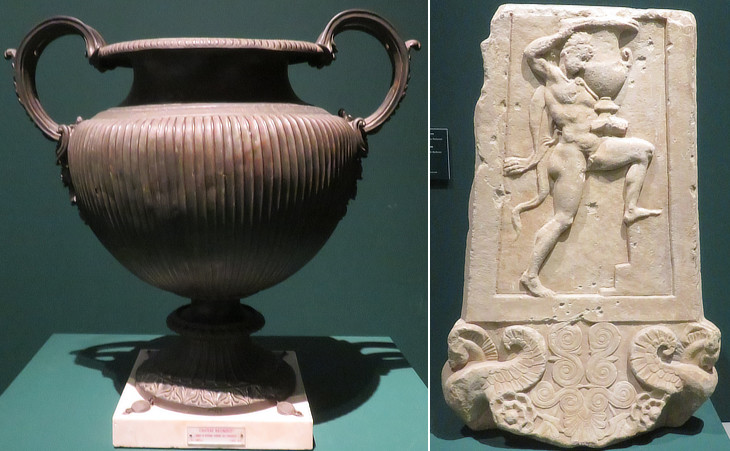
(left) Bronze vase donated by Mithridates VI Eupator (of a noble father) to the members of a gymnasium which was found at Anzio (late IInd century BC - Musei Capitolini); (right) base of a triangular chandelier from Palestrina with a relief depicting a satyr carrying a kantharos (IInd century AD - see the other two sides)
Mithridates VI Eupator, King of Pontus, was one of the fiercest enemies of Rome. Three wars were fought by the Romans to repel his invasions of neighbouring countries until Pompey managed to defeat him and force him out of his kingdom. The elegant bronze vase which was found at Anzio where emperors and wealthy Romans had their villas was most likely part of the boot of that victory.
The base of the chandelier is thought to have been made in a workshop of Athens for Roman customers. Its three sides were decorated with Dionysiac subjects.
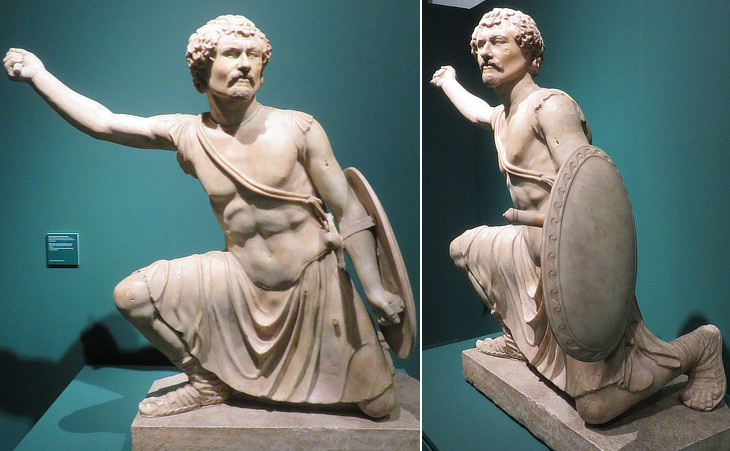
Wounded Barbarian warrior: head of Luni marble and body of Parian marble (Galleria degli Uffizi - Florence)
The statue entered the Medici collection of antiquities in the XVIth century and since then it was regarded as a Roman copy of a lost Greek original. In the 1990s a thorough restoration of the statue revealed that the body of Parian marble was actually an original portraying a warrior in a Greek military uniform (armour and short chiton) from the classical period. The head of a "Barbarian" is of the Hellenistic age. The position of the head is in line with the iconography of a wounded warrior (see examples at Museo Nazionale Romano and Musei Capitolini) and in particular the subject appears to express resistance, having been shot in the thigh with an arrow, of which few traces remain. The arms have undergone two separate restoration interventions, but their position is more or less faithful to that of the original arms. On his feet, the warrior is wearing krepídes, a very common type of sandal that was particularly suitable for long walks and therefore often used by soldiers (only the portion of the ankle and the right heel is original).
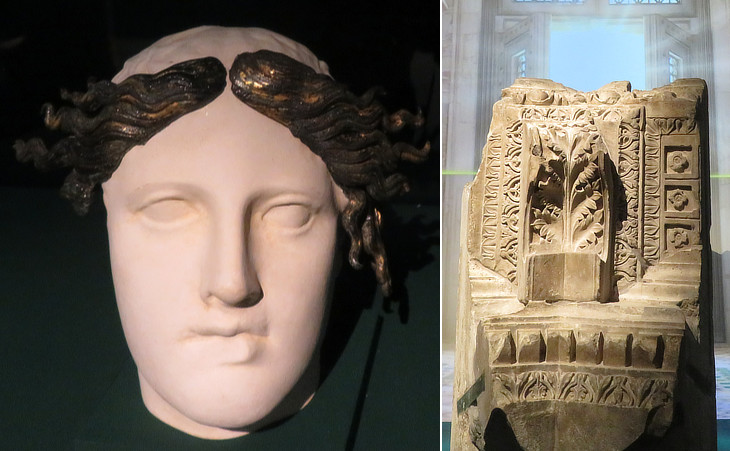
Findings during the excavations of Tempio di Apollo Sosiano in the 1930s: (left) gilded bronze hair (Vth century BC - Musei Capitolini); (right) top corner of the temple (Luni marble - end of the Ist century BC)
The statues which decorated the temple have been partially reconstructed at Centrale Montemartini and are thought to be Vth century BC Greek originals, perhaps taken from the Temple to Apollo Daphniforos at Eretria, a town on the island of Euboea. Some of them were decorated with bronze elements, a practice which was eventually adopted by the ancient Romans (e.g. at Colonna Trajana) and by the Popes (e.g. for the statues at the top of S. Pietro).
Immediately after the closure of the Exhibition in Rome a similar one Inspirations. Ancient Greek Art living in Italy opened at the Acropolis Museum of Athens. It testifies to the multiple forms of cultural exchanges between the two nations.