All images © by Roberto Piperno, owner of the domain. Write to romapip@quipo.it.


Notes:
Page added in May 2026.
All images © by Roberto Piperno, owner of the domain. Write to romapip@quipo.it.
Notes:
Page added in May 2026.
 at Museo Nazionale del Bargello
You may wish to see a page on the statues at Museo dell'Opera del Duomo first.
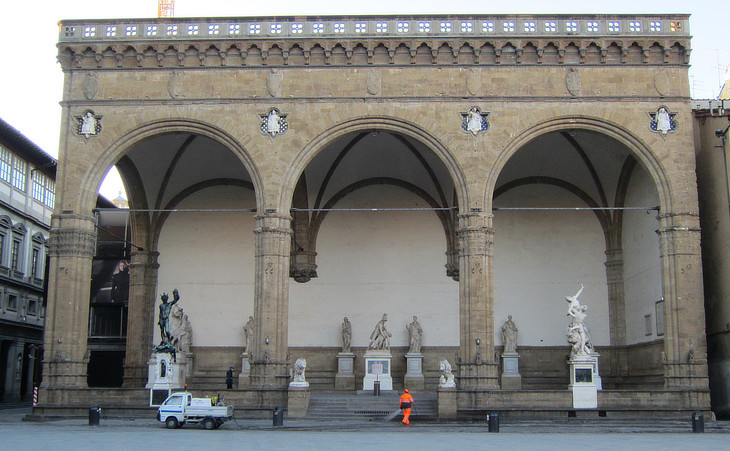
Loggia della Signoria (1376-1382) (early morning in late December)
25th October, 1644. We went to the Portico (..) what is most admirable is the Rape of a Sabine, with another man under foot, the confusion and turning of whose limbs is most admirable. It is of one entire marble, the work of John di Bologna, and is most stupendous. (..) Here is also the famous statue of David, by M. Angelo; Hercules and Cacus, by Baccio Bandinelli; the Perseus, in copper, by Benvenuto, and the Judith of Donatelli, which stand publicly before the old Palace. Near this stand Cosmo di Medicis on horseback, in brass on a pedestal of marble, and four copper bassorelievos by John di Bologna, with divers inscriptions.
John Evelyn - Diary and Correspondence related to his stay in Italy in 1644
Near the Gates of the Pallace here, stand two Statues of more
than Gygantean bulk: that of David is the hand of Michael Angelo:
and that of Hercules killing Cacus is
of the hand of Bandinelli. The
other Statues here in the Portico
hard by, are much cryed up for rare
Pieces, as that of Perseus in Brass;
that of the rape of the Sabins, in
Marble and that of Judith in brass
holding a sword in one hand, and
Holofernes' head in the other.
Richard Lassels' The Voyage of Italy, or a Compleat Journey through Italy in ca 1668
I have already mentioned the number of statues which ornament the streets and squares of Florence, and how much they are respected by the common people. I am told, they amount in all to above one hundred and fifty, many of them of exquisite workmanship, and admired by those of the best taste. Such a number of statues, without any drapery, continually exposed to the public eye, with the far greater number of pictures, as well as statues, in the same state, to be seen in the palaces, have produced, in both sexes, the most perfect insensibility to nudities.
John Moore's View of Society and Manners in Italy (in 1775)
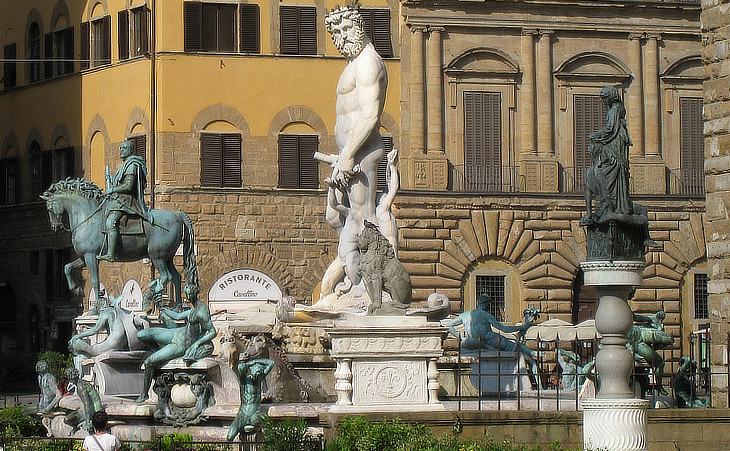
Piazza della Signoria (left to right): equestrian monument to Grand Duke Cosimo I by Jean de Boulogne aka il Giambologna (1594 - the image used as background for this page shows the head of the horse - see a relief of its pedestal), fountain with a Neptune by Bartolomeo Ammannati (1550-1565; see some details of it), Marzocco (1420 - the symbol of Florence) by Donatello and Judith killing Holophernes (1453-1457) by Donatello
In
the same Market-place is a most faire Fountaine set round
about with faire statues of brasse, and in the midst
thereof, the statues of a Giant, and of three horses,
almost covered with water, all wrought in white marble,
do power the waters out of their mouthes into the
Cesterne. (..) In the house of John Bolena a Flemming, and an
excellent engraver, I did see yet unperfected a horsemans statua of brasse, fifteen els high, the belly of the
horse being capable of 24 men, whereof foure might lie
in the throat; and this horse was made as going in the high way, putting forward the neere foot before, & the farre foot behind, & standing upon the other two, which statua was to be erected to Duke Cosmo, being valued
at 18. thousand crownes. Also another foot statua of
white marble, which was to be erected to Duke Ferdinand
then living (most likely that at Arezzo).
Fynes Moryson - An Itinerary: Containing His Ten Years Travel Through .. Italy (in 1594)
The Portico stands directly against the great piazza, where, to adorn one fountain, are erected four marble statues and eight of brass, representing Neptune and his family of sea gods, of a Colossean magnitude, with four sea horses, in Parian marble, in the midst of a very great basin: a work I think, hardly to be paralleled. Evelyn
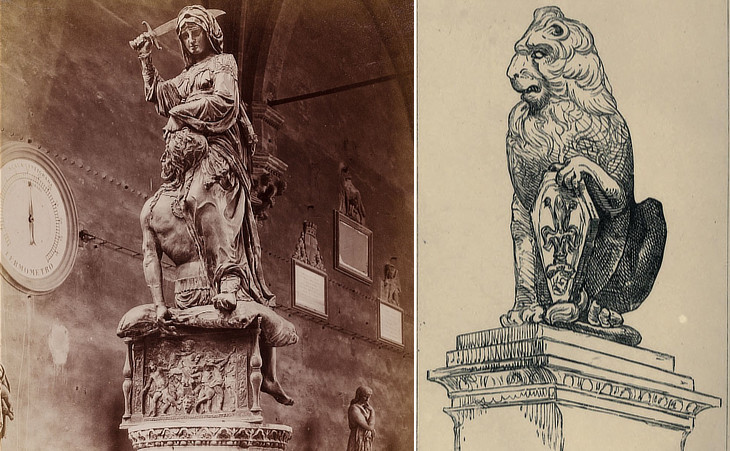
(left) Judith and Holofernes when the statue was inside Loggia della Signoria (1880) - it is now inside Palazzo della Signoria; (right) Marzocco (illustration from "Susan and Joanna Horner - Walks in Florence - 1884")
For the Signoria of Florence Donatello made a casting in metal which was placed under an arch of their Loggia in the Piazza, representing Judith cutting off the head of Holofernes; a work of great excellence and mastery. (..) This work was so well executed by Donate that the casting came out delicate and very beautiful, and it was afterwards finished so excellently that it is a very great marvel to behold.
Giorgio Vasari - Lives of the most eminent painters, sculptors & architects - transl. by Gaston Du C. De Vere
Judith killing Holofernes, a symbol of liberty and virtue, was a very popular subject, also for the decoration of churches (see a 1596 bronze relief by Tiburzio Vergelli at the Basilica of Loreto and a 1658 fresco by Raffaele Vanni at S. Maria del Popolo in Rome).
Vasari did not mention the Marzocco among the works of art in Piazza della Signoria, nor did the XVIth and XVIIth centuries travellers. This because the statue was made to ornament a papal apartment which the Republic had prepared in the convent of S. Maria Novella for a visit by Pope Martin V in 1419. In 1812 it was moved to Piazza della Signoria to replace a much worn out ancient statue of a lion. The original work by Donatello is now at Museo del Bargello.
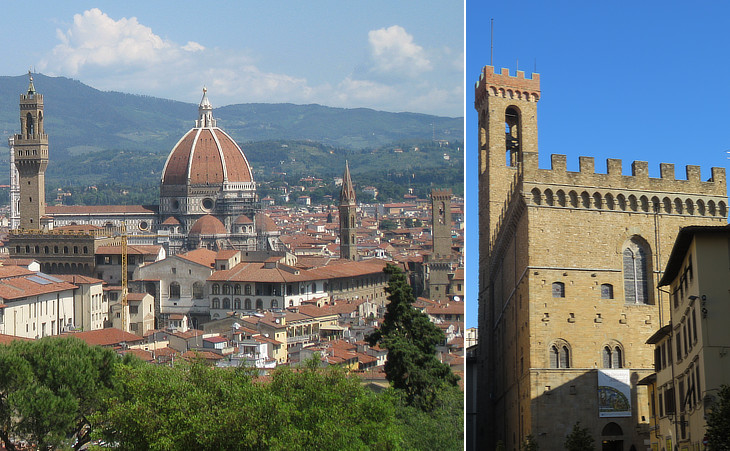
(left) Palazzo Vecchio, the Cathedral, the bell tower of Badia and the tower of il Bargello from Giardino Bardini at Costa S. Giorgio; (right) Palazzo del Bargello
The light and beautiful campanile of the Badia forms one of the principal ornaments of the views of Florence. It was also erected by Arnolfo, but, having sustained injury in the following cent., was in part taken down, but probably restored after the original design. (..) Palazzo Pretorio or del Podesta, more generally known as the Pal. del Bargello. This singular building was erected as the residence of the Podestà, the chief criminal magistrate of the Republic. (..) The Palace was erected by Lapo, the master of Arnolfo's father about the middle of the XIIIth century, but having been burned down in 1332 it was rebuilt nearly as we now see it by an almost unknown architect, Neri di Fioravanti. (..) On this building rises a lofty tower. (..) At a later period this palace was appropriated to the Bargello or chief of the police. Until recently it had served as a prison.
John Murray - A Handbook for Travellers in Central Italy - 1864
In 1865, in conjunction with the transfer of the capital from Turin to Florence, the palace became the first National Museum of the then newborn Kingdom of Italy and it was dedicated to the arts of the Middle Ages and the Renaissance.
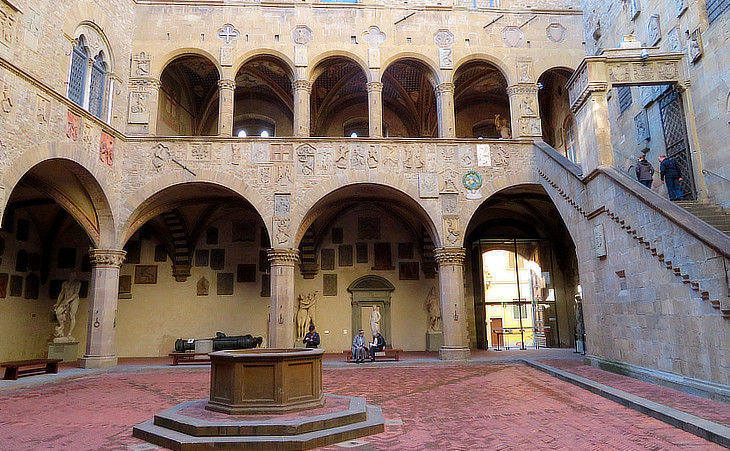
Courtyard
The walls of the inner court are covered with the armorial bearings of the magistrates. The handsome stairs leading to the Loggia above date from 1367. Murray
Beautiful and masterful though the Bargello is, it smells too strongly of restoration. (..) In its furbished and renovated chambers, it (displays) a hundred delicate works of sculpture from the convent walls where their pious authors placed them. If the early Tuscan painters are exquisite I can think of no praise pure enough for the sculptors of the same period, Donatello and Luca della Robbia, Matteo Civitale (a sculptor who mainly worked at Lucca) and Mino da Fiesole, who, as I refreshed my memory of them, seemed to me to leave absolutely nothing to be desired in the way of straightness of inspiration and grace of invention. The Bargello is full of early Tuscan sculpture, most of the pieces of which have come from suppressed religious houses.
Henry James - A travel account which was first published in the 1870s
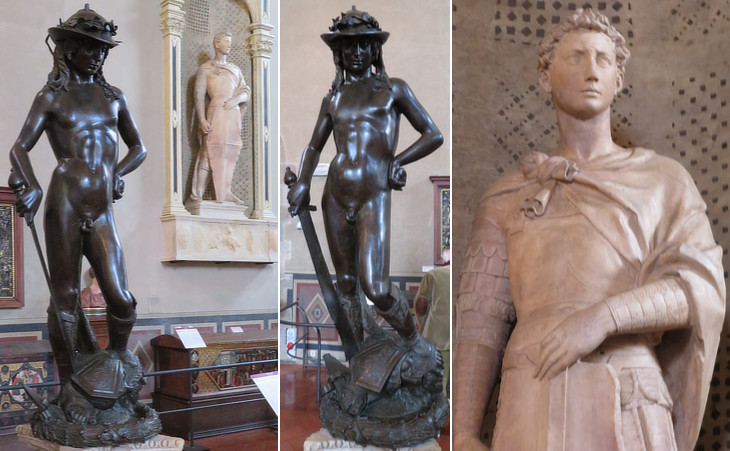
Donatello: (left/centre)) David (ca 1440) - you may wish to see Gian Lorenzo Bernini's David; (right) detail of St. George (1416)
In the courtyard of the Palace of the said Signori (Palazzo della Signoria) there is a life-size David, nude and in bronze. Having cut off the head of Goliath, he is raising one foot and placing it on him, holding a sword in his right hand. This figure is so natural in its vivacity and its softness, that it is almost impossible for craftsmen to believe that it was not moulded on the living form. This statue once stood in the courtyard of the house of the Medici, but it was transported to the said place on the exile of Cosimo. In our own day Duke Cosimo, having made a fountain on the spot occupied by this statue, had it removed. (..) For the Guild of Armourers (at Orsanmichele) Donatello made a most spirited figure of S. George in armour, in the head of which there may be seen the beauty of youth, courage and valour in arms, and a proud and terrible ardour; and there is a marvellous suggestion of life bursting out of the stone. It is certain that no modern figure in marble has yet shown such vivacity and such spirit as nature and art produced in this one by means of the hand of Donato. Vasari
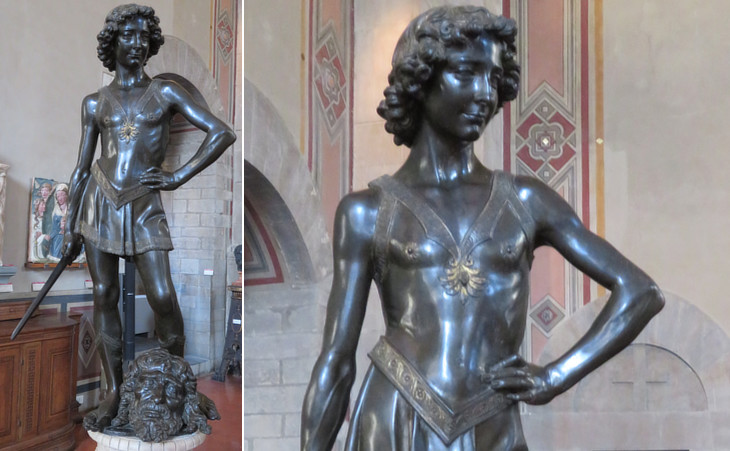
David by Andrea del Verrocchio (ca 1475 - a copy is at the Victoria and Albert Museum)
Andrea del Verrocchio a Florentine, was in his day a goldsmith, a master of perspective, a sculptor, a wood-carver, a painter, and a musician. (..) He was commissioned to make a David of bronze, two braccia and a half in height, which, when finished, was placed in the Palace, with great credit to himself. (..) Disciples of the same Andrea were Pietro Perugino and Leonardo da Vinci, of whom we will speak in the proper place. Vasari
Verrocchio worked also in Venice where he made an equestrian bronze statue of Bartolomeo Colleoni.
Florence for modern statues I think excels even Rome; but these I shall pass over in silence, that I may not transcribe out of others.
Joseph Addison - Remarks on several parts of Italy, in the years 1701, 1702, 1703
Addison was one of several travellers who focused on the ancient works of art of Italy and chose not to describe the modern ones, because they had little to add to Vasari's comments.
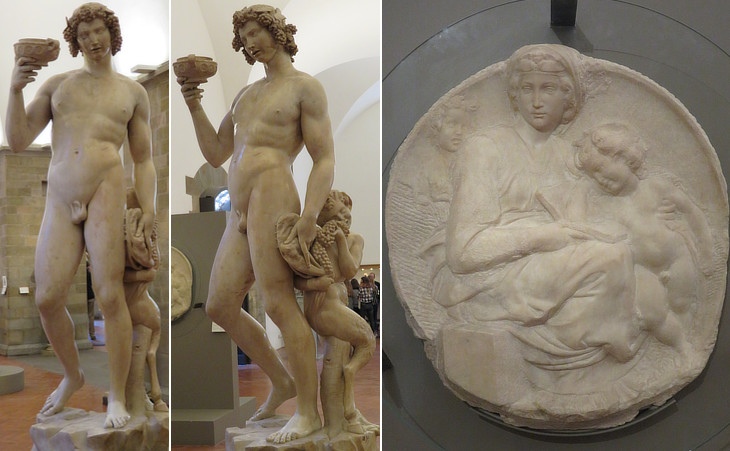
Michelangelo: (left/centre) Bacchus (1497); (right) Tondo Pitti (1503)
The talent of Michelagnolo was then clearly recognized by a Roman gentleman named Messer Jacopo Galli, an ingenious person, who caused him to make a Cupid of marble as large as life (now lost), and then a figure of a Bacchus ten palms high, who has a cup in the right hand, and in the left hand the skin of a tiger, with a bunch of grapes at which a little satyr is trying to nibble. In that figure it may be seen that he sought to achieve a certain fusion in the members that is marvellous, and in particular that he gave it both the youthful slendern ess of the male and the fullness and roundness of the female- a thing so admirable, that he proved himself excellent in statuary beyond any other modern that had worked up to that time. (..) In the year 1504 he began, but did not finish, two medallions of marble - one for Taddeo Taddei, which is now in his house, and another that he began for Bartolommeo Pitti. (..) These works were held to be admirable in their excellence. Vasari
Bacchus, the Statue which Mich. Angelo Made in Concurrence with that fine Antique one which stands near it, and then broke off the Hand, and pretended it to be an Antique dug up; one sees evidently where 'tis falen'd on: there is a Faun behind him in a fine Attitude eating Grapes: both are Drunk, 'tis Seen in their Faces, and all their Limbs.
Jonathan and Jonathan Richardson - Account of Some of the Statues, etc. in Italy - 1722
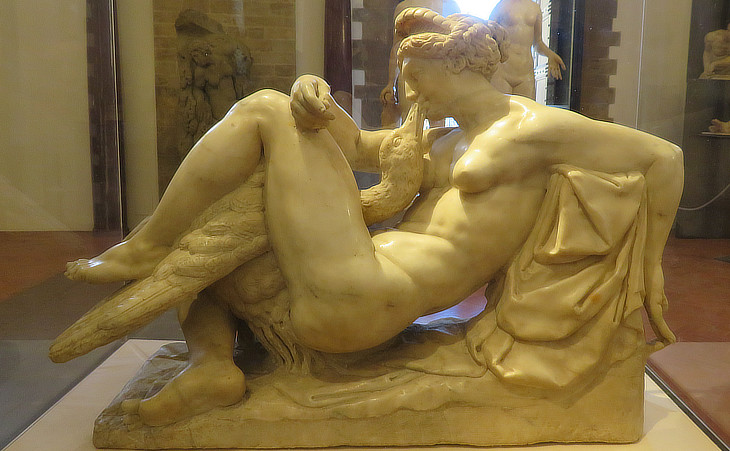
Leda and the Swan by Bartolomeo Ammannati (1540), based on a painting by Michelangelo (see some ancient very realistic depictions of this episode at Dion, Herculaneum and Pompeii)
Michelagnolo continually engaged in fortifying the city, but, although he was thus occupied, nevertheless he kept working at a picture of a Leda for the Duke of Ferrara, painted with his own hand in distemper-colours, which was a divine thing. (..) At this time he finished the Leda that he was painting, as has been related, at the request of Duke Alfonso. (..) Having arrived in Florence and found Michelagnolo, the envoy of Duke Alfonso presented to him letters of recommendation from that lord; whereupon Michelagnolo, receiving him courteously, showed him the Leda embracing the Swan that he had painted, with Castor and Pollux issuing from the Egg, in a large picture executed in distemper as it were with the breath. (..) Now in those days Antonio Mini, his disciple, who had two sisters waiting to be married, asked him for the Leda, and he gave it to him willingly, with the greater part of the designs and cartoons that he had made, which were divine things, and also two chests full of models, with a great number of finished cartoons for making pictures, and some of works that had been painted. When Antonio took it into his head to go to France, he carried all these with him; the Leda he sold to King Francis by means of some merchants, and it is now at Fontainebleau, but the cartoons and designs were lost, for he died there in a short time, and some were stolen; and so our country was deprived of all these valuable labours, which was an incalculable loss. (..) I could tell many particulars of Ammanati, but since he is my friend, and another, so I hear, is writing his history, I shall say no more, in order not to set my hand to things that may be related by another better than I perhaps might be able. Vasari
According to reports, Anne of Austria, widow of King Louis XIII of France and Regent for her son in 1643-1651, ordered the destruction of the painting due to her objections to its perceived "lasciviousness." The statue by Ammannati was most likely made for Francesco Maria della Rovere, Duke of Urbino. It was moved to Florence when the della Rovere collection was inherited by the Medici. Bartolomeo Ammannati worked for many years in Rome, mainly as an architect and occasionally with Giorgio Vasari, e.g. at Villa Giulia, Villa Medici and Palazzo di Firenze.
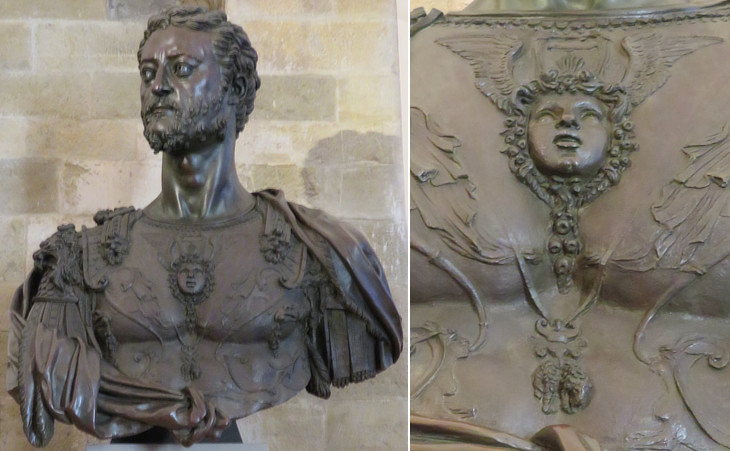
Grand Duke Cosimo I by Benvenuto Cellini (1545-1548), the detail shows a Gorgon and the symbol of the Golden Fleece (see a bust of Emperor Hadrian from the Farnese Collection which most likely Cellini had seen)
Now, to say something also of the sculptors in our Academy and of their works, although I do not intend to speak of them at any length, because they are alive and for the most part most illustrious in name and fame, I say that Benvenuto Cellini a citizen of Florence, who is now a sculptor (to begin with the oldest and most honoured), had no peer in his youth when he was a goldsmith, nor perhaps had he for many years any equal in that profession and in making most beautiful figures in the round and in low-relief, and all the other works of that craft (see a salt cellar he made for the King of France). (..) Then, having returned to his own country and entered the service of Duke Cosimo, he was first employed in some goldsmiths' work, and in the end was given some works of sculpture; whereupon he executed in metal the statue of the Perseus that has cut off the head of Medusa, which is in the Piazza del Duca. (..) And certainly it was a marvel that Benvenuto, after being occupied for so many years in making little figures, executed so great a statue with such excellence. Vasari

Flying Mercury by il Giambologna (1578)
An Academician, much in favour with our Princes for his talents, is Giovan Bologna of Douai, a Flemish sculptor and a young man truly of the rarest. (..) In bronze he has made a statue of Mercury in the act of flying, a very ingenious figure, the whole weight resting on one leg and on the point of the foot, which has been sent to the Emperor Maximilian, as a thing that is indeed most rare. Vasari
(at Villa Medici in Rome) There
was a Fountaine with a brasen Image of Mercurie upon
it. Moryson
Nov. 1644. Descending into the garden is a noble fountain governed by a Mercury of brass. Evelyn
Giambologna made several statues portraying a flying Mercury. That sent to Emperor Maximilian is lost. That from Villa Medici is the best known and it shows the god supported by a blowing wind. It has been adopted as a symbol of trade.
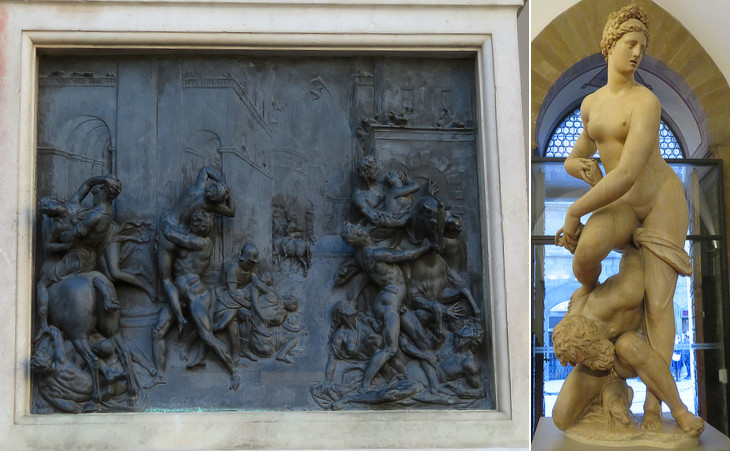
Other works by il Giambologna: (left) Rape of the Sabines, bronze relief on the pedestal of the marble statue by the same name (1583); (right) Florence Triumphant over Pisa (1575 - from Palazzo Vecchio)
Florentine sculptors of the first half of the seventeenth century faithfully nursed the heritage of the great Giovan Bologna. (..) Pietro Tacca, was certainly the greatest artist of this group and the most eminent successor to Giovanni Bologna. (..) First, from 1598 onwards he was a conscientious assistant to the master (see the bronze equestrian statue of Grand Duke Ferdinand I); later he finished a number of works left in various stages of execution at the latter's death. (..) In Giovanni Bologna's wake, Florentine Mannerist sculpture of the fin-de-siecle had, even more than Florentine painting of the period, an international success from the Low Countries to Sicily.
Rudolf Wittkower "Art and Architecture 1600-1750" Penguin Books 1958

Cannone di S. Paolo by Cosimo Cenni (1638 - see some elaborate Venetian guns of that period)
Return to Museo dell'Opera del Duomo or go to Cappelle Medicee.
See other pages on monuments of Florence: Florentine Recollections, An Italian Piazza and A Fortress with a View.