All images © by Roberto Piperno, owner of the domain. Write to romapip@quipo.it.


Notes:
Page added in June 2026.
All images © by Roberto Piperno, owner of the domain. Write to romapip@quipo.it.
Notes:
Page added in June 2026.
 Grottaferrata: Archaeological Museum
You may wish to see a page on the Abbey and the town first.
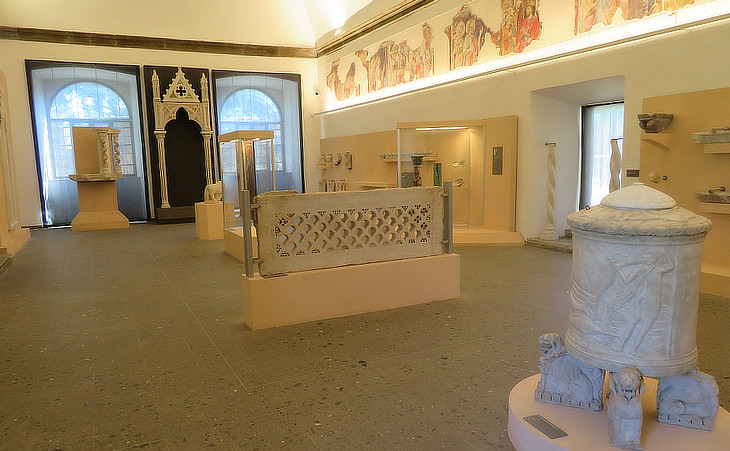
New set up of the museum: main hall (the liturgical vase is shown in page one)
Had all the ancient relics been collected and preserved on the spot, the Grottaferrata museum would have ranked among the richest in Europe. The modest attempt made lately by the worthy Basilians to start one makes us feel more keenly the losses of the past and the rapacity of the cardinal abbots, who treated as personal property, and carried away to their own private palaces in Rome, whatever the district placed under their temporary jurisdiction produced in the way of antiques.
Rodolfo Lanciani - Wanderings in the Roman Campagna - 1909.
Since 1894 the museum is housed in Palazzo del Commendatore and it is accessed from the main cloister of the Abbey. It was entirely overhauled in 2004-2017 and in its current set up it is not only an archaeological museum, but it displays exhibits which document the history of the Abbey.
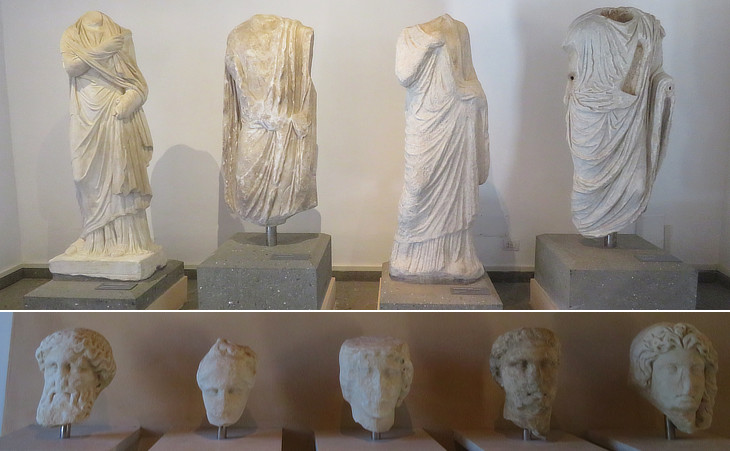
(above) Ancient statues which were found in the properties of the Abbey: the finest one (first to the left) portrays a woman with a chiton and a himation, a mantle (beginning Ist century AD - see similar statues at Delos and a statue of Minerva at Arezzo); (below) Heads from ancient statues: the last to the right portrays a young Caracalla as Alexander the Great (see a head of Augustus as Alexander the Great)
The Abbey stands upon an ancient Roman villa and its properties included fiefdoms in the environs of Rome and along the Tyrrhenian Sea, which were all very rich from an archaeological viewpoint. The exact locations where the statues and the heads were found are unknown.
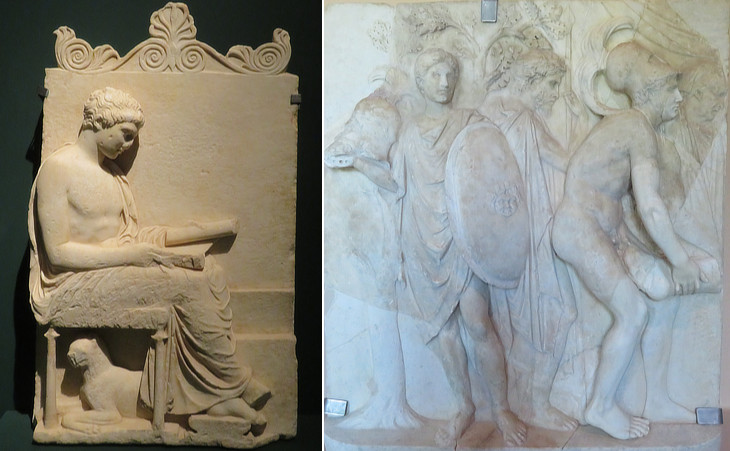
(left) Funerary stela (at a temporary exhibition on Greek Art in Early Rome); (right) part of a restored relief which most likely depicts the body of Achilles carried by Ajax and Ulysses
In a chapter which deals with sculpture in marble Pliny the Elder (Historia Naturalis - Book XXXVI) listed 225 famous Greek statues, many of which embellished Rome. The very fine stela portraying a young man reading a book is dated Vth century BC and it is thought to come from Ionia, a coastal region of Asia Minor where sculpture reached levels of fineness comparable to those of Attica.
The funeral procession was most likely part of a series of reliefs depicting events of the War of Troy; they were often depicted on sarcophagi (see one at Beirut from Tyre).
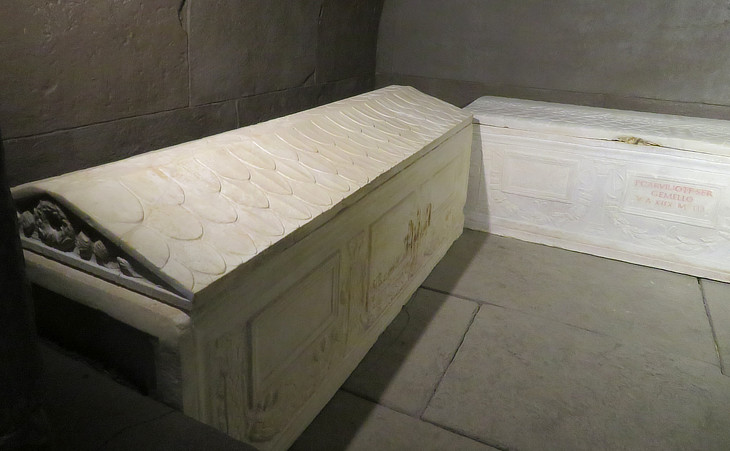
Ipogeo (underground chamber) delle Ghirlande, a rock-cut tomb discovered in 2000 at "Mutatio at Decimum"
BORGHETTO. A curious castle, built of the black volcanic stone which once paved the Via Latina, near which it stands, on the left. Borghetto is on the site of Ad Decimum, the first ancient Mutatio on the Latin road. (..) The Mutatio was so situated, that the horses from Rome drew travellers up only one-half of the long and tedious hill; the latter half falling to the share of those of Ad Decimum.
Sir William Gell - The topography of Rome and its vicinity - 1834
The tomb contained two Ist century AD sarcophagi which are decorated with garlands. They bear the names of Titus Carvilius Gemellus who died at 18 and of Ebuzia Quarta, his mother who died after him. The sarcophagus of Titus did not contain his ashes, but his partially mummified body, an unusual preactice in Rome. The sarcophagi retain their finely decorated lids.
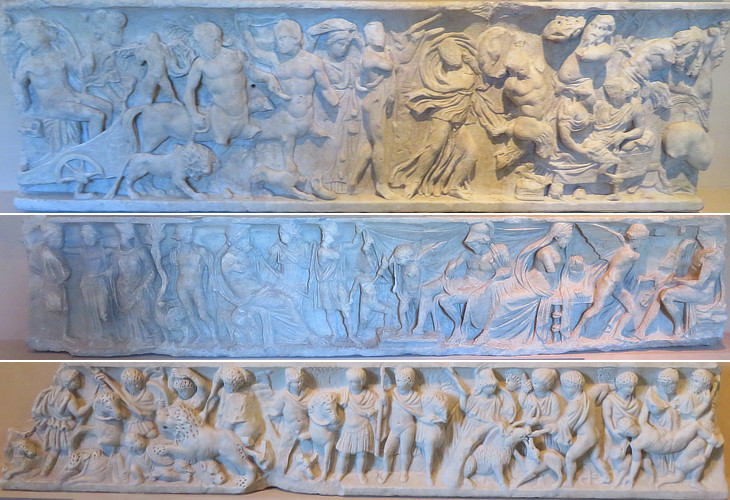
Sarcophagi: (above) Triumph of Bacchus and Ariadne (ca 180 AD); (middle) Venus and Mars trapped by Vulcan (ca 180 AD); (below) Hunting scenes (early IVth century)
Sarcophagi have been discovered near Mutatio ad Decimum and elsewhere in the properties of the Abbey and the museum houses some of the fronts of their boxes. The Triumph of Bacchus was a very popular subject for sarcophagi (see one at Lyon) and floor mosaics (see one at Sousse), less so that involving Mars and Venus:
The Sun was the first god they say to see the adulteries of Venus and Mars: he sees all things first. He was sorry to witness the act, and he told her husband Vulcan, son of Juno, of this bedroom intrigue, and where the intrigue took place. Vulcan's heart dropped, and he dropped in turn the craftsman's work he held in his hand. Immediately he began to file thin links of bronze, for a net, a snare that would deceive the eye. The finest spun threads, those the spider spins from the rafters, would not better his work. He made it so it would cling to the smallest movement, the lightest touch, and then artfully placed it over the bed. When the wife and the adulterer had come together on the one couch, they were entangled together, surprised in the midst of their embraces, by the husband's craft, and the new method of imprisonment he had prepared for them.
Ovid - The Metamorphoses - Book IV - Translated by A. S. Kline
The IVth century sarcophagus shows the use of the drill and a tendency to reduce the number of naked figures, (see a sarcophagus at Frascati showing the same features).
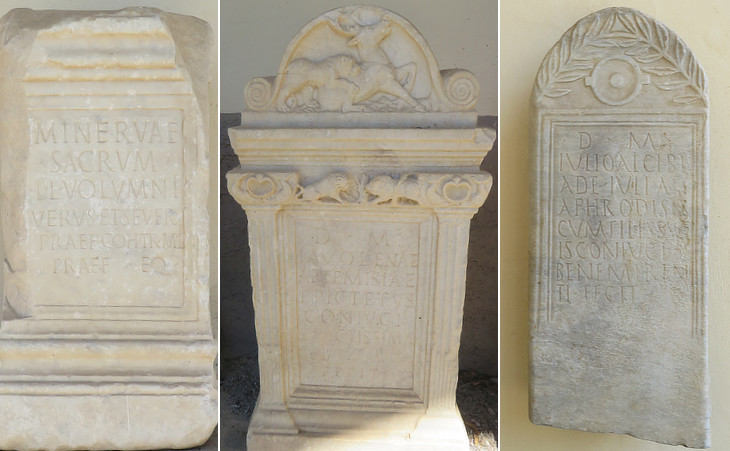
Inscriptions: (left) altar to Minerva; (centre) tombstone of Iavolena Artemisia with fine reliefs (lions attacking other animals were often depicted on sarcophagi); (right) tombstone of Iulio Alcibiade
Poggio Bracciolini (*) explored the Campagna, he visited
Alatri with its Cyclopean walls, Ferentino, Anagni,
Tusculum and Grotta Ferrata in search of ruins
and inscriptions.
Ferdinand Gregorovius - History of the city of Rome in the Middle Ages
The two tombstones testify to the strength of the monogamic Roman family. The relief of Artemisia was erected by Epictetus her husband who described her as sanctissima; that of Alcibiade by Aphrodisia, his wife who calls him benemerenti.
(*) Poggio Bracciolini (1380 - 1459), was an Italian scholar and an early Renaissance humanist who is best known for rediscovering and recovering many classical Latin manuscripts in monastic libraries and for listing all the ancient inscriptions he came across.
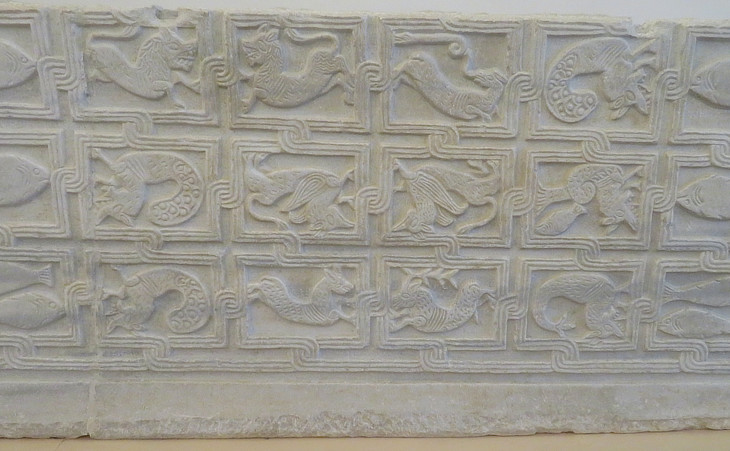
"Transenna", a marble parapet which separated the altar from the nave in early churches, e.g. at S. Clemente and at S. Sabina
This transenna is a rather rare exhibit. It is dated late VIIIth / early IXth century, a period during which Rome was a Byzantine province from a cultural point of view, but its subjects and design is typical of the first attempts by local sculptors to develop new patterns (see reliefs at Cividale). The depiction of real and imaginary animals became a feature of Romanesque architecture (see reliefs at the Cathedral of Fano).
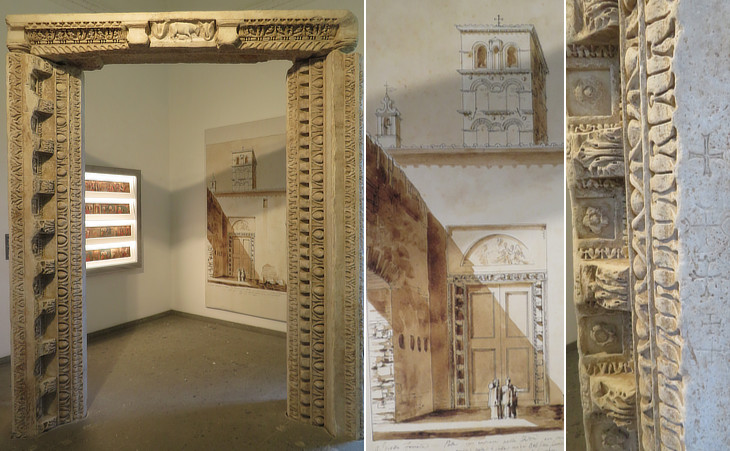
Recomposed portal of the narthex of the church which was dismantled at the beginning of the XXth century and reproduction of an 1841 drawing by Luigi Rossini
The portal was made up by reusing Roman materials of the IInd century AD: two cornices of a building, perhaps the villa beneath the Abbey, for the sides and a fragment of a sarcophagus for the lintel. A similar reuse of Roman materials can be noticed also at churches of nearby Albano and Velletri.
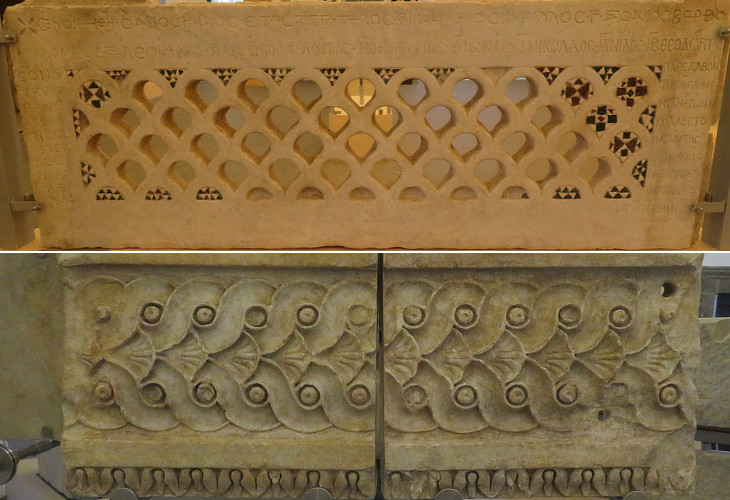
Reusage of a "transenna" (above) and of an architectural decoration (below)
A Vth century marble transenna, the origin of which is unknown, was reused in the XIIth century. It bears the names of the first twelve abbots (in Greek). A Latin inscription on the left side says: CONS/TRUIT/ HANC/ AULAM/ NICOLAU/S TER/ DECI/MUS/ AB/BAS which indicates that the transenna was placed in a chapel built by the tenth Abbot.
The marble decorative pattern is dated Ist century AD. It was used in three pieces to decorate the medieval church.
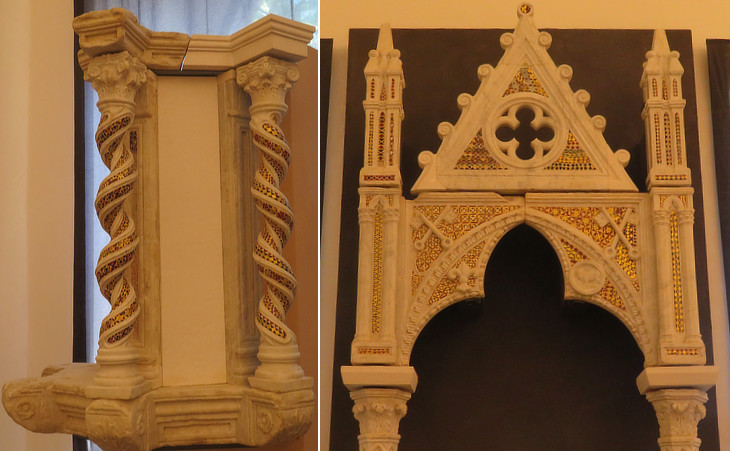
The medieval church had a fine Cosmati decoration which was similar to that of some of the finest churches of Rome, e.g. S. Maria in Cosmedin, S. Clemente, S. Paolo fuori le Mura and S. Giovanni in Laterano. Unfortunately the interior of the church was redesigned so many times that only a few fragments of it were not destroyed.
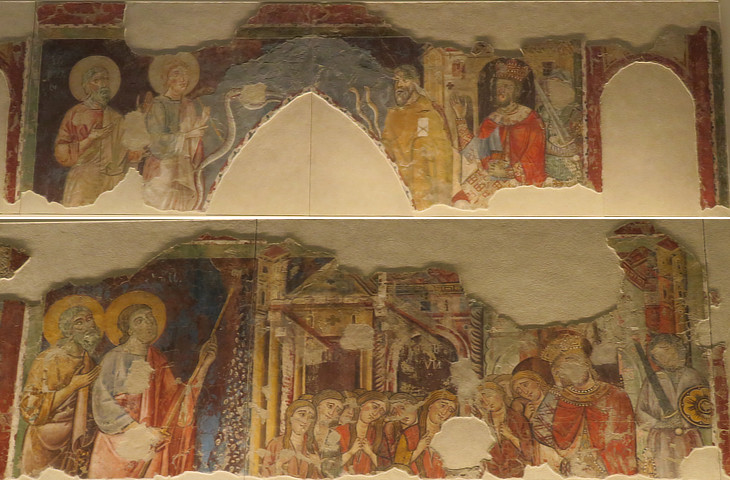
Medieval church: Frescoes with stories of Moses (Exodus) by a plurality of painters: (above) The Staff-to-Snake; (below) The Plague on the Firstborn
In 1881, during one of the many refurbishments of the church, a series of XIIIth century frescoes were discovered on the walls above a later wooden ceiling. The opening of windows interrupted some of the scenes. They were restored more than once and eventually they were moved to the museum.
The Staff-to-Snake scene: Moses and Aaron are portrayed on the left while throwing a stick which becomes a serpent. The Pharaoh (in a medieval attire) and his magicians are depicted on the other side of the scene. Another magician was most likely portrayed in the central space.
The Plague on the Firstborn scene: "So Moses said: Every firstborn son in Egypt will die, from the firstborn son of Pharaoh, who sits on the throne, to the firstborn son of the female slave, who is at her hand mill, and all the firstborn of the cattle as well. There will be loud wailing throughout Egypt - worse than there has ever been or ever will be again." The fresco depicts the Pharaoh accompanied by a soldier and the mothers of Egypt all grieving for the deaths of their firstborn. The scene is set against a background of medieval buildings.
Notwithstanding the missing parts and some poor repainting the scenes are very lively and full of colour and they bring to mind those of the same period at Oratorio di S. Silvestro.
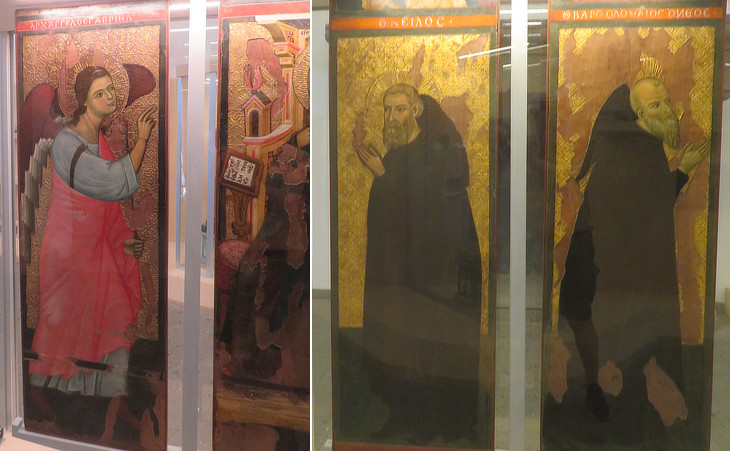
Diptych: (left) Annunciation (the right section is greatly damaged); (right) closing panels: Saints Nilus and Bartholomew the Younger (the two are portrayed also in the altarpiece of Cappella Farnese)
This wooden diptych is dated XIIIth century and is attributed to one of the Moses frescoes painters. It was placed on the altar of the sacred image until it was redesigned in the XVIIth century. St. Bartholomew the Younger was a disciple of St. Nilus and the third abbot of Grottaferrata; he is considered the second founder of the Abbey.
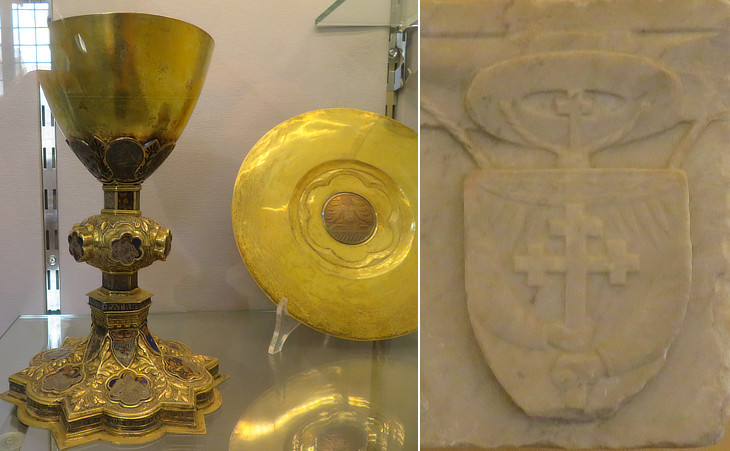
(left) Chalice and patena of Cardinal Bessarion; (right) his coat of arms on a marble slab
Better days, however, came with the appointment of Bessarion to the "commandership" of the abbey, made by Pius II on August 28, 1462. The subsequent ten years of his tenure of office are marked with letters of gold in the chronicles of the monastery. He raised the moral standard of his fellow monks, rebuilt their church, and took such good care of the library that even to-day, after four and a half centuries of further neglect, pleasant surprises await the bibliophiles. His name is connected with two gems of art, - the shrine of St. Andrew the Apostle, on the Flaminian road, and the presbyterial house adjoining the church of S. Cesario on the Via Appia. Lanciani
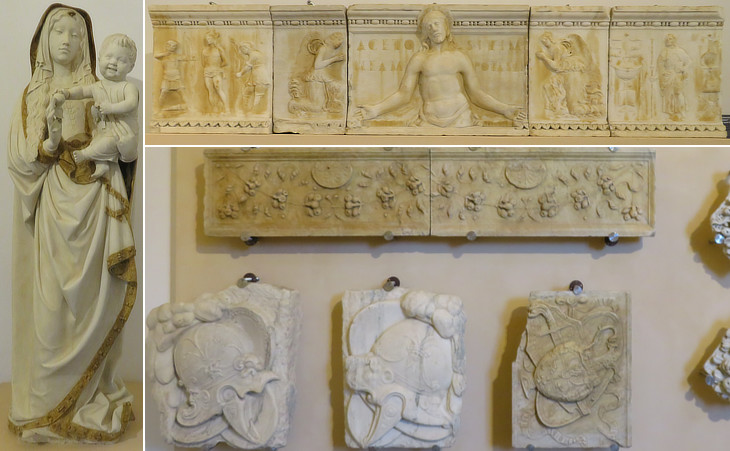
Late XVth century works of art: (left) Madonna delle Grazie (painted limestone); (right-above) marble predella portraying Christ as Man of Sorrows between angels and Sts. Sebastian and Roch; (right-below) other reliefs similar to those of the Renaissance gate
The statue is attributed to Giovanni di Biasuccio, a sculptor who is best known for having worked with Silvestro dell'Aquila in that town.
The predella is not entire: the inscription Aceto sitim meam potasti (I was thirsty and you gave me vinegar to drink) is part of the Solemn Reproaches, expressing the remonstrances of Jesus Christ with his people. St. Sebastian and St. Roch were specially invoked against pestilences, so that the predella might have been made on the occasion of that which developed in 1480 and the Solemn Reproach was part of the prayers sung to obtain its end.
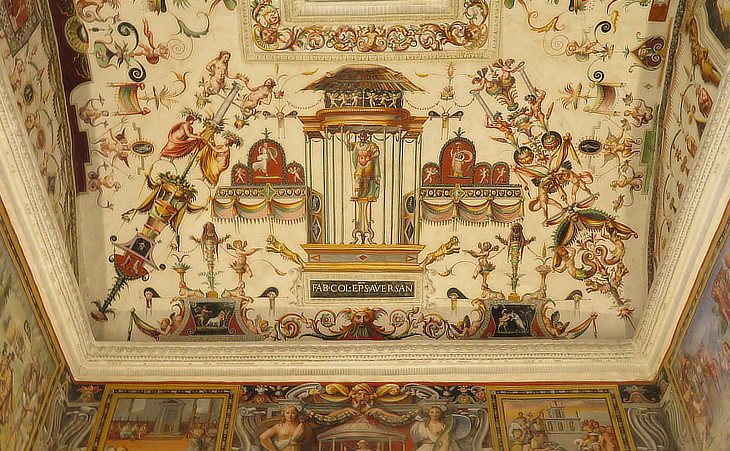
Hall decorated by Francesco da Siena (1547) for Fabio Colonna, Abbot of Grottaferrata
The fourteen successors, from Giuliano della Rovere to Carlo Rezzonico (nephew of Pope Clement XIII), mostly nephews of popes, turned the revenues of the abbey to their private advantage, and, in the matter of antiquities and works of art, laid hands on every object which could be conveniently removed to their private galleries in Rome. Lanciani
The Colonna, the powerful family whose fiefdoms included Marino, only a few miles from Grottaferrata, had three Abbots in the period 1503-1553. Fabio Colonna, Bishop of Aversa (near Naples), commissioned the decoration of a small hall of the palace which today is part of the museum. The name of Francesco da Siena has been found among those scratched on the ceilings of Domus Aurea, the palace of Nero, so the painter had a direct knowledge of the grotesque decoration which characterized that ancient building.
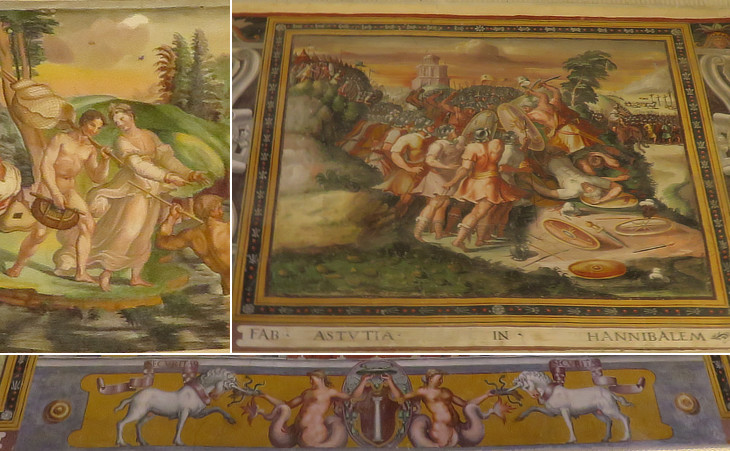
Colonna hall: (above-left) central scene of the ceiling; (above-right) scene from the life of Fabius Maximus; (below) coat of arms of Fabio Colonna and heraldic symbols (mermaids) of the Colonna between heraldic symbols of the Farnese (unicorns)
The decoration of the hall included eight scenes from the life of Fabius Maximus who managed to contain the advance of Hannibal. The name is the obvious link between the Abbot and the Roman dictator, but the choice is also an indication of the diplomacy Fabio Colonna employed to advocate his family interests with Pope Paul III who was keen on promoting those of his family. The image used as background for this page shows a coat of arms of the Colonna on a marble slab.
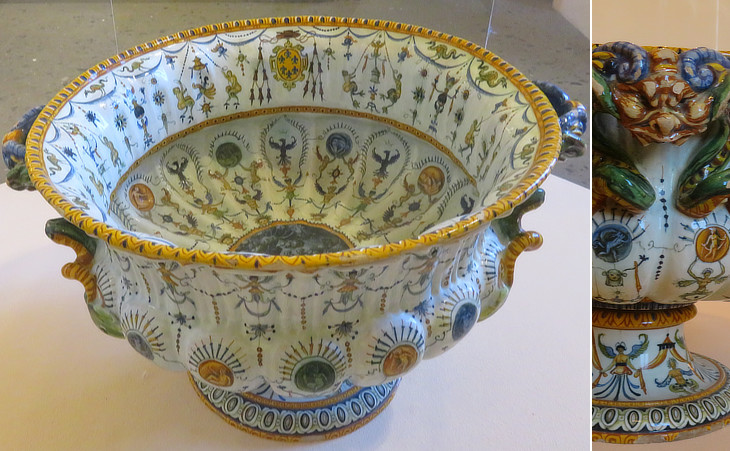
A "Rinfrescatore", basin for washing hands and face with the coat of arms of a Farnese Abbot (1570 from Urbino / Castel Durante)
Return to page one: Grottaferrata or move on to the next step in your tour of the Environs of Rome: Marino


