All images © by Roberto Piperno, owner of the domain. Write to romapip@quipo.it.


Notes:
Page added in September 2026.
All images © by Roberto Piperno, owner of the domain. Write to romapip@quipo.it.
Notes:
Page added in September 2026.
 The Cathedral (S. Lorenzo)
You may wish to see a page on the Ancient Town first.
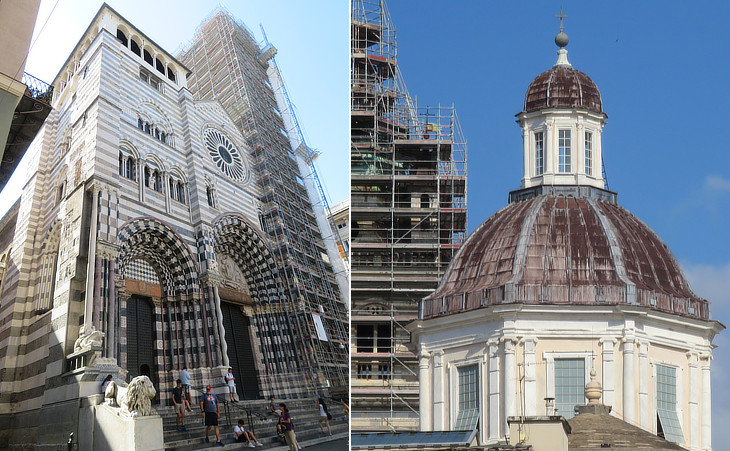
(left) Façade (western side of the building - early XIVth century); (right) dome (XVIth century)
16 Oct. 1644.
The Churches are no less splendid than the Palaces: St. Lawrence, in the middle of the City, of white and black polish'd stone, the inside wholly incrusted with marble and other precious materials.
John Evelyn's Diary and Correspondence related to his stay in Italy in 1644
Having said thus much of Genoa in general, I will now come to the particulars that are to be seen in it.
1. The Domo, or great Church of St. Laurence presents it self to my sight: It's the Cathedral of the Archbishop, who, when I passed that way last,
was Cardinal Stefano Durazzo, a man of great Vertue and Piety (see his gruesome tomb in Rome). This Church is of a noble Structure, all of black and white Marble intermingled, and all massive square stones.
Richard Lassels' The Voyage of Italy, or a Compleat Journey through Italy in ca 1668
The chief structures of Genoa are, the cathedral dedicated to S. Laurence, a large pile of building, but inferior in beauty to several other Italian churches.
Thomas Nugent - The Grand Tour - 1749
The cathedral dedicated to St. Laurence is encrusted with marble, and of a mixed style of Gothic, which has little or no beauty; the entrance however, consisting of three grand doors, with lofty pointed arches, with the circular window above, deserve notice.
John Chetwood Eustace's Classical Tour of Italy in 1802 (publ. 1813)
The Duomo or Cathedral of S. Lorenzo was consecrated in 1118, by the Pope Gelasius II., and restored about 1300.
The front belongs to the latter date; the lower part is occupied by threepointed arches, with the little columns and other appendages of Gothic
architecture. There is one marigold window in the centre, and several smaller ones. The intention was, probably, to erect two towers
(similar to what occurred in French cathedrals, e.g. at Reims), but of these only one has been executed, and that at a later period, and it does not preserve the character of the rest of the building. There is not the least trace in this edifice of the taste which prevailed at Pisa and Lucca.
John Murray - Handbook for travellers in Northern Italy - 1843
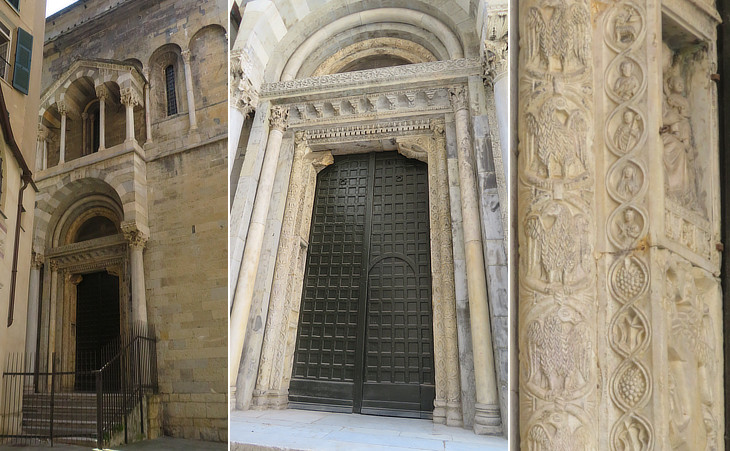
Northern side of the Cathedral: (left) Porta di S. Giovanni (XIIth century) opposite the Baptistery; (centre) portal; (right) detail of the decoration of the left pillar with the addition of a small Madonna (Pisan school)
At Genoa we are met by distinct traces of northern influence, modified, however, by passing through an Italian medium. The fine church of S. Lorenzo, which was consecrated in 1118, has undergone many subsequent alterations, and was extensively restored in 1307 and 1312.
Sir Thomas Graham Jackson - Gothic architecture in France, England, and Italy - 1915
The Cathedral of Genoa had distinct Romanesque features, but chiefly those which had developed in France. The northern side was embellished with
reliefs and fronts of Roman sarcophagi.
In 1118 Pope Gelasius II consecrated also the Cathedral of Pisa. The Italian maritime republics were in a period great economic and military development because the conquest of the Holy Land in 1099 had given them the monopoly of the trade with the Levant.
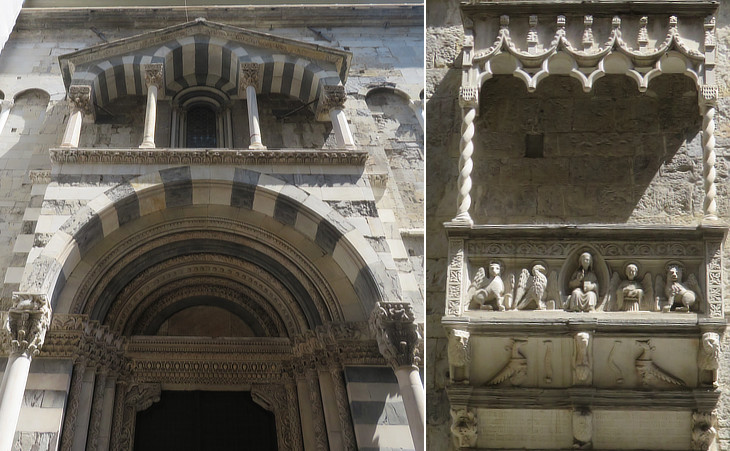
Southern side of the Cathedral: (left) Porta di S. Gottardo (XIIth century); (right) funerary monument to Antonio Grimaldi; it bears the coat of arms of the Grimaldi, the reigning house of the Principality of Monaco
Saint Gotthard was a German bishop and Benedictine abbot who was canonised in 1131 shortly after the consecration of the Cathedral. He was regarded as the patron of travelling merchants and this could explain why the Genoese dedicated one of the portals to him.
Doria, Spinola, Grimaldi and Fieschi (known as the Quator Gentes) were the four most powerful families of XIVth century Genoa.
In 1373, in an attempt to increase their influence over the Kingdom of Cyprus, the Genoese sent an expedition which conquered
Famagusta, the main port and one of the capitals of the island. In 1402 the Lusignan kings of Cyprus made an
attempt to conquer back Famagusta and Antonio Grimaldi was killed in the fight: his body was carried back to Genoa, where a fine monument to
him was erected at S. Giovanni di Prè, a church and hospital belonging to the Knights Hospitallers.
Prè means prati/meadows because the building was located outside Porta Vacca the western gate of the town. The hospital was eventually closed
and the church underwent many modifications; in 1895 it was decided to relocate the monument to the southern side of the Cathedral.
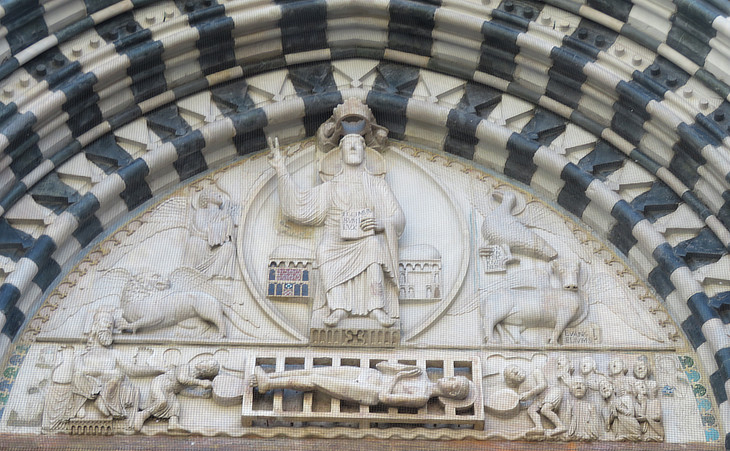
Main portal: upper part portraying Jesus between the symbols of the Evangelists, very similar to the relief at Saint-Trophime at Arles, and below the martyrdom of St. Lawrence
St. Lawrence is one of the most popular saints in Rome where eight historical churches are dedicated to him. He was a native of Spain and he travelled to Rome where he was appointed Deacon, a sacred charge to which were attached the care of the treasury of the Church and the distribution of its riches among the poor. Although the events related to his martyrdom in 257 occurred at Rome, he became popular throughout Italy and, in addition to Genoa, also Viterbo, Perugia and other Italian towns dedicated their Cathedral to him. In the specific case of Genoa, the saint is said to have sojourned there, near the site of the Cathedral, during his travels.
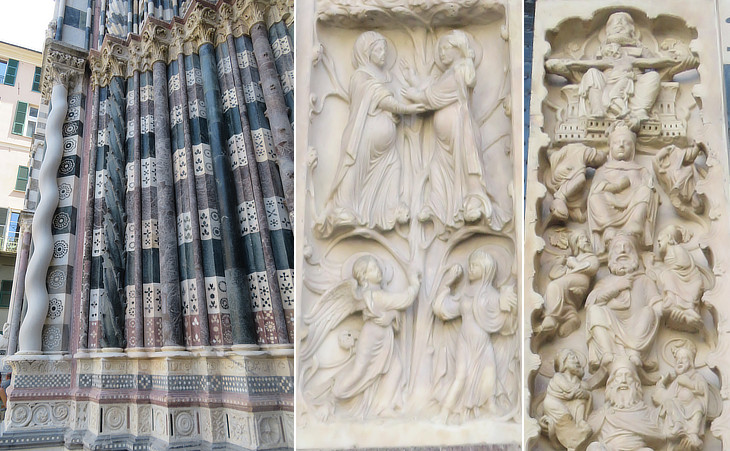
Main portal: (left) columns at the sides of the entrance; (centre) left side of the portal: scenes from the life of Mary; (right) right side of the portal: Tree of Jesse (Genealogy of Christ, see a more complex representation of it in an Orthodox monastery)
The columns of the portal were taken from Almeria, as part of the spoils won at the capture of that city, 1148 Murray
All these details betray a French influence, modified, of course by Italian feeling, and by the use of marble instead of free-stone. This mixture of sentiment is still more plainly seen in the magnificent west portal where the capitals might have been carved by a Frenchman from Burgundy, though the marble and inlaid work of the jambs is purely Italian. The admirable sculpture of some of the panels of the podium is more like French work in free-stone than Italian work in marble. This doorway appears to date from the restoration at the beginning of the XIVth century, when the church was probably nearly rebuilt from the XIIth-century columns upwards. Jackson
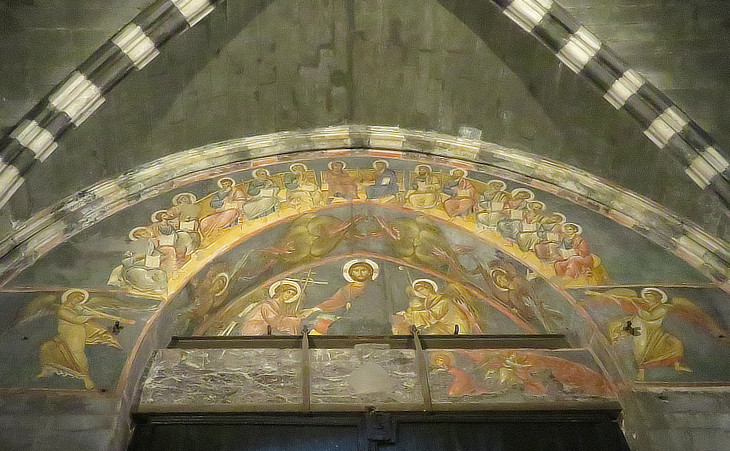
Byzantine-style fresco on the inner side of the main portal (ca 1315)
When the fresco was made Giotto and other Tuscan artists had already taken the lead in developing novel forms of painting, but the Deans of the Cathedral commissioned this fresco to an unknown artist. He was probably from Sicily or anyhow he was familiar with the representation of Christ in mosaics at Cefalù and Monreale.
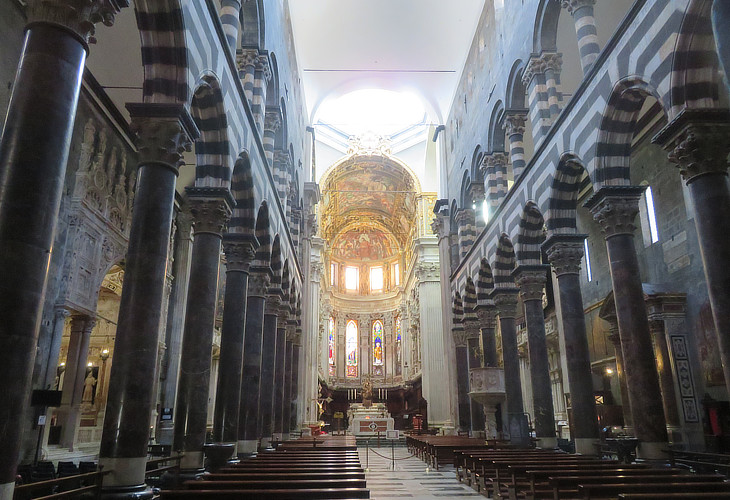
Interior - Main nave
The old Cathedral of San Lorenzo is about as notable a building as we have found in Genoa. It is vast, and has colonnades of noble pillars, and a great organ, and the customary pomp of gilded moldings, pictures, frescoed ceilings, and so forth. I can not describe it, of course - it would require a good many pages to do that. But it is a curious place. They said that half of it - from the front door half way down to the altar - was a Jewish Synagogue before the Saviour was born, and that no alteration had been made in it since that time. We doubted the statement, but did it reluctantly. We would much rather have believed it. The place looked in too perfect repair to be so ancient.
Mark Twain - The Pilgrims Abroad 1869
The inside is remarkable for the marble pillars, which support the roof. Nugent
The church has a nave of nine bays, carried by eight mono-cylindric columns of claret-coloured marble, varied with streaks and blots of other colours and white, and the shafts are diminished with an entasis. Each has a course of white marble next the base. (..) The arches are pointed and well moulded in two orders, and are banded with black and white voussoirs alternately. The splendour of these colonnades is almost unrivalled; this was the first marble church I saw in my student days, and I well remember the astonishment with which it struck me.
The capitals are very Classic, and have a deep abacus like those at S. Mark's in Venice. Three capitals next the east end have figures of angels at the corners instead of foliage and volutes. Above, in the place of a triforium, is an arcade of round arches on wide piers alternated with single shafts. The arches have two plain unmoulded orders in white marble, and all the capitals are foliated and have a strong abacus. (..) There is a simple clerestory of single round-headed lights perfectly plain. The aisles are lighted by tall round-headed lancets high up in the wall, opposite the quasi-triforium arcade. (..)
At the west end is a gallery on a vault with ribs and panels, all constructed in black and white marble. Jackson
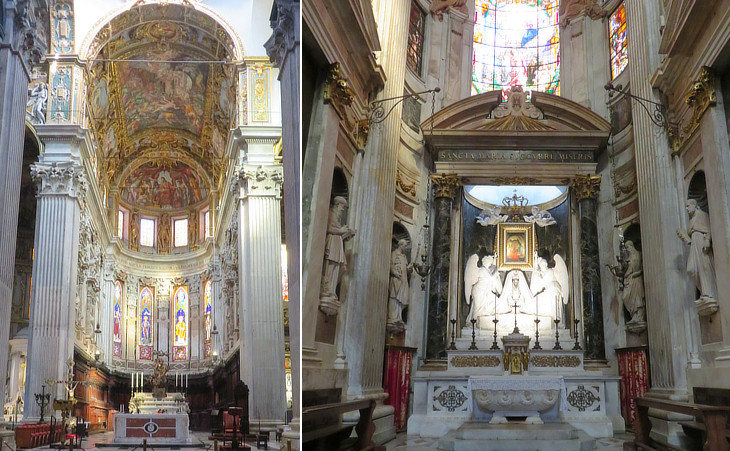
(left) Apse and main altar; (right) Cappella Balbi-Senarega designed by Carlo Barabino in the early XIXth century, next to the apse
The transepts, choir, and dome show only Renaissance work inside, but the transept has Gothic arcading without. Jackson
The cathedral is dedicated to St. Lorenzo. On St. Lorenzo's day, (August 10) we went into it, just as the sun was setting. Although these decorations are usually in very indifferent taste, the effect, just then, was very superb, indeed. For the whole building was dressed in red; and the sinking sun, streaming in, through a great red curtain in the chief doorway, made all the gorgeousness its own. When the sun went down, and it gradually grew quite dark inside, except for a few twinkling tapers on the principal altar, and some small dangling silver lamps, it was very mysterious and effective. But, sitting in any of the churches towards evening, is like a mild dose of opium.
Charles Dickens - Pictures from Italy - 1846
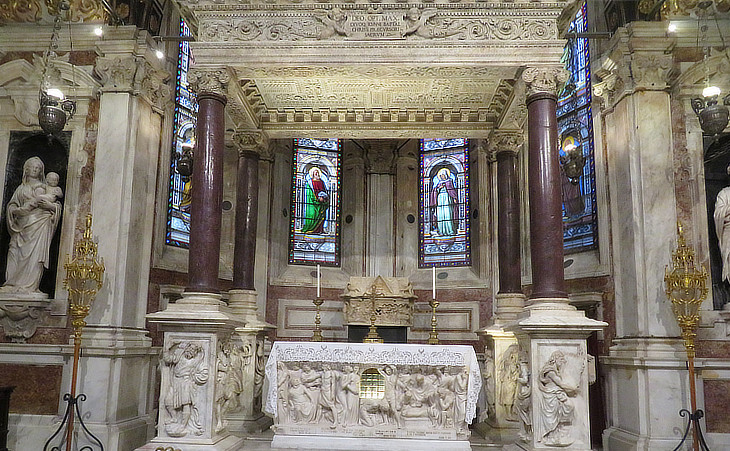
Chapel where the relics of St. John the Baptist were kept; they are now in the Treasury
On the altar of St. John stand 4 sumptuous columns of porphyry; and here we were shew'd an emerald supposed to be one of the largest in the world. Evelyn
In a Chapel over against the Pulpit, is kept reverently an authentick Relics of St. John Baptist, under the Altar; and the great Emeraud which they say here that our Saviour eat the Paschal Lamb with his Disciples. Both these were given to the Genoese by Baldwin King, of Hierusalem, for their great service done against the Turks in the Holy Land. Of the Relick of St. John Baptist, Baronius speaks credibly in his Ecclesiastical History. But for the Dish of Emeraud, I find no authority for it, either in Baronius Or any antient Author, that our Saviour Used it. Lassels
The ashes of S. John Baptist are said to be preserved in this church in a silver vessel, which stands upon four porphyry pillars. They preserve like-wise a large dish made of one single emerald, which they pretend to have been presented to Solomon by the queen of Sheba, and to be the same out of which our Saviour eat the paschal lamb. Nugent
The richest portion of this church is the Chapel of St. John the Baptist, into which no female is permitted to enter except on one day of the year, an exclusion imposed by Pope Innocent VIII., as it is said, in vendetta of the daughter of Herodias. The screen which divides it from the church is of a rich Gothic, and was completed about 1496. The tribune, supported by four porphyry pillars, covering the sarcophagus in which the so-called relics of the Baptist are contained, was erected in 1532 at the expense of Filippo Doria. The relics of the saint are contained in an iron-bound chest, which is seen through the apertures of the marble. Murray
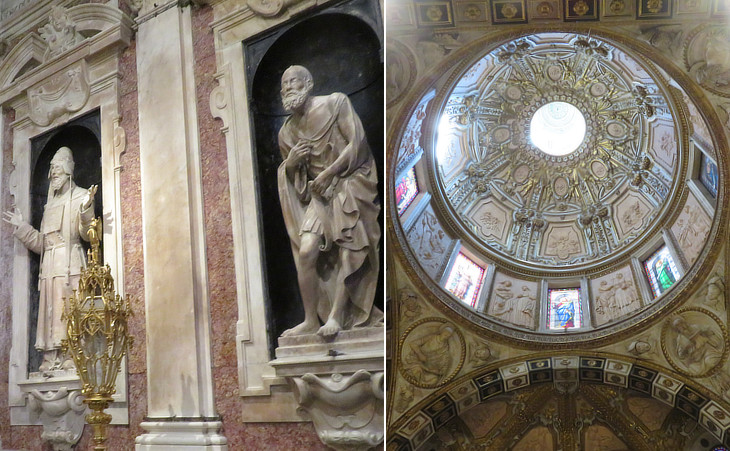
Chapel of St. John the Baptist: (left) statues by Matteo Civitale, a sculptor who was mainly active at Lucca; (right) dome which was decorated in 1604
The only remarkable circumstance about the cathedral, which is Gothic and gloomy, is the chapel where the pretended bones of
John the Baptist are deposited, and in which thirty silver lamps are continually burning.
Tobias Smollett's Travels through France and Italy in 1765
Eight niches in the interior of the chapel are also filled with statues, six of which are by Matteo Civitale (1435-1501), and two, the
Madonna, and the Baptist, by Sansovino. Murray
According to tradition the saint's body was cremated and the Genoese came
into possession of his ashes during the First Crusade when they landed at Myra where the remains of St. Nicholas
were also preserved. The ashes were initially divided among the various ships participating in the expedition,
but a storm prevented the boats from leaving until the sacred remains were gathered onto a single vessel and so they arrived triumphantly in Genoa.
Starting from 1327, recalling the miraculous departure of the ashes from Myra, people began to attribute to the relics the power to protect
ships and sailors, so that from that date the saint was proclaimed patron saint of Genoa.
The image used as background for this page shows a decorative relief of the chapel.
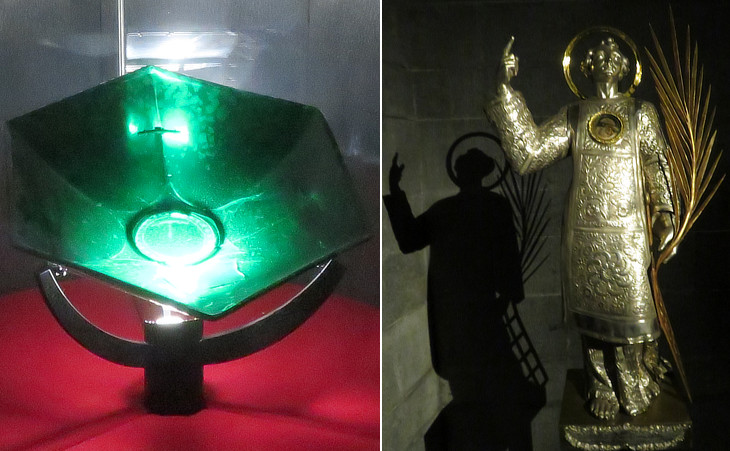
Treasury: (left) Sacro Catino (Holy Bowl); (right) silver statue portraying St. Lawrence (early XIXth century)
In the Treasury is preserved a more interesting relic, the Sacro Catino long supposed to be composed of a single emerald. It was part of the spoils won at the taking of Cesarea, 1101. The Crusaders and their allies divided the prey; and the Genoese, under the command of the celebrated Guglielmo Embriaco, selected this precious dish, or vessel, as their portion of the spoil. The traditionary worth of the material was infinitely enhanced by the fond traditions annexed to the vessel, whether as a gift from the Queen of Sheba to Solomon, or as the dish which held the Pascal Lamb at the Last Supper, or the Sang real, the vessel in which Joseph of Arimathea received the blood flowing from the side of the Redeemer, and in search of which the Knights of King Arthur made their quest. Three times each year was the Catino brought out of the sacristy, and exposed to the veneration of the faithful. A prelate of high rank exhibited it to the multitude; and around him were ranged the Clavigeri, to whose care the relic was committed. The Clavigeri, as their name imports, were the keepers of the keys of the sacristy; and they were solemnly bound never to allow these keys to depart from their custody. No stranger was allowed to touch the Catino under heavy penalties; and if any one attempted to try the material by steel or diamond, gem or coral, or any real or supposed test of its genuineness or hardness, they were to be punished with heavy fines, imprisonment, or even death. Acute and somewhat sceptical travellers, as Keysler and the Abbe Barthelemy, in spite of these precautions, saw enough to lead them to suppose that the Catino was glass, a fact which is now fully confirmed. But the extraordinary perfection of the material, as well as of the workmanship, must always cause it to be considered a very remarkable monument, and of remote antiquity. The dish is hexagonal, with some slight ornaments, which appear to have been finished with the tool, as in gem engraving. The colour is beautiful, the transparency perfect; but a few air-bubbles sufficiently disclose the substance of which it is made. The Catino was sent to Paris; and was reclaimed in 1816, with other objects of art. It was so carelessly packed that it broke by the way. The fragments have been united by a setting of gold filigree. Murray
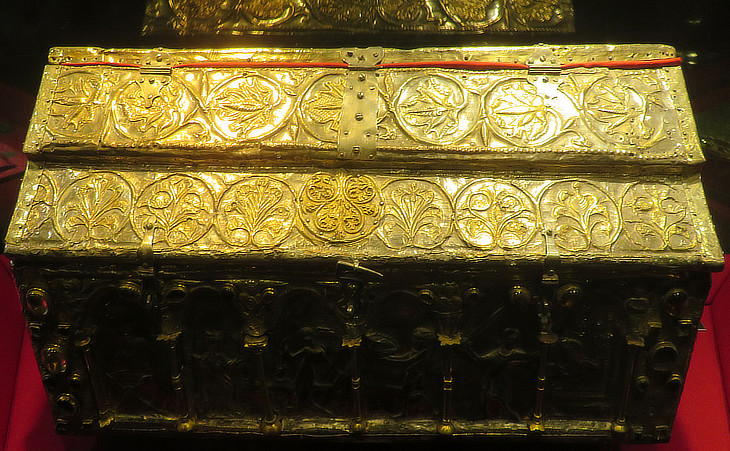
Treasury: Ark of St. John the Baptist's Ashes (XIIth century - Genoese goldsmiths)
The main point of interest about the Cathedral is the little Chapel of St. John the Baptist (inside the monumental one). They only allow women to enter it on one day in the year, on account of the animosity they still cherish against the sex because of the murder of the Saint to gratify a caprice of Herodias. In this Chapel is a marble chest, in which, they told us, were the ashes of St. John; and around it was wound a chain, which, they said, had confined him when he was in prison. We did not desire to disbelieve these statements, and yet we could not feel certain that they were correct - partly because we could have broken that chain, and so could St. John, and partly because we had seen St. John's ashes before, in another Church. We could not bring ourselves to think St. John had two sets of ashes.
They also showed us a portrait of the Madonna which was painted by St. Luke, and it did not look half as old and smoky as some of the pictures by Rubens. We could not help admiring the Apostle's modesty in never once mentioning in his writings that he could paint.
But isn't this relic matter a little overdone? We find a piece of the true cross in every old church we go into, and some of the nails that held it together. I would not like to le positive, but I think we have seen as much as a keg of these nails. Then there is the crown of thorns; they have part of one in Sainte Chapelle, in Paris, and part of one, also, in Notre Dame. And as for bones of St. Denis, I feel certain we have seen enough of them to duplicate him, if necessary. Twain
It is the oldest known ark to have been used to preserve the ashes of St. John the Baptist.
The shape is that of a rectangular building with a sloped "roof" covering which extends beyond the "walls", the work is decorated with plant motifs. The front side and the two short sides are decorated with precious stones, rectangular and oval shaped. According to a later tradition the ark was reported to be a devotional offering by Emperor Frederick Barbarossa.
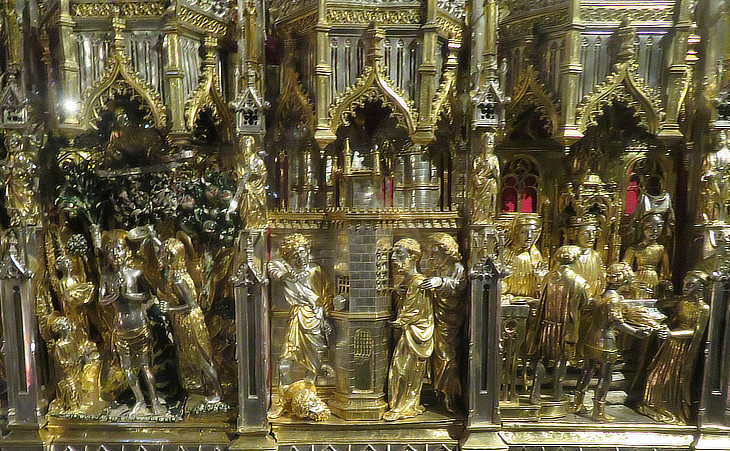
Treasury: Detail of the "Processional Ark of St. John's Ashes by Teramo Danieli and Simone Caldera
On the day of his nativity they are carried in procession, being placed in a shrine preserved in the treasury of the cathedral.
It was made in 1437 by Daniele di Terramo, of silver gilt, a combination of Gothic panels, tracery, and finials of the most delicate workmanship.
The sides are covered with imagery, the history of St. John; the figures being all but completely detached from the background. Murray
The ark was created in order to carry the ashes of St. John the Baptist on the occasion of his feast (June 24), a ritual that is still maintained
today. During the rite the archbishop would take the reliquary that normally contained his ashes and blesses the sea invoking the protection of God
on sailors, their ships and on the goods they carry. The ark was commissioned by the Priors of the Chapel and made between 1438 and 1445.
The shape of the ark is that of a miniature cathedral topped with heavily decorated spires and pinnacles. At the four corners two evangelists:
St. John and St. Matthew and the city's two patron saints: St. George and St. Lawrence. In the central part the life of the saint is told in ten
scenes. See an elaborate XIVth century reliquary at Siena.
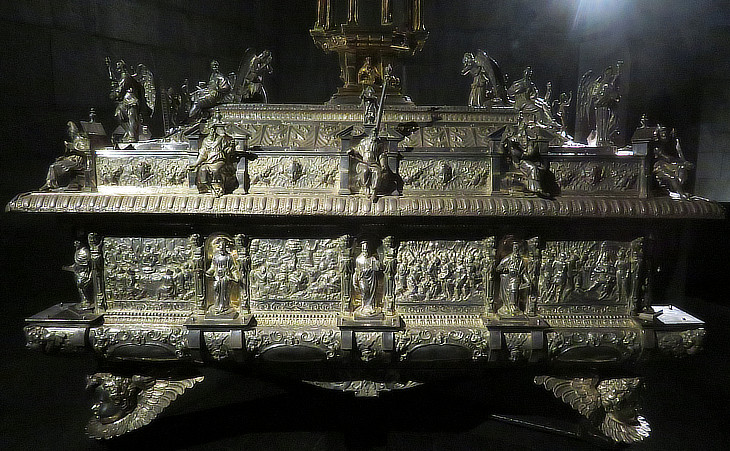
Treasury: silver processional arch for the Corpus Domini procession
The ark was built to carry a consecrated host in procession through the city streets at the feast of Corpus Domini. The commission was granted by the City Fathers in 1553, but the work, which involved Genoese, Flemish, German and Lombard silversmiths was completed in 1612. At the base are heads of angels, in the central part in relief Stories of the Passion, from the Last Supper to Christ's Burial, alternating with the figures of the Apostles. On the cover, seated on thrones, the Prophets, and angels with candlesticks and symbols of the Passion. On the plinth stand the four Sibyls, two on each side.
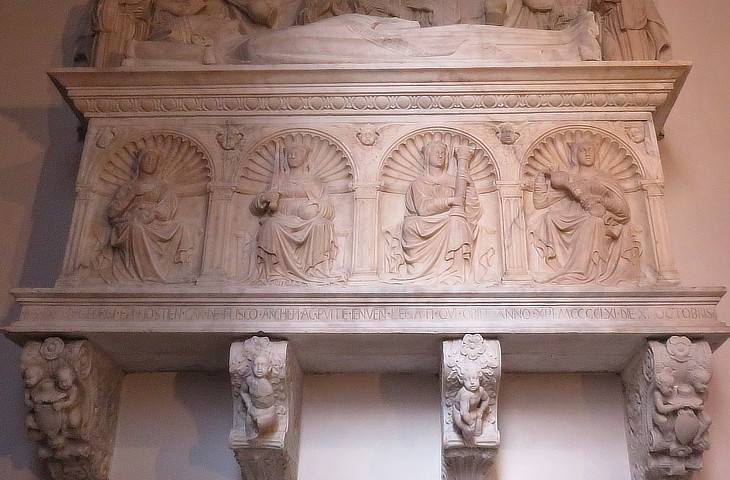
Monument to Cardinal Giorgio Fieschi (d. 1461) by Giovanni Gagini, other members of this family of sculptors were active at
Palermo; the reliefs portray Prudence, Justice, Strength and Temperance
The Chapel of St. John the Baptist and its relics are definitely the main attraction of the Cathedral, but also other monuments
deserve attention because they testify to the historical and artistic developments which occurred in Genoa.
Giorgio Fieschi was one of several cardinals of this noble family who had a fiefdom at Lavagna in the eastern part of the Riviera.
The Fieschi had close ties with the Angevin kings of Naples. Cardinal Guglielmo Fieschi (d.1256) was buried in
an ancient Roman sarcophagus at S. Lorenzo fuori le Mura.
Popes Innocent IV (d. 1254) and Adrian V belonged to this family.
The latter is mentioned in Dante's Comedy (Purgatory XIX - Longfellow's translation); the poet speaks to a soul who is purging his avarice and who
was a pope, i.e. Adrian V. Elected pope in 1276 he died after only 38 days.
Dante contributed to the widespread opinion that the Genoese are stingy (it persists to these days).
There are about half a dozen of the Genoese noblemen who have ten thousand a year: but the majority have not above a twentieth part of that sum. They live with great parsimony in their families; and wear nothing but black in public; so that their expences are but small. If a Genoese nobleman gives an entertainment once a quarter, he is said to live upon the fragments all the rest of the year. I was told that one of them lately treated his friends, and left the entertainment to the care of his son, who ordered a dish of fish that cost a zechine, which is equal to about ten shillings sterling. The old gentleman no sooner saw it appear on the table, than unable to suppress his concern, he burst into tears, and exclaimed. "Ah Figliuolo indegno! Siamo in Rovina! Siamo in precipizio! Ah, Prodigal! ruined! undone!".
Tobias Smollett's Travels through France and Italy in 1765
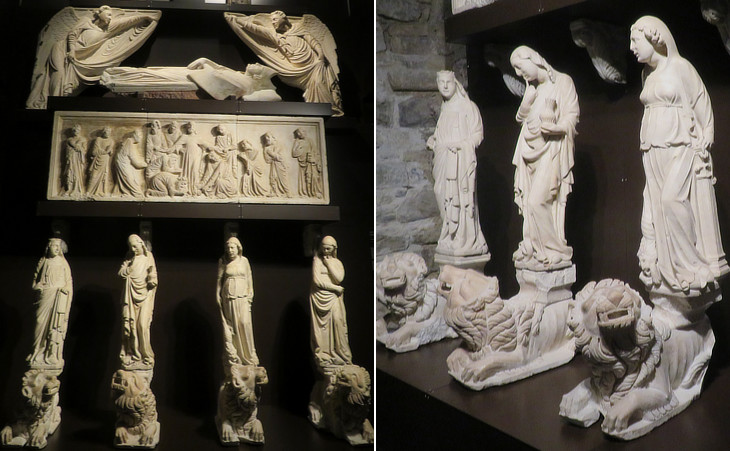
Museo Diocesano: Reconstructed monument to Cardinal Luca Fieschi (1336)
Cardinal Luca Fieschi was created cardinal in 1300. He helped Pope Boniface VIII at Anagni but he eventually established good relations with the French Popes who moved the Papal See to Avignon, where he spent many years and amassed great wealth and a large household. At his death he was initially buried in the Franciscan church of Avignon but his body was eventually transferred to Genoa and buried in the cathedral in a very complex monument which was designed and executed by sculptors from Pisa. Similar large monuments had been built in the late XIIIth and the early XIVth century at Orvieto, Perugia, Siena and Arezzo.
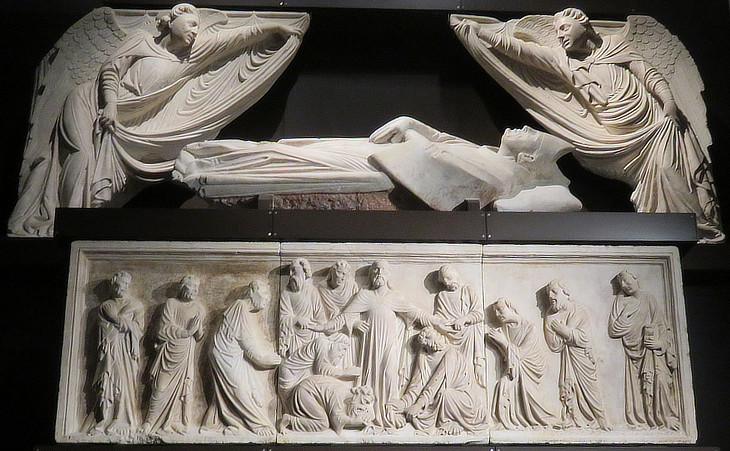
Museo Diocesano: Reconstructed monument to Cardinal Fieschi - details showing angels holding a curtain, the "gisant" of the dead and a relief portraying Jesus and the Twelve Apostles
The monument was most likely erected behind the main altar and near the XIVth century location of the Altar to St. John the Baptist.
It was a very prestigious location which testify to the power of Cardinal Fieschi and in general to that of his family.
In 1547 Giovanni Luigi Fieschi plotted against Andrea Doria and the rising power of his family. He lost his life and the Fieschi most of
their properties, a blow from which they never fully recovered.
The presbyterial area of the Cathedral required repairs and at the beginning
of the XVIIth century the monument to Cardinal Fieschi was relocated along a wall of a side nave, but only in part because of its size.
Over time some of its architectural details and statues were employed to decorate other monuments and altars.
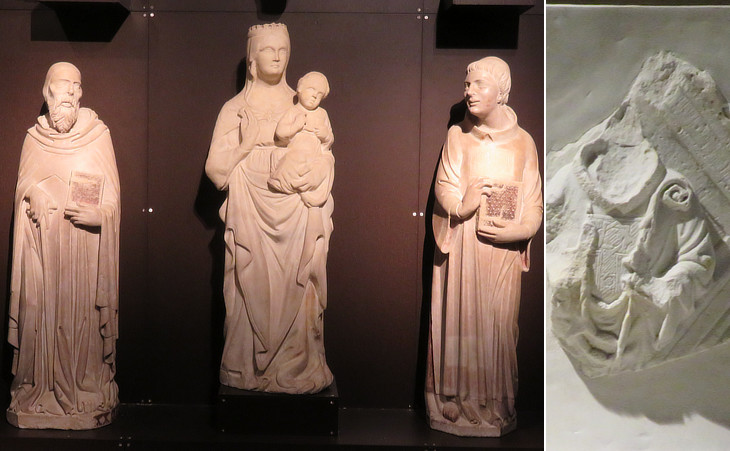
Museo Diocesano: Other elements of the monument to Cardinal Fieschi: (left) a Madonna between two saints; (right) a decorative element portraying a bishop
In the late XIXth century a thorough analysis of the medieval works of art which were scattered inside the Cathedral led to the identification of those which were most likely part of the monument to the Cardinal. They were removed and studied and many suggestions were made about their original positions in the monument. Today a partial reconstruction can be seen at Museo Diocesano, very near S. Lorenzo. The set up allows for a close view of statues and architectural details which would not have been otherwise easily noticeable. A similar effort has been made in Florence for the remaining elements of the medieval façade of the Cathedral.
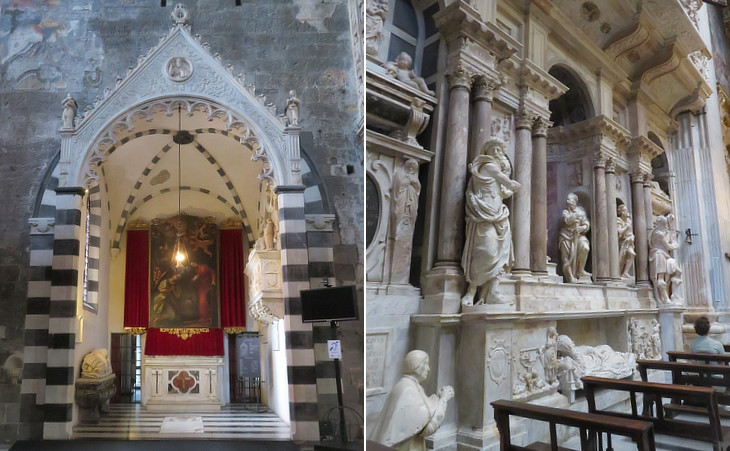
(left) Cappella De Marini; (right) Monument to Cipriano Pallavicino (aka Pallavicini), Archbishop of Genoa (d. 1586)
Other monuments of the Fieschi family can be seen in a chapel erected in 1452 by Nicola De Marini.
At the end of the XVth century the Cathedral was almost the funerary chapel of the Fieschi.
The Doria had to content themselves with S. Matteo, another medieval church in the vicinity of the Cathedral.
The Pallavicino/i became an extremely wealthy family of Genoa in the XVIth century and a branch of them is among those in Rome who still live in their historical palace and own extensive properties in the environs of the City. Other branches of the family are linked to fiefdoms near Parma and to the history of Venice.
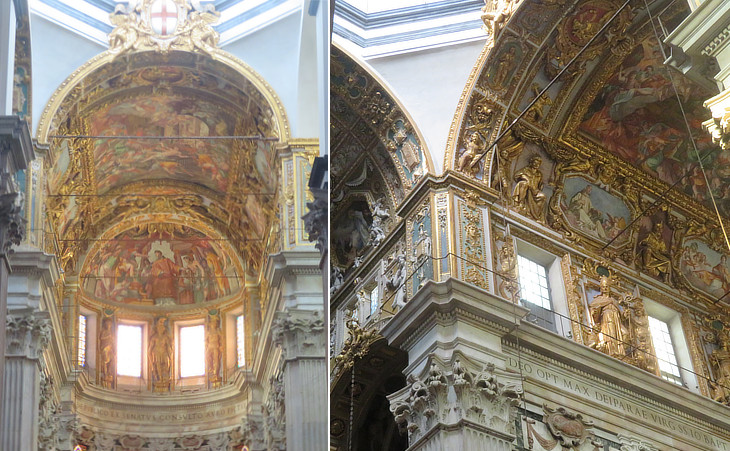
Ceiling and detail of the decoration of the apse with frescoes by Lazzaro Tavarone in 1622-1624
The Cathedral of San Lorenzo, to which we were afterwards conducted, whose exterior front is covered with alternate slabs of black and white marble, which were brought, either in whole or in part, from Jerusalem. Within, there was a prodigious richness of precious marbles. (..) I used to try to imagine how the English cathedrals must have looked in their primeval glory, before the Reformation, and before the whitewash of Cromwell's time had overlaid their marble pillars; but I never imagined anything at all approaching what my eyes now beheld: this sheen of polished and variegated marble covering every inch of its walls; this glow of brilliant frescos all over the roof, and up within the domes; (..) this wealth of silver, gold, and gems, that adorned the shrines of the saints, before which wax candles burned, and were kept burning, I suppose, from year's end to year's end; in short, there is no imagining nor remembering a hundredth part of the rich details.
Nathaniel Hawthorne - Passages from the French and Italian note-books - 1872
During the seventeenth century the old maritime republic had an immensely rich ruling
class who made their money for the most part by world-wide banking manipulations; and
the international character of their enterprises is also reflected in the artistic field. At the end of the previous century Genoa had possessed in Luca Cambiaso (1527-85) a great native artist. Capable of working on the largest scale, his influence remained a
vital force far into the Seicento, and among his followers must be numbered Lazzaro
Tavarone (1556-1641), Battista Castello (1547-1637} and his brother Bernardo (1557-
1629).
Rudolf Wittkower - Art and Architecture in Italy - 1600-1750. Publ. 1953
You may wish to see the ceiling of the apse of S. Andrea della Valle in Rome which was painted by il Domenichino. The combination of medieval structures and Renaissance/Baroque decoration is typical of most churches of Genova.
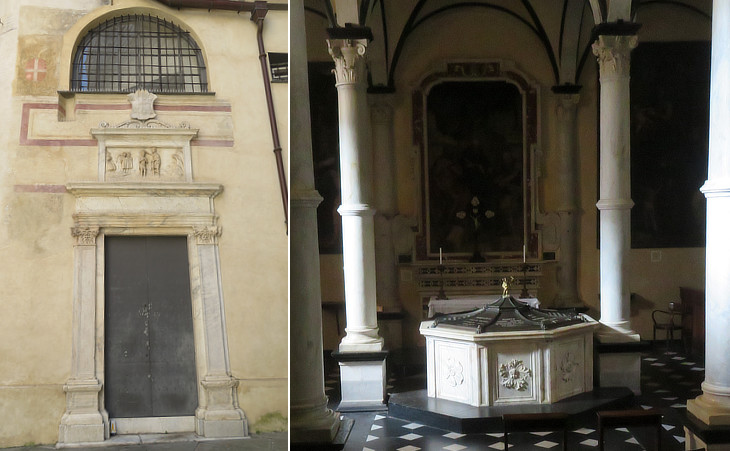
Battistero di S. Giovanni il Vecchio: (left) entrance opposite Porta di S. Giovanni; (right) interior with the baptismal font seen from the Cathedral
In origin the Baptistery was a separate building, but in 1502 it was redesigned at the initiative of Cardinal Pierre d'Aubusson, Grand Master of the Order of the Knights of Rhodes (his coat of arms stands over the portal of the building) and a direct access to it from the Cathedral was opened. The appellative "Il Vecchio", the Old, was given to the Baptistery after the construction of the chapel by the same name inside the Cathedral. The octagonal baptismal font was designed and decorated in the late XVth century. It was supposed to being used by immersion but the practice was already discontinued for adults and its size appears too small (see that at Pisa).
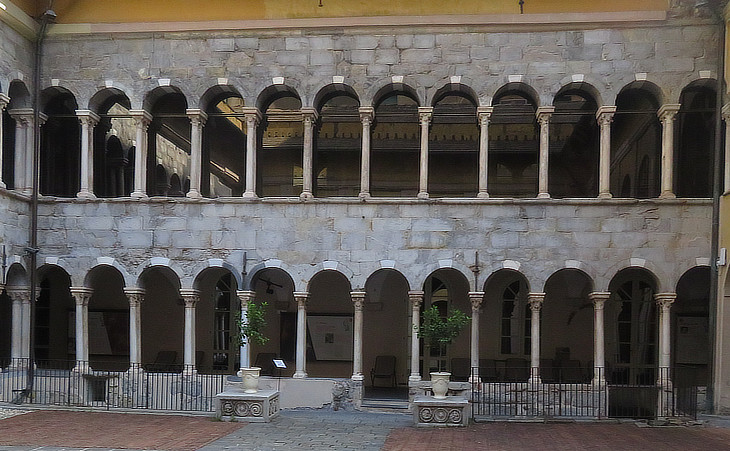
Cloister of the Chapter of S. Lorenzo
A residence for the Deans of the Chapter was built at a short distance from the Cathedral and also very near Palazzo Ducale, the residence of the lay magistrates of the Republic. Over time it became a very complex building surrounding a large cloister. Major modifications were made in the XVIth century and in 1653 when two floors were added. In the XVIIIth century its decoration was revamped in line with the fashion of the time. During the XIXth century the palace was gradually abandoned and eventually in 1923 it was sold to the City of Genoa and parts of it were turned into houses and offices. In the 1980s the municipal authorities returned it to the Archbishopric of Genoa to create a museum (Museo Diocesano) for the works of art of the many churches and monasteries which had been closed or destroyed (also by WWII bombings).
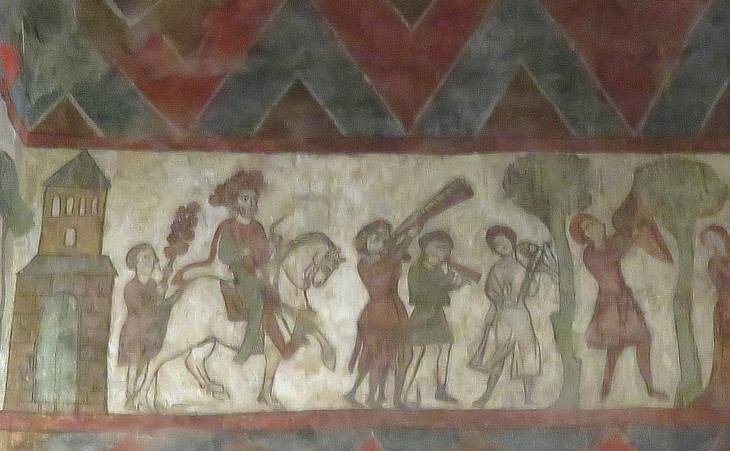
Chapter of S. Lorenzo: Fresco depicting some of the Months - detail showing May
The lengthy and careful restoration of the palace was aimed at removing modern additions and at highlighting its medieval features. A section of a XIIIth century decorative fresco was discovered in a room of the apartments of the Deans. It portrays some of the activities which occur between January and June, a subject which was often depicted by reliefs and statues in the decoration of medieval churches, e.g. at S. Zeno at Verona, the Baptistery of Pisa and in particular at S. Maria della Pieve at Arezzo. The depiction of May brings to mind poems which were dedicated to this month, e.g. a ballad by Agnolo Poliziano.
| Ben venga maggio, E 'l gonfalon selvaggio! Ben venga primavera, che vuol ch'uom s'innamori; e voi donzelle, a schiera con li vostri amadori, che di rose e di fiori vi fate belle il maggio, venite alla frescura delli verdi arbuscelli. |
Welcome May, and the bunch of wild flowers! Welcome spring, which makes men fall in love; and you, young women, lined up with your lovers, you, who with roses and flowers embellish yourselves in May, come under the shadow of the green branches. |
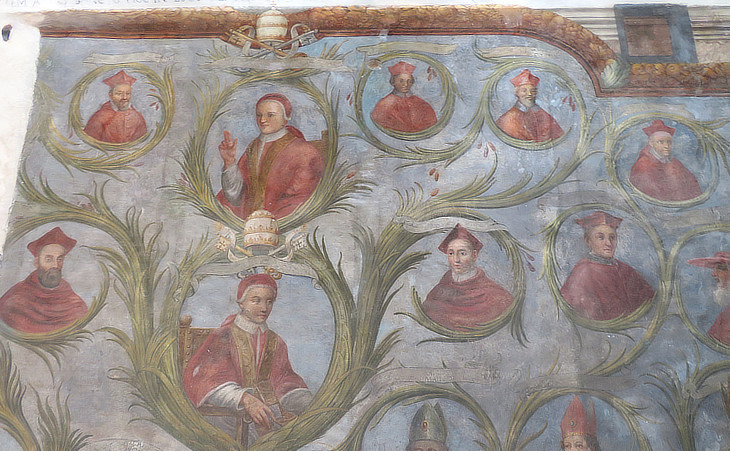
Upper gallery of the cloister: XVIIIth century fresco portraying Deans of the Chapter including Popes Innocent IV and Innocent VIII
Tentative plan of this section
The Ancient Town
The Cathedral
The Doria's Palaces and Church (S. Matteo)
Palazzo del Principe
The Harbour
The Piazza Nuova
The Strada Nuova
Via Balbi
Two Grand Churches
A Walk to Castello
In the Heart of the Old Town
Old and New Portoria
Museums: Exhibits from Churches
Museums/Palaces: Tursi and Bianco
Museums/Palaces: Rosso and Spinola
Some Environs of Genoa
Anthony van Dyck's 2026 Exhibition