All images © by Roberto Piperno, owner of the domain. Write to romapip@quipo.it.


Notes:
Page added in September 2026.
All images © by Roberto Piperno, owner of the domain. Write to romapip@quipo.it.
Notes:
Page added in September 2026.
 The Doria's Palaces and Church
You may wish to see pages on the Ancient Town and the Cathedral first.
Not farre from the Cathedrall is the Church Saint Matthew, wherein the Princes of the Family of d Auria have long had
their monuments.
Fynes Moryson - An Itinerary: Containing His Ten Years Travel Through .. Italy (in 1594)
The churches of S. Cyr, La Madonna della Vigna, S. Matthew, S. Mary of Carignan, and the Jesuits are extremely well worth a
traveller's notice.
Thomas Nugent - The Grand Tour - 1749
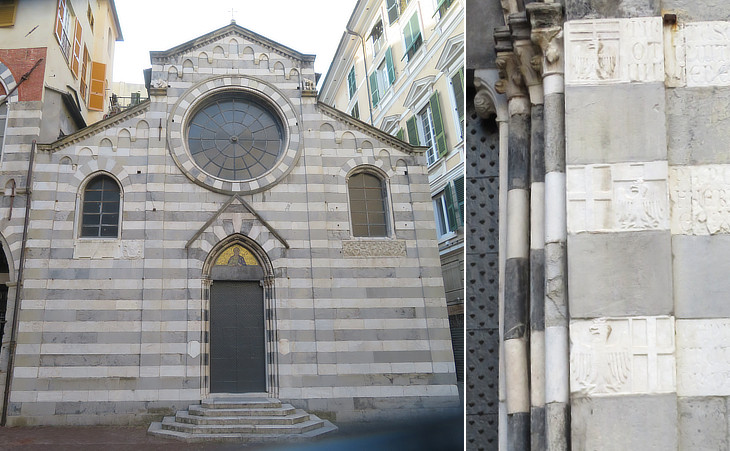
San Matteo: (left) façade; (right) coats of arms of the Doria (eagle) and of the Republic of Genoa (St. George's cross) next to the portal; the façade is embellished by a Roman sarcophagus, the tomb of Admiral Lamba Doria
San Matteo was under the patronage of the Doria family. The front, which is in a plain Gothic, is built in alternate
courses of black and white marble. Five of the white courses bear inscriptions relating to the achievements of the family.
The pilaster at either extremity of the facade, and on each side of the entrance door, present the banners of Genoa and of the Doria family.
John Murray - Handbook for travellers in Northern Italy - 1843
You must not fail of a visit to the Church of San Matteo,
set round with the palaces of the Doria family - the palace
which his grateful country gave the Admiral (Andrea Doria 1466-1560) after he refused to be her master, and the palaces of his kindred neighboring it round.
I do not remember any equal space in all Europe which, through a very little knowledge, so takes the heart as the gentle little church
founded by an earlier Doria, and, after four hundred years, restored by a later, and then environed with the stately homes of the race,
where they could be domesticated in the honor and reverence of their countrymen because of the goodness and greatness of the loftiest of their line.
William Dean Howells - Roman Holidays and others - 1908
S. Matteo and the palaces which surround it were
neglected by most travellers of the XVIIth and XVIIIth century, but today they attract many visitors because they retain a medieval/Renaissance
aspect which is lost in most of the historical part of Genoa.
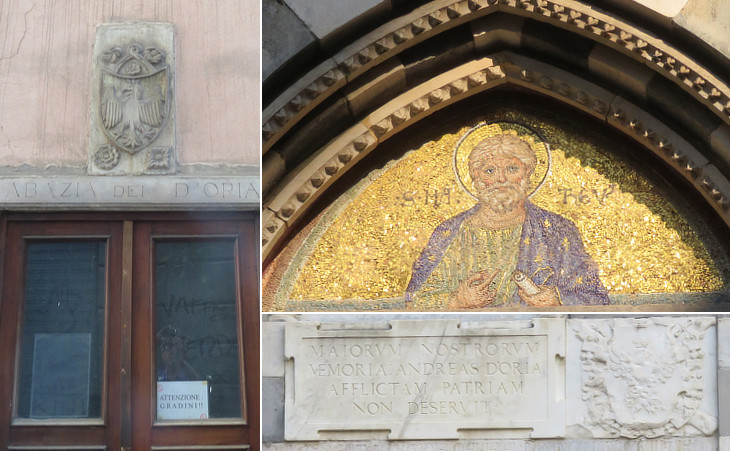
San Matteo: (left) left entrance to the church with inscription "Abazia dei D'Oria" (Abbey of the Doria); (right-above) mosaic of the façade portraying St. Matthew; (right-below) inscription saying that Andrea Doria did not let down his homeland in time of peril (the coat of arms was erased in 1798)
Over the door is one of the very few mosaics still existing in Genoa. It is in the ancient Greek style. Murray
The church was founded in 1125 by Martino Doria as a family chapel.
It was enlarged and redesigned in 1278 by the brothers Oberto, Lamba and Jacopo Doria. In 1284 Oberto was the Admiral of the Genoese fleet which defeated the
Pisan one at the Battle of Meloria.
St. Matthew is the patron of the tax collectors and it is thought that
the church was dedicated to him because the Doria were in charge of this function in Genoa.
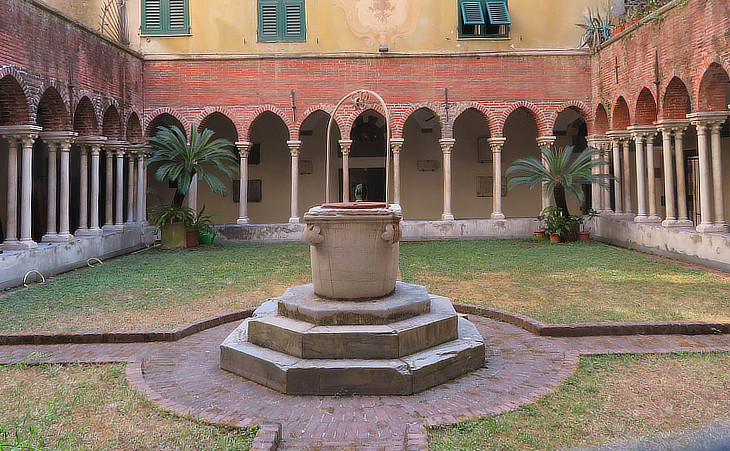
Cloister of S. Matteo
In the beautiful little cloister, on the left of the church, are the remains of the colossal statues of Giannettino
Doria (actually his son Giovanni Andrea I) and another of the family.
Augustus J. C. Hare - Cities of Northern and Central Italy - 1876.
The church, as well as the piazza, is full of Dorian memories, and the cloister must be visited for its rather damp beauty. Howells
An inscription says that the cloister was designed in 1308 by Magister Marcus Venetus, i.e. a prisoner of the Doria of Pisan and Venetian descent. It has 100 double columns which are typical of cloisters, e.g. those of
S. Paolo fuori le Mura and of the Cathedral of Monreale.
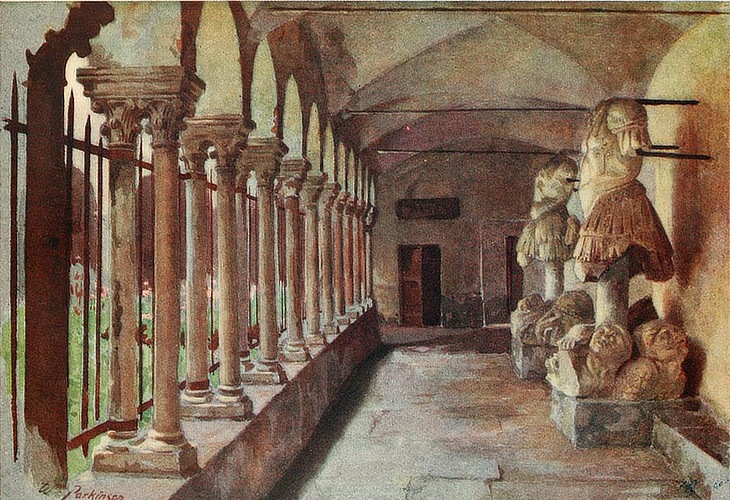
Cloister of S. Matteo by William Parkinson, from "Robert Walter Carden - The city of Genoa - 1908"
Against the wall here are gathered the
fragments of the statue of Doria which, when the French Revolution came to Genoa, the patriots threw out of the ducal palace and
broke in the street below. Howells
Against the western wall stand the broken remnants of the two statues which were erected
outside the Palazzo Ducale "to the Father and Liberator of his Country in MDXXVIII., and to the Preserver of its Liberty in MDCI.
The grateful Republic decreed that two statues should be erected before the Palazzo, and that these eternal words should bear witness
of their merits in the time to come: To Andrea D' Oria; who, because he gave back to his country its liberty after long oppression,
was called Father of his Country, the Genoese Senate have placed this (statue) while he was still alive, in undying memory of his benefits."
So also: "To Gianandrea D' Oria, Preserver of his Country's Liberty, S(enatus) G(enuensis) P(osuit)."
The ancient family of the D' Orias, collecting the shattered fragments of these beloved forms, in 1846 placed them as honoured monuments
of art and patriotism under the shadow of the ancestral church where the mortal remains of these great men lie in peace.
Carden
The remnants of the two statues are now inside Palazzo Ducale.
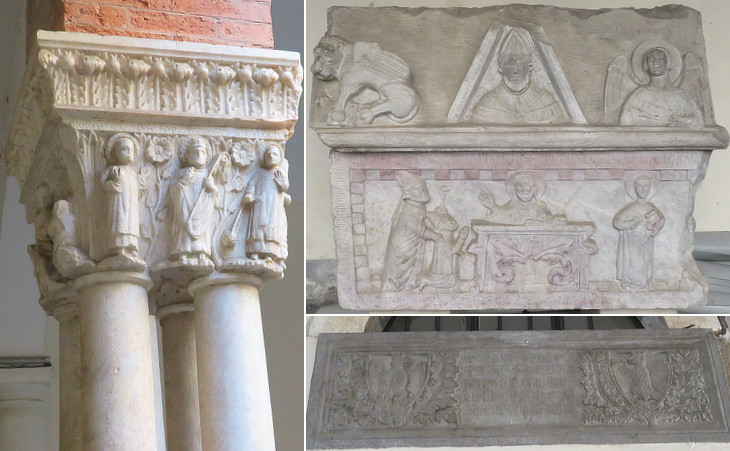
Cloister of S. Matteo: (left) capital portraying St. Fructuosus of Tarragona with Sts. Augurius and Eulogius, his two deacons; (right-above)
marble urn which was made in 1356 to contain the relics of Sts. Eleutherius and Maurus which were taken by Pagano Doria in 1354 from
Basilica Euphrasiana of Parenzo; (right-below)
tombstone of a Doria
The capitals at the angles of medieval cloisters had often a special decoration, e.g. at
Saint-Trophime (Arles). One of those at S. Matteo has elaborate reliefs portraying saints who were connected with the Doria family.
According to tradition in 711 Prosperus, Bishop of Tarragona, fled his country which was being conquered by the Arabs with the relics of three local martyrs.
An angel led him to Camogli, east of Genoa, where eventually a small church and a Benedictine abbey dedicated to St. Fructuosus were built at the initiative of the Doria.
Seven members of the family were buried there from 1275 to 1305.
The relics of saints had a particular appeal for the Italian maritime
republics, the most famous example being Venice and St. Mark; also the Pisans brought home some relics from the Levant and
St. Nicholas was carried away from Myra by seamen from Bari. In 1350-1355 Genoa and Venice were at war over the control of the straits between
the Aegean Sea and the Black Sea, but battles were fought in many parts of the Mediterranean Sea. In 1354 the Genoese, led by Pagano Doria, did not hesitate to enter the
Gulf of Venice (the Adriatic Sea) and to raid Venetian towns. The Republic of Genoa, to honour his achievements, decided to cover the costs of
building his tomb (now at the Museo di S. Agostino - it opens in another window). In the XVIth century Pagano was portrayed among the
heroes of the family in the suburban palace of Andrea Doria. In 1934 the relics of the two saints were returned to Parenzo and the marble urn which contained them was moved to the cloister.
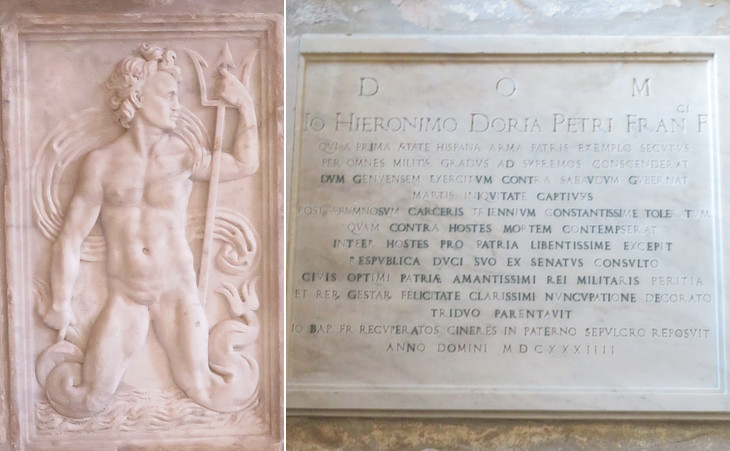
San Matteo: (left) relief inside the church portraying a triton holding a trident, a metaphor for Andrea Doria (see a portrait of the Admiral by il
Bronzino - it opens in another window); (right) 1634 funerary inscription in the cloister celebrating Gian Gerolamo Doria
Funerary monuments and inscriptions in the church and in the cloister provide insights in the history of Genoa, because the Doria held key positions in the government of the town. Their influence declined after 1767 when Andrea IV Doria was forced to relocate to the
Pamphilj palace in Rome by a decree by Pope Clement XIII in order to safeguards his rights on the Pamphilj properties which the Doria had acquired through marriage.
In 1625, during the Thirty Years' War, Gian Gerolamo Doria, an elderly man, was appointed commander of the
Genoese troops in a war against the Duke of Savoy and France.
He was defeated and taken prisoner to Turin where after three years in jail he died. In 1633 a peace was signed and in the following year the corpse of Gian Gerolamo was given back to Genoa and was buried at S. Matteo.
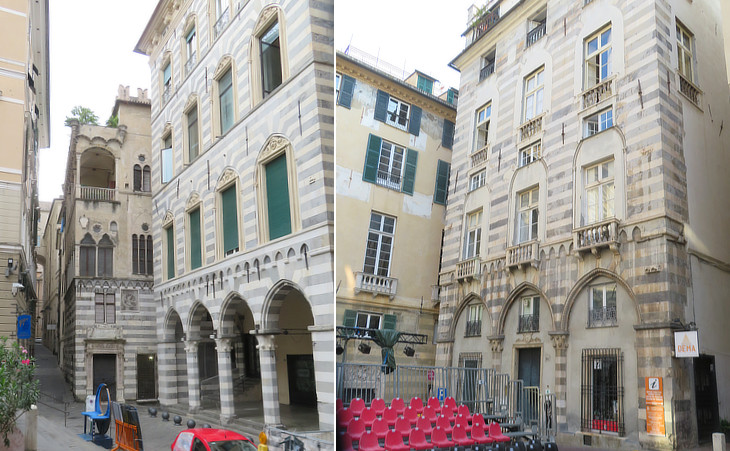
Piazzetta S. Matteo: (left) Via dell'Arcivescovado, a street leading to the Cathedral, palace donated to Andrea Doria by the Republic of Genoa and palace of Lamba
Doria; (right) Palaces of Giorgio Doria and of Domenicaccio (Gian Domenico) Doria
In the surrounding Piazza are some curious specimens of ancient domestic architecture. (..)
One of the inscriptions of the church commemorates the great naval victory of Curzola (a long and narrow island south of Spalato in the Adriatic Sea), September 7, 1298,
over the Venetian fleet, commanded by Andrea Dandolo,
by the Genoese, under Lamba Doria, both being the most honoured names in the military annals of Italy. The Genoese fleet
consisted of 76 galleys; their opponents, who numbered 96, sustained a total defeat; 74 Venetian galleys were captured and 7400 captives were
brought to Genoa by the conquerors. Murray
It is said that Marco Polo, the famous Venetian traveller was taken prisoner at Curzola.
He dictated his memories to Rustichello da Pisa, a prisoner from Pisa, in a Genoese jail.
Turning to the right on leaving the west door of the cathedral, by the Via and Salita del Arcivescovado, we reach the
Church of S. Matteo. The little platform in front of the church is surrounded by curious fifteenth-century palaces.
Hare
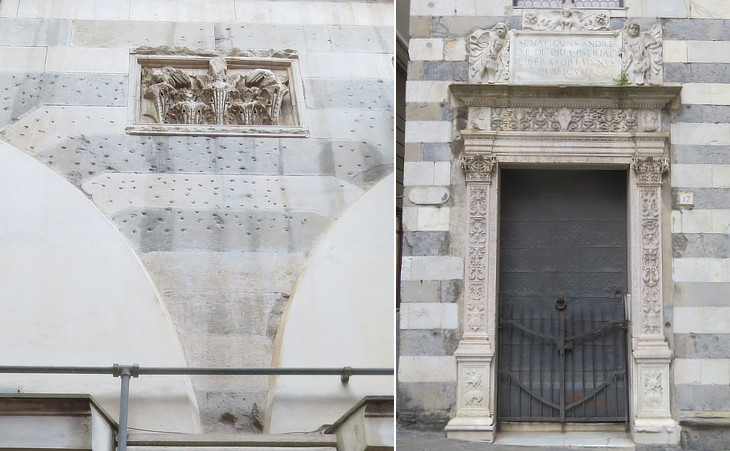
(left) Palazzo Doria Danovaro: element of the original building which was redesigned in the XIXth century; (right) portal of Palazzo Andrea Doria
If Genoa had the mortification, during the last three centuries, of seeing her glory on the decline, it must be owned that she found some
compensation in the internal tranquillity which she has almost invariably enjoyed during that period.
This tranquillity is ascribed to the revolution which the celebrated Andrea Doria planned and executed with so much decision and ability;
by which he wrested his country from the grasp of France, secured her independence abroad, and by a fair and moderate,
if not a perfect government, established order and concord at home. This event occurred in the beginning of September, 1528, and is still
commemorated by a festival of thanksgiving.
John Chetwood Eustace's Classical Tour of Italy in 1802 (publ. 1813)
The palace in the right-hand corner, striped with black and white marble, and with a door richly-adorned with arabesques, was that of the famous
Andrea Doria, given to him by the Republic, and bears the inscription: "Senat. Cons. Andreae de Oria Patria Liberatori Munus Publicum."
A palace has a long inscription relating to the victories of the Dorias. Two others have reliefs above their doors, of St. George and the Dragon. Hare
Munus Publicum i.e. with
public money. The Admiral however usually resided at his suburban palace.
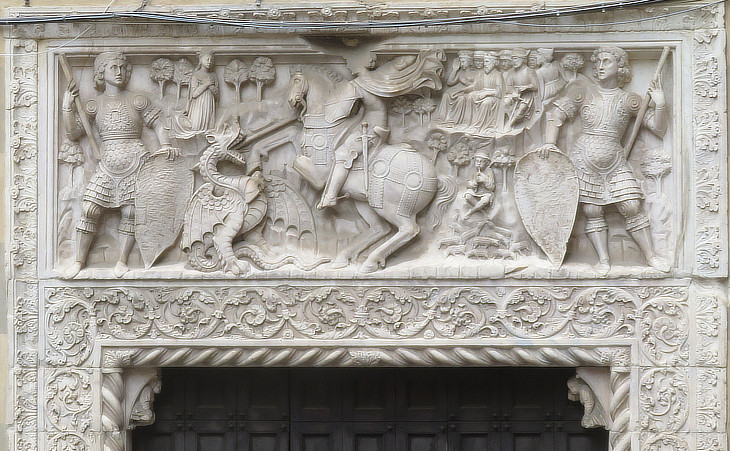
Portal of the House of Giorgio Doria by Giovanni Gagini (1457)
Genoa houses the relics of St. John the Baptist and its Cathedral is dedicated to St. Lawrence, but Pe Zena e pe San Zorzo
(For Genoa and for St. George) was the battle cry of the Genoese soldiers and seamen. It is associated with the conquest of
Jerusalem in 1099 in which Guglielmo Embriaco, a Genoese merchant and commander, had a major role. The red-on-white cross and the flag
showing the saint himself were subsequently used as the ensign of the Republic of Genoa.
Families who had served the Republic were allowed
to decorated their palaces with
reliefs with the traditional iconography of the saint in the act of killing a dragon.
The Gagini were a family of sculptors from today's Italian Switzerland who were active at Genoa and in Sicily, especially at Palermo where Domenico and Antonello Gagini worked at the decoration of the Cathedral.
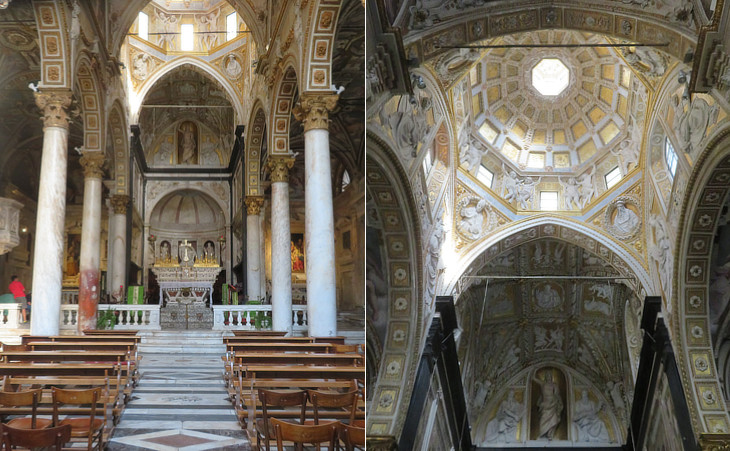
San Matteo: (left) interior; (right) dome
The interior, which is small, was splendidly reconstructed at the expense of the great Andrea Doria, who is here interred.
It is of the Corinthian order, discordant in its style from the exterior. Murray
Andrea Doria is buried in the crypt.
The interior was redesigned in the 1540s by Giovan Angelo Montorsoli, a Florentine Servite friar, a sculptor and architect who was also involved in the execution of some statues for the suburban residence of the Admiral.
Giorgio Vasari in his Lives of the most eminent artists highly praised the work of Montorsoli at S. Matteo:
Giovann' Agnolo then remembered that he had promised Prince Doria to return to Genoa, there to erect the sepulchral monument of that
Sovereign himself. This was to be constructed in the Church of San Matteo, and the Frate was furthermore to decorate the entire church.
He departed from Naples, therefore; and having arrived in Genoa, at once prepared the models for such works as the above-named Signore
had commanded, and which pleasing the latter greatly, Giovann' Agnolo set hand to the same. Prince Doria allowing him a good stipend,
and the monk being assisted by a fair number of masters. Thus dwelling in Genoa, Giovann' Agnolo made many friends among the Genoese nobles and
men of distinction, but more especially with certain physicians and these persons were of great use to him, seeing that they dissected
large numbers of human bodies; and, mutually aiding each other, they studied architecture and the laws of perspective in common;
by which means Giovann' Agnolo rendered himself most excellent in his art.
In 1545 Montorsoli established himself at Messina. Earthquakes destroyed many of the buildings he designed (you may wish to see a
fountain of Neptune and two very fine reliefs he made there).
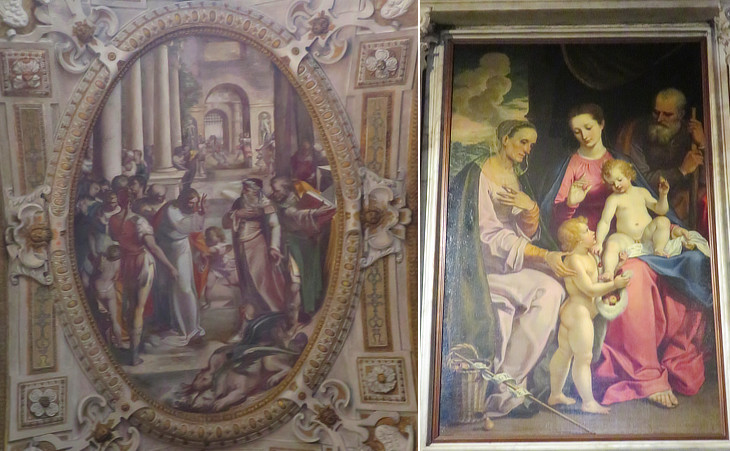
San Matteo: (left) ceiling: St. Matthew tames the Aethiopian dragons (*) by Luca Cambiaso (1527-1585); (right) Holy Family with St. Elisabeth and little St. John by
Bernardo Castello (1557-1629)
Prince Doria selected Luca Cambiaso to execute a very considerable work in fresco for the church of S. Matteo. (..)
Luca Cambiaso did not quit his native country to obtain instruction,
nor did he frequent any other school than that of his father; obscure indeed, but of a good method, and sufficient to a mind of genius.
Giovanni his father, a tolerable quattrocentista, after having exercised him in copying the designs
of Mantegna, a master of chasteness of contour, and having instructed him in the art of modelling, so useful in relief and foreshortening,
carried him to the palace Doria, and there pointed out to his attention those great prototypes of art, with the addition of his own instruction.
The study of these performances, by a youth who was born a painter, awakened in him such emulation, that he began in his fifteenth year to
produce works of his own invention; and gave promise of one day ranking, as he did, with the first painters of his age.
Bernardo Castello, travelling through Italy saw many works, and formed a style not devoid of grace, nor of correctness, when he worked with care. (..)
He had a fertile invention, in which he was aided by the poets of the age, whose friendship he assiduously cultivated. (..)
Genoa is filled, or rather glutted, with his works, yet they still maintain their reputation, as they are all sustained by a certain vigour and
grace of style.
Luigi Lanzi -
The history of painting in Italy - Transl. by Thomas Roscoe - 1828
(*) The apostle shielded himself with the sign of the cross and
confidently went out to meet these beasts. The minute the dragons saw him, they fell asleep at his feet, and he said to the sorcerers: "Where is your magical power now? Wake them up if you can!" And when all the people had gathered together,
Matthew ordered the dragons in Jesus' name to go away, and off they went, harming no one.
From the Golden Legend, a XIIIth century account of the lives of 153 saints.
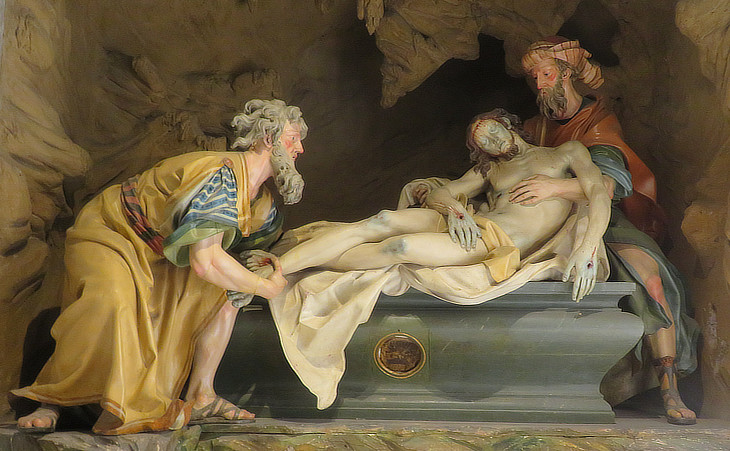
Nicodemus and Joseph of Arimathea in Christ's Deposition in the Sepulchre by Anton Maria Maragliano (early XVIIIth century)
Anton Maria Maragliano (1664-1739) raised a
popular tradition to the level of high art. He often worked from designs of his teacher,
the painter Domenico Piola. The style of his many multi-figured pictorial groups is
close to that of the Schiaffino: he knew how to combine the expression of ecstatic devotion with true Rococo grace.
Rudolf Wittkower - Art and Architecture in Italy - 1600-1750.
In 2018 a monographic exhibition at Palazzo Reale gave new lustre to an artist who
specialized in painted wooden statues, which were generally regarded as a minor genre. His works were appreciated also in Spain where these
statues were highly popular.
Move to:
The Ancient Town
The Cathedral
The Doria's Palaces and Church (S. Matteo)
Palazzo del Principe
The Harbour
The Piazza Nuova
The Strada Nuova
Via Balbi
Two Grand Churches
A Walk to Castello
In the Heart of the Old Town
Old and New Portoria
Museums: Exhibits from Churches
Museums/Palaces: Tursi and Bianco
Museums/Palaces: Rosso and Spinola
Some Environs of Genoa
Anthony van Dyck's 2026 Exhibition


