All images © by Roberto Piperno, owner of the domain. Write to romapip@quipo.it.


Notes:
Page added in October 2026.
All images © by Roberto Piperno, owner of the domain. Write to romapip@quipo.it.
Notes:
Page added in October 2026.
 The Piazza Nuova
You may wish to see pages on the Cathedral and the Doria's Palaces and Church first.
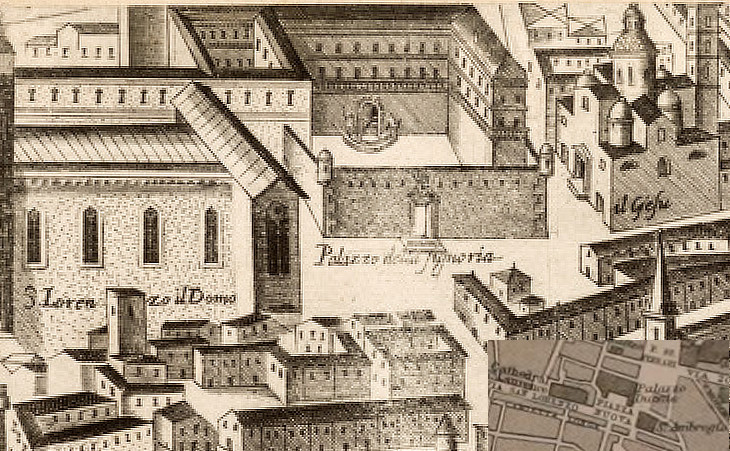
(left to right) The Cathedral (S. Lorenzo without the dome), Palazzo della Signoria (Ducale) and il Gesù (S. Ambrogio - see below) in a 1637 engraving by Alessandro Baratta;
(inset) detail of a XIXth century map showing the same buildings and the name of the piazza (today Piazza Giacomo Matteotti)
Neere the Cathedral lies the Dukes Pallace, not his private Pallace, but publike, which is kept by a guard of Dutchmen, who also have the
keeping of two of the strongest gates of the City. In the Court yard of this Pallace, is a foot statua, armed, and of white marble, erected
to the foresaid Andrea d Auria, by the Senate with the title of Father. of his Countrey, because he had lately restored the Citizens to their
liberty. And in an upper chamber called Sala brutta, are divers statuaes in the habits of Senators, erected to Paulo Spinola, to
Battista Grimaldo, and Ansaldo Grimaldi.
Fynes Moryson - An Itinerary: Containing His Ten Years Travel Through .. Italy (in 1594)
In origin the space in front of Palazzo Ducale was occupied by a maze of narrow streets, mainly inhabited by blacksmiths and coppersmiths. The neighbourhood was known as Ferraria
(ferro=iron). In the early XVIth century it was entirely pulled down because it was decided to protect the palace by building la Cortina, a wall with turrets which occupied part of the Ferraria; the remaining
empty space was called Piazza Nuova. In ca 1830 la Cortina was dismantled.
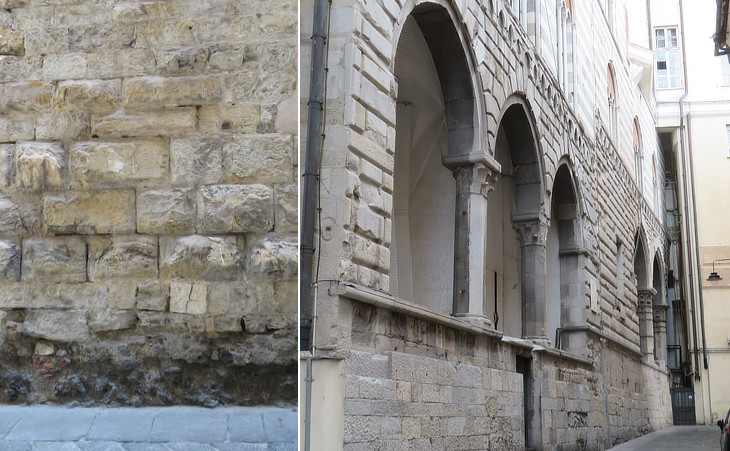
Palazzo Ducale: (left) IXth century wall opposite the northern side of the Cathedral; (right)
Portico of Palazzo di Alberto Fieschi (aka) Loggia dei Criminali
As the visitor leaves the Palazzo he should by no means omit to go down the narrow street beside it, in which the proud Torre del Comune
rears its hoary head. (..) It was somewhere here, perhaps at the window about twenty feet up and protected by forbidding bars, that the
heads of traitors to the state were exposed, while a lasting record of
their shame was graven upon the very walls themselves.
Robert Carden - The City of Genoa - 1908
Palazzo Ducale incorporates parts of a building erected by Alberto Fieschi in the late XIIIth century.
The Fieschi were one of the most powerful families of medieval Genoa and many of
their members were buried in the Cathedral. In 1935-1940 a restoration of Palazzo Ducale brought to
light its medieval structures.
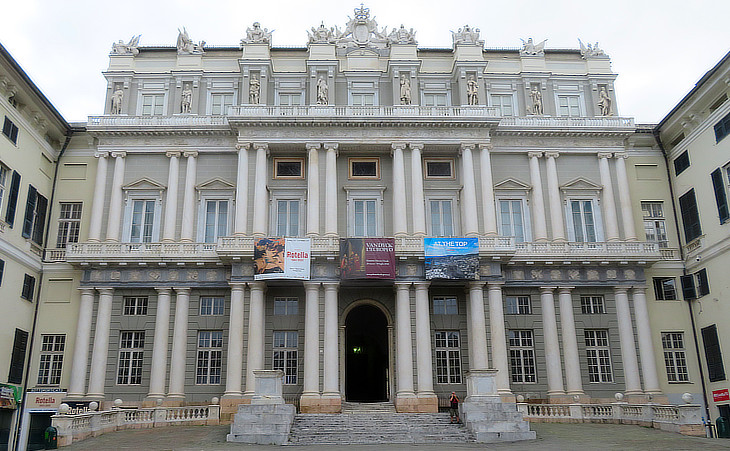
Palazzo Ducale: façade and in the foreground the pedestals of the statues of Andrea Doria and Giovanni Andrea Doria which were destroyed in 1797
We went thence to the Palace of the Dukes, where is also the Court of Justice. Neere the Ducal Palace we saw the publiq armoury, which was almost all new, most neatly kept and order'd, sufficient for 30,000 men.
We were shew'd many rare inventions and engines of warr peculiar to that armory, as in the state where gunns were first put in use.
The garrison of the towne chiefly consists of Germans and Corsicans.
John Evelyn's Diary and Correspondence related to his stay in Italy in 1644
There is also a very fine Pallace belonging to the Duke, who is a handsome old Man, and enjoys the Government onely for two yeares, and being of no power to doe any thing without the consent of the senate. In this Pallace there is a very fine Armory, which is worth the seing by All strangers, being accounted one of the Best in Italy, there being armour enough, if need weré, to suffice 50,000 Men.
Here in this Pallace also Every stranger that lodges in the Citty is to have a Bulleteen, or else, if any Person lodges any stranger without it,
that person so offending is to forfeit 300 Crownes of gold, which makes Persons very' cautious to lodge any Person without a Bulleteen from the
Pallace.
Francis Mortoft's Journal of his travels in France and Italy in 1659
The Ducal palace is large and magnificent even for Genoa; but two balustrades break the unity of the front and lessen its elevation.
The statues are not ill arranged. The enemies of the state are chained on the attic, and its benefactors are lodged within.
Joseph Forsyth's Remarks on Antiquities, Arts, and Letters in Italy in 1802-1803
The interior of the principal range of the building,
which contained
the hall of the senate and the other chief apartments, was destroyed by fire in 1777.
John Murray - Handbook for travellers in Northern Italy - 1848
The palace was redesigned in 1778-1783 in Neoclassical style by Simone Cantoni, an architect who is best known for his activity in Milan.
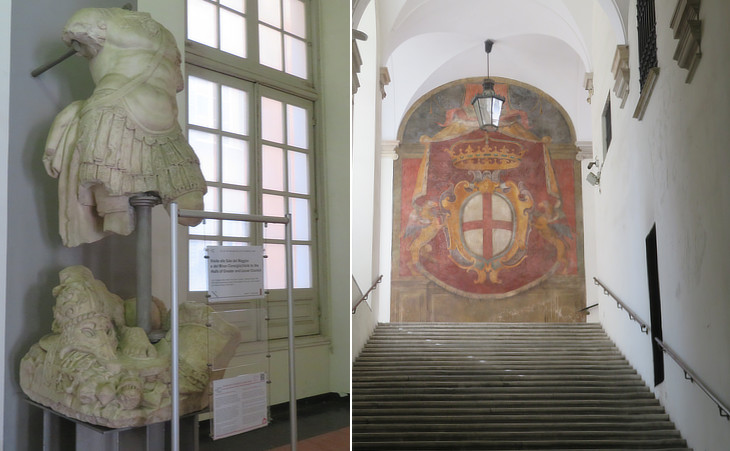
Palazzo Ducale: (left) fragments of the statue of Giovanni Andrea Doria by Taddeo Carlone; (right) grand staircase with the Cross of St. George, the symbol of the Republic of Genoa
The Palace of the Doge, or biennial Prince's here, with the several Chambers of Justice, and the Armory in it, for
thirty thousand men, ought
to be carefully seen. (..) In the foresaid Armory you see a Halbard with two Pistol barrels in the lower end of it. Here's also a Cannon of Leather so light, that a Man may carry it.
Richard Lassels' The Voyage of Italy, or a Compleat Journey through Italy in ca 1668
Andrew Doria has a statue erected to him at the entrance of the Doge's palace, with the glorious title of Deliverer of the commonwealth;
and one of his family another, that calls him its preserver. In the Doge's palace are the rooms, where the great and little council, with the
two colleges, hold their assemblies; but as the state of Genoa is very poor, though several of its members are extremely rich, so one may observe
infinitely more splendor and magnifices in particular persons houses, than in those that belong to the public.
Joseph Addison's Remarks on several parts of Italy, in the years 1701, 1702, 1703
Two statues erected by the republic to two heroes of the Doria family (one of whom was Andrea, to whom Genoa owes the independence and
prosperity of three centuries) stood conspicuous in the great court of the ducal palace, and were thrown down
and demolished by the French. (..) Never ancient tyrants shew more hatred to the restorers of liberty, than the French republican.
John Chetwood Eustace's Classical Tour of Italy in 1802 (publ. 1813)
The fragments of the statues were recovered by the Doria family and placed in the cloister of S. Matteo, the church where Andrea Doria and many other members of the family are buried.
In the 1990s, when Palazzo Ducale became a site for art exhibitions and other cultural events, they were relocated at the foot of the grand staircases.
Andrea and Giovanni Andrea were two admirals, yet they were depicted as ancient Roman commanders, probably having in mind two ancient statues portraying Caesar and Augustus which in 1565 were placed at Palazzo Senatorio in Rome.
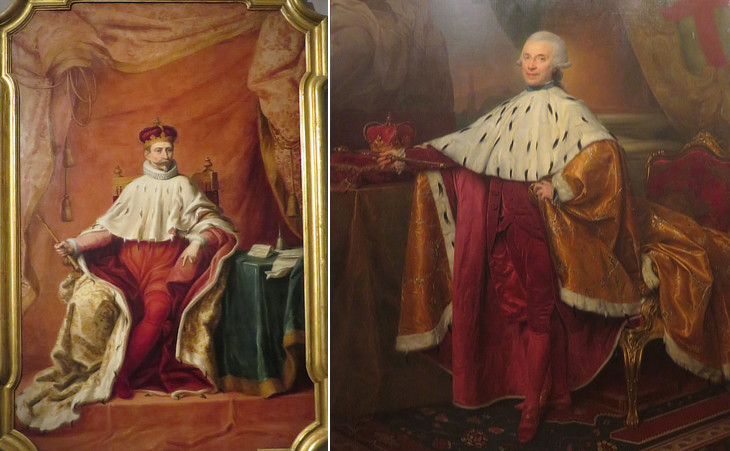
Portraits of Doge: (left) Giovanni Francesco Brignole, doge in 1635-1637, by Jacopo Antonio Boni (based on an earlier portrait -
Palazzo Rosso); (right) Michelangelo Cambiaso, doge in 1791-1793, by Anton van Maron (1792 - Palazzo Tursi)
They set also upon the land of Corsica, distant from Genoa about a hundred miles, and took it.
This Island gave the Republick of Genoa more honour than profit: for, it being-once a Kingdom, gives still to Genoa the Title of Serenissima,
and a Regal Crown over its Coat of Arms. Lassels.
The republic of Genoa has a crown and scepter for its doge, by reason of their
conquest of Corsica, where there was formerly a Saracen King. This indeed gives their ambassadors a more honourable reception at some courts.
Addison
The doge, who is stiled most illustrious and called his serenity, is chosen once in two years from amongst the ancient
nobility, but has no more power than the doge of Venice. (.. ) At his election a crown of gold is set on his head, and a scepter put into
his right hand as king of Corsica, an island subject to this republic. His guards are like those of other crowned heads, and he is cloathed
in robes of crimson velvet.
Thomas Nugent - The Grand Tour - 1749
Towards evening of June 6th 1797 a crowd of people marched up to the Palazzo Ducale, and demanded the
Libro d' Oro in which the names of all the nobles were inscribed, and having obtained possession of it, it was burnt amid shouts of
"Viva la Libertà". To complete the inauguration of the new government the robes, decorations and throne of the Doge were taken in procession
to the Piazza Acquaverde, and there burnt upon the ashes of the still smouldering Libro d'Oro. Carden
The day after our arrival we were presented to the Doge (Gerolamo Durazzo) a venerable old man,
who received us with great affability or rather kindness,
and very obligingly invited us to dinner; an honor which we were reluctantly compelled to decline as we were under the necessity of leaving
Genoa before the appointed day; a circumstance which we have many reasons to regret. The manners of the Doge were easy and unaffected;
his conversation was open and manly. Eustace
Durazzo was the last doge. In 1805 he was succeeded by Michelangelo Cambiaso
as a Mayor of Genoa appointed by the French government, because Genoa and Liguria had been
annexed by the French Empire.
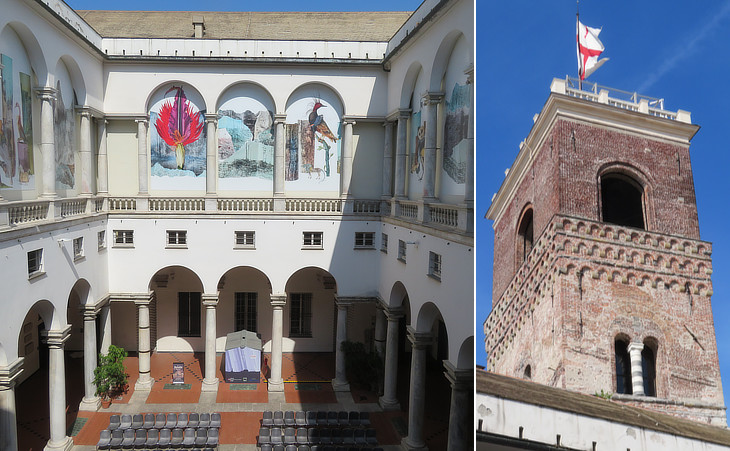
(left) Courtyard; (right) Torre Grimaldina
Externally, the Palazzo Ducale has somewhat of the aspect of an ancient fortress, with lofty massy walls, sloping outwards,
turrets and bartizans at the angles, and one great dungeon tower overshadowing the whole. Murray
The tower existed prior to the palace. It was part of a private building acquired by the Municipality.
Historical records indicate that by the early XIVth century it housed la Campana Grossa (the Great Bell)
which was used to summon the Elders to Council and the citizens to Assembly. Its lower and middle levels were turned into prisons in the XVIth
century. Its current aspect is the result of XXth century restorations aimed at enhancing its medieval aspect.
The Grimaldi were one of the most important families of Genoa, but exactly why the tower was named after them
is not known.
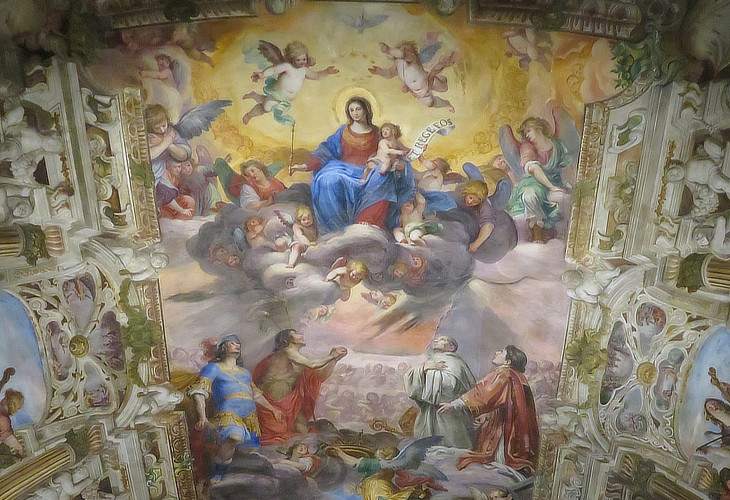
Cappella del Doge: illusionistic ceiling portraying the Virgin Mary and the four patron saints of Genoa: George, John the Baptist, Bernard of Clairvaux
and Lawrence by Giovanni Battista Carlone (1653)
In 1637 the Virgin Mary was given the title of Queen of Genova and the chapel was decorated with frescoes celebrating this event.
The inscription "et rege eos" (rule them) is taken from the "Te Deum", a Christian hymn traditionally ascribed to
St. Ambrose.
The protagonists of the older Genoese fresco style are the brothers Giovanni and Giovanni Battista Carlone, who belong to that fertile Lombard
family which had great decorators among its members for three centuries.
Rudolf Wittkower - Art and Architecture in Italy - 1600-1750.
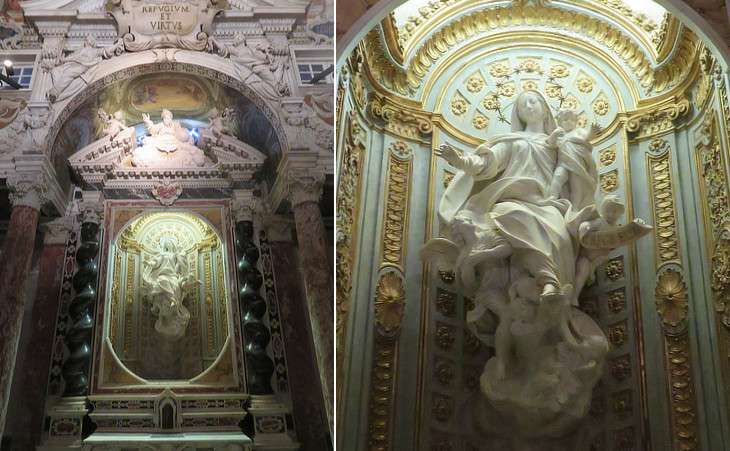
Cappella del Doge: altar with a statue by Francesco Schiaffino portraying the Virgin Mary and showing the inscription "et rege eos"
It must be admitted that the Palazzo Ducale is the most disappointing building in Genoa. (..) If the other portions of the
building are disappointing, at least there is consolation to be found in the chapel. It contains a fine group of the Virgin and Child which ranks high among the marbles in Genoa. It was carved by Francesco Schiaffino, one of the
last and best of Genoese sculptors. All the frescoes save two are by G. B. Carlone and are remarkable for the cleverness of the perspectives and
lighting. Carden
The two Schiaffino, Bernardo (1678-1725) and his younger brother Francesco (1689-1765) gave the style the
lighter eighteenth-century touch of the Rusconi school, in fact, Francesco went to Rome and studied with
Rusconi. Wittkower.
You may wish to see two fine portraits of members of the Durazzo family at Palazzo Reale
by Filippo Parodi and the Schiaffino (it opens in another window).
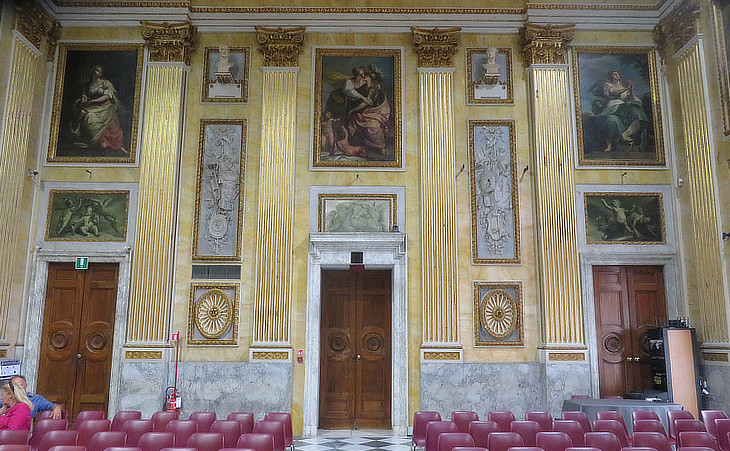
Sala del Minor Consiglio
(The 1528 Reform of the Government of the Republic stated):
There was to be a Gran Consiglio consisting of 400 members, of whom 300 were to be drawn by lot from the names of all nobles over the age of eighteen,
and the remaining 100 were elected by vote.
There was to be a Minor Consiglio of 100 members, elected by vote from the Gran Consiglio and most of the powers of
the larger council were delegated to the Minor Consiglio.
The most notable regulation was that which restricted the power of the Doge. Nine Senatori were to be elected,
and "one of them was to be of superior dignity and responsibility; but in authority equal to the others; who should be called the Doge". (..)
The Doge and Governors held office for two years. Carden
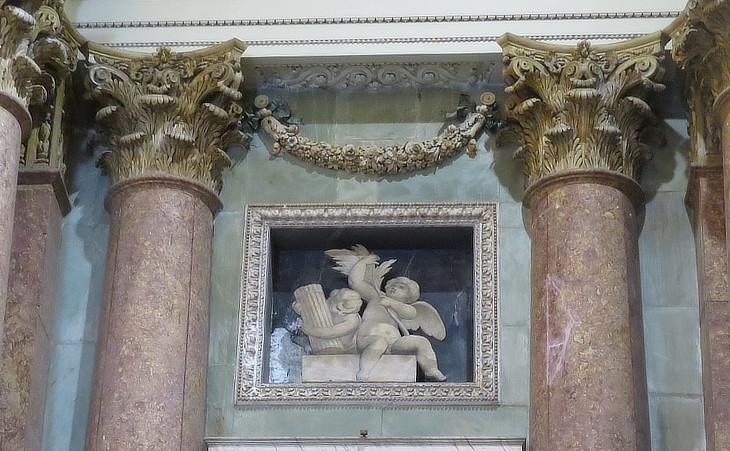
Sala del Maggior Consiglio (detail)
In the Town-House, one great Hall is painted in Fresco, Cieling and Sides, by Franceschino of Bologna.
There is another Room (as my Guide told me) painted by Solimena of Naples, but the Senate was sitting there, and I could not see it.
Edward Wright - Some observations made in travelling through France, Italy, &c. in 1720, 1721, and 1722
The doge's palace is a large building, where there are chambers for the great and little council, and for the colleges, as also lodgings for
the doge, and some of the senators and their families; but it is much inferior to the private palaces of the nobility. Nugent
The palace allotted to the Doge is spacious and ancient, but inferior in beauty to most of the mansions of the great families.
The hall however in which the senate assembled, is a most superb apartment; in length one hundred and twenty-five feet, in breadth forty-five,
and in height sixty-six; its roof is supported by pillars and pilasters; the space between contains niches, which were once graced with the
statues of the great men of the republic: these were removed, it is said, on the approach of the French, and have not yet been replaced.
Eustace
The hall of the senate is decorated by paintings, not of a high order, representing subjects taken from or
connected with the history of Genoa. Of these, the best are copies from pictures of Solimena existing before the fire. (..) The hall also contains
statues of the great men of Genoa. These were destroyed by the French in 1797. Murray
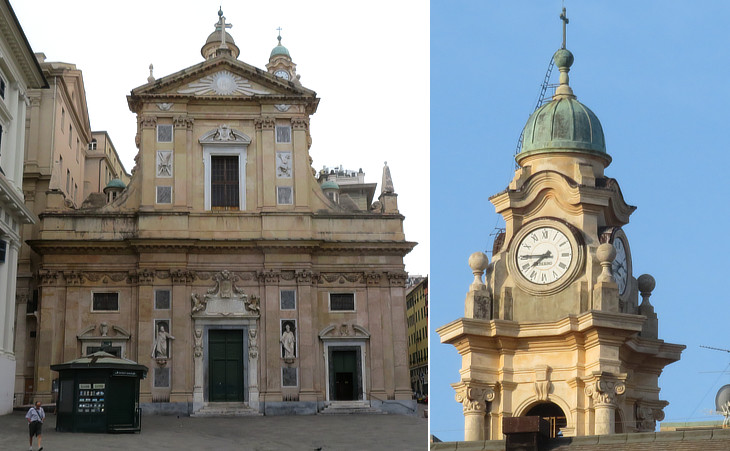
SS. Ambrogio e Andrea (il Gesù): (left) façade (redesigned in the XIXth century); (right) bell tower seen from Piazza De Ferraris
(in 1928 it replaced a smaller one); the image used as background for this page shows a detail of the façade with the letters IHS, similar to what
occurs at il Gesù in Rome
The Church of St. Ambrosio belonging to the Jesuites will, when finish'd, exceed all the rest. Evelyn
The Church of S. Ambrogio, belonging to the Jesuits, is neatly overcrusted with Marble, and gilt above in the Roof. It wants a little length,
for want of Room to build on: it being too near the Doge's Palace, and not daring to advance a step farther for fear of treading upon his heels.
Lassels
A medieval small church stood on the site of the current one. It was dedicated to St. Andrew and to St. Ambrose, patron of Milan,
because many citizens of that city lived in the neighbourhood. In 1552 it was acquired by the Jesuits who in 1589 began the construction of a
new church which was
designed by Giuseppe Valeriano, a Jesuit himself.
Like a number of other great churches of this period, the design of S. Ambrogio is dependent on the
Bramante-Michelangelo scheme for St Peter's. (..) All these buildings are interrelated; all of them have a square or rectangular outside shape and
only one façade (instead of four); and all of them link the centralized plan of St Peter's with an
emphasis on the longitudinal axis: S. Ambrogio by adding a smaller satellite unit to the west
and extending the east end. Wittkower
As mentioned by Lassels the length of the longitudinal axis of S. Ambrogio was constrained by la Cortina, the wall protecting Palazzo Ducale.
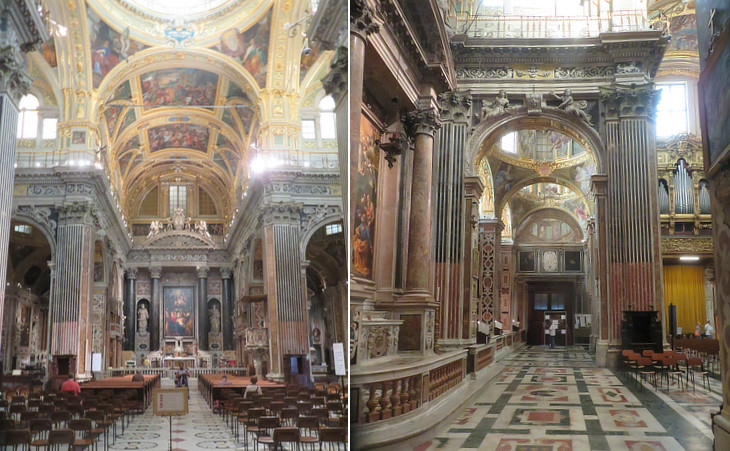
Interior: (left) main nave; (right) aisle
There is also A Church belonging to the Jesuits (..) all the
Pillars in the Church
being of very fine Marble, having very Rich Altars all about it, at the Biggest of which are two very great silver Candlestickes, being to my
apprehension at least 2 yds and high a piece. In this Church wee heard the most ravishingst musicke that wee ever heard in our lives, performed by
3 or 4 Eunuchs and singing Masters, with the Organs, Base Viols and Trumpets; these going all together made such melodious musicke as any
person could possibly desire. Mortoft (read about another concert he attended in Rome)
The Church of St. Ambrose has some vast Marble Pillars, each of one piece, with some good Paintings. Wright
It must also be emphasized that in the course of the seventeenth century the Order of
the Jesuits itself went through a characteristic metamorphosis: (..) mundane
interests in wealth, luxury, and political intrigue, and a frivolity in the interpretation of
the vows replaced the original zealous and austere spirit of the Order. (..) The turn to aestheticism in official religious circles is
one of the distinguishing mark of the new era. Even if the arts remained an important weapon in the post-counter reformatory arsenal,
they had no longer the sole function to instruct and edify, but also to delight. Wittkower
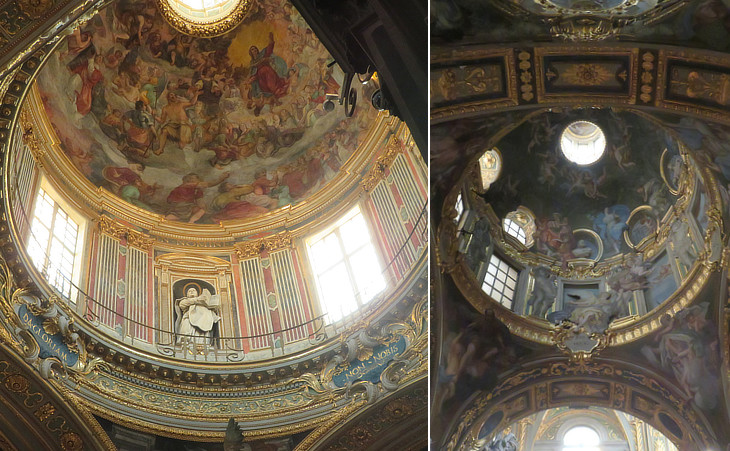
(left) Main dome: Triumph of the name of Jesus by Giovanni Battista e Giovanni Carlone; (right) one of the minor domes of the chapels
Santo Ambrogio or il Gesù, entirely built at the expense of the Pallavicini family. The interior is completely covered with rich marbles
and paintings; from the vaulting down to the pavement all is gold and colours. Here are several fine paintings. (..) The frescoes in the cupolas
are principally by Carlone and Castello. Murray
I think the pride or ostentation of the Italians in general takes a more laudable turn than that of other nations.
A Frenchman lays out his whole revenue upon tawdry suits of cloaths, or in furnishing a magnificent repas of fifty or a hundred dishes,
one half of which are not eatable nor intended to be eaten. His wardrobe goes to the fripier; his dishes to the dogs, and himself to the devil,
and after his decease no vestige of him remains. A Genoese, on the other hand, keeps himself and his family at short allowance, that he may
save money to build palaces and churches, which remain to after-ages so many monuments of his taste, piety, and munificence; and in the mean
time give employment and bread to the poor and industrious.
Tobias Smollett's Travels through France and Italy in 1765
The construction and decoration of S. Ambrogio was mainly paid for by the
Pallavicino/i family who amassed a fortune in the XVIth century by their trading and banking activities. Other large churches were built at the expense of the Sauli (S. Maria di Carignano) and Lomellini (SS. Annunziata) families.
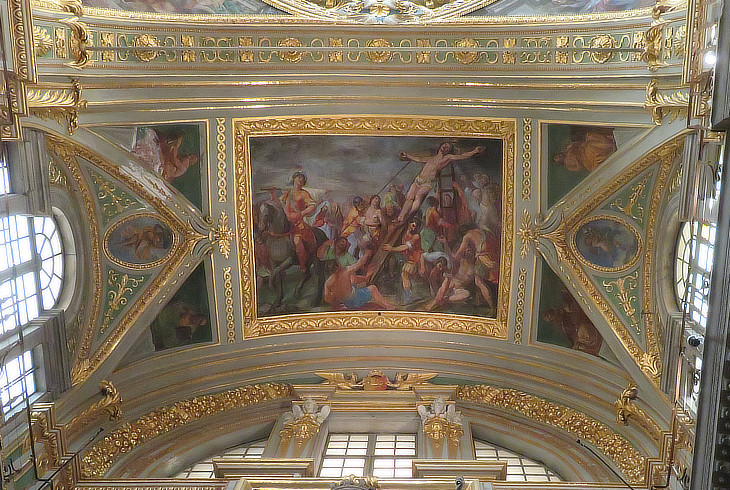
Ceiling of the apse by Giovanni Battista and Giovanni Carlone
Giovanni Carlone possessed as great talents for composition as any of his contemporaries; correct and graceful in design,
decided and intelligent in expression; and above all, he had an extraordinary brilliancy of colour in his frescos. (..) He left numerous works
in the same style at the Gesu. (..) Gio. Batista Carlone became the associate of Giovanni, his elder brother,
in principle and practice, whom he survived fifty years, as if to carry their style to the highest pitch of perfection. The similitude of style
would lead the unskilled to believe them the works of the same master; but the more experienced are able to ascertain the composition of Gio. Batista from a peculiar delicacy of tints and of chiaroscuro, and from a grander style of
design.
Luigi Lanzi - The History of Painting in Italy - 1828 - Transl. by Thomas Roscoe
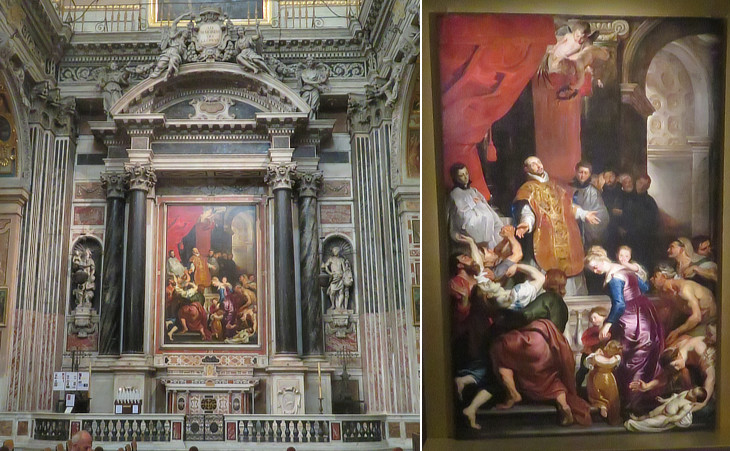
Cappella Pallavicini with "The Miracles of St. Ignatius" by Pierre Paul Rubens
(ca 1620 - Ignatius was canonized in 1622, but the Jesuits already regarded him as a saint)
St. Ignatius healing a Demoniac, by Rubens
painted whilst he was in this city. In this picture he was able to adapt his figures accurately to their site in the building. Murray
Of great importance for the future of Genoese painting were the Flemings. They had long
regarded Genoa as a suitable place to try their fortunes, and works by artists such as
Pieter Aertsen were already collected there in the late sixteenth century. (..) But the
names of all these Flemings are dwarfed by that of Rubens, whose stay in the city in 1607
(Circumcision - S. Ambrogio) and in 1620 (Miracle of St Ignatius - S. Ambrogio) was as
decisive as that of Van Dyck in 1621-2 and 1626-7 (see other Genoese paintings by Rubens and Van Dyck). Wittkower
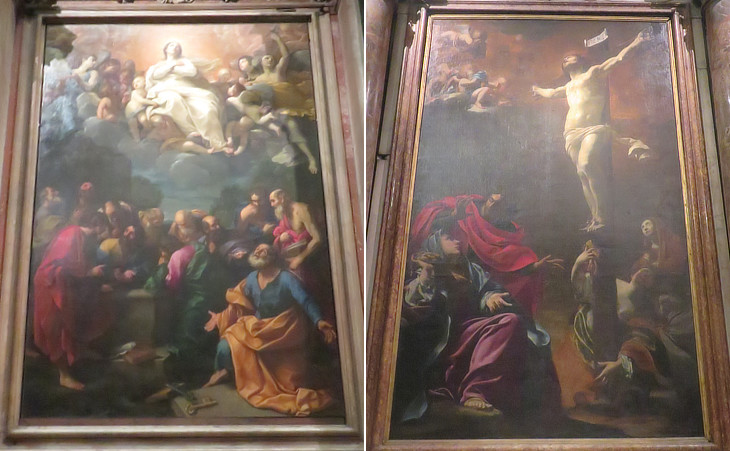
(left) The Assumption of Mary by Guido Reni (1616); (right) The Crucifixion by Simon Vouet (1621)
The Assumption at Genoa, one of Guido's most studied pieces was placed directly opposite the St. Ignatius of Rubens. (..)
Simon Vouet repaired to Genoa, but did not remain long; he
however executed some works, one particularly of the Crucifixion, at St. Ambrose, not unworthy of his great name. Lanzi
The Assumption, by Guido: the Virgin surrounded by hosts of angels. The commission for this picture was sent to Bologna,
and the offer for it was made to the Caracci and to Guido; when the latter, being willing to execute it for half of the price demanded by his
competitors, obtained the order. The Caracci were much vexed at this; but when the picture was exhibited, they put by their vexation, and
fully acknowledged the excellence of the production. Murray
Caravaggio, in Genoa for a short
while in 1605, left, it seems, no deep impression at that moment. Caravaggism gained
a foothold, however, through Orazio Gcntileschi and Vouet, who were in Genoa in
the beginning of the twenties. Wittkower
Move to
The Ancient Town
The Cathedral
The Doria's Palaces and Church
Palazzo del Principe
The Harbour
The Piazza Nuova
The Strada Nuova
Via Balbi
Two Grand Churches
A Walk to Castello
In the Heart of the Old Town
Old and New Portoria
Museums: Exhibits from Churches
Museums/Palaces: Tursi and Bianco
Museums/Palaces: Rosso and Spinola
Some Environs of Genoa
Anthony van Dyck's 2026 Exhibition


