All images © by Roberto Piperno, owner of the domain. Write to romapip@quipo.it.


Notes:
Page added in November 2026.
All images © by Roberto Piperno, owner of the domain. Write to romapip@quipo.it.
Notes:
Page added in November 2026.
 Two Grand Churches
You may wish to see pages on the Cathedral, Via Balbi and Strada Nuova first.
Genoa's great period of architectural development is the second half of the
sixteenth century. (..) During the seventeenth century
the old maritime republic had an immensely rich ruling class who made their money for the most part by world-wide banking manipulations;
and the international character of their enterprises is also reflected in the artistic field. (..) It can, therefore, be seen that in the first decades of the seventeenth century Genoa was in active contact with all the major artistic trends, Italian and foreign.
Rudolf Wittkower - Art and Architecture in Italy - 1600-1750.
The wealth of Genoa is testified to by two grand churches the building and
decoration of which
was promoted by very wealthy families. The construction of S. Maria Assunta di Carignano began in 1552 and it was paid for by the Sauli family.
The enlargement and redesign of SS. Annunziata del Vastato started after 1591 when the Lomellini family were given the right of patronage over the church.
The impressive financial effort required by these two grand churches was regarded with sympathy by all the Genoese population, as they
showed the real ranking of their city, because the Cathedral was not at the same standard of those of many other Italian towns, including Venice and
Pisa,
the historical rivals of Genoa, but also Siena and Orvieto, not to mention Florence and Rome.
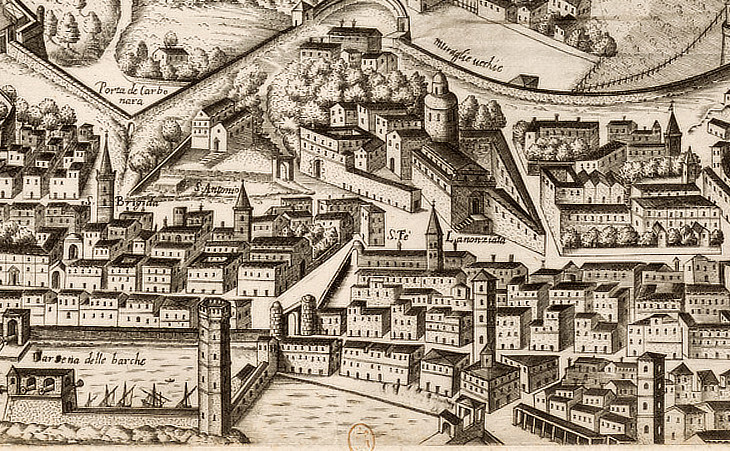
"La Nunziata" (SS. Annunziata) in a 1637 engraving by Alessandro Baratta
 | Ma se ghe penso alôa mi veddo o mâ, véddo i mæ mónti e a ciàssa da Nonçiâ. But if I think about it, then I see the sea, I see my mountains, the Annunziata square. |
Ma se ghe penso (But if I think about Genoa) was written in 1925 and it has become the most popular song about Genoa, similar to Arrivederci Roma for Rome. It testifies to the affection of the Genoese for this church. The reference to Vastato or Guastato (broken/spoiled) is due to the fact that the church was first erected in the XIIIth century in an empty space because the existing buildings had been demolished to make room for the medieval walls. The church was redesigned in ca 1520 and it was dedicated to St. Francis because it was assigned to the Order of Friar Minors Conventuals. In 1537 it was assigned to the Observant branch of the Friar Minors and the dedication was changed.
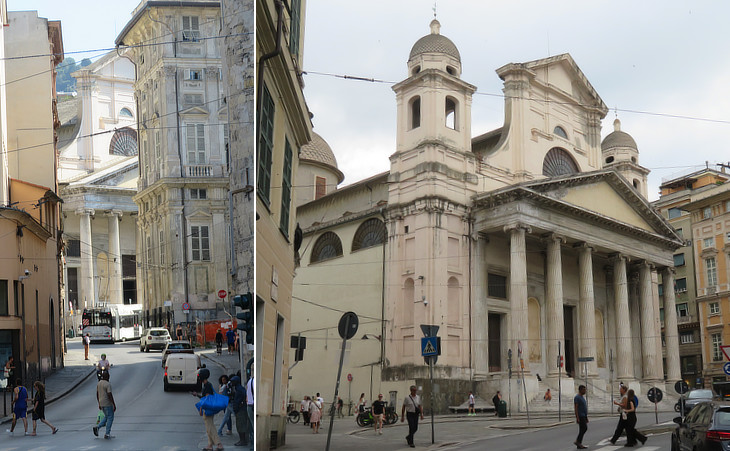
(left) "La Nunziata" seen from the harbour; (right) 1867 façade; Via Balbi is the street to the left of the
church
That of the Annunciada, founded at the charges of one family, in the present and future designe can never be outdone for cost and art.
John Evelyn's Diary and Correspondence related to his stay in Italy in 1644
The Churches in this Citty are also as stately, for the most Part, as the houses, especially one of them, begun to be built
by a Gentleman some 40 yeares agoe, who to make it as stately as possible Art and Estate of man could forward it, spent his whole Estate,
which was very great, upon the building of it, and after his death left it to his Brother and generation, which to this day are in
building of it, to make it outvye all other Churches, it being not as yet finished.
Francis Mortoft's Journal of his travels in France and Italy in 1659
After the Domo, I saw the Church of the Annunciata which draweth up the Ladder after it for neatness. It's still in building and not
quite finished. It's thus beautified at the cost of two Brothers Lomellini, Rich Gentlemen, and Merchants of this Town
(learn more about them).
The third part of their gains goes to the adorning of this Church.
Richard Lassels' The Voyage of Italy, or a Compleat Journey through Italy in ca 1668
The facade is in a poor style of modern architecture.
John Murray - Handbook for travellers in northern Italy - 1843
The church was yet to be completed in the XIXth century.
The outside aspect in a mix of Neoclassical and Renaissance styles does not match that of the interior.
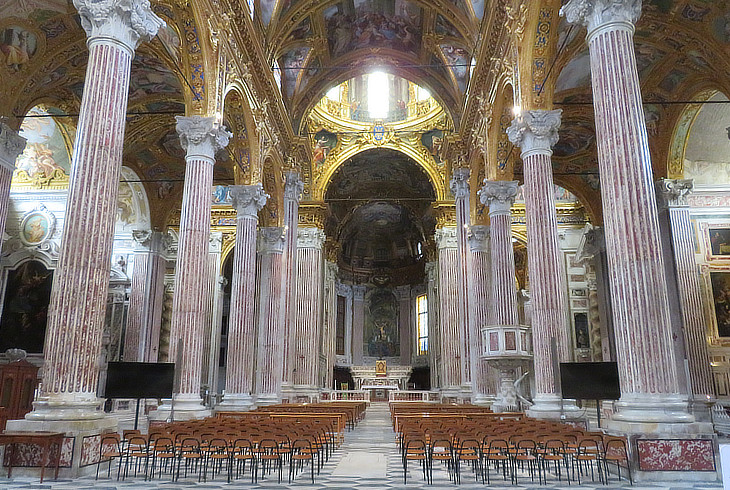
But any person that enters into it cannot but
be astonished that such a stately Building. All the sealing is painted with very curious and lively Pictures, that the like was
never seene in any Church before. All the Pillars in the Church are of pure fine Marble, and at one of the Altars at the upper end
of the Church, on the right hand, are a such Rare pillars of Marble, and wherein is shewne so much Art in carving them, that if there
were nothing else to make the Church commended, this were alone to make it famous. Mortoft
The churches are very fine, particularly that of the Annunciation, which looks wonderfully beautiful in the inside, all but
one corner of it being covered with statues, gilding, and paint.
Joseph Addison's Remarks on several parts of
Italy, in 1701, 1702, 1703
After this we went to the Annonciata, a church built by the family Lomellini, and belonging to it;
which is, indeed, a most stately structure, the inside wholly marble of various kinds, except where gold and painting take its place.
Thomas Gray's Letters to family and friends from France and Italy in 1739-1741
Notwithstanding the impact of heavy WWII bombings, the interior is still very impressive and it justifies the remarks made by most travellers.
Some of the side chapels and paintings however were entirely destroyed.
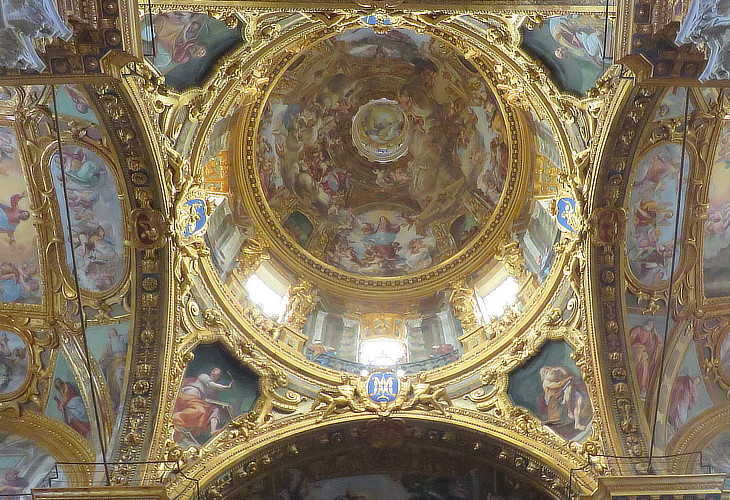
"La Nunziata": dome by Giovanni Andrea Ansaldo (1632-1635)
The Roof of it is all gilt, and set with curious Pictures in Platfound.
The Altars round about the Church, are cheeked with exquisite Pillars, and adorned with rare Pictures. The two Rows of shaft Pillars, which hold
up the Roof of the Church, are so beautiful, being of a red and white Marble, that they look like Jasper, and ravish the Beholder:
They are curiously wrought and channelled. Lassels
The church of the Annunciation is the finest in Genoa, built at the sole expence
of the family of Lomellini; the roof is gloriously gilded, the pillars that support it are of marble, and the walls covered with most exquisite
paintings. The altars are magnificent, and adorned with fine pictures done by Rubens, and other great masters.
Thomas Nugent - The Grand Tour - 1749
Near the choir of the Nunziata we behold the cupola of Ansaldo, injured by damp, yet notwithstanding remarkable for a most beautiful division and grandeur of the architecture, and for many figures which remain uninjured. When we survey this fine work, we cannot refuse to this artist a great talent for the decoration of cupolas,
which may be esteemed the summit of the art of painting, as the colossal is of sculpture. (..) Ansaldo is one of those masters who painted both much and well.
Luigi Lanzi - The history of painting in Italy - Transl. by Thomas Roscoe - 1828

"La Nunziata": ceiling of the main nave (another detail of the ceiling can be seen in the background image for this page): The Ascension by Giovanni Battista Carlone
The church of the Nunziata del Guastato, a splendid
monument of the piety and the riches of the noble family of Lomellini, and an edifice which confers honour on the city,
which has enlarged and ornamented it as its cathedral, possesses no work more astonishing than the three naves,
almost nearly the whole of which are decorated by the two Carlone brothers. In the middle one the elder brother represented the
Epiphany of our Lord, his Entrance into Jerusalem, the Prayer at Gethsemane, the Resurrection, the Ascension,
the Descent of the Holy Ghost, the Assumption of the Virgin, and other passages of the New Testament. Lanzi
The roof is painted by Carlone. Eleven painters of this name have left their productions in Genoa and the Riviera. This Carlone was born at Genoa in 1594, and died at an
advanced age. (..) The very rich marbles of the interior of L'Annunciata give it extraordinary splendour. The roof too has been recently regilt,
and the church completely restored. Murray
I could say that the Church of the Annunciation is a wilderness
of beautiful columns, of statues, gilded moldings, and pictures almost countless, but that would give no one an entirely perfect idea of the thing,
and so where is the use? One family built the whole edifice, and have got money left. There is where the mystery lies. We had an idea at first
that only a mint could have survived the expense.
Mark Twain - The Pilgrims Abroad 1869
Even the cathedral (though I give it up as indescribable) was nothing at all in comparison with a church to which the commissionaire
afterwards led us; a church that had been built four or five hundred years ago, by a pirate, in expiation of his sins, and out of the profit
of his rapine (a characterization for foreign readers). This edifice, in its interior, absolutely shone with burnished gold, and glowed with pictures; its walls
were a quarry of precious stones, so valuable were the marbles out of which they were wrought; its columns and pillars were of
inconceivable costliness; its pavement was a mosaic of wonderful beauty, and there were four twisted pillars made out of stalactites.
Perhaps the best way to form some dim conception of it is to fancy a little casket, inlaid inside with precious stones, so that there
shall not a hair's-breadth be left unprecious-stoned, and then to conceive this little bit of a casket increased to the magnitude of a
great church, without losing anything of the excessive glory that was compressed into its original small compass, but all its pretty
lustre made sublime by the consequent immensity. At any rate, nobody who has not seen a church like this can imagine what a gorgeous
religion it was that reared it.
Nathaniel Hawthorne - Passages from the French and Italian note-books - 1872
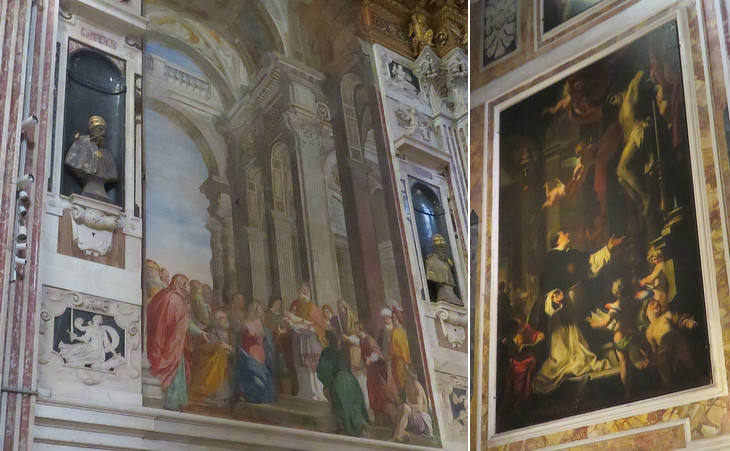
"La Nunziata": (left) Presentation to the Temple by Giulio Benso (ca 1640); (right) St. Thomas Aquinas by Giovanni Battista Carlone (1670)
At the West End of the Annunciata is a Last Supper of Camillo Procacino, not seen to advantage; the Light of the great Window over
it, and of the Door under it, glaring in your Eyes. (..) There is a Crucifix of white Marble, in a Niche,
where a real Light is let in somewhere from above, accompanying a represented one of carv'd and gilded Rays, which has a very good Effect.
I saw several such afterwards at Rome, where the Light transmitted thro' a yellow Glass (especially when the Sun happen'd to shine through it)
falling in with those gilded Rays, and so striking on the Figure, gave a surprising Beauty to it (e.g. at Cappella Cornaro).
Edward Wright Some observations made in travelling through France, Italy, &c. in 1720, 1721, and 1722
Giulio Benso excelled all his school in architecture
and perspective. Genoa, perhaps, does not possess any work in this department superior to that of Benso in the Nunziata del Guastato;
in the choir of which he represented perspective pictures with balustrades and colonnade. Lanzi
Giulio Benso (1601-68) may also be mentioned: his frescoes in the Annunciata (partly destroyed during the war) reveal him as an able painter
with a special interest in quadratura" and "sotto in su" compositions.
Rudolf Wittkower - Art and Architecture in Italy - 1600-1750.
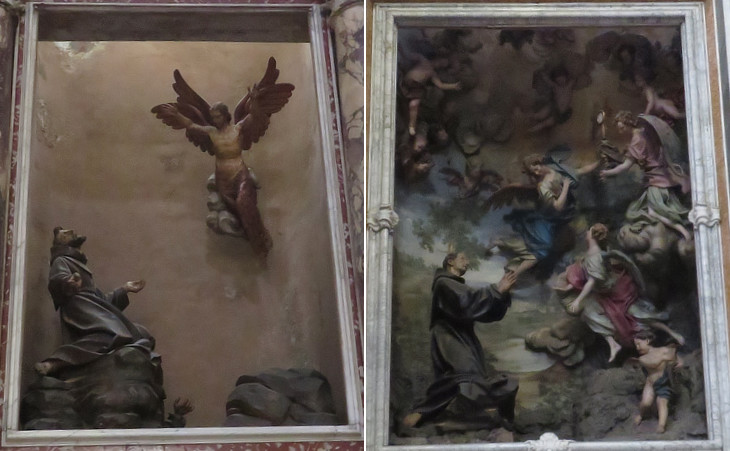
"La Nunziata": works by Anton Maria Maragliano (1664-1739): (left) St. Francis receiving the Stigmata; (right) St. Paschal Baylon, a XVIth century Spanish Franciscan monk who was canonized in
1690, worshipping the Blessed Sacrament; see
another of his painted sculptures at S. Matteo
The fame of Anton Maria Maragliano is limited to Genoa and its environs. He trained as a woodworker at the workshop of his uncle. At the age of 24 he wanted to set up his own workshop. In order to do this he needed to enrol into the guild of the joiners, but he refused and wrote to the Senate of Genoa to be granted an exemption claiming that his sculptures should be regarded as the product of a liberal art and not of a mechanical process. The Senate granted him the exemption and Maragliano run a very busy workshop which specialized in polychrome processional groups for the Genoese brotherhoods, altarpieces, saints, and figureheads for the Genoese galleys. In 2019 a monographic exhibition at Palazzo Reale acknowledged the artistic value of his painted sculptures. You may wish to see some fine Renaissance wood sculptures at L'Aquila and a mix of sculpture and painting by il Baciccio, a Genoese painter at Lanuvio.
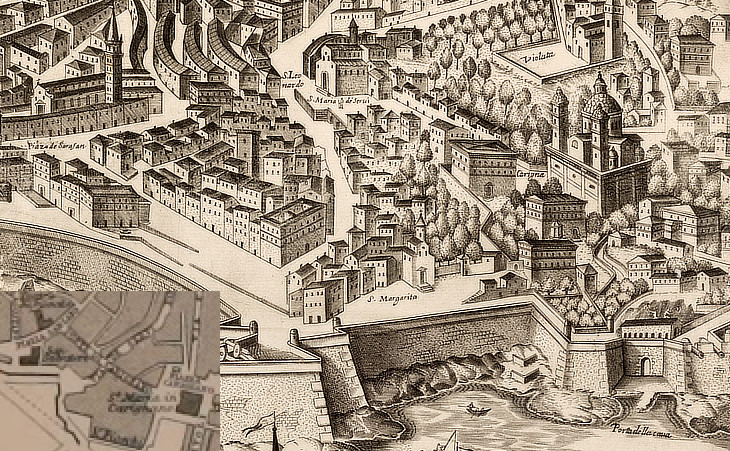
The hills of Castello (left with the tall bell tower of S. Agostino) and of Carignano (right) with the planned aspect of S. Maria Assunta in a 1637 engraving by Alessandro Baratta
(before the construction of a bridge between the two hills); (inset) detail of a XIXth century map showing the bridge (you may wish to see it in an early XXth century
photograph - it opens in another window)
We pass to the church called Di Carignano. In his way to this edifice the traveller will behold with astonishment a bridge of the same name
thrown over, not a river, but a deep dell now a street; and looking over the parapet he will see with surprise the roofs of several houses of six
stories high, lying far beneath him. This bridge consists of three wide arches, but its boldness and elevation are its only merit, for beauty,
it possesses none.
John Chetwood Eustace's Classical Tour of Italy in 1802 (publ. 1813)
Many of the churches
of Genoa were demolished by the French. Amongst the churches which remain, the most conspicuous in the general
view of the city is Santa Maria di Carignano, finely situated on a hill, built from the ground about 1552, and endowed by the Sauli family.
Murray
In 1481 the Fieschi, at the time one of the most powerful families of Genoa, barred the Sauli from their family church.
Bandinello Sauli, the leader of the family, reacted to this affront by vowing to build the largest church of Genoa. The fortunes of the Fieschi were shattered in 1547 because
they plotted against Andrea Doria, and the heirs of Bandinello Sauli fulfilled his vow by commissioning Galeazzo
Alessi the design of the new church.
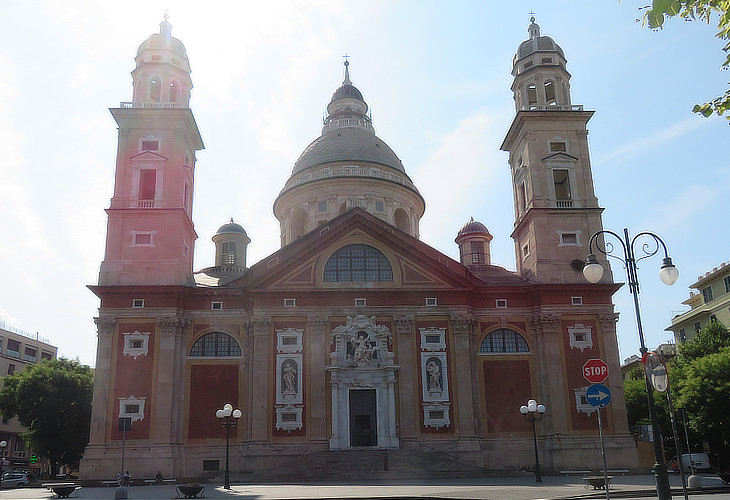
S. Maria Assunta di Carignano (western side with the main entrance)
Full in front, on the swell of the hill of Carignano, stands the church with a little grove around it.
The situation is commanding, and well adapted to display a magnificent edifice to advantage, especially if faced with a colonnade.
But this church has not that decoration; it is a square building, adorned with Corinthian pilasters. The four sides have the same ornaments and a
similar pediment; only the western side or front is rather encumbered than graced with two towers. In the centre rises a dome.
The Genoese compare this church to St. Peter's. In size the comparison is not, I presume, meant to hold, nor in form either;
it must then be confined to the dome and the two towers; features which a thousand other churches have in common with the Vatican. (..) The interior is in the form of a Greek cross. The merit of this building consists in its advantageous situation and its simplicity.
Eustace
Although the final appearance of the church does not resemble that of S. Pietro, at the time
Aleazzi designed it, Nuovo S. Pietro was expected to have a Greek cross layout (see a fresco in the Vatican Library).
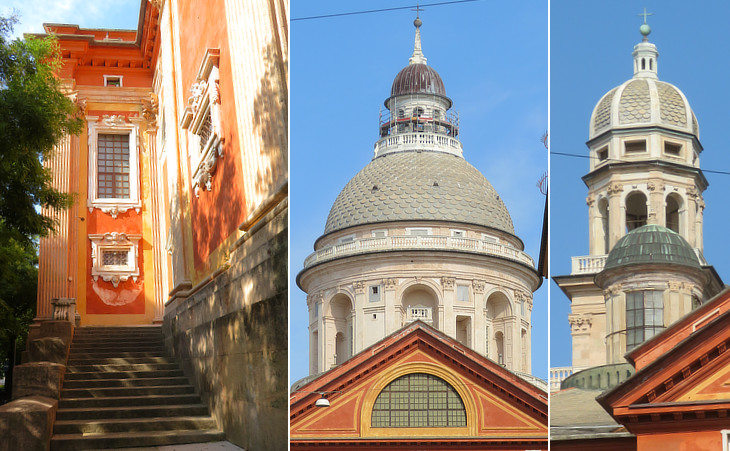
S. Maria Assunta di Carignano: (left) eastern side; (centre) dome; (right) one of the two bell towers
The several Terraces on the Outside of the Cupola, and other Parts of the Church, are all of Marble:
but that is no Rarity here for, besides the fine white Marble of Carrara, which is not far off, the nearer Mountains on each side of
Genoa afford great Quantities of other sorts. Wright
It has only one order, and one cornice that runs unbroken all around; this single order is not loaded either with an attic or a balustrade;
the cornice is prominent and effective; the windows are not numerous nor too large, and the few niches are well placed. So far the architect is
entitled to praise; but what shall we say to the pigeon holes in the frieze, to the little petty turrets on each side of the pediments,
to the galleries that terminate on the point of these pediments, a new and whimsical contrivance, and above all, to the two towers which
encumber and almost hide the front. These deformities might easily have been retrenched, if the architect could have checked his inclination
to innovate. Eustace
As a matter of fact the construction of the church took a very long time and the initial project by Alessi
was modified by other architects; the façade was redesigned in the XIXth century by Carlo Barabino.
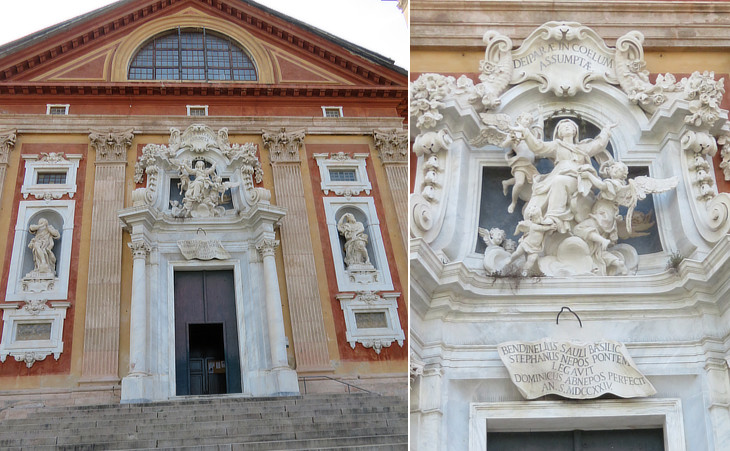
S. Maria Assunta di Carignano: (left) façade; (right) central portal with a statue of the Virgin Mary by Claude David, a French sculptor, which was finished by Bernardo Schiaffino:
the 1724 inscription celebrates
the three generations of the Sauli family who built the church and the bridge
The reader will perhaps be surprised when he is informed, that the church of Carignano was built at the expense of a noble Genoese of the name of Sauli, and that the bridge which leads to it was erected by his son, to facilitate the approach to a monument so honorable to his family. Such instances of magnificence were not uncommon in he brilliant eras of Grecian and Roman liberty, though Cicero seems disposed to censure them as ostentations; and only abstains from a severer expression out of tenderness to his friend Pompey. We have no reason to suspect ostentation on this occasion; but supposing that such a selfish motive had infected the founder's intention, I know not still whether it be not far more honorable to the individual and advantageous to the public, that the exuberance of a large fortune should be thus discharged in stately edifices, than in luxurious repasts and convivial intemperance. And here, I cannot suppress an observation which I think due in justice to the Italian character. Travellers of all descriptions are apt to reproach them with a niggardly and parsimonious spirit, because they do not entertain strangers, with the luxuries of the table and a succession of dinners, and because they confine their civilities to conversazzioni, and ices and lemonade. Admitting this statement to be generally speaking accurate, though there are many exceptions to it; yet it only follows that in their ideas of enjoyment the Italians differ much from transalpine nations, and not that their taste in this respect is irrational or ill-founded. Eustace
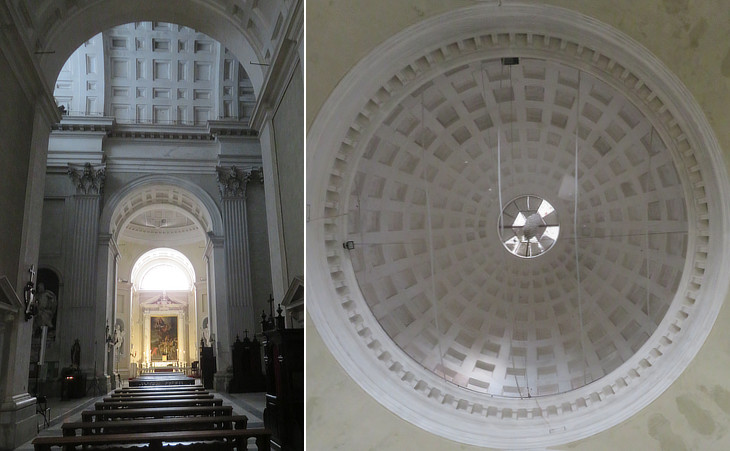
S. Maria Assunta di Carignano: (left) interior; (right) dome
It has a design simple and noble, all white.
President Charles de Brosses - Lettres familières sur l'Italie (1739-1740)
The Sauli held important offices in Genoa and three times they were appointed Doge of the Republic and three other members of the family
were created cardinals. Yet their wealth was not unlimited as that of the Lomellini and the interior of the church is rather bare,
which helps appreciate its neat design.
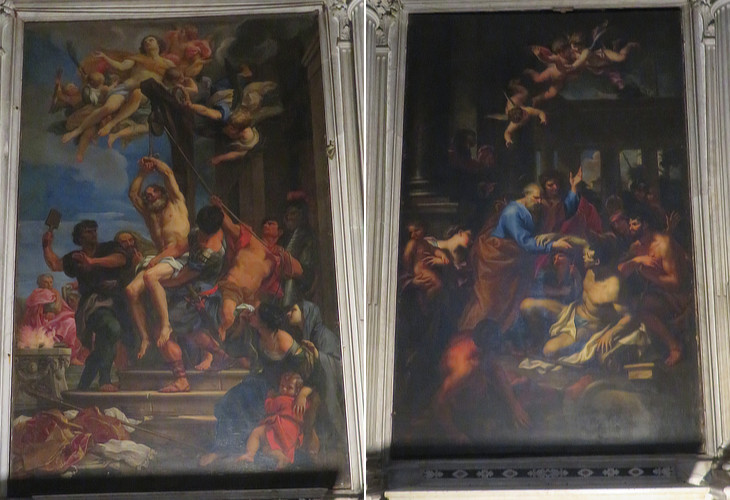
S. Maria Assunta di Carignano: The Martyrdom of St. Blaise by Carlo Maratta (see some other works by this leading Roman painter); (right) St. Peter and St. John
healing the Palsy by Domenico Piola (see some other works by him at Palazzo del Principe)
Paintings. St. Francis receiving the stigmata, Guercino:
originally good, though now damaged. St. Francis is represented as very young. (..) The Martyrdom of St. Blaise, Carlo Maratti; the saint good, the chief executioner
badly foreshortened. (..) St. Peter and St. John
healing the Palsy, Piola. Murray
From his soft and easy manner, examples of which are to be met with in every part of the
Genoese territories, Piola
could occasionally depart, as in the picture of the Miracle of St. Peter at the Beautiful Gate of the Temple, painted at Carignano, where the
architecture, the fleshes, the gestures, are highly studied. Lanzi
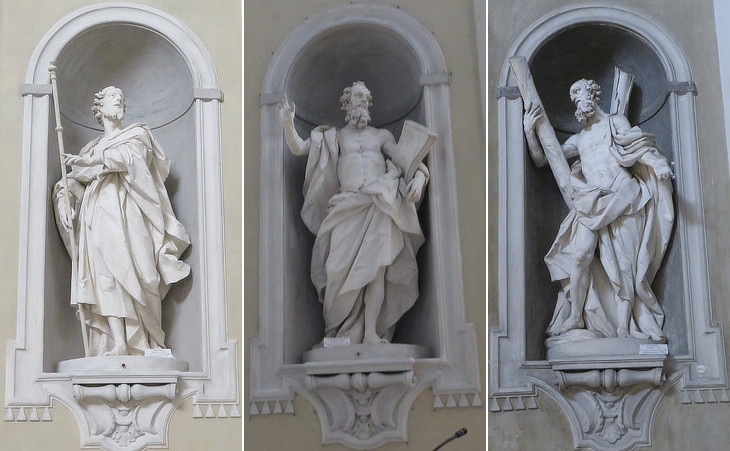
S. Maria Assunta di Carignano: stucco statues of the Apostles designed by Francesco Schiaffino and executed by Diego Carlone in the side pillars
In the Church of St. Maria de Carignano
are four large Statues of white Marble, which stand adjoyning to the four great Pillars which support the Cupola. Wright
The
large marble statues call to mind those which Bernini placed in the Octagon of S. Pietro.
Between 1700 and 1715 twelve monumental marble statues of the Apostles were
executed for the niches of S. Giovanni in Laterano
and this prompted the Sauli to commission similar statues, albeit of stucco, for S. Maria Assunta di Carignano, which overall can be regarded as the most "Roman" church of Genoa.
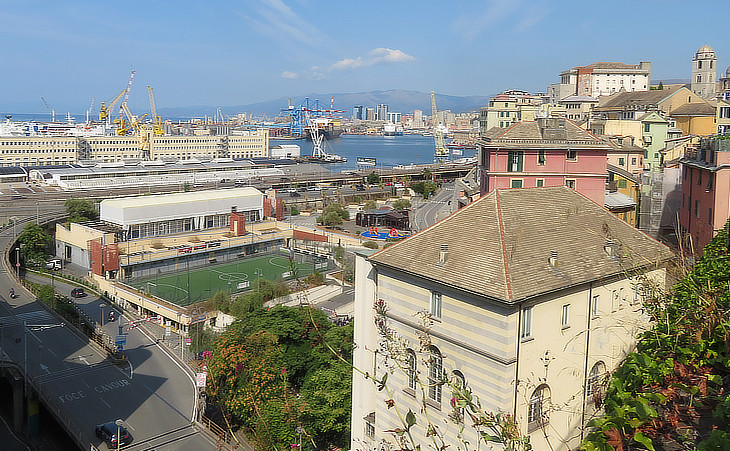
View towards the harbour; the area was extensively bombed during WWII (far right: bell tower of S. Silvestro,
the monastery was razed to the ground)
The Church stands on the Top of a Hill and I went up the Cupola of it; from whence I had a fine View of the City,
and the adjacent Mountains. Wright
I had heard much of the ponte Carignano (..) there is nothing at all curious in its construction.
Hard by the bridge there is an elegant church, from the top of which you have a very rich and extensive prospect of the city, the sea and the
adjacent country, which looks like a continent of groves and villas.
Tobias Smollett's Travels through France and Italy in 1765
The view from this church is one of the finest in the neighborhood of Genoa, as it includes the city, the port, and the moles, with all
the surrounding hills. Eustace
A fine view of Genoa is obtained from the top of the cupola, which is ascended with tolerable ease. Murray
Move to
The Ancient Town
The Cathedral
The Doria's Palaces and Church
Palazzo del Principe
The Harbour
The Piazza Nuova
The Strada Nuova
Via Balbi
Two Grand Churches
A Walk to Castello
In the Heart of the Old Town
Old and New Portoria
Museums: Exhibits from Churches
Museums/Palaces: Tursi and Bianco
Museums/Palaces: Rosso and Spinola
Some Environs of Genoa
Anthony van Dyck's 2026 Exhibition