All images © by Roberto Piperno, owner of the domain. Write to romapip@quipo.it.


Notes:
Page added in May 2026.
All images © by Roberto Piperno, owner of the domain. Write to romapip@quipo.it.
Notes:
Page added in May 2026.
 at Cappelle Medicee
You may wish to see pages on the statues at Museo dell'Opera del Duomo and at Museo del Bargello first.
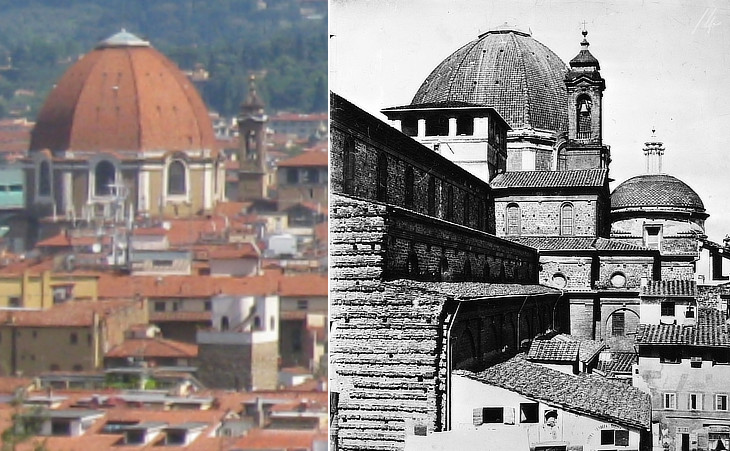
(left) Dome of Cappella dei Principi seen from the highest point of Giardino di Boboli; (right) Domes of Cappella dei Principi and of Sacrestia Nuova in a XIXth century photograph
Let us turn from a subject too fertile and alluring for a traveller, and pass to the church of St. Lorenzo, the next in rank as an object of curiosity, not so much for its own internal beauties as for the edifices united or connected with it. These are the Sacristy, the Medicean chapel, and the Laurentian library. (..) Close to the Sacristy and behind the chancel of the church, though the communication is not yet open, stands the intended mausoleum of the Medicean family.
John Chetwood Eustace's Classical Tour of Italy in 1802 (publ. 1813)
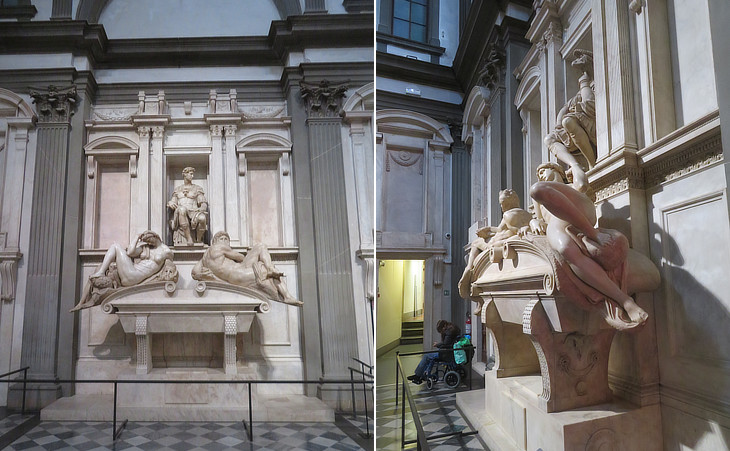
Sagrestia Nuova: (left) side with the Monument to Giuliano de Medici with Night and Day; (right) side with the Monument to Lorenzo de Medici with Twilight and Aurora
The new Sacristy deserves to be carefully visited, because of the bodies of the Princes of the Family of Medices, which are depositated here till the Chappel mentioned above be finished. In this new Sacristy also are seen the four Statues made by Michael Angelo, representing the Day, the Night, Aurora, and the Evening; the four parts which compose Time by which all Men are brought to their Graves.
Richard Lassels' The Voyage of Italy, or a Compleat Journey through Italy in ca 1668
The Sacristy, which is a chapel and the mausoleum of several princes of the Medicean line, was planned by Michael Angela, and is adorned with several statues of his workmanship. Some are finished in his best style; others remain unfinished, but display, it is thought, even in the imperfect parts, the grand daring touches and inimitable manner of the sculptor. Eustace
Michelangelo worked at the sacristy and at its monuments in 1520-1534.
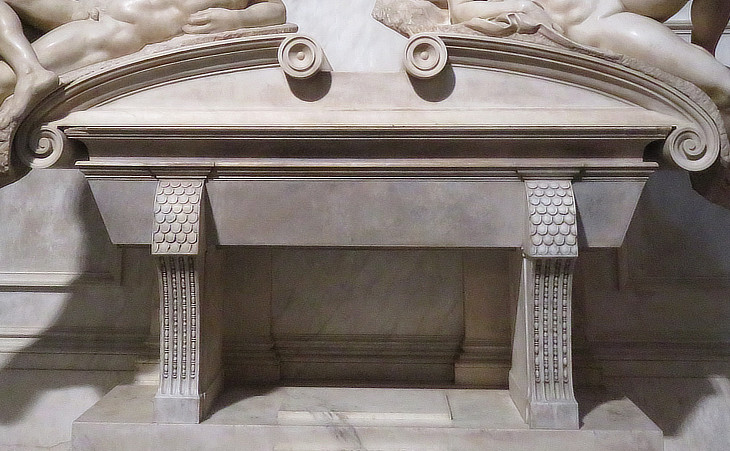
Sarcophagus; its very novel design characterizes other tombs attributed to Michelangelo, e.g. the Monument to Cecchino Bracci at S. Maria in Aracoeli and even that to Pope Urban VIII by Gian Lorenzo Bernini. The image used as background for this page shows a detail of its decoration
(Michelangelo and Pope Clement) after discussing many things together, they resolved to finish completely the library and new sacristy of S. Lorenzo in Florence. Michelagnolo therefore departed from Rome, and raised the cupola that is now to be seen, causing it to be wrought in various orders of composition. (..) He made four tombs in that sacristy, to adorn, the walls and to contain the bodies of the fathers of the two Popes, the elder Lorenzo and his brother Giuliano, and those of Giuliano, the brother of Leo, and of Duke Lorenzo, his nephew. And since he wished to execute the work in imitation of the old sacristy that Filippo Brunelleschi had built, but with another manner of ornamentation, he made in it an ornamentation in a composite order, in a more varied and more original manner than any other master at any time, whether ancient or modern, had been able to achieve, for in the novelty of the beautiful cornices, capitals, bases, doors, tabernacles, and tombs, he departed not a little from the work regulated by measure, order, and rule, which other men did according to a common use and after Vitruvius and the antiquities, to which he would not conform. That licence has done much to give courage to those who have seen his methods to set themselves to imitate him, and new fantasies have since been seen. (..) Wherefore the craftsmen owe him an infinite and everlasting obligation, he having broken the bonds and chains by reason of which they had always followed a beaten path in the execution of their works.
Giorgio Vasari - Lives of the most eminent painters, sculptors & architects - transl. by Gaston Du C. De Vere
Before the time of Bernini, two kinds of sepulchral monuments prevailed, one from the highest antiquity, which was a sarcophagus, either plain or covered with basso-relievos, with or without the statue of the deceased on its top. The other kind was introduced by Michael Angelo, in the Mausoleum of Julius the Second, and those of the Medici family, in the Chapel of St. Lorenzo at Florence. In these the sarcophagus, as in the former kind, was suited to the niche or architecture against which it was placed, and surmounted or surrounded by statues of the deceased and his moral attributes.
Both these practices were rational and proper, the one for plainer, the other for more magnificent tombs.
John Flaxman and Richard Westmacott - Lectures on sculpture, as delivered before the president and members of the Royal Academy - Publication date 1865
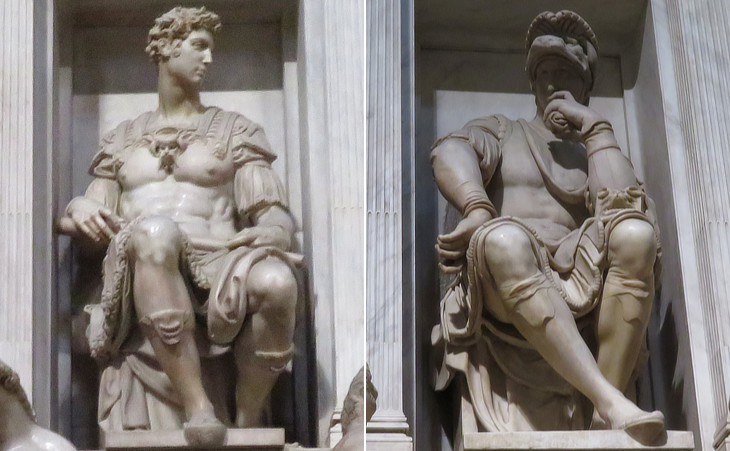
The Dukes: (left) Giuliano; (right) Lorenzo
There, among the other statues, are the two Captains armed; one the pensive Duke Lorenzo, the very presentment of wisdom, with legs so beautiful and so well wrought, that there is nothing better to be seen by mortal eye; and the other is Duke Giuliano, so proud a figure, with the head, the throat, the setting of the eyes, the profile of the nose, the opening of the mouth, and the hair all so divine, to say nothing of the hands, arms, knees, feet, and, in short, every other thing that he carved therein, that the eye can never be weary or have its fill of gazing at them; and, of a truth, whoever studies the beauty of the buskins and the cuirass, believes it to be celestial rather than mortal. Vasari
In a Chappell of this Church are many faire
statuaes of Marble, and one most faire erected to Duke
Alexander (!) killed by treason, by which he is made sitting
with a sad countenance, his right hand laid to his mouth,
and his left hand resting upon his knee.
Fynes Moryson - An Itinerary: Containing His Ten Years Travel Through .. Italy (in 1594)
In the Sagrestia Nuova, or Cappella dei Depositi erected by Michelangelo, we have a building planned for its monuments, and the monuments executed for the building which contains them. The monuments are those of Giuliano and Lorenzo de' Medici. Giuliano was the third son of Lorenzo the Magnificent, younger brother consequently of Leo X., and father of Cardinal Ipolito who was created Duke of Nemours by Francis I., and died in 1516, in his 37th year: the allegorical figures on his monument represent Day and Night. Lorenzo, the son of Pietro, and grandson of Lorenzo the Magnificent, was created Duke of Urbino by his uncle Leo X. In 1518 he married Madeleine de Boulogne, of the royal house of France: the sole fruit of this union was Catherine dei Medici, afterwards the queen of Henry II. He died in 1519, surviving the birth of his daughter only a few days. The statue of Lorenzo is seated. He is represented absorbed in thought. He rests his face upon his hand, which partially covers the chin and mouth. The general action is one of perfect repose, and the expression that of deep meditation. It is impossible to look at this figure without being forcibly struck with the mind that pervades it. For deep and intense feeling it is one of the finest works in existence. It has been well observed of this statue that it has no resemblance to the antique, but it rivals the best excellences of the ancients in expression combined with repose and dignity. The figures reclining at his feet are intended to represent Aurora and Twilight, or Morning and Evening. The merit of these sculptures was fully appreciated when they first appeared.
John Murray - A Handbook for Travellers in Central Italy - 1864
Michelangelo treated the statues of these two men so vaguely, that to this day there is an uncertainty as to their identity. That generally called Giuliano wears the armour of a Roman general, and sits with the bâton of his office across his knees, turning his head, as if to watch some distant evolutions of his troops. He is an abstract military hero, whose connection with the wonderful figures which recline upon the sarcophagus below him, we are at a loss to understand. (..) Did the Night and Day recline below Lorenzo, we might suppose that the first meant Death, and the second Resurrection; and that the Thinker, "Il Pensoso" is absorbed in their contemplation, as he sits with one finger pressed upon his lip, as if forbidding interruption, and with a mysterious depth of expression in his face, which is buried beneath the shadow of a helmet.
Charles Perkins - Tuscan Sculptors - 1864
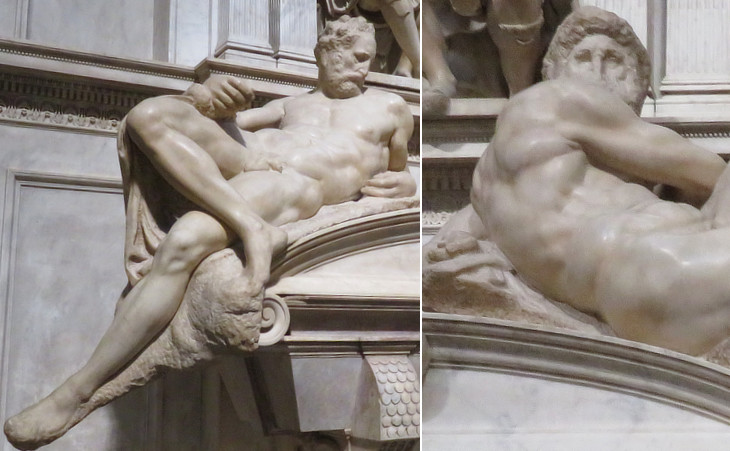
(left) Twilight; (right) Day
Even more did he cause everyone to marvel by the circumstance that in making the tombs of Duke Giuliano and Duke Lorenzo de' Medici he considered that earth alone was not enough to give them honourable burial in their greatness, and desired that all the phases of the world should be there, and that their sepulchres should be surrounded and covered by four statues; wherefore he gave to one Night and Day and to the other Dawn and Twilight; which statues, most beautifully wrought in form, in attitude, and in the masterly treatment of the muscles, would suffice, if that art were lost, to restore her to her pristine lustre. Vasari
The Chapel of the Medici in S. Lorenzo. The Church has nothing considerable besides this Chapel; and here are the Figures of Mich. Angelo of the Women and Men over Arches, (a good Drawing of one of the Women my Father has). the Men's Faces are left Sbozzati: these were intended for the Tomb of Julius II.
Jonathan and Jonathan Richardson - Account of Some of the Statues, etc. in Italy - 1722
The Day is a giant, who in the shadowy indistinctness of his features, and the grandeur of his strange attitude, resembles those forms which fancy shapes in the clouds. Perkins
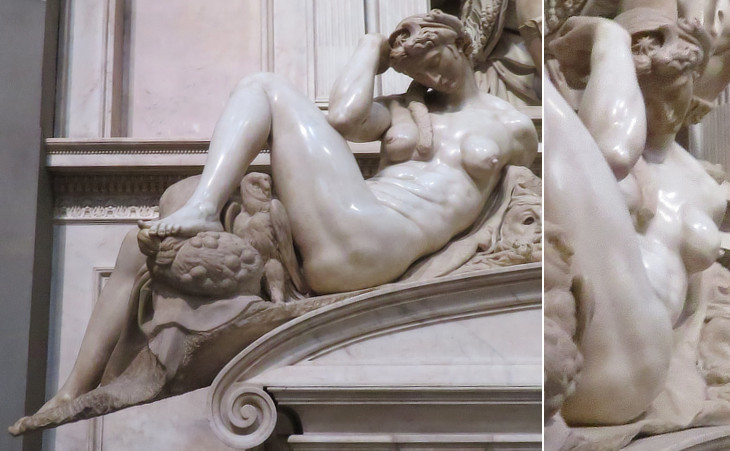
Night
And what can I say of the Night, a statue not rare only, but unique? Who is there who has ever seen in that art in any age, ancient or modern, statues of such a kind? For in her may be seen not only the stillness of one sleeping, but the grief and melancholy of one who has lost a great and honoured possession; and we must believe that this is that night of darkness that obscures all those who thought for some time, I will not say to surpass, but to equal Michelagnolo in sculpture and design. In that statue is infused all the somnolence that is seen in sleeping forms; wherefore many verses in Latin and rhymes in the vulgar tongue were written in her praise by persons of great learning. Vasari
That which represents Night is a rare statue, and hugely cryed up by all Sculptors and Virtuosi. Lassels
Nothing can exceed the solemn beauty of the figure of Night, which is placed at one side of the sarcophagus, while one of Day confronts it on the other. This last statue, though unfinished, possesses all the vigour for which the works of the great sculptor are remarkable; but Night breathes the very soul of melancholy contemplation, and fixes the attention by its depth of repose. One turns again and again to gaze on this exquisite statue, which addresses itself most powerfully to the imagination. The other monument has two figures, representing Dawn and Twilight, both worthy the chisel of Buonarotti; but Night fascinated me so much, that I could not give these figures the portion of attention which was their due.
Marguerite, Countess of Blessington - The Idler in Italy - 1839
The Night is a colossal woman buried in sleep, her identity marked by the star between two small horns upon her forehead, the bunch of poppies beneath her foot, the owl, and the mask suggestive of dreams. Perkins
The character of Michael Angelo's sculpture is too lofty and original to be dismissed without farther notice, although we must acknowledge it has been criticised with severity, because it rarely possesses the chaste simplicity of Grecian art. True; but although Michael Angelo lived long, he did not live long enough to give absolute perfection to all his works: yet the pensive sitting figure of Lorenzo di Medici, in the Medici Chapel, is not without this charm. (..) The recumbent statues in the monument of Julian di Medici, in the same chapel, of Daybreak or Dawn, and Night, are grand and mysterious: the characters and forms bespeak the same mighty mind and hand evident throughout the ceiling of the Sistine Chapel, and Last Judgment.
John Flaxman and Richard Westmacott - Lectures on sculpture, as delivered before the president and members of the Royal Academy - Publication date 1865
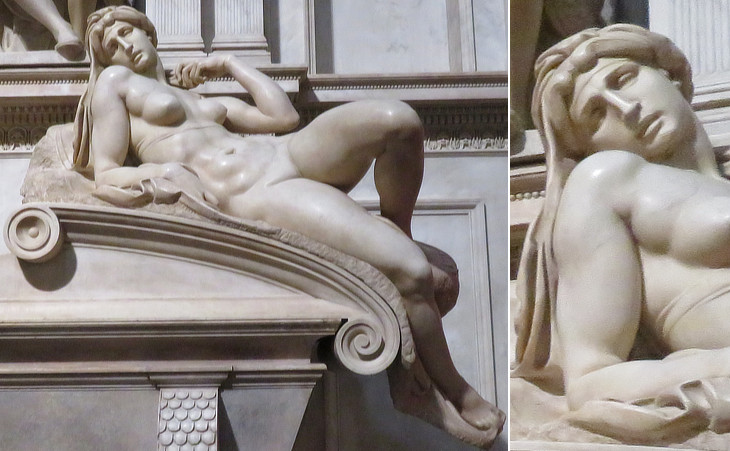
Aurora (Dawn, Day-break)
But what shall I say of the Dawn, a nude woman, who is such as to awaken melancholy in the soul and to render impotent the style of sculpture? In her attitude may be seen her effort, as she rises, heavy with sleep, and raises herself from her downy bed; and it seems that in awakening she has found the eyes of that great Duke closed in death, so that she is agonized with bitter grief, weeping in her own unchangeable beauty in token of her great sorrow. Vasari
Others of the Medici Family are deposited here, whose Monuments are adorn'd with admirable Sculpture of Mich. Angelo, particularly with four Figures which represent the Day, the Night, the Day-break, and the Twilight. One of these is much in the Attitude of the Leda of his which is in print (see a Leda at Museo del Bargello). The late Great Duke (Cosimo III) order d the Nudities of these to be cover d, which Was doing while we were there.
Edward Wright's Observations made in France, Italy &c. in the years 1720, 1721 and 1722.
(Michelangelo was) a genius that seems to have delighted in difficulties, and who loved to call into play every nerve and muscle of the frame he was forming. Michael Angelo was prodigal in his display of muscular power in his statues, and not unfrequently impaired the grandeur of their effect by it. Blessington
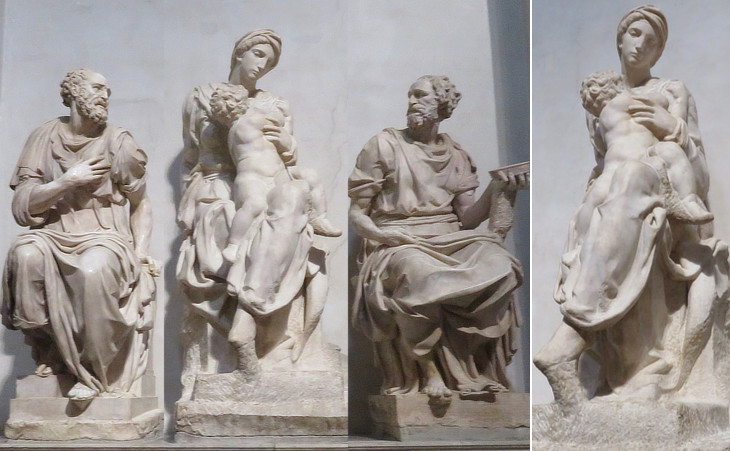
Other statues by Michelangelo: a Madonna between Sts. Cosma and Damiano
At this same time he continued the work in the above-mentioned sacristy, in which were seven statues that were left partly finished and partly not. With these, and with the architectural inventions of the tombs, it must be confessed that he surpassed every man in these three professions; to which testimony is borne by the statues of marble, blocked out and finished by him, which are to be seen in that place. One is Our Lady who is in a sitting attitude, with the right leg crossed over the left and one knee placed upon the other, and the Child, with the thighs astride the leg that is uppermost, turns in a most beautiful attitude towards His Mother, hungry for her milk, and she, while holding Him with one hand and supporting herself with the other, bends forward to give it to Him; and although the figure is not equal in every part, and it was left rough and showing the marks of the gradine, yet with all its imperfections there may be recognized in it the full perfection of the work. Vasari
In addition to the works above referred to, in the Capella dei Depositi is a remarkable unfinished group of the Virgin and Child, by Michelangelo. Murray
In this same chapel there is a very noble and thoroughly Michelangelesque group of the Madonna and Child , in which the Infant stands upon his mother's knee, and turns to bury his face in her bosom. All the lines are grand and suggestive, and the masses of form and drapery broad and noble. We feel that Michelangelo was here working out the idea in his mind, without having gone through any intermediate process. Perkins
The Madonna and Child on the north side of the same chapel is simple, and is endowed with a sentiment of maternal affection never found in the Greek sculpture, but frequently in the works of this artist, particularly in his paintings, and that of the most tender kind. John Flaxman and Richard Westmacott
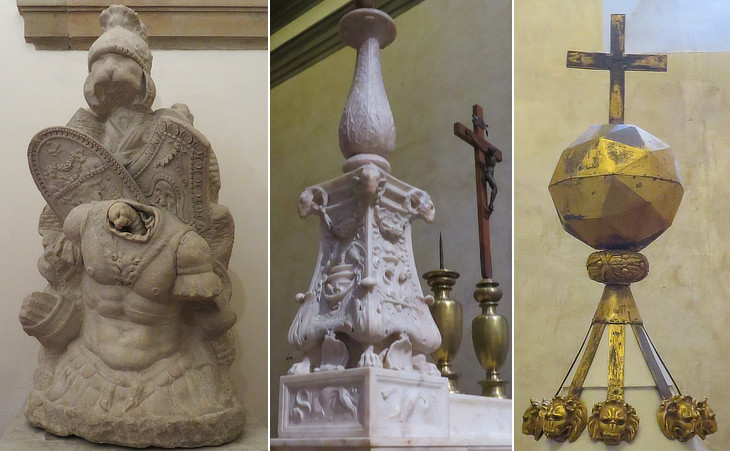
Decorative elements: (left) a military trophy; (centre) candelabrum of the altar; (right) bronze tip which was to be placed at the top of the small dome of the chapel
He had a ball with seventy-two faces made by the goldsmith Piloto, which is very beautiful. Vasari
Michelangelo's initial design for the monuments of Giuliano and Lorenzo included a military trophy to be placed above the niche housing their statues. Their execution was entrusted with Silvio Cosini, one of his assistants who excelled in bizarre subjects. Eventually the design of the monuments was modified and the trophies were not utilized. Cosini was also involved in the execution of two marble candelabra which are placed on the altar of the chapel.
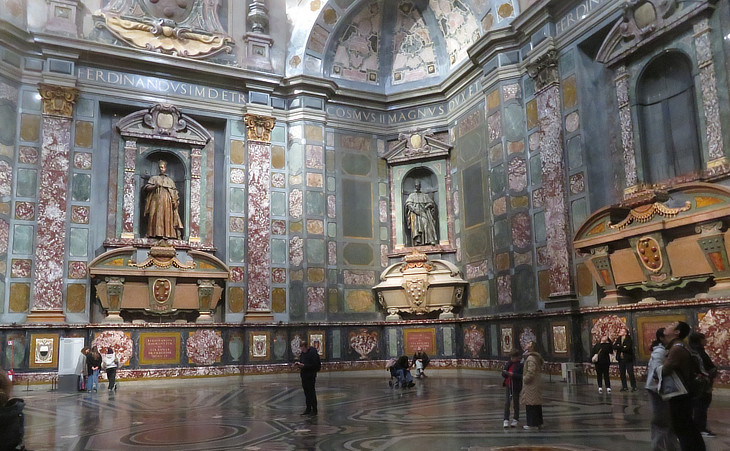
Cappella dei Principi (see a page on the use of coloured marbles in the chapels of the churches of Rome)
The Chappel of S. Laurence is the neatest thing that ever eye beheld. All the inside of it is to be over-crusted with Jasper Stones, of several Colours and Countreys, with other rich Stones, all above Marble, and all so neatly polished and shining, that the Art here exceeds the Material. This Chappel is round, and round about are to be fixed within the walls, as high as a man can reach, the Tombs of all the Great Dukes of Florence, in a most gallant manner, and of most exquisite polished Stones, with a great Cushion of some richer Stone, and a Ducal Crown of Pretious Stones reposing upon that Cushion. Over these Tombs the Statues of all the Great Dukes, at full length, and in their Ducal Habits, all of Brass gilt, are to be placed in niches round about the Chappel. The Roof is to be Vaulted all over With an overcrusting of Lapis Lazuli (a blew pretious Stone with Veins of Gold in it) which will make it look like Heaven it self. (..) In fine , this Chappel is so rich within with its own shining bare walls, that it scorns all Hangings, Painting, Gilding, Mosaick Work, and such like helpers of bare Walls, because it can find nothing richer and handsomer than its own pretious Walls. Its now above threescore years since it was begun and there are ordinarily threescore men at work daily here, and yet there's onely the Tomb of Ferdinand the Second perfectly finished. The very Cushion which lieth upon his Tomb cost Threescore thousand Crowns, by which you may guess at the rest. Indeed these stately Tombs make almost death it self look lovely, and dead mens ashes grow proud again. Lassels
1658-Dec. 20. The rarenesse and richnesse of this Altar is such that none can Imagine anything to be more curious and rich than it. And it is to be placed in a Chappell, which wee afterwards saw, that the Grand Duke is in building, which when finished it may take the preheminence of all the rare Buildings In the world, and may be wel counted one of the world's wonders. All the Wals about this Chappel being of Jasper inlaid with Lapis Lazarus, Pearles and Diamonds. There are also the statues of some of the great Dukes set up in this Chapel, where one may see the Crownes that are at there feete, sett abound with Rich and precious stones.
This Chappell hath beene 60 yeares already in building, and it is thought it may be many more yeares be fore it be finished, In regard the Duke growes something weary of being at the Vast charge which the building puts him too, yet there are daily men at worke about it, soe that in tyme it may be brought to perfection, which when it is, it will exceede all buildings that have beene made or will be made for the tyme to come, and may be wel counted the wonder of Christendome.
Francis Mortoft's Journal of his travels in France and Italy in 1659
Note of Malcolm Letts, the curator of the 1925 edition: The Chapel of the Princes in the Church of S. Lorenzo, the burial place of the Grand Dukes, begun in 1604 on a magnificent scale, but not even now completed. A new floor was begun in 1888. A sum of £880,000 is said to have been spent on the construction and decoration. It almost terrified the 17th century travellers by its grandeur. Words fail them to describe it, but tastes change, and the chapel to-day is gloomy and oppressive in its magnificence.
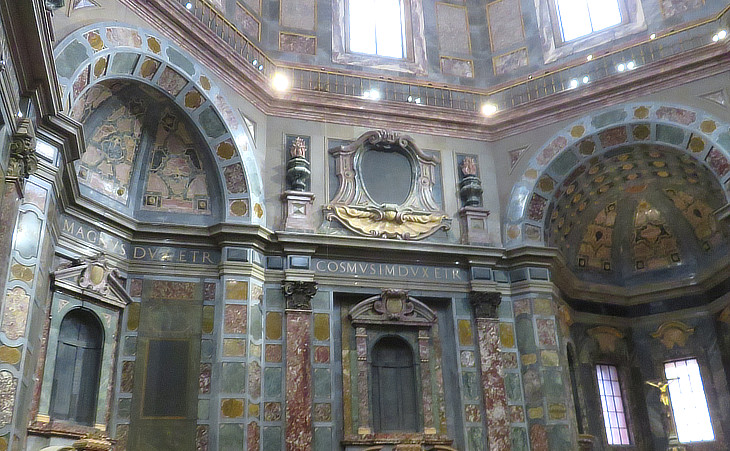
Cappella dei Principi: upper part
The chapel of St, Lorenzo is, perhaps, the finest and most expensive habitation that ever was reared for the dead; it is encrusted with precious stones, and adorned by the workmanship of the best modern
sculptors. Some complain that, after all, it has a gloomy appearance. There seems to be no impropriety in that, considering what the building was intended for; though, certainly, the same effect might have been produced at less expence.
John Moore's View of Society and Manners in Italy (in 1775)
The Florence of the early seventeenth century developed her own brand of a
classicizing Mannerism, and this was by and large in keeping with the all Italian position. Florence (..) remained to all intents and purposes anti-Baroque and hardly ever broke wholly with the
tenets of the early seventeenth-century style. The names of the main practitioners at the
beginning of the seventeenth century are Giovanni de' Medici (d. 1621), Cosimo I's
natural son, who supervised the large architectural undertakings during Ferdinand I's
reign (1587-1609). (..) During the first half of the seventeenth century the erection of the huge octagonal
funeral chapel (Cappella dei Principi) absorbed the interest and exhausted the treasury
of the Medici court. Lavishly incrusted with coloured marbles and precious stones,
the chapel, lying on the main axis of S. Lorenzo, was to offer a glittering viewpoint from
the entrance of the church. Since the wall between the church and the chapel remained
standing, this scenic effect, essentially Baroque and wholly in keeping with the Medicean
love of pageantry and the stage, was never obtained. As early as 1561 Cosimo I had
planned a funeral chapel, but it was only Grand Duke Ferdinand I who brought the idea
to fruition. After a competition of the most distinguished Florentine artists, Giovanni
de' Medici together with his collaborator, Alessandro Pieroni, and Matteo Nigetti prepared the model which was revised by Buontalenti (1603-4). The latter was in charge of the building until his death in 1608, when Nigetti continued as clerk of works for the
next forty years. If in spite of such activity the chapel remained a torso for a long time
to come, it yet epitomizes Medici's ambition of the early seventeenth century.
Rudolf Wittkower Art and Architecture in Italy 1600-1750 Penguin Books 1958
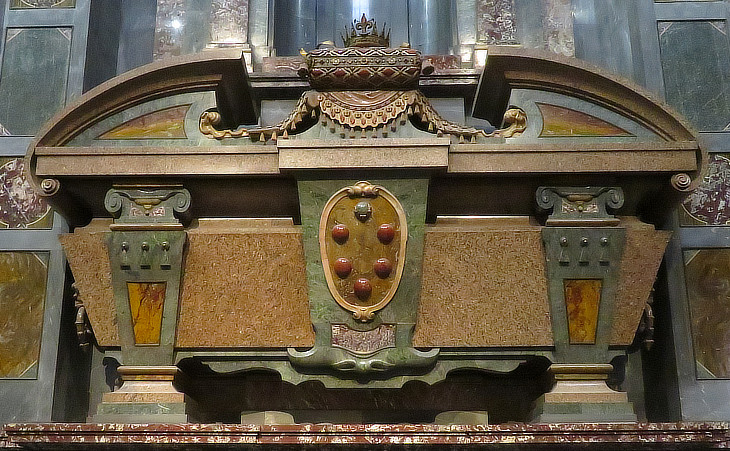
Sarcophagus of Grand Duke Cosimo III and above it the crown of the Grand Dukes upon a cushion
The Medicean Chapel is an illustration of the old story of the painter who, being unable to represent Venus beautiful covered her with finery. The first stone was laid in January 1604, the architect being Giovanni dei Medici, and afterwards Matteo Nigetti. Its founder, Ferdinand I., intended the building for the actual reception of the Holy Sepulchre. In 1603 there arrived at Florence a mysterious personage from the East, styling himself Faccardine, Emir of the Druses. This emir, now he was on Christian ground, revealed the fact that he was a descendant of the "Pio Goffredo," and, as such, entertained an hereditary hatred against the Turks; and he offered his aid to the Grand Duke to enable him to acquire (i. e. to steal) the most revered relic of Christendom, When Faccardine returned to Jerusalem in 1604, a small fleet of galleys was despatched to the coast of Syria, under the command of the captain-general, Inghirami; and Faccardine and his confederates actually found means to enter the church, and to begin their operations for detaching the sepulchre, when, being discovered by the "malice" of the Greeks, they were compelled to take to flight, leaving the marks of the saw. The ill success of the intended larceny was viewed as a great misfortune. Cosimo II. converted the building into the cemetery of the grand ducal family. (..) The Medicean cenotaphs are, in splendour of material, in accordance with the mausoleum which encloses them; they are formed of red and grey granite. The cushion upon which the grand ducal crown is placed is of the most wonderful workmanship inlaid not merely with pietre dure, but with precious stones. (..) The roof, divided into 8 compartments, surmounted by as many hexagonal lunettes, is covered with frescoes executed between 1828 and 1837, by the late director of the Academy, Pietro Benvenuti. The bodies of the Grand Dukes are contained in a crypt below. Murray
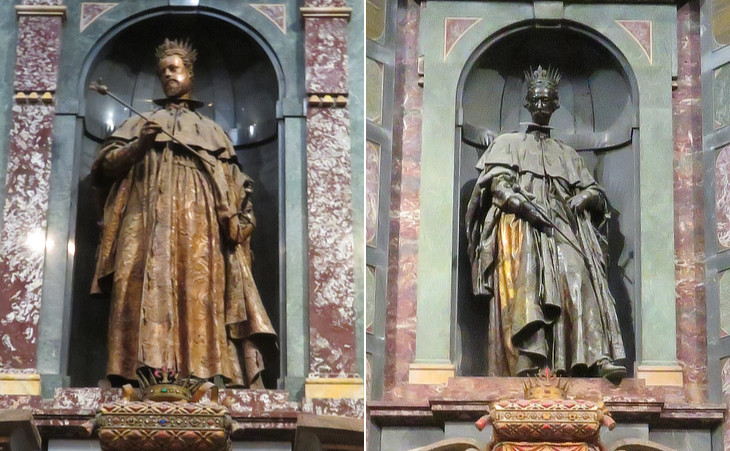
Statues of Grand Dukes: (left) Ferdinand I (see his equestrian statue at Piazza dell'Annunziata); (right) Cosimo II (see a bust of him in the same square)
In the Church of S. Laurence are interred several of the Great Dukes family. And to this Church belongs the famous Chappel of S. Lorenzo, built by the Great Dukes, which when finished is like to be for its bigness the most sumptuous, rich and magnific structure in the world. This Chappel is of an octagonal figure, and the roof of it a large Cupola. (..) On the sides are to be placed Statues and Monuments for such as have been Great Dukes. The first, beginning on the left hand as you enter in, intended (as we conjectured) for Alexander who was only Duke of Florence, is not yet made up. The rest have on the top the names, and underneath in a niche the Effigies of the Great Dukes some in stone and some in brass under that a Coffin or Cushion with a Ducal Crown lying upon it. (..) There is one side more remaining for Ferdinand II, the V. Great Duke, who is dead since our being there, the present Great Duke's name being Cosimus III.
John Ray's Observations (..) made in a journey through part of (..) Italy in 1663.
The only statues yet placed on the tombs are those of Ferdinand I. (died 1610), modelled by G. da Bologna, and cast by Pietro Tacca, and of Cosimo II. (d. 1620), by Pietro Tacca alone, and which as a work of art stands pre-eminent. Murray
Pietro Tacca (1577-1640), is certainly the most eminent successor to Giovanni Bologna. (..) The famous fountains in the Piazza Annunziata at Florence, with their crossing jets of water, the over-emphasis on detail (which presupposes inspection from a near standpoint and not, as so often in the Baroque, from far away), the virtuosity of execution, and the decorative elegance of monstrous formations are as close to the spirit of Late Mannerism as the over-simplified gilt bronze statues of Ferdinand I and Cosimo II in the Cappella dei Principi in S. Lorenzo (1627-34). Wittkower
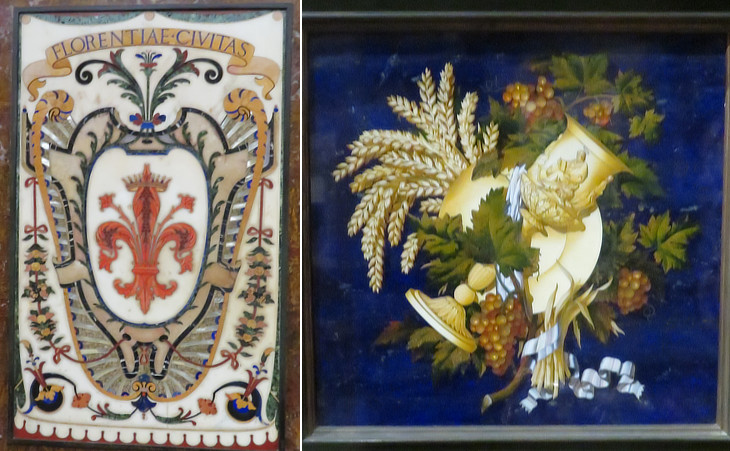
(left) Coat of arms of Florence; (right) detail of the decoration of the altar
The chapel of St. Lawrence will be perhaps the most costly piece of work on the face of the earth, when compleated; but it advances so very slowly that it is not impossible but the family of Medicis may be extinct before their burial-place is finished.
The great Duke Ferdinand II (Cosimus III) has lived many years separate from the Dutchess, who is at present in the court of France, and intends there to end her days. The Cardinal his brother is old and infirm, and could never be induced to resign his purple for the uncertain prospect of giving an heir to the dukedom of Tuscany. The great Prince has been married several years without any children; and notwithstanding all the precautions in the world were taken for the marriage of the Prince his younger brother (as the finding out a lady for him who was in the vigour and flower of her age, and had given marks of her fruitfulness by a former husband) they have all hitherto proved unsuccessful.
Joseph Addison - Remarks on several parts of Italy, in the years 1701, 1702, 1703
The late Cardinal de Medici, married the Princess Eleonora of Guastalla, a fine young Lady. (..) His Eminence would willingly have excus'd himself at the Age he was of from marrying at all; but his elder Nephew, Prince Ferdinand, being dead without Issue, and his other Nephew Don Gastone [now Great Duke] not being likely to have any, he was over-persuaded to it. Wright
This edifice was begun two hundred years ago, and if completed upon the plan on which it was commenced, it would surpass every sepulchral building in the world. (..) Beneath is a subterraneous chapel, where the bodies, whose names are inscribed on the sarcophagi above, are to repose. (..) But "Nescia mens hominum fati sortisque futurae", (Man is ignorant of his destiny and of the future -
Virg. Aen. x. 501.)
before the magnificent monument intended for their reception was finished, the Medicean line has failed; the work is now suspended, and if we may judge from the impoverished state of the country and the agitation of the times, it is not likely to be resumed for many years, if ever. (..) If the present system of French influence and exaction should continue, the Medicean chapel, stripped of its rich decorations, will be abandoned to oblivion until undermined by time it shall one day bury under its ruins the remains which it was commissioned to preserve, as a sacred deposit enshrined in pomp and magnificence. Eustace
The armorial bearings of the principal cities and states of Tuscany incorporated in the dominions of the Medici, which range round the chapel, are examples of the richness of this work. The red Giglio on the shield of Florence is the most elegant of the coats. It is delicately and elaborately formed of different hues of coral and cornelian, inlaid so as to represent the relief and the shading of the flower, which is evidently, like the fleur-de-lys of France, no lily, but the three-petaled iris, which still grows on the walls of Florence. All the bearings, as before observed, are natural-coloured stones; the giallo antico standing for or, lapis lazuli azure, rosso antico gules, etc. Murray
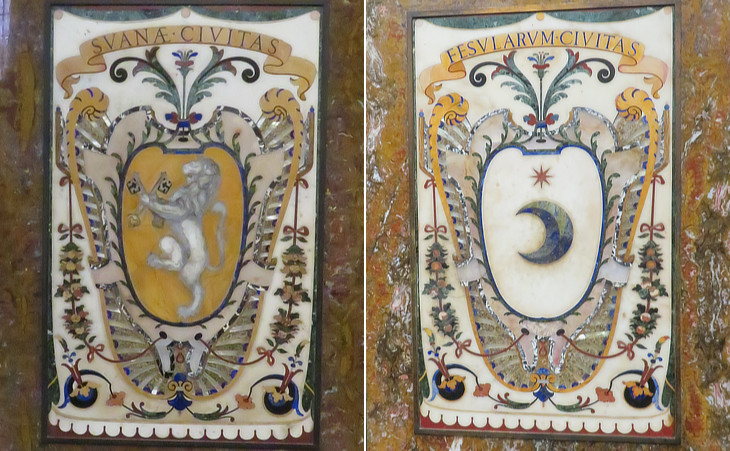
Coats of arms of Sovana (left) and Fiesole (right)
Between each Tomb are inlaid in the Walls, the Arms, or Scutchions of the several Towns of the Great Dukes Dominions, all blazoned according to their several Colours in Herauldry, by several pretious Stones which compose them: and these are not made in little, but are fair great. Scutchions made purposely of a large size for to fill up the void places between the Tombs. The Towns are these; Florence, Siena, Pisa, Livorno, Volterra, Arezzo, Pistoia, Cortona, Monte Pulciano, etc. which contributed (I suppose) something each of them to this Costly Fabrick. Lassels
I was much disappointed in the chapel of St. Lorenzo. Notwithstanding the great profusion of granite, porphyry, jasper, verde antico, lapis-lazuli, and other precious stones, representing figures in the way of marquetry, I think the whole has a gloomy effect. These pietre commesse are better calculated for cabinets, than for ornaments to great buildings, which ought to be large masses proportioned to the greatness of the edifice.
Tobias Smollett's Travels through France and Italy in 1765
The walls are entirely covered with the richest marbles and pietre dure - jasper, chalcedony, agate, lapis lazuli, and still more precious stones, composing the Florentine mosaic of "pietre commesse" of which the materials are entirely different from that of the modern Roman mosaic. In the Roman mosaic the colours are artificial, it being formed of little pieces of opaque glass, called "smalto," In the Florentine mosaic no colours are employed, excepting what are natural to the stone; and the varied tints and shading are formed by a judicious adaptation of the gradations which the material afforcd. By means of these only, graceful and elaborate representations of flowers, fruit, ornaments, etc., have been produced. Marbles and jaspers of brilliant colours, being, of course, valuable are only used in thin slices, like veneer, about of an inch thick. Murray
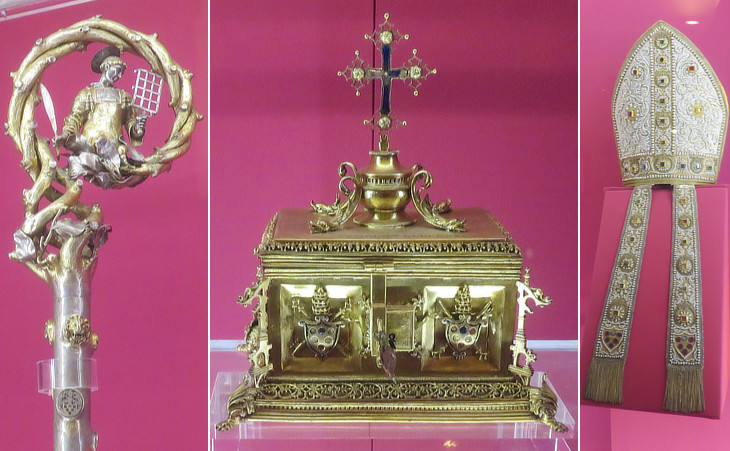
"Treasury of Pope Leo X" at Sacrestia Nuova: (left) top of a pastoral staff portraying St. Lawrence carrying a grid (see another very fine pastoral staff at Museo dell'Opera del Duomo di Siena); (centre) reliquary with the coat of arms of the Pope; (right) a mitre, the ceremonial headdress of bishops
Two small rooms behind the altar of Sacrestia Nuova house some fine examples of the skill of the Florentine goldsmiths of the early XVIth century whereas in the crypt beneath Cappella dei Principi some reliquaries of the late XVIIth century are on display.
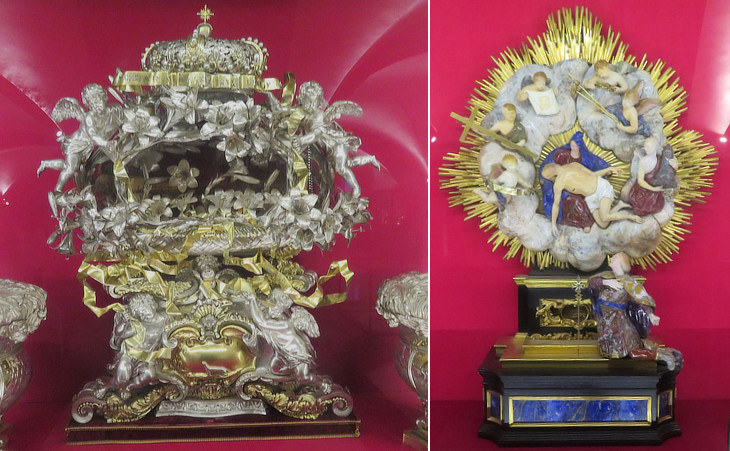
Crypt of Cappella dei Principi: (left) Reliquary of St. Casimir, a XVth century Polish prince who is said to have been canonized by Pope Leo X; (right) Reliquary of St. Emeric of Hungary, an XIth century pious prince who was killed by a boar, similar to Adonis
Other pages of this section: Museo dell'Opera del Duomo and Museo del Bargello.
Other pages on Florence: Piazza della SS. Annunziata, Florentine Recollections (some comparisons between monuments of Rome and Florence), Fortress of Belvedere and Fiesole.