All images © by Roberto Piperno, owner of the domain. Write to romapip@quipo.it.


Notes:
Page added in April 2026.
All images © by Roberto Piperno, owner of the domain. Write to romapip@quipo.it.
Notes:
Page added in April 2026.
 in Central Asia - Gonur-Tepe and Nisa
You may wish to see an introductory page to this section first.
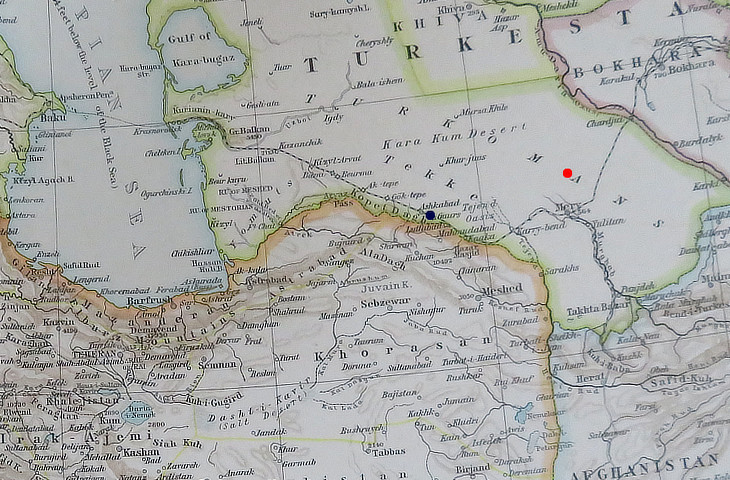
1900 Times Atlas of the World showing today's Turkmenistan, at the time a province of the Russian Empire - blue dot: Nisa; red dot: Gonur Tepe
We had the choice between two roads; both perilous, and traversing the desert home of the Turkomans, the only difference being that of the tribes through which they pass. The way by Meshed, Merv, and Bokhara was the shortest, but would entail the necessity of proceeding through the midst of the Tekke tribes, the most savage of all the Turkomans, who spare no man, and who would not hesitate to sell into slavery the Prophet himself, did he fall into their hands. On the other route are the Yomut Turkomans, an honest, hospitable people. Still, that would necessitate a passage of forty stations through the desert, without a single spring of sweet drinking water. After some observations had been made, the route through the Yomuts, the Great Desert, Khiva, and Bokhara was selected.
Arminius Vambery - Travels in Central Asia in 1863
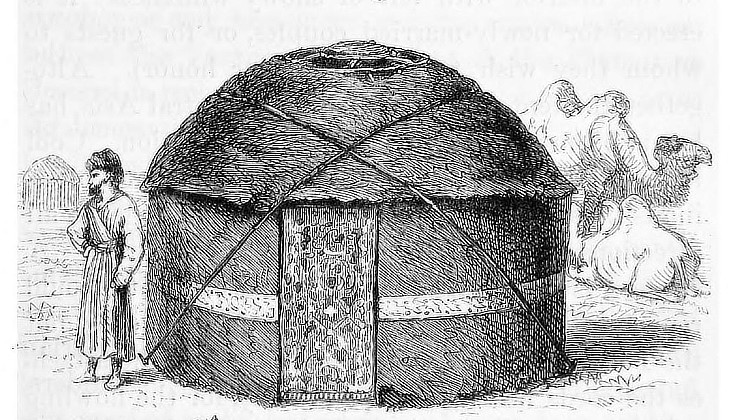
A tent of the Turkomans from "Arminius Vambery - Travels in Central Asia in 1863"
The Tekke form at this day the greatest and most powerful tribe of the Turkomans, They are separated into two principal encampments - the first at Akhal (to the east of Tedjend), and the second at Merv. According to the best accounts, they have sixty thousand tents. Possessing less land that is capable of being cultivated than the other Turkoman tribes, they are, so to say, almost forced by nature itself to commit acts of robbery, and are a real scourge in the hand of God to the northeasterly portions of Persia, to Herat and its neighborhood. (..) The Yomuts inhabit the east shore of the Caspian Sea and some of its islands. (..) The tent of the Turkoman, which is met with in the same form throughout all Central Asia and as far as the remotest parts of China, is very neat, and in perfect accordance with the life led by the nomad. (..) Altogether the tent, as I met with it in Central Asia, has left upon my mind a very pleasing impression. Cool in summer and genially warm in winter, what a blessing is its shelter when the wild hurricane rages in all directions around the almost boundless steppes! Vambery
Until the construction of the Transcaspian Railway by the Russians in 1879-1886 there were almost no towns of some importance in today's Turkmenistan because its nomadic population lived in tents.
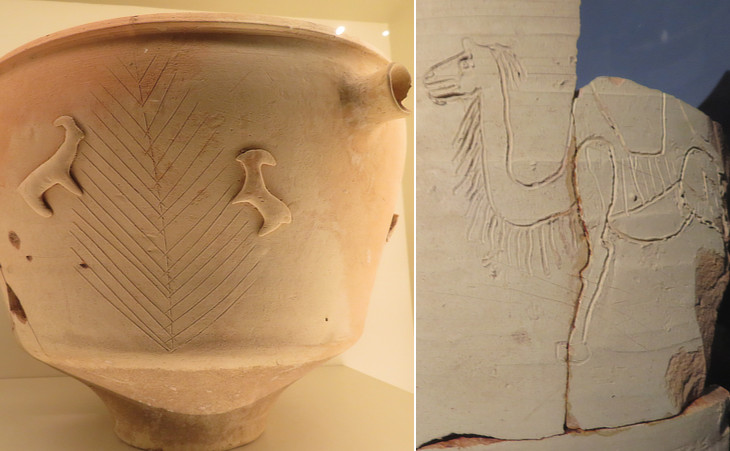
2026 Temporary Exhibition at Musei Capitolini: "Ancient Civilisations of Turkmenistan"; pottery from Gonur-Tepe with images of animals (the image used as background for this page shows a pottery ram head)
The arid steppes of Turkmenistan seemed the most unlikely area where to seek for evidence of ancient civilisations until Viktor Sarianidi or Sarigiannides (1929-2013), a Soviet archaeologist of Greek Pontic origin, discovered in 1990 a series of settlements dating to the Bronze and early Iron Ages. Chief amongst these was the capital city Gonur-Tepe, which was founded at the end of the third millennium BC, lasting till around 1600 BC. Tepe means hill in Turkish, e.g. Karatepe (Black Hill). The excavations led to the identification of the Bactria-Margiana Archaeological Complex (short BMAC), also known as the Oxus civilisation. Some of the most interesting findings of the excavations at Gonur-Tepe are on display at the Museum of Fine Arts of Ashgabat, the modern capital of Turkmenistan. A temporary exhibition of these findings in Rome was organised with the patronage of Atageldy Shamuradov, Minister of Culture of Turkmenistan, and Mukhametdurdy Mamedov, of the National Department of Turkmenistan of Protection, Research and Restoration of Historical and Cultural Sites.
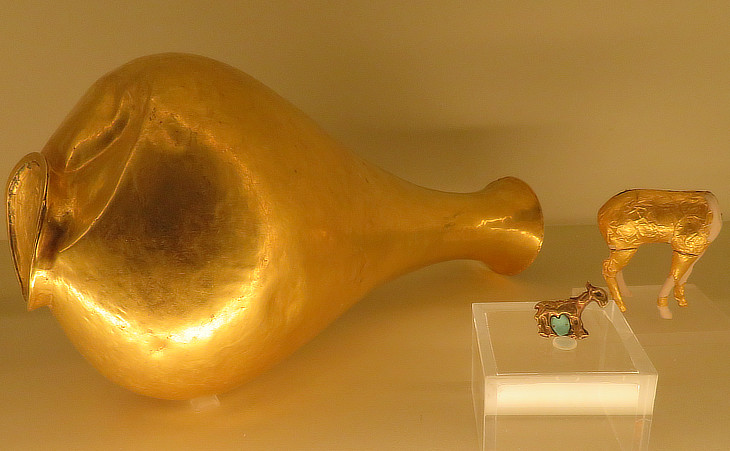
Goldware from tombs at Gonur-Tepe
The most valuable discoveries have been
made in chamber tombs and royal burying sites
(hypogea). Most of these tombs, with very few
exceptions, have been looted in antiquity. Quite
often «the accuracy» of the looting hole so exactly
corresponded to the location of the richest
funeral gifts that one can't help thinking that a person, involved in the funeral, took part in
the looting. But fortunately for the archaeologists,
the items that remained unnoticed by the
tomb raiders included golden and silver objects,
various ivory masterpieces, splendid stone and
terracotta artifacts and many other things. This
leaves no doubt that the people buried in the
chamber mausoleums belonged to the richest
and most prosperous strata of ancient Margiana
society, and those whose remains lay in the
tombs, to the governing elite.
Viktor Sarianidi, Nadezhda Dubova and Kirill Samurskiy - Treasures of Ancient Margiana - 2020
Golden goblets and jugs were accessories
of the highest aristocracy. Of particular interest is a figurine depicting an antelope which was found in 2012. One side was made of gold, the other one of silver and it was decorated with a turquoise inlay.
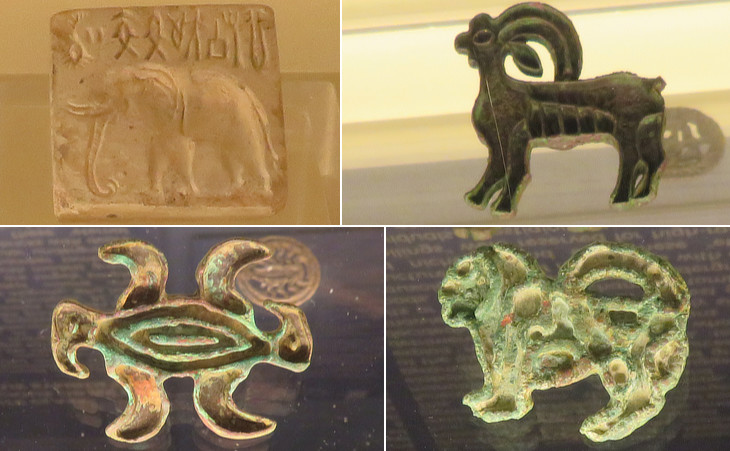
Seals depicting real and mythological animal
The stone seal depicting an elephant and an Akkadian
inscription, confirms the close links of Margiana with Mesopotamia, the Middle
Eastern centre of ancient
civilisations. The Akkadian Empire was established in the 24th century BC when Sargon, its founder, conquered a number of Sumerian city-states.
The elephant depicted in the seal was most likely an Indian war elephant which had been introduced to the Middle East.
The compartment seals were women belongings. They were worn at the waist or
neck. The main objective of
all the images on stamps was to drive off damage and evil forces. The masters who made them used only
bronze baffles of varying
thickness and length to
create very dynamic
images of animals.
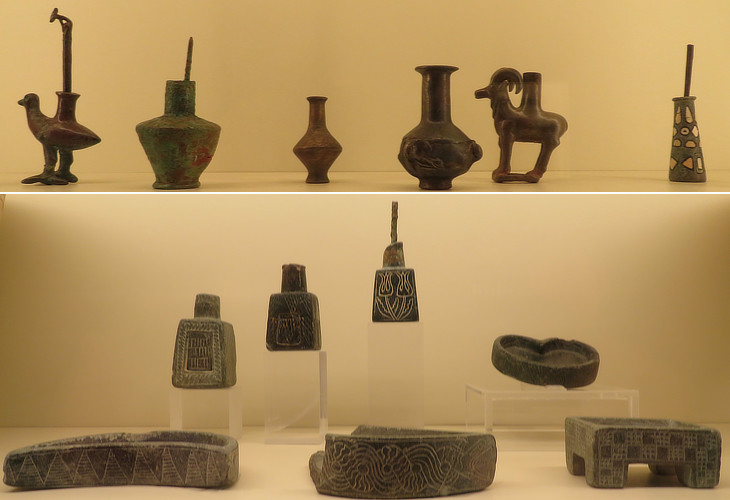
Bronze and stone (chlorite) artefacts
Chlorite is a soft and easy-to-work greenish rock. Given their weight, chlorite objects rarely exceed 25 cm in height (you may wish to see those at the Azerbaijan Museum of Tabriz in Iran). They were mainly used for small cosmetic flacons, lamps or incense burners. Some of them are decorated with carvings depicting tulips (a flower which is also a national symbol of Turkey).
One of the remarkable features
of the BMAC culture is the
abundance of tulips images
made in different techniques
and presented with sufficient
reliability, the plant which is
still encountered at Gonur.
Research shows that people of
ancient Margush country could
have rituals associated with the
rebirth of nature, carried out
at the time of flowering tulips. Treasures of Ancient Margiana
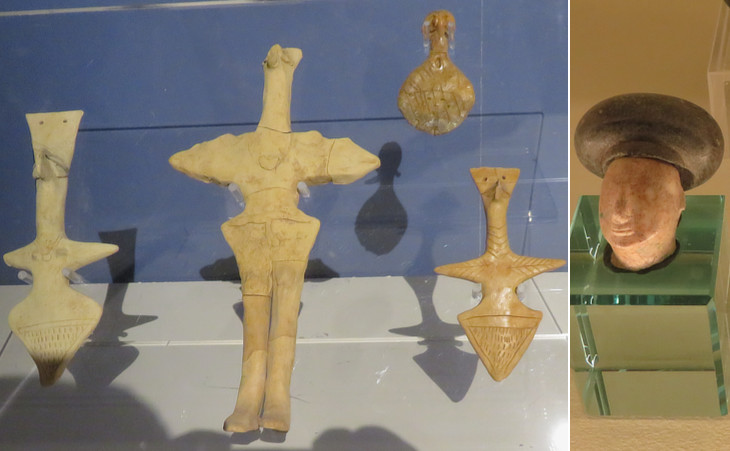
(left) Anthropomorphic statuettes; (right) composite portraits
Female terracotta figurines of deities are distinguished by majestic
crowns on their heads and necklaces around necks. Most figurines depicting
winged deities with legs
and bird's heads are male. The holes in the crown of terracotta figurines show that it was suspended
on a string or a thin leather strap. In some cases a buried girl holds a female figurine in her hands, crossed in front of chest.
Whose faces were reproduced on composite statuettes: buried in the grave? deity? someone
else? While questions remain unanswered, the common feature of all items is that
they are made of white stone, the hair and hats are usually made of dark stone. On a well preserved
statuette the eyebrows were painted and lips and eyes were coloured. Treasures of Ancient Margiana
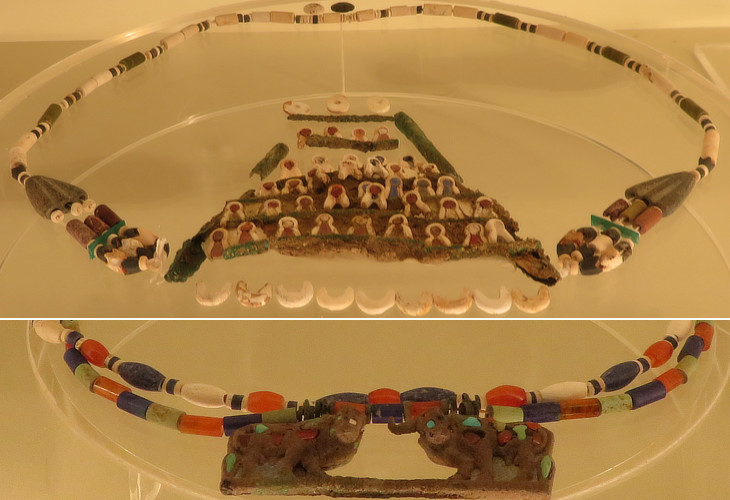
Necklaces or breastplates: (above) warrior breastplate; (below) (Necropolis, Grave 2900), necklace, silver, lapis lazuli, cornelian, turquoise, second half of the 3rd - beginning of the 2nd mill.
A special type of graves was constructed for the ruling elite - the governor, and, apparently, the highest priests. Such graves were found on the eastern shore of the Gonur's large southern basin. They formed the so-called Gonur Royal Necropolis, where eight royal burying sites and three accompanying huge «ditches-pits» were arranged. The beautiful inlaid breastplate with two silver pendant figures of bulls belonged to a man.
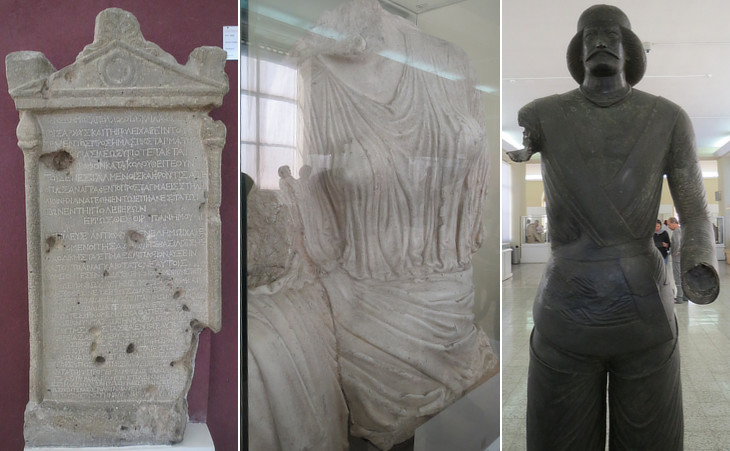
National Museum of Iran at Tehran: (left) stela bearing an inscription of the time of Antiochus III (discovered in 1943); (centre) statue of Penelope; (right) "Shami" statue portraying a Parthian commander
Some exhibits at the National Museum of Tehran help in understanding the history of Nisa, the second archaeological site of Turkmenistan which is covered in this page.
In 193 BC, by means of a letter sent to Menedemus, ruler of Media, the Seleucid king Antiochus III established the official cult of his wife, the queen Laodice, appointing notable eponymous priestesses, chosen among the princesses of the reign. He ordered that the letter be published on several stelae in the most important places. .
The marble statue of Penelope was discovered in Persepolis in 1945 (in three fragments). It is a rare example of Greek sculpture found on Persian soil. Experts have two theories about how the statue ended up in Iran. One is that it was brought to Persepolis by Xerxes the Great after the conquest of Athens in 480 BC. And the second, that it was gifted by the Greeks to the Persians as a show of goodwill.
The "Shami" Statue is the most important and iconic surviving work from the Parthian Empire, housed at the National Museum of Iran. The bronze statue is almost completely preserved and depicts a Parthian Prince or nobleman. It was found by local peasants in Shami village, Khuzestan Province, when workers discovered it while digging foundations for construction in 1935.
In 330 Alexander the Great conquered Persepolis and put an end to the Achaemenid Persian Empire. He continued his military campaign and he reached the River Yaxarte (Syr Daria) near today's Samarkand. He regarded the river as the extreme limit of his empire and he colonised the region with his Macedonian veterans. His general Seleucus inherited this part of the Empire. These events favoured the development of cultural links between Greece and Central Asia. In the IIIrd century BC the Parni, an Iranian tribe led by Arsacid conquered Parthia, which roughly corresponds to today's Turkmenistan.
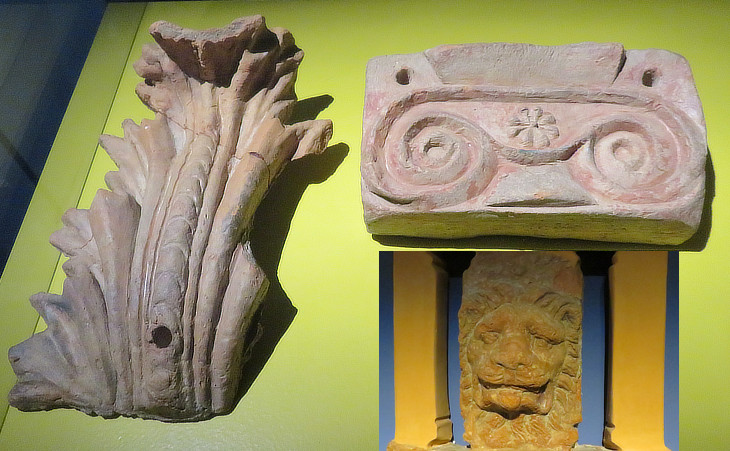
Terracotta decorative elements of Greek design from Nisa
The Parthian Fortresses of Nisa are the remnants of the first capital of the Parthian Empire. The Parthians became a major power in the Near East and an arch-enemy of the Roman Empire on its eastern borders. From Nisa, they created a huge empire that stretched from the Indus to the Euphrates. The site consists of the two tells of Old Nisa (the royal citadel) and New Nisa (the ancient town). Old Nisa consists of partially excavated mud brick walls, and the remains of New Nisa are even less spectacular. Archaeological excavations in two parts of the site have revealed richly decorated architecture, illustrative of domestic, state and religious functions. They underline the interaction between Central Asian and Mediterranean cultures.
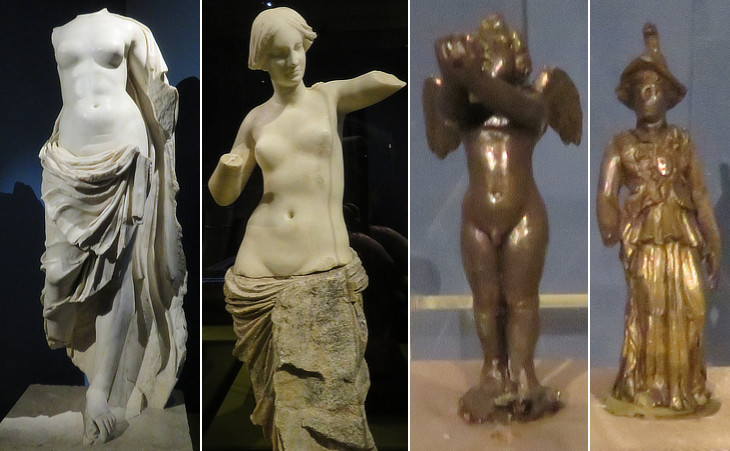
(left) "Goddess of Nisa" and Aphrodite Anadyomene (so-called "Rhodogune", after the name of a Parthian princess), marble
and gypsum; (right) small bronze statues of Eros and Athena
The Northern Complex includes the so-called Large Square building in which rooms with different functions have been identified: the royal treasury, the wine vault in the northern part, and auxiliary premises in the south-eastern parts. This is where many famous art works of Old Nisa were found: the Rhodogune marble and gypsum statue, the Goddess of Nisa marble statue, ivory rhytons, fragments of royal thrones, and 2,700 ostraka (pieces of pottery with writing, usually accounting records).
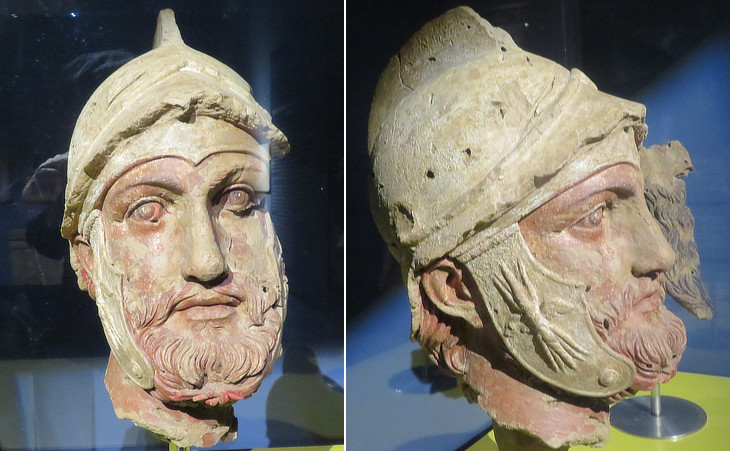
Head of a clay statue of a helmeted warrior or of Zeus in military attire, because of the thunderbolt symbol on the helmet cheekpiece
The head portion of a large clay statue was found in 1984. It is dated to a period roughly corresponding with the rule of King Mithridates II (124 to 91 BC). Other fragments from of a total of six statues were found in the same site, one of which represented a woman. The head belonged to a statue that was approximately one and a half times taller than a human. The sculpture represents a bearded man of mature age, with regular facial features. The cheekpieces of the helmet are decorated by a large relief depicting a bunch of lightning bolts, equipped with a pair of spread wings. The head was made by an experienced sculptor, with great realism and attention to detail, and the helmet as a good copy of known combat headgear of the Hellenistic period. See a coin of Phraates III, Parthian king in 70-57 BC wearing a roughly similar helmet. Remains of another helmeted head were also found. The two heads suggest the representation of a divine figure, rather than any Parthian individual.
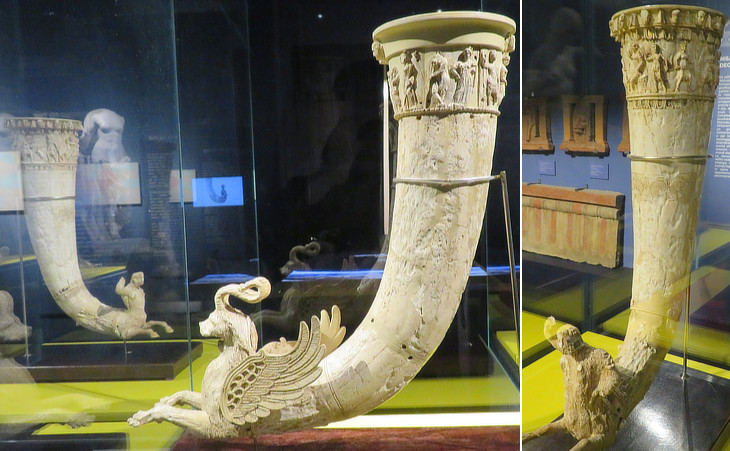
Two rhytons (ceremonial cups) ending with a lion-griffin (left) and a centaur (right); they were made of ivory, stone and glass paste and were found in 1948 at Old Nisa; see other rhytons on Cyprus and at Tabriz in Iran
The word rhyton is the Greek neuter of rhytos "flowing,". It is often translated as "drinking horn", primarily because of its appearance, due to its manufacture from the curved horn of a bovid. At its upper end, such a horn can be filled with liquid. But on a rhyton, the lower end is not the solid, natural horn; rather, it has a spout for pouring liquid out. This spout must be closed with one's finger, and when one opens it, the liquid runs out of it. The ancestors of rhytons must have been simple drinking horns. Nisian rhytons repeat the shape of elephant tusks, but they are not made from a single tusk, but from several parts cut from pieces of different tusks. Most likely, these rhytons were once an expensive ceremonial service. They are a vivid evidence of Hellenistic art, in which Greek and local features were combined.
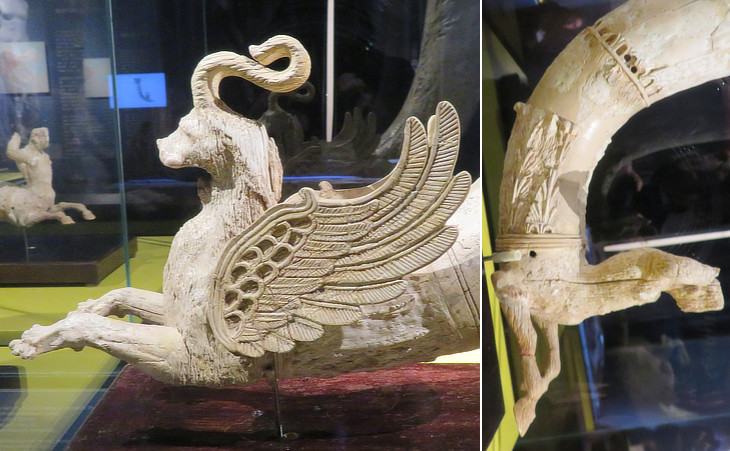
Nisa rhytons: details of the protomes (decorative ends)
From the time of Alexander the Great up to the end of the Parthian period, rhytons in gilded silver have been found. Natural material is evidenced in the horn-shaped rhytons of Old Nisa which are made from the ivory of elephant tusks, whether from Indian elephants or from African elephants of Ethiopia. With the conquest of the Persian world by Alexander the Great, the arts of the whole region changed dramatically. Greek and Oriental art mingled in a most fruitful exchange, which transformed the imagery of the rhytons in a most beautiful way.
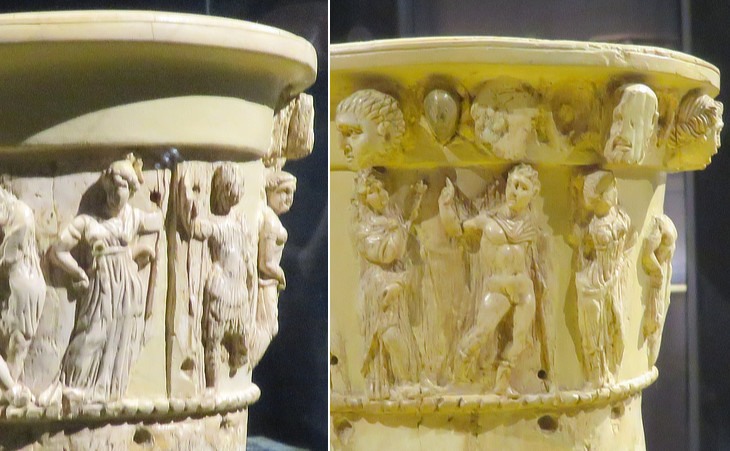
Nisa rhytons: details of the rims which portray Greek gods
If one views Parthian art as a complex whole, inseparable from Hellenized Oriental art, the rhytons of Nisa take on particular significance. Their origin remains open to speculation, the carved reliefs around the rims of them do not show any evidence of Parthian religiosity, but only purely Greek religious connotations. It is possible that they were produced by artists who were moved to the Parthian kingdom as an outcome of war. Alexander the Great promoted syncretism among Greeks, Macedonians, and Iranians as well as other tribes of the East, and under the rule of the philhellenic Parthians the rhytons very likely were used also in religious ceremonies, but they cannot really be linked to a specific Parthian practice.


