
All images © by Roberto Piperno, owner of the domain. Write to romapip@quipo.it.


Notes:
Page revised in March 2021.
All images © by Roberto Piperno, owner of the domain. Write to romapip@quipo.it.
Notes:
Page revised in March 2021.
 - Meteora - The Monasteries
You may wish to see an introductory page first.
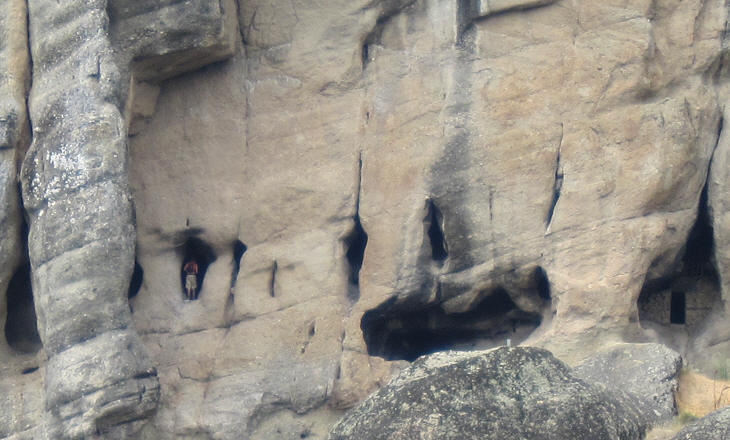
Possible location of anchorite settlements in the rock supporting Varlaam monastery
It is generally thought that anchorites (religious people who withdrew from secular life) started to retire in the natural caves of Meteora at around the year 1,000 A.D. Their number probably increased after the Latin conquest of Constantinople in 1204 when security in Greece greatly deteriorated as a consequence of a prolonged period of conflicts and unrest.
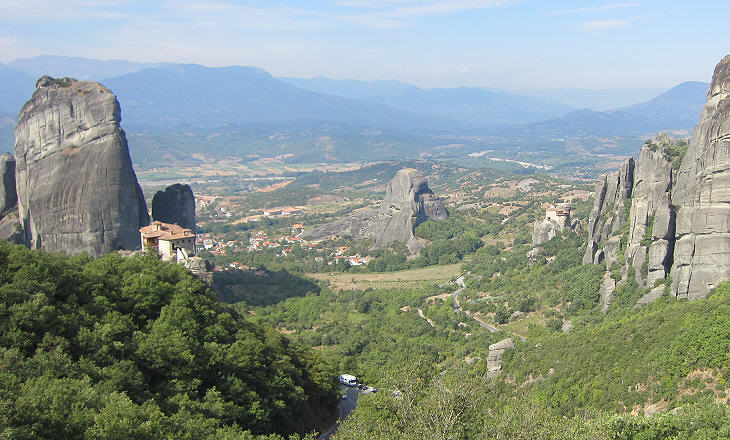
Monasteries of Rousanou (left) and Agios
Nikolaos Anapafsas (right); in the centre the rock of Doupiani
Along with anchorites also coenobites (monks living in a small community) settled at Meteora; they chose Doupiani, a rock which stood isolated on the plain, for their Sunday gatherings; they developed techniques for building a church and ancillary facilities on a horizontal crack of the rock where the ruins of an abandoned monastery can still be seen.
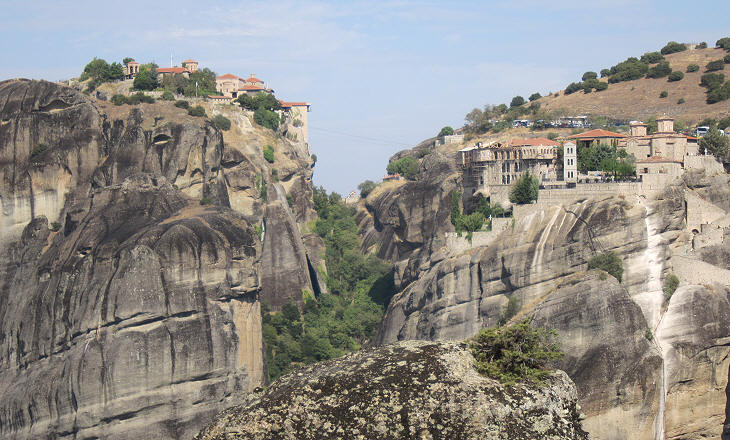
Monasteries of Megalo (Great) Meteoron (left) and Varlaam (right) which is shown also in the image used as background for this page
Although the construction of the monasteries in such inaccessible locations is often attributed to fear of Ottoman attacks, Megalo Metereon, the largest monastery, was built in 1356 when the Serbians invaded the region. King Stefan IX Dusan promoted the constitution of an autonomous Serbian patriarchate and the monks of Meteora feared that they would be forced to betray their allegiance to the Patriarch of Constantinople.
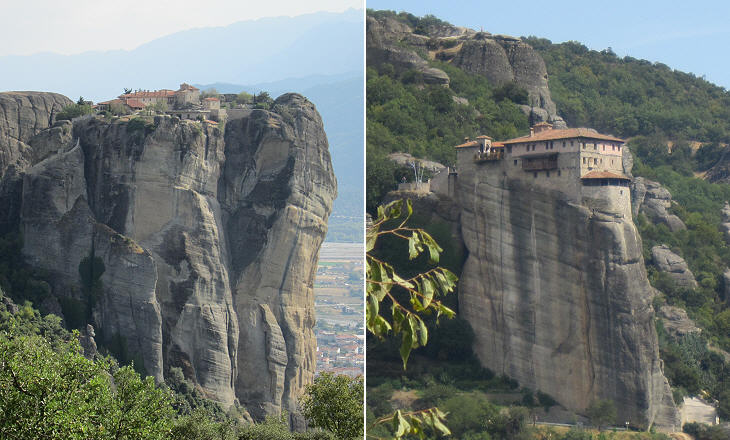
Monasteries of Agia Triada (left) and Rousanou (right)
(November 1809) The rock of Meteora (Megalo Metereon), unlike
some of the others, which are mere peaks, has a
small level on the summit, not only sufficient to
afford ample room for the buildings, but leaving
also a field of fine turf, which forms a delightful
promenade, but might be much improved if it
were planted and laid out as a garden.
William Martin Leake - Travels in northern Greece - 1835
Megalo Metereon was built on a rock, the top of which provided space for a minuscule citadel, but with the increase of the number of
monasteries, some rocks were chosen which offered only very small space for buildings, as in the case of Rousanou.
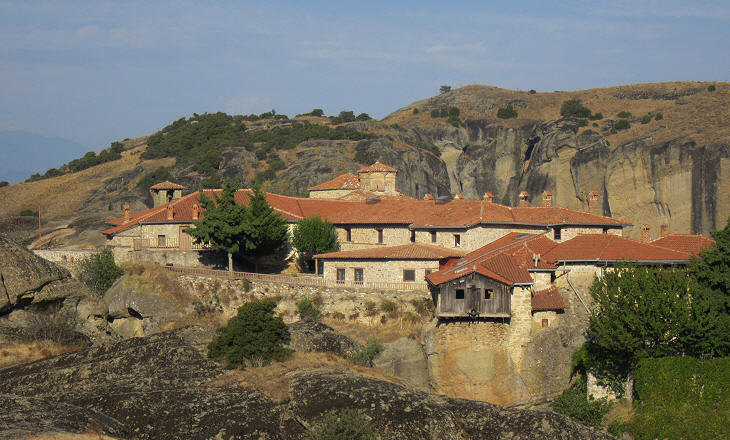
Monastery of Agia Triada (Holy Trinity)
Saint Trinity is occupied by five or six
monks. Leake
In 1382 Evrenos Bey, a Byzantine convert, led the Ottomans in the conquest of Thessaly; the region became part of the Ottoman Empire for almost 500 years, during which time the monasteries of Meteora kept Greek culture alive. The reasons for living in inaccessible locations did not subside, because conflicts among local Ottoman officers and among the various ethnic groups which populated the region (Greeks, Turks, Albanians and Romanians) exposed the monasteries to the risk of raids.
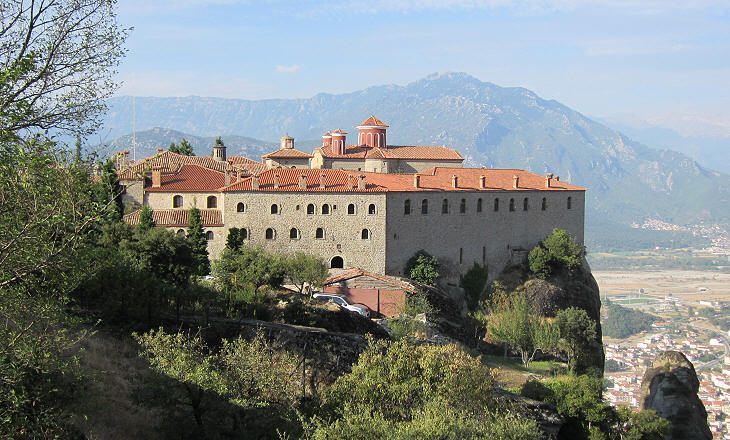
Monastery of Agios Stefanos
Saint Stephen stands on the summit of the
precipice, which I before described as overhanging
the northern end of Kalambaka. Leake
Based on the addition of new facilities and on the decoration of the churches it is possible to say that the XVIth century was a golden century for the monastic communities of Meteora; the Ottoman Empire was at war against alliances promoted by the Popes and sought if not the support, the acquiescence of its Greek subjects; the Patriarch of Constantinople was regarded as a high officer of the Sultan and the practice of the Orthodox religion was not hindered; the heads of the monasteries were regarded as being influential in maintaining overall control of the Christian provinces of the empire.
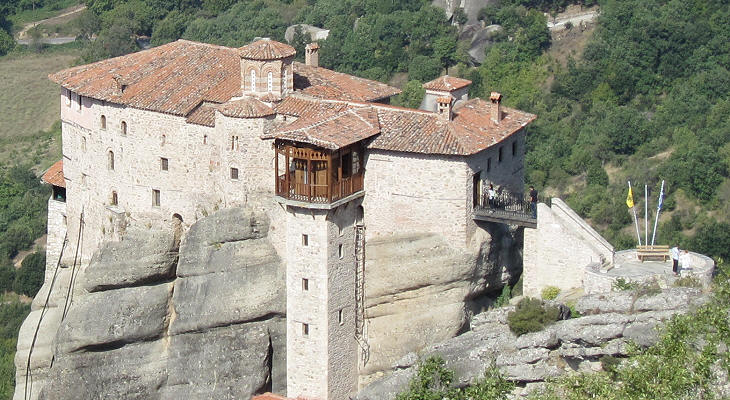
Monastery of Rousanou or Agia Barbara
Orsami, or Russami, stands on the peak of
a naked rock, and contains only two or three monks. (..) The Meteora has a debt
of fifty purses; some of the other monasteries owe
as much as seventy, which bearing the usual interest of one per cent, per mensem, is severely felt by them. But what the monks chiefly complain of is the general want of charity among the Greeks
themselves, who no longer contribute to those collections made by their travelling brethren, which
in former times constituted the greatest part of
their revenue. Leake
The situation worsened during the XVIIIth century when the number of Meteora monasteries fell and the attitude of Ottoman authorities started to be wary that the monasteries could hide and assist klephts, the anti-Ottoman insurgents. As a matter of fact the revolt of 1821 which led to the Greek War of Independence was ignited by the Orthodox clergy.
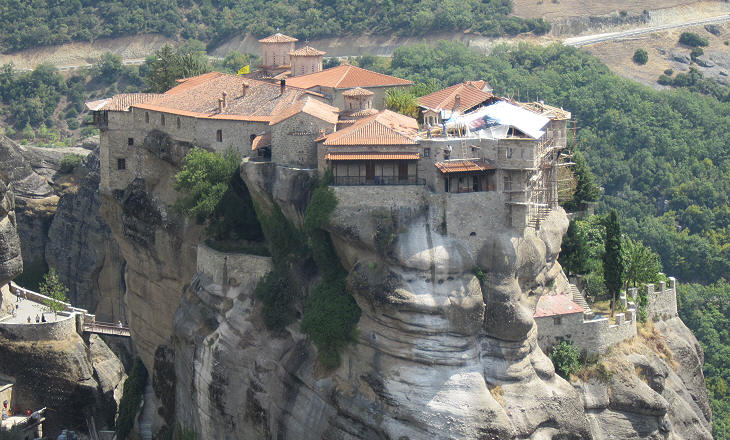
Monastery of Varlaam seen from Megalo Meteoron
The third in date, and second in magnitude
and revenue, is Varlaam, so called from a hermit
who is enrolled among the saints of the Greek
calendar, and who fixed his abode upon this rock,
which has space only for the church and other
buildings. (..) Varlaam contains at present
only five or six resident caloyers. Leake
A similar situation occurred during WWII, when the Germans raided some Meteora monasteries in search of Greek partisans; at the end of the war only four monasteries were still active. Today the active monasteries are six; the fee they exact from visitors is small, but high enough to allow the communities to improve and restore their facilities.
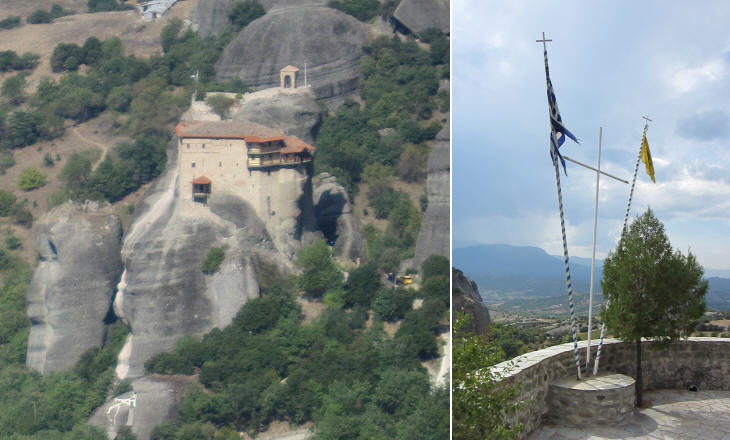
Monastery of Agios Nikolaos Anapafsas
The second monastery in antiquity is St.
Nicolas, which contains five or six monks. Leake
Move to page three to visit the monasteries or return to page one.


